• Beg Inn Ing Gauguin, Van Gogh
Total Page:16
File Type:pdf, Size:1020Kb
Load more
Recommended publications
-

Cézanne and the Modern: Masterpieces of European Art from the Pearlman Collection
Cézanne and the Modern: Masterpieces of European Art from the Pearlman Collection Paul Cézanne Mont Sainte-Victoire, c. 1904–06 (La Montagne Sainte-Victoire) oil on canvas Collection of the Henry and Rose Pearlman Foundation, on long-term loan to the Princeton University Art Museum TEACHER’S STUDY GUIDE WINTER 2015 Contents Program Information and Goals .................................................................................................................. 3 Background to the Exhibition Cézanne and the Modern ........................................................................... 4 Preparing Your Students: Nudes in Art ....................................................................................................... 5 Artists’ Background ...................................................................................................................................... 6 Modern European Art Movements .............................................................................................................. 8 Pre- and Post-Visit Activities 1. About the Artists ....................................................................................................................... 9 Artist Information Sheet ........................................................................................................ 10 Modern European Art Movements Fact Sheet .................................................................... 12 Student Worksheet ............................................................................................................... -
Site/Non-Site Explores the Relationship Between the Two Genres Which the Master of Aix-En- Provence Cultivated with the Same Passion: Landscapes and Still Lifes
site / non-site CÉZANNE site / non-site Guillermo Solana Museo Thyssen-Bornemisza, Madrid February 4 – May 18, 2014 Fundación Colección Acknowledgements Thyssen-Bornemisza Board of Trustees President The Museo Thyssen-Bornemisza Hervé Irien José Ignacio Wert Ortega wishes to thank the following people Philipp Kaiser who have contributed decisively with Samuel Keller Vice-President their collaboration to making this Brian Kennedy Baroness Carmen Thyssen-Bornemisza exhibition a reality: Udo Kittelmann Board Members María Alonso Perrine Le Blan HRH the Infanta Doña Pilar de Irina Antonova Ellen Lee Borbón Richard Armstrong Arnold L. Lehman José María Lassalle Ruiz László Baán Christophe Leribault Fernando Benzo Sáinz Mr. and Mrs. Barron U. Kidd Marina Loshak Marta Fernández Currás Graham W. J. Beal Glenn D. Lowry HIRH Archduchess Francesca von Christoph Becker Akiko Mabuchi Habsburg-Lothringen Jean-Yves Marin Miguel Klingenberg Richard Benefield Fred Bidwell Marc Mayer Miguel Satrústegui Gil-Delgado Mary G. Morton Isidre Fainé Casas Daniel Birnbaum Nathalie Bondil Pia Müller-Tamm Rodrigo de Rato y Figaredo Isabella Nilsson María de Corral López-Dóriga Michael Brand Thomas P. Campbell Nils Ohlsen Artistic Director Michael Clarke Eriko Osaka Guillermo Solana Caroline Collier Nicholas Penny Marcus Dekiert Ann Philbin Managing Director Lionel Pissarro Evelio Acevedo Philipp Demandt Jean Edmonson Christine Poullain Secretary Bernard Fibicher Earl A. Powell III Carmen Castañón Jiménez Gerhard Finckh HSH Prince Albert II of Monaco Giancarlo Forestieri William Robinson Honorary Director Marsha Rojas Tomàs Llorens David Franklin Matthias Frehner Alejandra Rossetti Peter Frei Katy Rothkopf Isabel García-Comas Klaus Albrecht Schröder María García Yelo Dieter Schwarz Léonard Gianadda Sir Nicholas Serota Karin van Gilst Esperanza Sobrino Belén Giráldez Nancy Spector Claudine Godts Maija Tanninen-Mattila Ann Goldstein Baroness Thyssen-Bornemisza Michael Govan Charles L. -

The Ambiguity of Perception and the Paintings of Paul Cézanne Author(S): Joyce Brodsky Source: Artibus Et Historiae, Vol
A Paradigm Case for Merleau-Ponty: The Ambiguity of Perception and the Paintings of Paul Cézanne Author(s): Joyce Brodsky Source: Artibus et Historiae, Vol. 2, No. 4 (1981), pp. 125-134 Published by: IRSA s.c. Stable URL: https://www.jstor.org/stable/1483119 Accessed: 17-11-2018 16:51 UTC JSTOR is a not-for-profit service that helps scholars, researchers, and students discover, use, and build upon a wide range of content in a trusted digital archive. We use information technology and tools to increase productivity and facilitate new forms of scholarship. For more information about JSTOR, please contact support@jstor.org. Your use of the JSTOR archive indicates your acceptance of the Terms & Conditions of Use, available at https://about.jstor.org/terms IRSA s.c. is collaborating with JSTOR to digitize, preserve and extend access to Artibus et Historiae This content downloaded from 204.147.202.25 on Sat, 17 Nov 2018 16:51:02 UTC All use subject to https://about.jstor.org/terms JOYCE BRODSKY A Paradigm Case for Merleau-Ponty: the Ambiguity of Perception and the Paintings of Paul C6zanne Paul C6zanne does not readily come to mind when paintings one and in particular the self-portraits4. first encounters some of Merleau-Ponty's key phrases C6zanne's like self-portraits are in part recordings of con- "being-in-the world" and the "lived Body"'. The frontationpainter and encounter with the nature of things as other. was terrified of women, desperately afraid of "anyone They are get- the least understood and least explored of all his ting their hooks into him", and so easily bruised that he genres as a result of being neither mimetic-commemorative often even avoided contact with his friends. -

Van Gogh Museum Journal 2002
Van Gogh Museum Journal 2002 bron Van Gogh Museum Journal 2002. Van Gogh Museum, Amsterdam 2002 Zie voor verantwoording: http://www.dbnl.org/tekst/_van012200201_01/colofon.php © 2012 dbnl / Rijksmuseum Vincent Van Gogh 7 Director's foreword In 2003 the Van Gogh Museum will have been in existence for 30 years. Our museum is thus still a relative newcomer on the international scene. Nonetheless, in this fairly short period, the Van Gogh Museum has established itself as one of the liveliest institutions of its kind, with a growing reputation for its collections, exhibitions and research programmes. The past year has been marked by particular success: the Van Gogh and Gauguin exhibition attracted record numbers of visitors to its Amsterdam venue. And in this Journal we publish our latest acquisitions, including Manet's The jetty at Boulogne-sur-mer, the first important work by this artist to enter any Dutch public collection. By a happy coincidence, our 30th anniversary coincides with the 150th of the birth of Vincent van Gogh. As we approach this milestone it seemed to us a good moment to reflect on the current state of Van Gogh studies. For this issue of the Journal we asked a number of experts to look back on the most significant developments in Van Gogh research since the last major anniversary in 1990, the centenary of the artist's death. Our authors were asked to filter a mass of published material in differing areas, from exhibition publications to writings about fakes and forgeries. To complement this, we also invited a number of specialists to write a short piece on one picture from our collection, an exercise that is intended to evoke the variety and resourcefulness of current writing on Van Gogh. -

Boundaries in Modern Representations of Bathers: an Assault on Male Sexual Pleasure
Boundaries in Modern Representations of Bathers: An Assault on Male Sexual Pleasure Christophe Viret Water, the origin of life on earth, is the most universal symbol of fertility known to man. Every living organism depends on water for survival; water’s nurturing qualities associate it with the female body, which bears and nurtures children, populating humanity. Depictions of the nude female form immersed in water have recurred in Euro- pean artwork: drawing the female nude was considered to be the most venerable form of art by the French Academy, which led the European art world for much of the eighteenth and nineteenth centuries. Until the late nineteenth century, visions of female nudes frolicking in water dominated the romanticized, and seductive, act of bathing. In the late nineteenth and early twentieth centuries, though, by breaking down the academic representations of bathers and their purpose to delight the male viewer’s eyes, modern artists brought the assumption of male pleasure when viewing nudes under assault. I. Fragonard, The Bathers, 1765 The female nudes in Fragonard’s The Bathers are intended to arouse the male viewer without either distancing him from them or drawing him into the painting. The Bathers was a part of the rococo movement based around the Enlightenment philosophy that the purpose of life might be to enjoy our time on earth instead of attempting to merit entrance into heaven. The American Declaration of Independence, a document that was written based on this Enlightenment ideal, stated that “all men are…endowed by their creator with certain unalienable rights,” amongst which are “life, liberty, and the pursuit of happiness.”1 Hence, rococo paintings are often “dominated by a simple and beauti- ful nature where appeased passions would leave room for pure love,” propagating an idealized “dream of happiness.”2 Both of these state- This paper was written for Rebecca Gertmenian’s Nineteenth and Twentieth Century Art elective in the fall of 2010. -

Chanting Flowers by Zsuzsanna Bacsa Palmer
Palmer Chanting Flowers by Zsuzsanna Bacsa Palmer Ha folyóvíz volnék If I were a river Bánatot nem tudnék No sorrow would I be knowing Hegyek völgyek között Between mountains and valleys Zengedezve járnék I would run forever chanting. Ahol kiterülnék Where I would leave the riverbed Virágot növelnék I would make flowers grow Hegyek völgyek között Between mountains and valleys Virágot növelnék I would make flowers grow. Leányok leszednék The maids would pick the flowers Bokrétába kötnék Tie them into a bunch S az o´´ édesiknek And pin them onto the hats Kalapjára tu´´znék Of their sweethearts. It hasn’t always been like this. Es war nicht immer so. Nem volt mindíg így. In the first half of my life, I was able to think in one language only. I did not have to constantly and unconsciously go through each thought in order to fully understand all the connotations it trilingualism, may have in my three languages. That is the hard part; the thinking, talking to yourself when Dreisprachigkeit there are no listeners. Seeing all the hues of colors that appear with each translation, smelling háromnyelvüség: all the odors, scents, and bouquets. native-like control of I admired people speaking many languages and assumed that they could use them at three languages their liking, but their mother tongue would always prevail as the deepest inner voice. And now that I am in this same situation, I know that songs and prayers stay monolingual. For me, they will always be in Hungarian. However, I also learned that emotions, caresses, and embraces are above any language. -

Van Gogh Museum Enterprises 39 the Works Council 41
Van Gogh Museum Annual Report 2018 Van Gogh Museum Annual Report 2018 Contents Supervisory Board statement 5 1 Report of the Board 7 2018 in short 9 2 Overview of 2018 17 Museum Affairs19 The Mesdag Collection 26 Public Affairs28 Operations 36 Van Gogh Museum Enterprises 39 The Works Council 41 3 Appendices to annual report 43 Overview of the organisation 45 Social Annual Report 46 Acquisitions 48 Gifts 53 Supporters 54 Conserved works 57 Collection information 66 Overview of outgoing loans 67 Long-term loans to the VGM 76 Long-term loans to other museums 78 Research projects 79 Museum publications 81 Additional functions 82 Lectures and other academic activities 84 Publications employees 87 Supervisory Board statement 2018 was once again a resoundingly successful year for the Van Gogh Museum. Vincent van Gogh and his contemporaries continue to inspire millions of people all around the world, as is reflected in the sustained high numbers of visitors to both the museum and its website. In the past year, 2,165,000 art lovers from the Netherlands and abroad visited the museum, and our online fan base grew exponentially. After being officially opened by King Willem-Alexander during a celebratory event, the exhibition Van Gogh & Japan attracted an impressive 430,000 visitors, making it a great success. Van Gogh aspires was published last year, the Strategic Plan 2018-2020 outlining how the museum will work towards realising its Strategic Pillars in the years ahead. In its endeavours to deliver and uphold its mission, vision and core values, the museum focuses on three dimensions: local, global and digital. -

Portrait Vincent Van Gogh
Portrait Vincent Van Gogh . Vincent was born in 1853 in the Netherlands. He tried to be preacher, a school teacher, and an art dealer before embarking on his career. Van Gogh spent 2 years sharpening his drawing skills before he allowed himself to use color or paint. He was almost entirely self-taught. His closest friend and relative was his brother Theo, and art dealer, who also supported him financially. Vincent Spent his life in poverty, choosing to spend money on paints rather than food to eat. His early paintings portrayed the lives of poor farmers and coal miners. The colors he used were dull and dark. Later, he was strongly influenced by the Impressionists of the day. With time he became much bolder in his paintings. He began to use slashing brush strokes and clear, bright colors. He was a pioneer for expressionism. Expressionists profoundly show their emotions through their paintings. The Potato Eaters 1885 Van Gogh Museum, Amsterdam, Netherlands This painting was Van Gogh’s first major work and would also be his only painting in a group setting. Coalmine in the Borinage 1879 Still Life with Beer Mug and Fruit 1881 Some of Van Gogh’s early paintings of farmers. Why do you think he used dull and dark colors in these early works? A Digger 1881 Sower with Basket 1881 Girl Kneeling in Front of a Bucket, 1881 La chambre de Van Gogh à Arles (Van Gogh’s Room at Arles) 1889 (200Kb); Oil on canvas, 57 x 74 cm (22 1/2 x 29 1/3 in); Musee d’Orsay, Paris Vincent’s Chair and Pipe What are the differences in these chairs? "Vincent's chair with -

Shapiro Auctions
Shapiro Auctions RUSSIAN AND INTERNATIONAL FINE ART & ANTIQUES Saturday - October 25, 2014 RUSSIAN AND INTERNATIONAL FINE ART & ANTIQUES 1: A RUSSIAN ICON OF HOLY MARTYR PARASKEVA WITH LIFE USD 30,000 - 40,000 A RUSSIAN ICON OF HOLY MARTYR PARASKEVA WITH LIFE SCENES, NORTHERN SCHOOL, LATE 16TH-EARLY 17TH CENTURY, the figure of Saint Paraskeva, venerated as the healer of the blind as well as the patron saint of trade and commerce, stands in a field of flowering plants, she holds her martyr`s cross in one hand and an open scroll in the other, a pair of angels places a crown upon her head, surrounding the central image are fourteen scenes from the saint`s life, including the many tortures she endured under Emperor Antoninus Pius and the Roman governor Tarasius. Egg tempera, gold leaf and gesso on wood panel with kovcheg. Two insert splints on the back, one missing, one-half of the other present. 103 x 80 cm (40 ½ x 31 1/2 in.)PROVENANCESotheby`s, New York, June 10-11, 1981, lot 541.Collection of Bernard Winters, Armonk, New York (acquired at the above auction)Bernard J. Winters was a philanthropist and art collector who was captivated by Russian icons. Over a fifty-year period, he worked closely with Sotheby`s, Christie`s, and private collectors to cultivate his collection. His monumental icons, as well as those purchased from Natalie Hays Hammond, daughter of John Hays Hammond, diplomat, were some of his favored items. 2: A RUSSIAN ICON OF THE VENERABLE SERGIUS OF RADONEZH, USD 10,000 - 15,000 A RUSSIAN ICON OF THE VENERABLE SERGIUS OF RADONEZH, YAROSLAVL SCHOOL, CIRCA 1600, the saint depicted holding a scroll featuring an excerpt from his last words to his disciples, "Do not be sad Brothers, but rather preserve the purity of your bodies and souls, and love in a disinterested manner," above him is an image of the Holy Trinity - a reference to his Monastery of the Holy Trinity, as well as to the icon painted by Andrei Rublev under Sergius` successor, on a deep green background with a red border. -

Paul Cézanne (1839-1906)
CezQnne M POCKET LIBRARY OF (iREAT ART • 5 O tf (2g>^\ ny^ Property of The Hilla von Rebay Foundation MM THE POCKET LIBRARY OF GREAT ART '/ Plate i. self-portrait. About 1886. Pencil The Art Institute of Chicago (Arthur Heun Fund) PAUL CEZANNE (1839-1906) text by THEODORE ROUSSEAU, JR. Curator of Paintings The Metrofolitan Museum of Art , New York published by HARRY N. ABRAMS, INC., in association with POCKET BOOKS, INC., New Yor\ FIRST PRINTING Copyright 1953 by Harry N. Abrams, Incorporated. Copyright in the United States and foreign countries under International Copyright Convention. All rights reserved under Pan-American Convention. No part of the contents of this book may be repro- duced without the written permission of Harry N. Abrams, Incorporated. Printed in U.S.A. MILTON S. FOX, Editor Plate 2. study OF oranges. 1895-1900. Water color Collection Carroll S. Tyson, Philadelphia fyjC&saflnSs Cezanne devoted his life entirely to painting. It was not until his last years that he was understood and ad- mired by a small group of painters and one or two far- sighted collectors and dealers. But in the half-century which has passed since his death, his influence has domi- nated almost every movement of modern painting. He was born in 1839 in Aix-en-Provence, a provincial town in southern France. His father, a self-made man, started as a hat maker and became one of the most promi- nent bankers of the town. It was thanks to the money he left his family that Paul was able to continue painting in spite of his failure to sell any of his work until just before the end of his life. -

Bloch Galleries: 19Th -Century and 20Th -Century European Painting
Library Guide Bloch Galleries: 19th -Century and 20th -Century European Painting Resource List | March 2017 Vincent van Gogh, Dutch (1853-1890). Restaurant Rispal at Asnières, 1887. Oil on canvas, 28 7/8 x 23 5/8 inches. Gift of Henry W. and Marion H. Bloch, 2015.13.10. The art of the nineteenth century includes the first major movements and styles of modern art. Spanning many different styles from Neoclassicism and Romanticism through the early 20th century, including Expressionism, Dada and Surrealism, this bibliography presents a survey of resources on European painting of the nineteenth century. We have included titles on the different art movements of the period, and works about individual artists featured in the Bloch Galleries. A selection of general resources concludes the listing. If you have questions, please contact the reference staff at the Spencer Art Reference Library (telephone: 816.751.1216). Library hours and services are listed on the Museum’s website at www.nelson-atkins.org Selected by: Roberta Wagener | Library Assistant, Public Services Collection Catalogues Brettell, Richard R. and Joachim Pissarro. Manet Gerstein, Marc S. and Richard R. Brettell. to Matisse: Impressionist Masters from the Marion and Impressionism: Selections from Five American Henry Bloch Collection. Kansas City: The Nelson- Museums. New York: Hudson Hills Press, 1989. Atkins Museum of Art, 2007. Call No: Reading Room N582 .K31 1990 no. 1 Call No: Reading Room N582 .K31 2007 no. 2 Library Resource List 2017 | Bloch Galleries | 1 Major Art Movements in the Bloch Galleries Impressionism British Portraiture Brettell, Richard R. Impression: Painting Quickly in Garstang, Donald, ed. -
Cézanne Drawing Checklist
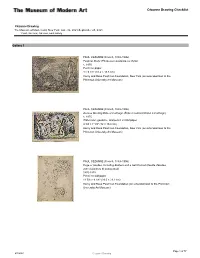
Cézanne Drawing Checklist Cézanne Drawing The Museum of Modern Art, New York June 06, 2021-September 25, 2021 11w53, On View, 3rd Floor, East Gallery Gallery 1 PAUL CÉZANNE (French, 1839–1906) Pastoral Study (Étude pour pasterole ou idylle) c. 1870 Pencil on paper 4 × 5 1/4" (10.2 × 13.3 cm) Henry and Rose Pearlman Foundation, New York (on extended loan to the Princeton University Art Museum) PAUL CÉZANNE (French, 1839–1906) Aeneas Meeting Dido at Carthage (Énée recontrant Didon à Carthage) c. 1875 Watercolor, gouache, and pencil on laid paper 4 3/4 × 7 1/4" (12 × 18.4 cm) Henry and Rose Pearlman Foundation, New York (on extended loan to the Princeton University Art Museum) PAUL CÉZANNE (French, 1839–1906) Page of Studies, Including Bathers and a Self-Portrait (Feuille d'études avec baigneurs et autoportrait) 1875-1878 Pencil on laid paper 11 5/8 × 9 1/8" (29.5 × 23.2 cm) Henry and Rose Pearlman Foundation (on extended loan to the Princeton University Art Museum) Page 1 of 77 6/1/2021 Cézanne Drawing 1 PAUL CÉZANNE (French, 1839–1906) The Bath of the Courtesan (recto); Nude Female with Attendants (verso) (La Toilette de la courtisane (recto); Femme nue entourée d'amirateurs (verso)) c. 1880 (recto); c. 1885 (possibly later) (verso) Pencil and watercolor on paper 7 1/2 × 8 1/4" (19 × 21 cm) Arkansas Museum of Fine Arts. Purchase PAUL CÉZANNE (French, 1839–1906) Portrait of the Artist (recto); Fragment of a Landscape Study (verso) (Autoportrait (recto); Étude de paysage (verso)) 1880 (recto); n.d.