Contemporary Conflict Analysis of Iraq
Total Page:16
File Type:pdf, Size:1020Kb
Load more
Recommended publications
-

The Resurgence of Asa'ib Ahl Al-Haq
December 2012 Sam Wyer MIDDLE EAST SECURITY REPORT 7 THE RESURGENCE OF ASA’IB AHL AL-HAQ Photo Credit: Asa’ib Ahl al-Haq protest in Kadhimiya, Baghdad, September 2012. Photo posted on Twitter by Asa’ib Ahl al-Haq. All rights reserved. Printed in the United States of America. No part of this publication may be reproduced or transmitted in any form or by any means, electronic or mechanical, including photocopy, recording, or any information storage or retrieval system, without permission in writing from the publisher. ©2012 by the Institute for the Study of War. Published in 2012 in the United States of America by the Institute for the Study of War. 1400 16th Street NW, Suite 515 Washington, DC 20036. http://www.understandingwar.org Sam Wyer MIDDLE EAST SECURITY REPORT 7 THE RESURGENCE OF ASA’IB AHL AL-HAQ ABOUT THE AUTHOR Sam Wyer is a Research Analyst at the Institute for the Study of War, where he focuses on Iraqi security and political matters. Prior to joining ISW, he worked as a Research Intern at AEI’s Critical Threats Project where he researched Iraqi Shi’a militia groups and Iranian proxy strategy. He holds a Bachelor’s Degree in Political Science from Middlebury College in Vermont and studied Arabic at Middlebury’s school in Alexandria, Egypt. ABOUT THE INSTITUTE The Institute for the Study of War (ISW) is a non-partisan, non-profit, public policy research organization. ISW advances an informed understanding of military affairs through reliable research, trusted analysis, and innovative education. ISW is committed to improving the nation’s ability to execute military operations and respond to emerging threats in order to achieve U.S. -

The Mandaeans
The Mandaeans A Story of Survival in the Modern World PHOTO: DAVID MAURICE SMITH / OCULI refugees and spoken to immigration officials in Aus- The Mandaeans appear to be one of the most tralian embassies and international NGOs about their misunderstood and vulnerable groups. Apart from being desperate plight. She laments that the conditions in a small community, even fewer than Yazidis, they do which they live are far worse than she could have ever not belong to a large religious organisation or have imagined, and she fears they may have been forgotten links with powerful tribes that can protect them, so by the international community overwhelmed by the their vulnerability makes them an easy target. To make massive displacement and the humanitarian disaster matters worse they are scattered all over the country, caused by the Syrian civil war. so they are the only minority group in Iraq without a There is no doubt that more of a decade of sectarian safe enclave. If the violence persists, it is feared their infighting has had a devastating impact on Iraqi society ancient culture and religion will be lost forever. as a whole. But religious minority groups have borne the brunt of the violence. For the past 14 years Mand- andaeans have a long history of per- aeans, like many other minorities, have been subjected secution. Their survival into the modern to persecution, murder, kidnappings, displacement, world is little short of a miracle. Their forced conversion to Islam, forced marriage, cruel M origins can be traced to the Jordan treatment, confiscation of assets including property and Valley area and it is thought that they may have migrated the destruction of their cultural and religious heritage. -
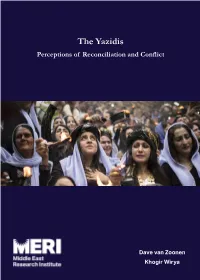
The Yazidis Perceptions of Reconciliation and Conflict
The Yazidis Perceptions of Reconciliation and Conflict Dave van Zoonen Khogir Wirya About MERI The Middle East Research Institute engages in policy issues contributing to the process of state building and democratisation in the Middle East. Through independent analysis and policy debates, our research aims to promote and develop good governance, human rights, rule of law and social and economic prosperity in the region. It was established in 2014 as an independent, not-for-profit organisation based in Erbil, Kurdistan Region of Iraq. Middle East Research Institute 1186 Dream City Erbil, Kurdistan Region of Iraq T: +964 (0)662649690 E: info@meri-k.org www.meri-k.org NGO registration number. K843 © Middle East Research Institute, 2017 The opinions expressed in this publication are the responsibility of the authors. All rights reserved. No part of this publication may be reproduced or transmitted in any form or by any means, electronic or mechanical including photocopying, recording, or any information storage or retrieval system, without the prior written permission of MERI, the copyright holder. Please direct all enquiries to the publisher. The Yazidis Perceptions of Reconciliation and Conflict MERI Policy Paper Dave van Zoonen Khogir Wirya October 2017 1 Contents 1. Executive Summary ............................................................................................................................4 2. “Reconciliation” after genocide .........................................................................................................5 -

The Evolution of the Revolution
The Evolution of the Revolution THE CHANGING NATURE OF IRAN’S AXIS OF RESISTANCE KENNETH M. POLLACK MARCH 2020 AMERICAN ENTERPRISE INSTITUTE Executive Summary ince the earliest days after the 1979 Islamic Soleimani in January 2020 could significantly impede S Revolution, the Iranian regime has sought to build further progress. a coalition across the Middle East to help it achieve its As it stands currently, the Axis is comprised of ideological and geostrategic goals. Tehran understood both state and non-state actors. These groups include that its ability to secure the Islamic Republic in Iran, Hezbollah, Hamas, the Popular Front for the Liber- overturn the regional status quo, drive out the United ation of Palestine–General Command (PFLP-GC), States, and make Iran the regional hegemon was lim- Palestinian Islamic Jihad (PIJ), and occasionally the ited if it acted on its own. It could only succeed with Kurdistan Workers’ Party. State and quasi-state actors the help of others. openly aligned with Tehran include Hamas in Gaza, However, for the next two decades, the Axis was Iraq, Hezbollah in Lebanon, Syria, and the Houthis little more than rhetoric, ascribing greater unity in Yemen. of effort to an amalgam of states,semi-states , and Ultimately, the new operating method of Iran’s non-state actors than was ever the reality. It was pri- Axis of Resistance is a strategy born of necessity. It marily a psychological ploy to frighten its adversaries is a strategy of the weak, unlikely to succeed against and make its members feel less isolated in the face the strong except when they are badly constrained of American hostility. -

The Real Outcome of the Iraq War: US and Iranian Strategic Competition in Iraq
The Real Outcome of the Iraq War: US and Iranian Strategic Competition in Iraq By Anthony H. Cordesman, Peter Alsis, Adam Mausner, and Charles Loi Anthony H. Cordesman Arleigh A. Burke Chair in Strategy Revised: December 20, 2011 Note: This draft is being circulated for comments and suggestions. Please provide them to acordesman@gmail.com Chapter 6: US Strategic Competition with Iran: Competition in Iraq 2 Executive Summary "Americans planted a tree in Iraq. They watered that tree, pruned it, and cared for it. Ask your American friends why they're leaving now before the tree bears fruit." --Mahmoud Ahmadinejad.1 Iraq has become a key focus of the strategic competition between the United States and Iran. The history of this competition has been shaped by the Iran-Iraq War (1980-1988), the 1991 Gulf War, and the US invasion of Iraq in 2003. Since the 2003 war, both the US and Iran have competed to shape the structure of Post-Saddam Iraq’s politics, governance, economics, and security. The US has gone to great lengths to counter Iranian influence in Iraq, including using its status as an occupying power and Iraq’s main source of aid, as well as through information operations and more traditional press statements highlighting Iranian meddling. However, containing Iranian influence, while important, is not America’s main goal in Iraq. It is rather to create a stable democratic Iraq that can defeat the remaining extremist and insurgent elements, defend against foreign threats, sustain an able civil society, and emerge as a stable power friendly to the US and its Gulf allies. -

Iran's Foreign and Defense Policies
Iran’s Foreign and Defense Policies name redacted Specialist in Middle Eastern Affairs December 21, 2016 Congressional Research Service 7-.... www.crs.gov R44017 Iran’s Foreign and Defense Policies Summary Iran’s national security policy is the product of many, and sometimes competing, factors: the ideology of Iran’s Islamic revolution; Iranian leadership’s perception of threats to the regime and to the country; long-standing Iranian national interests; and the interaction of the Iranian regime’s various factions and constituencies. Some experts assert that the goal of Iran’s national security strategy is to overturn a power structure in the Middle East that Iran asserts favors the United States and its allies Israel, Saudi Arabia, and other Sunni Muslim Arab regimes. Iran characterizes its support for Shiite and other Islamist movements as support for the “oppressed” and asserts that Saudi Arabia, in particular, is instigating sectarian tensions and trying to exclude Iran from regional affairs. Others interpret Iran as primarily attempting to protect itself from U.S. or other efforts to invade or intimidate it or to change its regime. Its strategy might, alternatively or additionally, represent an attempt to enhance Iran’s international prestige or restore a sense of “greatness” reminiscent of the ancient Persian empires. From 2010 until 2016, Iran’s foreign policy also focused on attempting to mitigate the effects of international sanctions on Iran. Iran employs a number of different tools in pursuing its national security policy. Some Iranian policy tools are common to most countries: traditional diplomacy and the public promotion of Iran’s values and interests. -

Why Jihadis Lose Dr
Combating Terrorism Center at West Point Objective • Relevant • Rigorous | November 2017 • Volume 10, Issue 10 FEATURE ARTICLE A VIEW FROM THE CT FOXHOLE Why Jihadis Lose Dr. Angela Misra Fratricidal jihadis fail to learn from their mistakes Mohammed Hafez Co-Founder, The Unity Initiative NOVEMBER 2017 CTC SENTINEL 1 Te Curse of Cain: Why Fratricidal Jihadis Fail to Learn from Teir Mistakes By Mohammed Hafez The Islamic State is the latest jihadi group to fall victim to its The rapid and comprehensive demise of the Islamic State own strategic errors. After rising like a phoenix from the ashes in is the latest reminder that fratricidal jihadis are destined to 2013, it failed to learn the lessons of earlier jihads. Rather than lose. Over the last three decades, jihadis have consecutively building bridges with Syria’s Islamist factions, it went its own way lost their civil wars in Algeria, Iraq, and Syria because by declaring a caliphate and waging war on fellow rebels. Worst of three strategic errors. They portray their political still, it glorified its genocidal violence, practically begging the entire conflicts as religious wars between Islam and impiety, world to form a military coalition against it. Today, it has lost all the territory it once held in Iraq and is all but finished in Syria. forcing otherwise neutral parties to choose between These three movements had perfect opportunities to topple their repressive autocrats or ardent fanatics. Furthermore, regimes. Yet, in the crucible of civil wars, they turned their guns they pursue transformational goals that are too ambitious on fellow rebels—alienating their supporters, fragmenting their for other rebel groups with limited political objectives, ranks, and driving away external sponsors. -
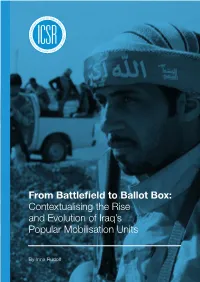
From Battlefield to Ballot Box: Contextualising the Rise and Evolution of Iraq’S Popular Mobilisation Units
From Battlefield to Ballot Box: Contextualising the Rise and Evolution of Iraq’s Popular Mobilisation Units By Inna Rudolf CONTACT DETAILS For questions, queries and additional copies of this report, please contact: ICSR King’s College London Strand London WC2R 2LS United Kingdom T. +44 20 7848 2098 E. mail@icsr.info Twitter: @icsr_centre Like all other ICSR publications, this report can be downloaded free of charge from the ICSR website at www.icsr.info. © ICSR 2018 From Battlefield to Ballot Box: Contextualising the Rise and Evolution of Iraq’s Popular Mobilisation Units Contents List of Key Terms and Actors 2 Executive Summary 5 Introduction 9 Chapter 1 – The Birth and Institutionalisation of the PMU 11 Chapter 2 – Organisational Structure and Leading Formations of Key PMU Affiliates 15 The Usual Suspects 17 Badr and its Multi-vector Policy 17 The Taming of the “Special Groups” 18 Asa’ib Ahl al-Haqq – Righteousness with Benefits? 18 Kata’ib Hezbollah and the Iranian Connection 19 Kata’ib Sayyid al-Shuhada – Seeking Martyrdom in Syria? 20 Harakat Hezbollah al-Nujaba – a Hezbollah Wannabe? 21 Saraya al-Khorasani – Tehran’s Satellite in Iraq? 22 Kata’ib Tayyar al-Risali – Iraqi Loyalists with Sadrist Roots 23 Saraya al-Salam – How Rebellious are the Peace Brigades? 24 Hashd al-Marji‘i – the ‘Holy’ Mobilisation 24 Chapter 3 – Election Manoeuvring 27 Betting on the Hashd 29 Chapter 4 – Conclusion 33 1 From Battlefield to Ballot Box: Contextualising the Rise and Evolution of Iraq’s Popular Mobilisation Units List of Key Terms and Actors AAH: -
ISIS Propaganda and Recruitment
The Secret of Attraction ISIS Propaganda and Recruitment The Hashemite Kingdom of Jordan The Deposit Number at the National Library (2016/3/1239) 324.21 Abu Rumman, Mohammad Suliman et al. The Secret of Attraction: ISIS Propaganda and Recruitment/ Mohammad Suliman Abu Rumman et al.; translated by William John Ward et al. –Amman: Friedrich-Ebert-Stiftung, 2016 (121) p. Deposit No.: 2016/3/1239 Descriptors: /Political Conditions// Terrorism// Arab Countries/ يتحمل املؤلف كامل املسؤولية القانونية عن حمتوى مصنفه وﻻ يعرّب هذا املصنف عن رأي دائرة املكتبة الوطنية أو أي جهة حكومية أخرى. Published in 2016 by Friedrich-Ebert-Stiftung- Jordan and Iraq FES Jordan & Iraq P.O. Box 941876 11194 Amman Jordan Email: fes@fes-jordan.org Website: www.fes-jordan.org Not for Sale © FES Jordan & Iraq All rights reserved. No part of this publication may be reprinted, reproduced, or utilized in any form or by any means without prior written permission from the publishers. The views and opinions expressed in this publication are solely those of the original authors. They do not necessarily represent those of the Friedrich-Ebert- Stiftung or the editors. Translation: Abu Rumman (Samira Kawar), Lombardi & Abou-Taam (EVS Translations), all others (Industry Arabic) Editing: Banan Malkawi, Anja Wehler-Schoeck Cover: Ramzi Al Arabi Printing: Economic Press ISBN: 978-9957-484-65-1 2 Table of Contents Anja Wehler-Schoeck Introduction: Falling for ISIS ...................................................................................... 5 Mohammad Abu Rumman The Secret of Attraction: ISIS Propaganda and Recruitment ......................... 7 Hassan Abu Hanieh The Islamic State’s Appeal: Theories of Attraction ............................................ 15 Hassan al-Safadi The Case of Syria ............................................................................................................ -

Iraq's Evolving Insurgency
CSIS _______________________________ Center for Strategic and International Studies 1800 K Street N.W. Washington, DC 20006 (202) 775 -3270 Access: Web: CSIS.ORG Contact the Author: Acordesman@aol.com Iraq’s Evolving Insurgency Anthony H. Cordesman Center for Strategic and International Studies With the Assistance of Patrick Baetjer Working Draft: Updated as of August 5, 2005 Please not e that this is part of a rough working draft of a CSIS book that will be published by Praeger in the fall of 2005. It is being circulated to solicit comments and additional data, and will be steadily revised and updated over time. Copyright CSIS, all rights reserved. All further dissemination and reproduction must be done with the written permission of the CSIS Cordesman: Iraq’s Evolving Insurgency 8/5/05 Page ii I. INTR ODUCTION ................................ ................................ ................................ ................................ ..... 1 SADDAM HUSSEIN ’S “P OWDER KEG ” ................................ ................................ ................................ ......... 1 AMERICA ’S STRATEGIC MISTAKES ................................ ................................ ................................ ............. 2 AMERICA ’S STRATEGIC MISTAKES ................................ ................................ ................................ ............. 6 II. THE GROWTH AND C HARACTER OF THE INSURGENT THREA T ................................ ........ 9 DENIAL AS A METHOD OF COUNTER -INSURGENCY WARFARE ............................... -

Iraq Tribal Study – Al-Anbar Governorate: the Albu Fahd Tribe
Iraq Tribal Study AL-ANBAR GOVERNORATE ALBU FAHD TRIBE ALBU MAHAL TRIBE ALBU ISSA TRIBE GLOBAL GLOBAL RESOURCES RISK GROUP This Page Intentionally Left Blank Iraq Tribal Study Iraq Tribal Study – Al-Anbar Governorate: The Albu Fahd Tribe, The Albu Mahal Tribe and the Albu Issa Tribe Study Director and Primary Researcher: Lin Todd Contributing Researchers: W. Patrick Lang, Jr., Colonel, US Army (Retired) R. Alan King Andrea V. Jackson Montgomery McFate, PhD Ahmed S. Hashim, PhD Jeremy S. Harrington Research and Writing Completed: June 18, 2006 Study Conducted Under Contract with the Department of Defense. i Iraq Tribal Study This Page Intentionally Left Blank ii Iraq Tribal Study Table of Contents TABLE OF CONTENTS EXECUTIVE SUMMARY CHAPTER ONE. Introduction 1-1 CHAPTER TWO. Common Historical Characteristics and Aspects of the Tribes of Iraq and al-Anbar Governorate 2-1 • Key Characteristics of Sunni Arab Identity 2-3 • Arab Ethnicity 2-3 – The Impact of the Arabic Language 2-4 – Arabism 2-5 – Authority in Contemporary Iraq 2-8 • Islam 2-9 – Islam and the State 2-9 – Role of Islam in Politics 2-10 – Islam and Legitimacy 2-11 – Sunni Islam 2-12 – Sunni Islam Madhabs (Schools of Law) 2-13 – Hanafi School 2-13 – Maliki School 2-14 – Shafii School 2-15 – Hanbali School 2-15 – Sunni Islam in Iraq 2-16 – Extremist Forms of Sunni Islam 2-17 – Wahhabism 2-17 – Salafism 2-19 – Takfirism 2-22 – Sunni and Shia Differences 2-23 – Islam and Arabism 2-24 – Role of Islam in Government and Politics in Iraq 2-25 – Women in Islam 2-26 – Piety 2-29 – Fatalism 2-31 – Social Justice 2-31 – Quranic Treatment of Warfare vs. -

Informations Sur Les Tribus Irakiennes De La Région De Tikrit Et Leur Implication Dans Les Événements De 2003-2007
IRAK Note 4 juillet 2014 Informations sur les tribus irakiennes de la région de Tikrit et leur implication dans les événements de 2003-2007 Avertissement Ce document a été élaboré par l’Ofpra en vue de fournir des informations aux agents chargés du traitement des demandes de protection internationale. Il ne prétend pas faire le traitement exhaustif de la problématique, ni apporter de preuves concluantes quant au fondement d’une demande de protection internationale particulière. Il ne doit pas être considéré comme une position officielle de l’Ofpra ou des autorités françaises. Ce document, rédigé conformément aux lignes directrices communes à l’Union européenne pour le traitement de l’information sur le pays d’origine (avril 2008) [cf. http://www.ofpra.gouv.fr/documents/Lignes_directrices_UE.pdf], se fonde principalement sur des renseignements puisés dans des sources qui sont à la disposition du public. Toutes les sources utilisées sont référencées. Elles ont été sélectionnées avec un souci constant de recouper les informations. Le fait qu’un événement, une personne ou une organisation déterminée ne soit pas mentionné(e) dans la présente production ne préjuge pas de son inexistence. La reproduction ou diffusion du document n’est pas autorisée, à l’exception d’un usage personnel, sauf accord de l’Ofpra en vertu de l’article L. 335-3 du code de la propriété intellectuelle. Irak – Informations sur les tribus de Tikrit et les événements de 2003-2007 Sommaire 1. Les tribus arabes dans la société irakienne..................................................... 3 2. Les tribus de la province de Salah ad-Din (Tikrit) ............................................ 4 3. La province de Salah ad-Din (Tikrit) sous Saddam Hussein ..............................