Social Policy and Ethics Andrew Singleton (Pp.205–11)
Total Page:16
File Type:pdf, Size:1020Kb
Load more
Recommended publications
-

Missionaries of Civilisation the Commercial
Recent Exhibition UMABulletin NEWS FROM THE UNIVERSITY OF MELBOURNE ARCHIVES HE HIGHLIGHTS of a recent exhibition held at the Leigh Scott Gallery in the TBaillieu Library on the history of tea, titled Tea: the global infusion, were two collections www. lib.unimelb.edu.au/collections/archives/index.html No. 21, July 2007 of Chinese silk paintings from the UMA. These exquisite 19th century works were borrowed from the Strathfieldsaye Estate and Una Porter Collections for the duration of the Missionaries of Civilisation exhibition and were also used to illustrate the The Commercial Travellers’ Association of Victoria catalogue and posters. The Strathfieldsaye Estate Collection documents the Gippsland pastoral property EFORE THE ADVENT of that Clive Disher bequeathed to the University huge retail chains, and in 1976. The Disher family had owned this Blong before online com- estate for over a century and the bequest merce, commercial travellers included the extensive archive that documents rode the nation’s back roads, in detail the management of the property dusting off their sample kits during this period. in front of the keen eyes of storekeepers. Their work was Una Porter was a graduate of medicine more than a nine-to-five job from the University of Melbourne and — it was a lifestyle. Many youngest daughter of F.J. Cato, co-founder of would spend weeks away the grocery business Moran and Cato. The from their families living Porter papers include the personal corres- in hotels, mixing with other Please note: The Cultural Collections pondence of the Cato family dating from the Reading Room, Baillieu Library, will be open commercial travellers and on Saturdays for a trial period from 28 July 1880s as well as material related to Moran and drinking with locals. -

Newsletter 128 FINAL RT
Newslett er In the Michaelmas 2006 issue – 128 Suffulti spe quae crescit —Editorial ............................................... 3 AGM at Wimbledon—21st October ..............................................4 Why Mass in Latin?—talk by Ruth Bleakley ................................... 6 Sacred Music—reflections by Mgr Domenico Bartolucci ............16 US LLA Convention—report by Mike Withers............................18 Prosper Guéranger—Book Review by Christopher Francis..........21 New Book by Denis Crouan —La Messe en Latin et en Grégorian 23 The Holy Eucharist— Sermon by Fr Cormac Rigby ....................24 Adrian Fortescue—some new insights ...................................... 25 Regina Caeli —new CD of Music to Our Lady.............................28 New Lectionary—to be based on NRSV......................................29 Organ Recital in Islington—John McGreal plays Bach ................31 ASSOCIATION FOR LATIN LITURGY www.Latin -Liturgy.org SUFFULTI SPE QUAE CRESCIT Editorial In our last editorial we spoke of the air of confidence and optimism that seemed to surround the present papacy. If anything, that feeling is now stronger. There had been a suggestion that despite the Pope’s fine vision for the Church, he lacked ‘generals’ on the ground to support him in what needed to be done. Now however, it is evident that he has been calmly appointing carefully chosen prelates to key positions, men he knows and trusts after his many years in the Vatican. In Rome all seems positive – even though not everyone will end up with all that they might hope for! When we turn to our own country, the contrast is inescapable. In the matter of changes affecting the Holy Days of Obligation, our Bishops’ Conference has drawn upon itself an unprecedented storm of criticism, reflected even in The Tablet and confirmed in its opinion poll. -

LDS AMDG Oxford University Catholic Chaplaincy
Student Cross Pilgrimage Fri 27 Mar -5 Apr Chapel of St Thomas More College Representatives College Masses During Holy Week, walking as a group, carrying the Cross to Walsingham. All Souls Demelza Shaw Contact pui.mak@stcatz.ox.ac.uk Society of St Vincent de Paul Weekly Schedule AMDG Balliol Heinrich von Jagwitz-Biegnitz 3rd wk Mon 02 Feb 6pm Blackfriars James Bergida Serving those in need in the local community including early morning tea to the Greater Glory of God Brasenose James Wills 7th wk Tue 03 Mar 6pm round for the homeless and visits to the elderly Sunday Mass 9.00am, 11.00am (sung), 5.45pm, 9pm Contact Joanna Klaptocz joanna.klaptocz@gtc.ox.ac.uk (Sunday evening Masses from 0th-8th week only ) Christ Church Joseph McCrave CAFOD Group Corpus Christi Kalina Slaska-Sapala 2nd wk Wed 28 Jan 6pm Weekday Mass Monday-Saturday 12.15pm, 5.30/6pm Mass in Colleges Exeter Lucy Hennings Raising awareness of global issues of justice through the international Catholic for University members (details inside Term Card and on charity. Contact Charles oxford.cafod@gmail.com Oxford University Green Templeton Mary McMenamin weekly newsletter) Harris Manchester Christian Life Communities (CLC) Sacrament of Reconciliation Sat 11.15–12noon Sun 10.15–10.45am & on request. Hertford Alice Grout-Smith & Rebecca Carr Praying together to observe and respond to where God is at work in our daily Jesus Clare McEvoy & Joasia Rejman 2nd wk Tue 27 Jan 6pm Morning Prayer Monday-Friday 8–8.15am (1st-8th wk) Catholic Chaplaincy lives. Contact Fr Dushan dushan.croos@campion.ox.ac.uk Keble Hannah Schofield 3rd wk Tue 03 Feb 6pm Silent Eucharistic Adoration Kellogg Nightfever The Old Palace, Rose Place, St Aldates, Oxford ox1 1rd Monday-Friday 7.30am–8am (1st-8th wk) LMH Prayer vigil at Blackfriars on Fri 23 Jan, inviting passers-by to enter and stay for 01865 276994 catholic.chaplaincy@ox.ac.uk Linacre a short time in silence in the Church. -
Analysis of International Baccalaureate Program
October 8, 2020 Analysis of International Baccalaureate Program By Dr. Denise Donohue and Dr. Dan Guernsey he following is part of The Cardinal Newman Society’s series of analyses of secular T materials and programs used in Catholic education. Such materials and programs must be carefully evaluated to determine if their underlying philosophy, content, and activities are aligned to the mission of Catholic education and, if used, what adaptations might be needed. The Newman Society’s “Policy Guidance Related to Secular Materials and Programs in Catholic Education” offers a framework for such evaluation and is the basis for this particular analysis. Overview The International Baccalaureate (IB) program is used in about 5,000 schools in more than 150 countries,1 including more than 1,800 schools in the United States.2 The IB program has steadily increased its presence in the U.S., adding about 100 new schools a year in recent years.3 Catholic schools currently comprise 2 percent of that total.4 Originally designed to instruct the children of international diplomats, the IB Diploma Program (IBDP) and its foundational Theory of Knowledge course were officially registered in Geneva in 1968. As the program slowly acquired global recognition, the Middle and Primary Year Programs were introduced, followed by a program geared toward students on a career-related track. The mission statement reads: 1 See https://www.ibo.org/about-the-ib/ (accessed on June 12, 2020). 2 See https://www.ibo.org/country/US/ (accessed on June 12, 2020). 3 “International Baccalaureate: Guided by a Mission” at https://www.newsweek.com/insights/best-usas-ib- accredited-schools-2016 (accessed on June 12, 2020). -

Catholic East Anglia – November 2019
Catholic November 2019 FREE East Anglia Newspaper of the Diocese of East Anglia www.rcdea.org.uk Richard’s Priests on the Schools celebrate ordination is move around the Year of the seventh of year the Diocese Word – page 5 – page 6 – page 8 Jean’s 30-year involvement in Newman cause I Jean Johnson from Ipswich was in Rome for the canonisation of Cardinal John Henry Newman – a cause with which she has been personally involved for over 30 years as part of the Friends of Newman Committee. The former head of a Catholic girls school in Birmingham, Jean, who lived just over a mile from where Newman was at the Oratory, spoke to BBC Radio Suffolk live from Rome. “We are all so excited about today. I had a reserved seat and an invitation to a reception at the British Embassy attended by Prince Charles,” she said. “There are lots of similarities in my own faith journey to Newman’s,” said Jean. “I was brought up an evangelical – both my dad and grandad were evangel - ical preachers - then friends took me to an Anglican church. They told me to read about Newman and the Oxford Move - ment. This took me back to the writings about the early church in the first few centuries and showed that the church did many of the things that the Catholic The canonisation Mass at St Peter’s church does today. Things like having Square in Rome and, right, Peter bishops, priests and deacons and asking Wygnanski proclaiming the Gospel. for the prayers of Mary and the Saints,” Pictures © Mazur/cbcew.org.uk said Jean. -
Principles of the New Evangelization: Analysis and Directions
PRINCIPLES OF THE NEW EVANGELIZATION: ANALYSIS AND DIRECTIONS By Richard M. Rymarz, B.Sc (Hons), M.Sc, M.Ed.Studies, Grad Dip Ed, Ed.D, M.A (Theol). A thesis submitted as full requirement for the degree of Doctor of Philosophy at Australian Catholic University. School of Theology Faculty of Philosophy and Theology Australian Catholic University Date of Submission: 25th of May 2010 University Research Services Office Melbourne Campus Locked Bag 4115 Fitzroy VIC 3065 1 STATEMENT OF AUTHORSHIP AND SOURCES This thesis contains no material published elsewhere or extracted in whole or in part from a thesis by which I have qualified for or been awarded another degree or diploma. No part of this thesis has been submitted towards the award of any other degree or diploma in any other tertiary institution. No other person’s work has been used without due acknowledgement in the main text of the thesis. Richard M. Rymarz 2 ABSTRACT This thesis, after appropriate analysis, proposes a number of principles, which guide both an understanding of the new evangelization as formulated by Pope John Paul II and how the new evangelization can be applied. The key insight of the new evangelization is that growing numbers of people, especially in Western countries such as Australia, whilst retaining what can be termed a “loose” form of Christian affiliation, can no longer be described as having a living sense of the Gospel. This makes these people distinct from the classical focus of missionary activity, namely, those who have never heard the Gospel proclaimed. Pope John Paul II’s exposition of the new evangelization arose from his understanding of key conciliar and post-conciliar documents. -

Human Sexuality in Catholic Education
December 2020 Human Sexuality in Catholic Education atholic education is committed to the pursuit of truth and promotion of the Gospel. Central C to its mission is the integral formation of students’ minds, hearts, and bodies in truth and holiness. A significant challenge toward this end is confusion in the common culture regarding the nature of human sexuality. The Catholic Church has a deep and rich understanding of the human person informed by natural law and firmly rooted in Christian revelation, which is its privilege and duty to proclaim and which the culture desperately needs to hear. Errors in understanding human sexuality can lead to errors in understanding human nature, the moral order, and even truth and reality itself. Catholic education’s proclamation of the full truth of humanity requires both sensitivity and courage. It requires clarity, charity, and integrity. It requires loving pastoral responses and clearly articulated beliefs, standards, and policies. Such pastoral efforts and policies should support the mission of Catholic education, be consistent with Church teaching, and be based on a sound Christian anthropology (i.e., concept of the human person). This concept derives from the overarching biblical vision of the human person, which proposes that we find our deepest identity and happiness only by making a sincere gift of ourselves to others. God made men and women as complementary creatures who are naturally ordered to the special union of one man and one woman in marriage. Central as well to the Christian concept of the human person is that God made both men and women in His image, of equal and immense dignity, existing as a unity of body and soul, and destined for union with Him according to His plan. -
Full Issue 2016 (Volume 10)
Inklings Forever: Published Colloquium Proceedings 1997-2016 Volume 10 A Collection of Essays Presented at the Tenth Frances White Ewbank Colloquium on Article 54 C.S. Lewis & Friends 6-5-2016 Full Issue 2016 (Volume 10) Follow this and additional works at: https://pillars.taylor.edu/inklings_forever Part of the English Language and Literature Commons, History Commons, Philosophy Commons, and the Religion Commons Recommended Citation (2016) "Full Issue 2016 (Volume 10)," Inklings Forever: Published Colloquium Proceedings 1997-2016: Vol. 10 , Article 54. Available at: https://pillars.taylor.edu/inklings_forever/vol10/iss1/54 This Full Issue is brought to you for free and open access by the Center for the Study of C.S. Lewis & Friends at Pillars at Taylor University. It has been accepted for inclusion in Inklings Forever: Published Colloquium Proceedings 1997-2016 by an authorized editor of Pillars at Taylor University. For more information, please contact pillars@taylor.edu. Full Issue 2016 (Volume 10) Cover Page Footnote This file is not paginated the same as the print journal. Contact pillars@taylor.edu if you need additional pagination information. This full issue is available in Inklings Forever: Published Colloquium Proceedings 1997-2016: https://pillars.taylor.edu/inklings_forever/vol10/iss1/54 Inklings Forever, Volume X Proceedings from the Frances White Ewbank Colloquium on C. S. Lewis and Friends Joe Ricke and Rick Hill, Editors Copyright © 2017 Taylor University Winged Lion Press Hamden, CT All rights reserved. Except in the case of quotations embodied in critical articles or reviews, no part of this book may be reproduced or transmitted in any form or by any means, electronic or mechanical, including photocopying, recording, or by any information storage or retrieval system, without written permission of the publisher. -
The Enduring Effects of War: Introduction
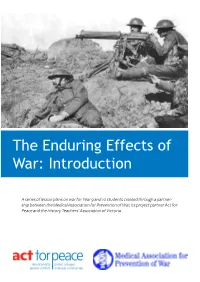
The Enduring Effects of War: Introduction A series of lesson plans on war for Year 9 and 10 students created through a partner- ship between the Medical Association for Prevention of War, its project partner Act for Peace and the History Teachers’ Association of Victoria. The Enduring Effects of War: Introduction INTRODUCTION History teachers often struggle with lessons about war. Conflicts have shaped the ancient and modern world and it is important that students are aware of the role of conflicts in the history of civilisation. In addition to developing a world view, teachers hope that understanding the history of war will help future generations learn from the actions of their ancestors. However, many teachers are concerned that unless approached sensitively, the focus on war in the classroom can have the opposite effect, causing students to glorify it. This unique set of resources has been developed from the perspectives of medical practitioners, many of them also war veterans. It helps students focus on the physical and mental costs of war, aspects of conflict often marginalised by larger themes of mateship and national pride. Students will learn about the often silent effects of war: injury, mental illness and disease. ABOUT THE MEDICAL ASSOCIATION FOR PREVENTION OF WAR The Medical Association for Prevention of War (Australia) is a professional not-for-profit organisation that works to promote peace and disarmament. MAPW aims to reduce the physical and psychological impact, as well as environmental effect, of wars throughout the world. MAPW has branches in every state and territory in Australia. The members of MAPW are mostly medical practitioners who use their understanding of world medical issues in the campaign to prevent war using diplomatic channels rather than armed combat. -
Analysis of Secular Character Development Programs and Materials
October 8, 2020 Analysis of Secular Character Development Programs and Materials By Dr. Denise Donohue and Dr. Dan Guernsey he following is part of The Cardinal Newman Society’s series of analyses of secular T materials and programs used in Catholic education. Such materials and programs must be carefully evaluated to determine if their underlying philosophy, content, and activities are aligned to the mission of Catholic education and, if used, what adaptations might be needed. The Newman Society’s “Policy Guidance Related to Secular Materials and Programs in Catholic Education” offers a framework for such evaluation and is the basis for this particular analysis. Overview By their very nature, schools form character; as long as schools have existed, there have been character development programs and materials. Many are designed for public schools and are therefore secular in orientation.1 Because public schools cannot directly address the theological foundations of virtue, morality, and character, they primarily rely on cultural, psychological, or philosophical assumptions to ground their efforts. Unfortunately, many programs and materials designed primarily for public schools have been tainted by atheistic humanism or relativism. Other resources are more promising, based on concepts of natural law and a traditional Western understanding of the human person without explicitly teaching traditional Christian norms. 1 There are numerous, widely varied programs. By way of example, but without endorsement, these include such programs as Alive to the World, an international character-building program; Character Counts, used in public schools across the U.S.; the Center for the 4th and 5th Rs, which promotes moral virtue; the Human Dignity Curriculum of World Youth Alliance; and the Heart2Heart program of Illinois Right to Life. -

Conference Speakers KEYNOTES Associate Professor David Goodman
Conference Speakers KEYNOTES Associate Professor David Goodman Goldfields Comparisons: Georgia (USA) 1820s, New Zealand, California and Victorian Goldrushes David teaches US history at the University of Melbourne. He is the author of the 1994 book Gold Seeking: Victoria and California in the 1850s (Allen and Unwin and Stanford University Press) and more recently of Radio’s Civic Ambition: American Broadcasting and Democracy in the 1930s (Oxford University Press). Leigh Olver “Blood and Bone”: Discovering Ned Kelly: Using DNA to trace an ancestor resulting in family reconnections Born and raised in the Victorian central goldfields town of Maryborough, Leigh was awarded his Fine Arts Degree (Ballarat CAE),Post Grad Dip Fine Art (RMIT), Dip Ed (BendigoCAE), awarded RMIT Painting Travel Scholarship and travelled extensively throughout Europe/USA. He has since held various exhibitions and worked as a Secondary Art Teacher for over 22 years (various schools). He has an avid interest in Ned Kelly Family History and is a Ned Kelly descendant via the King branch. Involved with various Ned Kelly events, including recently providing the DNA sample which assisted with the identification of Ned Kelly’s remains. Professor Robert Pascoe The Footy Tribes of Ballarat Robert Pascoe is a Professor of History and Dean Laureate at Victoria University in Melbourne and the author of the The Winter Game (1995). With Mark Pennings of QUT he is co-authoring a new multi-volume series on football in colonial Victoria, published in Ballan by Connor Court. Robert is a well known historian, author & experienced media commentator. Conference Speakers KEYNOTES Susan Fayad Heritage at Your Fingertips Susan Fayad is the Coordinator Heritage, City of Ballarat. -

FAITH and MORALS Language in Catholic School Teacher
FAITH AND MORALS LANGUAGE IN CATHOLIC SCHOOL TEACHER EMPLOYMENT DOCUMENTS A Compilation from Diocesan Statements, Handbooks and Contracts by Denise Donohue, Ed.D., and Dan Guernsey, Ed.D. June 2015 Summary A companion to the Cardinal Newman Society’s analysis, Faith and Morals Language in Catholic School Teacher Employment Documents: Best Practices Brief, this compilation provides additional source material for researching and reviewing faith and morals clauses in diocesan employment documents for Catholic school teachers. The citations were collected from Catholic dioceses in the United States during the second quarter of 2015. All of The Cardinal Newman Society’s research and analysis, including this paper, is available online on the Society’s website at http://www.CardinalNewmanSociety.org. Copyright © 2015 The Cardinal Newman Society. Permission to reprint is hereby granted provided no modifications are made to the text and it is identified as a publication of The Cardinal Newman Society. Note: The views expressed herein are those of the authors and not necessarily those of The Cardinal Newman Society. The Cardinal Newman Society 9720 Capital Court Suite 201 Manassas, Virginia 20110 703/367-0333 Research@CardinalNewmanSociety.org Faith and Morals Language in Catholic School Teacher Employment Documents: A Compilation from Diocesan Statements, Handbooks and Contracts by Denise Donohue, Ed.D., and Dan Guernsey, Ed.D. Introduction his compilation is a companion to the Cardinal Newman Society’s analysis, Faith and T Morals Language in Catholic School Teacher Employment Documents: Best Practices Brief. It provides additional source material for the reader to consider when researching and reviewing faith and morals clauses in diocesan employment documents for Catholic school teachers.