Piddubnyj-Artikel
Total Page:16
File Type:pdf, Size:1020Kb
Load more
Recommended publications
-

CIUS Endowment Fund: $808,695 the fi Elds of History, Political Science, Law, and Economics
CIUS Newsletter Spring 2005 Spring Canadian Institute of Ukrainian Studies 450 Athabasca Hall, University of Alberta, Edmonton, Alberta, Canada T6G 2E8 CIUS and the Orange Revolution: Informing the Public and Media on Events in Ukraine Fall 2004 was a period in which CIUS staff became increasingly fo- cused on the presidential elections in Ukraine. Th is involved, for the most part, informing colleagues, the me- dia, and the general public about the Ukrainian presidential elections and what has become known as the Orange Revolution. CIUS also managed the Ukraine Transparency and Election Monitoring Project (UTEMP) in this period. UTEMP was offi cially launched on 10 September 2004, when Toronto MP Borys Wrzesnewskyj presented CIUS with a $250,000 cheque on behalf of his family’s charitable foundation “Dopo- moha Ukraini—Aid to Ukraine.” James Jacuta headed the project for CIUS, while the NGO Community Energy Foundation was CIUS’s partner in Voting on 26 December in Zaporizhia, Ukraine. Photo by Ruby Swanson, Department of Ukraine. Physics, University of Alberta. Ms. Swanson was an observer at the 26 Dec 2004 vote. UTEMP sent 26 Canadians to Ukraine under the auspices of the monton–Mill Woods–Beaumont), Judy Mr. Jacuta, and UTEMP observers. project. Some were involved in design- Wasylycia-Leis (Winnipeg North), MPs Borys Wrzesnewskyj and Peter ing and delivering seminars on election Borys Wrzesnewskyj (Etobicoke Goldring were featured several times laws, policies, and procedures for local Centre), and Senator David Smith. Th e in national TV broadcasts by both the election offi cials and scrutineers. Oth- Canadian government’s decision not to CBC and CTV networks from Kyiv. -
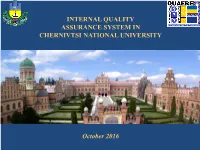
Internal Quality Assurance System in Chernivtsi National University
INTERNAL QUALITY ASSURANCE SYSTEM IN CHERNIVTSI NATIONAL UNIVERSITY October 2016 REVELANCE Socio-economic changes in society The adoption of a new legal framework in higher education Increasing demands and needs of the main stakeholders in higher education defined QUALITY OF HIGHER EDUCATION as a priority for Ukrainian society LAW OF UKRAINE “ON HIGHER EDUCATION” Section V. QUALITY OF HIGHER EDUCATION 16. Higher education quality assurance system Higher education quality assurance system in Ukraine consists of: Quality assurance system of the National Agency of higher education quality assurance and independent quality assurance and assessment organizations External quality assurance systems of higher educational units and higher education Internal quality assurance systems of higher educational units and higher education FACTORS OF HIGHER EDUCATION QUALITY Factors that determine the content of training, organization of educational process in higher educational units: requirements of the labor market, state and society to modern specialist; advances in science and technology that should be taken into account while forming the content of vocational training; the level of general education of students; logistical and financial support of the educational process; interaction with employers. Factors that are directly detected in educational process of higher educational units: level of educational, professional and academic training programs; introduction of modern innovative and information technologies; professional and practical -

Nikolaj Von Wassilko. Bukovinian Statesman and Diplomat
https://doi.org/10.4316/CC.2019.01.010 POLITICS AND INTERNATIONAL STUDIES NIKOLAJ VON WASSILKO. BUKOVINIAN STATESMAN AND DIPLOMAT Oleksandr DOBRZHANSKYI Yurii Fedkovych Chernivtsi National University (Ukraine) E-mail: dobrzhanskiy@i.ua Abstract: The article is dedicated to the study of the political biography of Nikolaj von Wassilko, a well-known Bukovinian leader, one of the most controversial personages among Ukrainian politicians of Austria-Hungary at the end of the 19th – the beginning of the 20th century. It is worth mentioning that many scientists from various countries wrote about N. Wassilko, but separate studies about his life and political activities have not been written yet. Author paid considerable attention to the formation of N. Wassilko's political views, the evolution of his preferences from conservative Rusynism and Moscophilia philosophy to the populistic doctrine. Since the beginning of the 20th century, N. Wassilko became almost the sole leader of Ukrainians in Bukovina. The article presents the analysis of his activities in the Austrian Parliament, the Diet of Bukovina, public organizations, and his initiatives to resolve various regional issues. His activities in the years of World War I were equally rich. In particular, the article shows his diplomatic activities as the ambassador of the ZUNR (West Ukrainian People's Republic) in Vienna, the ambassador of the UPR (Ukrainian People's Republic) in Switzerland and other countries. At the end of the research, the author points out the remarkable path of N. Wassilko in the history of the Ukrainian movement in Bukovina in the early twentieth century, as one of the central figures of the Ukrainian diplomacy during 1918-1924. -

A Guide to the Archival and Manuscript Collection of the Ukrainian Academy of Arts and Sciences in the U.S., New York City
Research Report No. 30 A GUIDE TO THE ARCHIVAL AND MANUSCRIPT COLLECTION OF THE UKRAINIAN ACADEMY OF ARTS AND SCIENCES IN THE U.S., NEW YORK CITY A Detailed Inventory Yury Boshyk Canadian Institute of Ukrainian Studies University of Alberta Edmonton 1988 Canadian Institute of Ukrainian Studies University of Alberta Occasional Research Reports Publication of this work is made possible in part by a grant from the Stephania Bukachevska-Pastushenko Archival Endowment Fund. The Institute publishes research reports periodically. Copies may be ordered from the Canadian Institute of Ukrainian Studies, 352 Athabasca Hall, University of Alberta, Edmonton, Alberta, T6G 2E8. The name of the publication series and the substantive material in each issue (unless otherwise noted) are copyrighted by the Canadian Institute of Ukrainian Studies. PRINTED IN CANADA Occasional Research Reports A GUDE TO THE ARCHIVAL AND MANUSCRIPT COLLECTION OF THE UKRAINIAN ACADEMY OF ARTS AND SCIENCES IN THE U.S., NEW YORK CITY A Detailed Inventory Yury Boshyk Project Supervisor Research Report No. 30 — 1988 Canadian Institute of Ukrainian Studies University of Alberta Edmonton, Alberta Dr . Yury Boshyk Project Supervisor for The Canadian Institute of Ukrainian Studies Research Assistants Marta Dyczok Roman Waschuk Andrij Wynnyckyj Technical Assistants Anna Luczka Oksana Smerechuk Lubomyr Szuch In Cooperation with the Staff of The Ukrainian Academy of Arts and Sciences in the U.S. Dr. William Omelchenko Secretary General and Director of the Museum-Archives Halyna Efremov Dima Komilewska Uliana Liubovych Oksana Radysh Introduction The Ukrainian Academy of Arts and Sciences in the United States, New York City, houses the most comprehensive and important archival and manuscript collection on Ukrainians outside Ukraine. -

Lelov: Cultural Memory and a Jewish Town in Poland. Investigating the Identity and History of an Ultra - Orthodox Society
Lelov: cultural memory and a Jewish town in Poland. Investigating the identity and history of an ultra - orthodox society. Item Type Thesis Authors Morawska, Lucja Rights <a rel="license" href="http://creativecommons.org/licenses/ by-nc-nd/3.0/"><img alt="Creative Commons License" style="border-width:0" src="http://i.creativecommons.org/l/by- nc-nd/3.0/88x31.png" /></a><br />The University of Bradford theses are licenced under a <a rel="license" href="http:// creativecommons.org/licenses/by-nc-nd/3.0/">Creative Commons Licence</a>. Download date 03/10/2021 19:09:39 Link to Item http://hdl.handle.net/10454/7827 University of Bradford eThesis This thesis is hosted in Bradford Scholars – The University of Bradford Open Access repository. Visit the repository for full metadata or to contact the repository team © University of Bradford. This work is licenced for reuse under a Creative Commons Licence. Lelov: cultural memory and a Jewish town in Poland. Investigating the identity and history of an ultra - orthodox society. Lucja MORAWSKA Submitted in accordance with the requirements for the degree of Doctor of Philosophy School of Social and International Studies University of Bradford 2012 i Lucja Morawska Lelov: cultural memory and a Jewish town in Poland. Investigating the identity and history of an ultra - orthodox society. Key words: Chasidism, Jewish History in Eastern Europe, Biederman family, Chasidic pilgrimage, Poland, Lelov Abstract. Lelov, an otherwise quiet village about fifty miles south of Cracow (Poland), is where Rebbe Dovid (David) Biederman founder of the Lelov ultra-orthodox (Chasidic) Jewish group, - is buried. -

USHMM Finding
https://collections.ushmm.org Contact reference@ushmm.org for further information about this collection PINUS RUBINSTEIN COLLECTION, circa 1900-1950 2015.607.1 United States Holocaust Memorial Museum Archives 100 Raoul Wallenberg Place SW Washington, DC 20024-2126 Tel. (202) 479-9717 e-mail: reference@ushmm.org Descriptive summary Title: Pinus Rubinstein collection Dates: circa 1900-1950 Accession number: 2015.607.1 Creator: Rubinstein, Pinus, ?-1963 Extent: .7 linear feet (3 book enclosures, 1 oversize box, and 1 folder) Repository: United States Holocaust Memorial Museum Archives, 100 Raoul Wallenberg Place SW, Washington, DC 20024-2126 Abstract: The Pinus Rubenstein collection includes a diary, in three volumes, from Pinus Rubinstein (later known as Ben-Saar), dated 1900 to 1949, and written primarily while the he lived in Bukovina, in Czernowitz and Sadagora (Chernivtsi and Sadhora, Ukraine). The diaries describe Rubinstein’s adolescent years in Sadagora, his service in the Austrian Army in World War I, his marriage and life in Czernowitz in the inter-war years, life in German-occupied Czernowitz from 1941-1944, and his family’s post-war journey to Romania, Austria, Italy, and eventually Israel. The diaries also contain poetry and stories from Rubinstein, signed under his pen name of Ben-Saar. In addition, the collection contains a portrait photograph of the Czernowitz Hairdressers Academy, 1936, to which Pinus Rubinstein belonged and a visiting card for Ben-Saar (P. Rubinstein), in his role as chairman of the organization "Poale Tsedek," in Beit She'an, Israel. Languages: German, Yiddish, Hebrew, Romanian Administrative Information Access: Collection is open for use, but is stored offsite. -
Ukrainians in Russia: a Bibliographic and Statistical Guide
Research Report No. 55 Ukrainians in Russia: A Bibliographic and Statistical Guide Compiled by Serge Cipko Canadian Institute of Ukrainian Studies Press University of Alberta Edmonton 1994 Canadian Institute of Ukrainian Studies Press Occasional Research Reports The Institute publishes research reports periodically. Copies may be ordered from the Canadian Institute of Ukrainian Studies Press, 352 Athabasca Hall, University of Alberta, Edmonton, Alberta, Canada T6G 2E8. The name of the publication series and the substantive material in each issue (unless otherwise noted) are copyrighted by the Canadian Institute of Ukrainian Studies Press. PRINTED IN CANADA Occasional Research Reports Ukrainians in Russia: A Bibliographic and Statistical Guide Compiled by Serge Cipko Research Report No. 55 Canadian Institute of Ukrainian Studies Press University of Alberta Edmonton 1994 Digitized by the Internet Archive in 2016 https://archive.org/details/ukrainiansinruss55cipk Table of Contents Introduction 1 A Select Bibliography 3 Newspaper Articles 9 Ukrainian Periodicals and Journals Published in Russia 15 Periodicals Published Abroad by Ukrainians from Russia 18 Biographies of Ukrainians in Russia 21 Biographies of Ukrainians from Russia Resettled Abroad 31 Statistical Compendium of Ukrainians in Russia 33 Addresses of Ukrainian Organizations in Russia 39 Periodicals and Journals Consulted 42 INTRODUCTION Ukrainians who live in countries bordering on Ukraine constitute perhaps the second largest ethnic minority in Europe after the Russians. Despite their significant numbers, however, these Ukrainians remain largely unknown to the international community, receiving none of the attention that has been accorded, for example, to Russian minorities in the successor states to the former Soviet Union. According to the last Soviet census of 1989, approximately 4.3 million Ukrainians live in the Russian Federation; unofficial estimates of the size of this group run considerably higher. -

The Residence of Bukovyna and Dalmatia Metropolitans in Chernivtsi
THE RESIDENCE OF BUKOVYNA AND DALMATIA METROPOLITANS IN CHERNIVTSI NOMINATION BY THE GOVERNMENT OF UKRAINE OF THE FOR INSCRIPTION THE RESIDENCE OF BUKOVYNA AND DALMATIA METROPOLITANS I N CHERNIVTSI ON THE WORLD HERITAGE LIST 2008 PREPARED BY GOVERNMENT OF UKRAINE, STATE AND LOCAL AUTHORITIES AND THE ACADEMIC COUNCIL OF YURIJ FEDKOVYCH NATIONAL UNIVERSITY TABLE OF CONTENTS Summery…………………………………………………………………………..…5 1. IDENTIFICATION OF THE PROPERTY 1.A Country . …... 16 1.B State, province or region . …………..…18 1.C Name of property . …….….19 1.D Geographical coordinates to the nearest second. Property description . ……. 19 1.E Maps and plans . ………...20 1.F Area of nominated property and proposed buffer zone . .. … . ..22 2. DESCRIPTION 2.A Description of property . ………........26 2.B History and development . .………………..38 3. JUSTIFICATION FOR INSCRIPTION 3.A Criteria under which inscription is proposed and justifi cation for inscription 48 3.B Proposed statement of outstanding universal value . 54 3.C Comparative analysis . 55 3.D Integrity and authenticity . 75 4. STATE OF CONSERVATION AND FACTORS AFFECTING THE PROPERTY 4.A Present state of conservation . .79 4.B Factors affecting the property . 79 (i) Development pressures . 80 (ii) Environmental pressures . 80 (iii) Natural disasters and risk preparedness . 80 (iv) Visitor/tourism pressures . 81 (v) Number of inhabitants within the property and the buffer zone . .. 87 5. PROTECTION AND MANAGEMENT OF THE PROPERTY 5.A Ownership . 90 5.B Protective designation . 98 5.C Means of implementing protective measures . 110 5.D Existing plans related to municipality and region in which the proposed property is located . 111 5.E Property management plan or other management system . -

Czernowitz: the Jerusalem of Bukovina
CZERNOWITZ: THE JERUSALEM OF BUKOVINA Daniel Hrenciuc Technical College, Rădăuţi (Romania) hrenciuc@yahoo.com Rezumat: Articolul analizează rolului evreilor în istoria şi evoluţia oraşului Cernăuţi, devenit prin ponderea, contribuţia şi atmosfera mozaică un veritabil “Ierusalim al Bucovinei”. Evreii au reprezentat majoritatea locuitorilor municipiului Cernăuţi, un spaţiu renumit prin înţelegerea şi coabitarea grupărilor etnice, specifică Europei Centrale. În Cernăuţi s-au format şi afirmat Paul Celan (Paul Antschel), Moses Barasch, Jacob Eisenscher, Arthur Kolnik, Şlomo Lerner, Iţic Manger, Eliezer Steinbarg, Moses Rosenkrantz, Eric Singer, Rose Ausländer, Victor Wittner, Isac Schneyer, Clara Bloom, Alfred Kitner, Immanuel Weissglass, Alfred Gong, Alfred Margul Sperber ş.a. În 1908 în Cernăuţi a avut loc primul Congres Mondial consacrat idişului. Această atmosferă a fost puternic viciată în perioada interbelică de manifestarea puternică a naţionalismului şi antisemitismului. Abstract: Cernăuţi, known as Czernowitz in Yiddish, gathered together important personalities in order to debate on the issue of the status of Yiddish. The power and the contribution of the Jews of Bukovina to the culture and spirituality of Bukovina – beyond the economic references, such as commerce, finances and banks – were really impressive, as a proof being the personalities asserted within the Bukovina area including at the top: Paul Celan (Paul Antschel) Moses Barasch, Jacob Eisenscher, Arthur Kolnik, Slomo Lerner, Itic Manger, Eliezer Steinbarg, Moses Rosenkrantz, -

Radical Nationalist Parties and Movements in Contemporary Ukraine Before and After Independence: the Right and Its Politics, 1989-1994
Nationalities Papers, Vol. 25, No. 2, 1997 RADICAL NATIONALIST PARTIES AND MOVEMENTS IN CONTEMPORARY UKRAINE BEFORE AND AFTER INDEPENDENCE: THE RIGHT AND ITS POLITICS, 1989-1994 Taras Kuzio Introduction The radical right in the Ukrainian political spectrum is dominated by three move- ments—the Nationalist Union Ukrainian State Independence (DSU), the Ukrainian National Assembly (UNA, formerly the Ukrainian Inter-Party Assembly, UMPA) and the Congress of Ukrainian Nationalists (KUN). The UNA is dominated by the highly secretive Ukrainian Nationalist Union (UNS) which grew out of the national- ist wing of the Association of Independent Ukrainian Youth (SNUM). The KUN was launched in 1992 in Ukraine as the overt arm of the emigre Organisation of Ukrainian Nationalists-Bandera faction (known commonly as OUN revolutionaries, or OUNr). Other organisations, such as SNUM and the more radical eastern Ukrainian-based Association of Ukrainian Youth (SUM), increasingly adopted "revolutionary nationalism" as their ideology in 1990-1991, with nationalists propagating a "youth cult" to attract the younger generation (both for members and intellectual support).1 It is also often pointed out that Ukrainian nationalism will have a large appeal among the youth of tomorrow.2 Other nationalist groups, though smaller, have also emerged, such as the Ukrainian National-Radical Party (UNRP) and the Organisation for the Liberation of Ukraine,3 but they have remained largely insignificant. The UNRP was established at the end of 1990 in L'viv, joined the Ukrainian Inter-Party Assembly (UMPA) but remained underground. Its leader, Mykhailo Stasiuk, launched the nationalist and widely read journal Derzhavnist in 1991, claiming the highly inflated membership figure of 500 members.4 The Ukrainian National Party (UNP) and the Ukrainian People's Democratic Party (UNDP), the founders of the UMPA, amalga- mated into the Ukrainian National Conservative Party (UNKP) in 1992. -

Abn Correspondence Bulletin of the Anti-Bolshevik Bloc of Nations
FREEDOM FOR NATIONS ! CORRESPONDENCE FREEDOM FOR INDIVIDUALS! JANUARY-FEBRUARY 1989 CONTENTS: Carolling Ukrainian-Style ....................... 2 The Autobiography of Levko Lukyanenko ..................... 3 European Freedom Council Meeting ..............................16 Statement of the European Freedom Council .............. 16 Hon. John Wilkinson, M.P. Eastern European Policy for Western Europe .............. 19 Genevieve Aubry, M.P. Is Switzerland Ready for a New Challenge with the European Nations .......................... 26 Sir Frederic Bennett Can the Soviet Russian Empire Survive? ....................... 31 Bertil Haggman Aiding the Forces of Freedom in the Soviet Empire ................................... 34 Ukrainian Christian Democratic Front Holds Inaugural Meeting ........... 40 David Remnick Ukraine Could be Soviets’ Next Trouble Spot ..............41 Bohdan Nahaylo Specter of the Empire Haunts the Soviet Union ..........45 Appeal to the Russian Intelligentsia ......... ......................47 Freedom for Nations! Freedom for Individuals! ABN CORRESPONDENCE BULLETIN OF THE ANTI-BOLSHEVIK BLOC OF NATIONS Publisher and Owner (Verleger und Inha It is not our practice to pay for contribut ber): American Friends of the Anti-Bolshevik ed materials. Reproduction permitted only Bloc of Nations (AF ABN), 136 Second Avenue, with indication of source (ABN Corr.). New York, N.Y. 10003, USA. Annual subscription: 27 Dollars in the Zweigstelle Deutschland: A. Dankiw, USA, and the equivalent of 27 US Dollars in Zeppelinstr. 67, 8000 München 80. all other countries. Remittances to Deutsche Editorial Staff: Board of Editors Bank, Munich, Neuhauser Str. 6, Account Editor-in-Chief: Mrs. Slava Stetsko, M.A. No. 3021003, Anna Dankiw. Zeppelinstr. 67 Schriftleitung: Redaktionskollegium. 8000 München 80 Verantw. Redakteur Frau Slava Stetzko. West Germany Zeppelinstraße 67 Articles signed with name or pseudonym 8000 München 80 do not necessarily reflect the Editor’s opinion, Telefon: 48 25 32 but that of the author. -

Political Memes During the 2019 Ukrainian Presidential Election
COGNITIVE STUDIES | ÉTUDES COGNITIVES, 20 Warsaw 2020 Article No.: 2246 DOI: 10.11649/cs.2246 Citation: Pidku˘ımukha, L., & Kiss, N. (2020). Battle of narratives: Political memes during the 2019 Ukrainian presidential election. Cognitive Studies | Études cogniti- ves, 2020 (20), Article 2246. https://doi.org/10.11649/ cs.2246 LIUDMYLA PIDKU˘IMUKHA NADIYA KISS Ukrainian Language Department, Faculty of Institute for Slavic Studies, Justus Liebig Uni- Humanities, National University of Kyiv– versity of Giessen, Germany Mohyla Academy, Ukraine https://orcid.org/0000-0002-2077-7605 https://orcid.org/0000-0003-2017-1213 nadiya.kiss@slavistik.uni-giessen.de l.pidkuimukha@ukma.edu.ua BATTLE OF NARRATIVES: POLITICAL MEMES DURING THE 2019 UKRAINIAN PRESIDENTIAL ELECTION Abstract The article highlights the peculiarities of political internet memes as information units that shape public opinion. The article also examines the role of memes in society. The research material inclu- des creolized memes (including both verbal and visual elements) about the Ukrainian politicians Petro Poroshenko and Volodymyr Zelenskyi. These memes were created in 2019 during the Ukrai- nian presidential election. The article firstly focuses on the verbal aspects of the memes and their semantic and functional features. In addition, the peculiarities of opponent image construction are analysed. The article then examines the influence of Ukrainian politicians on the conduct of the “meme war”. The article also sheds light on the role which memes play in the polarization of society. Keywords: political meme; creolized meme; polarization of society; elections; image of opponent; politics in Ukraine 1 Introduction A peculiarity of political internet memes frequently lies in the fact that they not only reflect ideas, but also demonstrate a certain attitude towards a political event, political power in general, or a specific political leader.