Harold Wilson, Lyndon B. Johnson and Anglo-American Relations
Total Page:16
File Type:pdf, Size:1020Kb
Load more
Recommended publications
-

David Eyman on Lyndon Johnson's War: America's Cold War Crusade
Michael H. Hunt. Lyndon Johnson's War: America's Cold War Crusade in Vietnam, 1945-1968. New York: Hill & Wang, 1996. ix + 146 pp. $11.00, paper, ISBN 978-0-8090-1604-4. Reviewed by David Eyman Published on H-War (November, 1996) For the scholar, the Vietnam War presents a sic concept of Americans as innocent moral cru‐ labyrinth of motives and actions, many of which saders (to use Greene's perception) who operated have long been approached with speculation outside of and in ignorance of the context of Viet‐ rather than certainty. For this slim volume namese history and culture. Michael Hunt, an Asian scholar whose previous The author begins his book with a long look work has dealt largely with Chinese-American at the American approach to the Cold War. In the foreign policy matters, draws upon both Ameri‐ first chapter of the study, "The Cold War World of can and Vietnamese sources, some only recently The Ugly American," he examines the United made available, in an attempt to explain how the States' seeming indifference to the particular situ‐ United States came to be drawn into the conflict ation in Vietnam while focused on a more global in Southeast Asia. The result is not so much a new question. That focus painted Ho Chi Minh with the set of revelations as it is a reaffirmation of the brush of communism rather than patriotism and view that the United States moved into this con‐ led initially to support of French colonialism in flict because it could not understand Vietnamese the area, then to the support of anticommunist problems in any context other than that of the leaders, an approach that drew the United States Cold War. -
A Look at Presidential Power and What Could Have Been John T
Southern Illinois University Carbondale OpenSIUC Honors Theses University Honors Program 8-1992 The Difference One Man Makes: A Look at Presidential Power and What Could Have Been John T. Sullivan Follow this and additional works at: http://opensiuc.lib.siu.edu/uhp_theses Recommended Citation Sullivan, John T., "The Difference One Man Makes: A Look at Presidential Power and What Could Have Been" (1992). Honors Theses. Paper 60. This Dissertation/Thesis is brought to you for free and open access by the University Honors Program at OpenSIUC. It has been accepted for inclusion in Honors Theses by an authorized administrator of OpenSIUC. For more information, please contact opensiuc@lib.siu.edu. The Difference One Man Makes: A Look at Presidential Power and What Could Have Been By John T. Sullivan University Honors Thesis Dr. Barbara Brown July 1992 A question often posed in theoretical discussions is whether or not one person can make a difference in the ebb and flow of history. We might all agree that if that one person were a President of the United states, a difference could be made; but how much? While the presidency is the single most powerful position in the U.s. federal system of government, making it a formidable force in world affairs also, most scholars agree that the presidency, itself, is very limited, structurally. The success of a president in setting the nation along a desired course rests with the ingredients brought to the position by the person elected to it. Further, many events occur outside the control of the president. Fortune or failure depends upon how the individual in office reacts to these variables. -

H-Diplo Review Essay
H201-Diplo Review 8Essay H-Diplo H-Diplo Essay Editor: Diane Labrosse H-Diplo Essay No. 158 H-Diplo Web and Production Editor: George Fujii An H-Diplo Review Essay Published on 28 June 2018 Max Boot. The Road Not Taken: Edward Lansdale and the American Tragedy in Vietnam. New York: Liveright Publishing, 2018. ISBN: 978-0-87140-941-6 (hardcover, $35.00). URL: http://tiny.cc/E158 Reviewed by Jeffrey P. Kimball, Miami University, Professor Emeritus dward Lansdale (1908-1987) gave up his job with a California advertizing firm to serve as an intelligence officer in the Office of Strategic Services during World War II. Still with the agency after the war—now renamed the Central Intelligence Agency—he was assigned the role of adviser to the EPhilippine government in its fight to suppress the left-leaning Hukbalahap peasant guerrilla rebellion. The fundamental elements of Lansdale’s counter-guerrilla strategy included reform of the government, propaganda and ‘civic-action’ programs that addressed the peasantry’s concerns, black ops, psychological warfare, and the development of counter-guerrilla military units, tactics, and programs. Lansdale also played an important role in assisting reformist Ramon Magsaysay’s rise to the presidency of the Philippines. For Max Boot, the author of this mammoth 715-page book (including back matter), Lansdale’s counter-guerrilla methods in the Philippines constituted the “road” or strategy that the United States should later have followed in Vietnam– but did not. (In 1959, one of Lansdale’s colleagues, Sam Wilson, renamed and broadened the term ‘counter- guerrilla’ warfare as ‘counterinsurgency’ warfare [321-322].) Lansdale’s brief assignment to Indochina in 1953 as U.S. -

COLD WAR, DETENTE & Post- Cold War Scenario
Lecture #01 Political Science COLD WAR, DETENTE & Post- Cold War Scenario For B. A.(Hons.) & M.A. Patliputra University, Patna E-content / Notes by Prof. (Dr.) S. P. Shahi Professor of Political Science & Principal A. N. College, Patna - 800013 Patliputra University, Patna, Bihar E-mail: profspshahi@gmail.com 1 Outline of Lecture Cold War: An Introduction Meaning of Cold War Causes of Cold War DETENTE End of Cold War International Scenario after Cold War Conclusion Cold War: An Introduction After the Second World War, the USA and USSR became two Super Powers. One nation tried to reduce the power of other. Indirectly the competition between the super powers led to the Cold War. It is a type of diplomatic war or ideological war. The Cold War was a period of geopolitical tension or conflict between two superpowers i.e., the United States of America and USSR, after World War-II. 2 The period is generally considered to span the Truman Doctrine (1947) to the dissolution of the Soviet Union (1991), but the first phase of the Cold War began immediately after the end of the Second World War in 1945. The conflict was based around the ideological and geopolitical struggle for global influence by the two powers. United States of America was a representative of Capitalistic ideology and Soviet Union was a representative of Socialist ideology. The United States created the NATO military alliance in 1949 in apprehension of a Soviet attack and termed their global policy against Soviet influence containment. The Soviet Union formed the Warsaw Pact in 1955 in response to NATO. -
Richard Neustadt
!RICHARD NEUSTADT Presidential Power and the Modern President From this often-read book comes the classic concept of presidential power as "the power to persuade. " Richard Neustadt observed the essence of presidential power when working in the executive branch during Franklin Roosevelt's term as president. He stayed to serve under President Truman. It is said that President Kennedy brought Presidential Power with him to the White House, and Neustadt worked briefly for JFK. The first half of the excerpt, in which he shows how presidents' well-developed personal characteristics permit successful persuasive abilities, comes from the book's first edition. The excerpt's closing pages reflect Neustadt's recent musings on the nation, on world affairs, and on the challenges presidents face. IN THE EARLY summer of 1952, before the heat of the campaign, President [Harry] Truman used to contemplate the problems of the general-become-President should [Dwight David] Eisenhower win the forthcoming election. "He'll sit here," Truman would remark (tapping his desk for emphasis), "and he'll say, 'Do this! Do that!' And nothing will happen. Poor Ike-it won't be a bit like the Army. He'll find it very frustrating." Eisenhower evidently found it so. "In the face of the continuing dissidence and disunity, the President sometimes simply exploded with exasperation," wrote Robert Donovan in comment on the early months of Eisenhower's first term. "What was the use, he demanded to know, of his trying to lead the Republican Party. ..... And this reaction was not limited to early months alone, or to his party only. -

Chapter One: Postwar Resentment and the Invention of Middle America 10
MIAMI UNIVERSITY The Graduate School Certificate for Approving the Dissertation We hereby approve the Dissertation of Jeffrey Christopher Bickerstaff Doctor of Philosophy ________________________________________ Timothy Melley, Director ________________________________________ C. Barry Chabot, Reader ________________________________________ Whitney Womack Smith, Reader ________________________________________ Marguerite S. Shaffer, Graduate School Representative ABSTRACT TALES FROM THE SILENT MAJORITY: CONSERVATIVE POPULISM AND THE INVENTION OF MIDDLE AMERICA by Jeffrey Christopher Bickerstaff In this dissertation I show how the conservative movement lured the white working class out of the Democratic New Deal Coalition and into the Republican Majority. I argue that this political transformation was accomplished in part by what I call the "invention" of Middle America. Using such cultural representations as mainstream print media, literature, and film, conservatives successfully exploited what came to be known as the Social Issue and constructed "Liberalism" as effeminate, impractical, and elitist. Chapter One charts the rise of conservative populism and Middle America against the backdrop of 1960s social upheaval. I stress the importance of backlash and resentment to Richard Nixon's ascendancy to the Presidency, describe strategies employed by the conservative movement to win majority status for the GOP, and explore the conflict between this goal and the will to ideological purity. In Chapter Two I read Rabbit Redux as John Updike's attempt to model the racial education of a conservative Middle American, Harry "Rabbit" Angstrom, in "teach-in" scenes that reflect the conflict between the social conservative and Eastern Liberal within the author's psyche. I conclude that this conflict undermines the project and, despite laudable intentions, Updike perpetuates caricatures of the Left and hastens Middle America's rejection of Liberalism. -
The Foreign Service Journal, January 1977
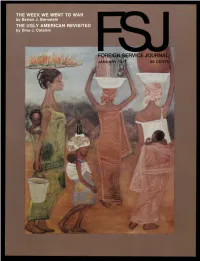
THE WEEK WE WENT TO WAR by Barton J. Bernstein THE UGLY AMERICAN REVISITED by Dino J. Caterini FOREIGN SERVICE JOURNAI JANUARY 197| 60 CENT % p f'1 4 "WM A I y l f H r * ML IlLV Diplomacy comes in all sizes* Ford’s 1977 diplomatic lineup comes in Mail us the coupon below and we’ll send full-car sizes like the Continental, Marquis you complete information on the Ford-built and LTD. Trimmer sizes like the new car of your choice—and how you can get Thunderbird, LTD H, Cougar and it at our special discount. What could be Cougar XR-7. Personal sizes like Mark V, more diplomatic? Granada and Monarch. Compact sizes like *Cannot be driven in the U.S. Comet, Maverick, Mustang n, Bobcat and Pinto. Pick the car that’s sized right for you, then check out the special diplomatic discount savings you can get on any 1977 Ford-built car or light truck. Delivery will be arranged for you, either stateside or overseas. And you can have the car built to Export* or Domestic specifications. Please send me full information on using my diplomatic discount to purchase a new WRITE TO: DIPLOMATIC SALES: FORD MOTOR COMPANY 815 Connecticut Ave. N.W. Washington, D.C. 20006/Tel: (202) 785-6047 NAME ADDRESS CITY STATE 1977 Granada Four-Door Ghia COUNTRY ZIP FORD EXPORT CORPORATION FOREIGN SERVICE JOURNAL American Foreign Service Association JANUARY 1977: Volume 54, No. 1 Officers and Members of the Governing Board PATRICIA WOODRING, President LARS HYDLE, Vice President CHARLOTTE CROMER, Second Vice President USIA: A Counter Proposal FRANK CUMMINS, Secretary GUNTHER K. -
Introduction
Notes Introduction 1. It is important to note that whilst the international context of German foreign policy changed virtually overnight with the end of the Cold War, the content of German foreign policy was resistant to wholesale changes. To this end Eberwein and Kaiser state, ‘To a certain extent, when Germany was unified and attained full sovereignty, its position in international politics changed overnight’, in Eberwein, W.-D. and Kaiser, K. (eds) (2001), p. 3, Germany’s New Foreign Policy: Decision-making in an Interdependent World (Basingstoke: Palgrave). Banchoff contends that, ‘The collapse of the Soviet bloc and reunifi- cation transformed the context of German foreign policy’ in Banchoff, T. (1999), p. 131, The German Problem Transformed: Institutions, Politics and Foreign Policy, 1945–1995 (Ann Arbor: University of Michigan Press). 2. Ladrech, R. (1994), ‘Europeanization of domestic politics and institutions: the case of France’, Journal of Common Market Studies, 32/1: 69–88; Miskimmon, A. and Paterson, W. E. (2003), ‘Foreign and Security Policy: On the Cusp Between Transformation and Accommodation’, in K. Dyson and K. H. Goetz (eds) (2003), German, Europe and the Politics of Constraint (Oxford: Proceedings of the British Academy/Oxford University Press), pp. 325–345; Lüdeke, A. (2002), Europäisierung der deutschen Außen- und Sicherheitspolitik: Konstitutive und opera- tive Europapolitik zwischen Maastricht und Amsterdam (Opladen: Leske ϩ Budrich); Schmalz, U. (2004), Deutschlands europäisierte Aussenpolitik (Wiesbaden: VS Verlag); Smith, M. E. (2000), ‘Conforming to Europe: The Domestic Impact of EU Foreign Policy Co-operation’, Journal of European Public Policy, 7/4: 613–631; Torreblanca, J. I. (2001), ‘Ideas, Preferences and Institutions: Explaining the Europeanization of Spanish Foreign Policy’, Arena Working Papers, WP01/26, University of Oslo. -
Timeline of the Cold War
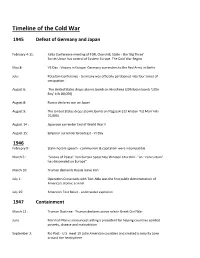
Timeline of the Cold War 1945 Defeat of Germany and Japan February 4-11: Yalta Conference meeting of FDR, Churchill, Stalin - the 'Big Three' Soviet Union has control of Eastern Europe. The Cold War Begins May 8: VE Day - Victory in Europe. Germany surrenders to the Red Army in Berlin July: Potsdam Conference - Germany was officially partitioned into four zones of occupation. August 6: The United States drops atomic bomb on Hiroshima (20 kiloton bomb 'Little Boy' kills 80,000) August 8: Russia declares war on Japan August 9: The United States drops atomic bomb on Nagasaki (22 kiloton 'Fat Man' kills 70,000) August 14 : Japanese surrender End of World War II August 15: Emperor surrender broadcast - VJ Day 1946 February 9: Stalin hostile speech - communism & capitalism were incompatible March 5 : "Sinews of Peace" Iron Curtain Speech by Winston Churchill - "an "iron curtain" has descended on Europe" March 10: Truman demands Russia leave Iran July 1: Operation Crossroads with Test Able was the first public demonstration of America's atomic arsenal July 25: America's Test Baker - underwater explosion 1947 Containment March 12 : Truman Doctrine - Truman declares active role in Greek Civil War June : Marshall Plan is announced setting a precedent for helping countries combat poverty, disease and malnutrition September 2: Rio Pact - U.S. meet 19 Latin American countries and created a security zone around the hemisphere 1948 Containment February 25 : Communist takeover in Czechoslovakia March 2: Truman's Loyalty Program created to catch Cold War -

Presidential Power in the Modern Era
1 Presidential Power in the Modern Era With box cutters and knives, nineteen hijackers took control of four commercial jets on the morning of September 11, 2001, and flew the planes into the towers of the World Trade Center, the Pentagon, and Shanksville, Pennsylvania. The South and North Towers in New York collapsed at 10:05 and 10:28 a.m., respectively. Fires in the Pentagon burned for another seventy-two hours. In all, over three thousand civilians (including several hundred New York City fire fighters and police) died in the attacks. The greatest terrorist act in U.S. history sent politicians scrambling. Not surprisingly, it was the White House that crafted the nation’s response, little of which was formally subject to congressional review. In the weeks that followed, President Bush issued a flurry of uni- lateral directives to combat terrorism. One of the first was an execu- tive order creating a new cabinet position, Secretary of Homeland Se- curity, which was charged with coordinating the efforts of forty-five federal agencies to fight terrorism. Bush then created a Homeland Security Council to advise and assist the president “with all aspects of homeland security.” On September 14, Bush issued an order that au- thorized the Secretaries of the Navy, Army, and Air Force to call up for active duty reservists within their ranks. Later that month, Bush issued a national security directive lifting a ban (which Gerald Ford originally instituted via executive order 11905) on the CIA’s ability to “engage in, or conspire to engage in, political assassination”—in this instance, the target being Osama bin Laden and his lieutenants within al Qaeda, the presumed masterminds behind the September 11 at- tacks. -
Section Summary 16 the WAR’S END and IMPACT SECTION 4
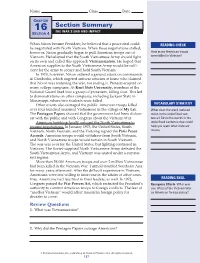
Name Class Date CHAPTER Section Summary 16 THE WAR’S END AND IMPACT SECTION 4 When Nixon became President, he believed that a peace deal could READING CHECK be negotiated with North Vietnam. When these negotiations stalled, however, Nixon gradually began to pull American troops out of How many American troops Vietnam. He believed that the South Vietnamese Army should fight were killed in Vietnam? on its own and called this approach Vietnamization. He hoped that American supplies to the South Vietnamese Army would be suffi- cient for the army to secure and hold South Vietnam. In 1970, however, Nixon ordered a ground attack on communists in Cambodia, which angered antiwar activists at home who claimed that Nixon was widening the war, not ending it. Protests erupted on many college campuses. At Kent State University, members of the National Guard fired into a group of protesters, killing four. This led to demonstrations on other campuses, including Jackson State in Mississippi, where two students were killed. Other events also outraged the public. American troops killed VOCABULARY STRATEGY over four hundred unarmed Vietnamese in the village of My Lai. What does the word induced The Pentagon Papers showed that the government had been dishon- mean in the underlined sen- est with the public and with Congress about the Vietnam War. tence? Circle the words in the American bombing finally induced the North Vietnamese to underlined sentence that could resume negotiations. In January 1973, the United States, South help you learn what induced Vietnam, North Vietnam, and the Vietcong signed the Paris Peace means. -

Killing Hope U.S
Killing Hope U.S. Military and CIA Interventions Since World War II – Part I William Blum Zed Books London Killing Hope was first published outside of North America by Zed Books Ltd, 7 Cynthia Street, London NI 9JF, UK in 2003. Second impression, 2004 Printed by Gopsons Papers Limited, Noida, India w w w.zedbooks .demon .co .uk Published in South Africa by Spearhead, a division of New Africa Books, PO Box 23408, Claremont 7735 This is a wholly revised, extended and updated edition of a book originally published under the title The CIA: A Forgotten History (Zed Books, 1986) Copyright © William Blum 2003 The right of William Blum to be identified as the author of this work has been asserted by him in accordance with the Copyright, Designs and Patents Act 1988. Cover design by Andrew Corbett ISBN 1 84277 368 2 hb ISBN 1 84277 369 0 pb Spearhead ISBN 0 86486 560 0 pb 2 Contents PART I Introduction 6 1. China 1945 to 1960s: Was Mao Tse-tung just paranoid? 20 2. Italy 1947-1948: Free elections, Hollywood style 27 3. Greece 1947 to early 1950s: From cradle of democracy to client state 33 4. The Philippines 1940s and 1950s: America's oldest colony 38 5. Korea 1945-1953: Was it all that it appeared to be? 44 6. Albania 1949-1953: The proper English spy 54 7. Eastern Europe 1948-1956: Operation Splinter Factor 56 8. Germany 1950s: Everything from juvenile delinquency to terrorism 60 9. Iran 1953: Making it safe for the King of Kings 63 10.