The State of Electronic Democracy in Britain
Total Page:16
File Type:pdf, Size:1020Kb
Load more
Recommended publications
-

Anti-Imperial World Politics: Race, Class, and Internationalism in the Making of Post-Colonial Order
P a g e | 1 Anti-imperial World Politics: Race, class, and internationalism in the making of post-colonial order Christopher Patrick Murray London School of Economics and Political Science PhD. International Relations P a g e | 2 I certify that this thesis which I am presenting for examination for the PhD degree in International Relations at the London School of Economics and Political Science is solely my own work. I consider the work submitted to be a complete thesis fit for examination. I authorise that, if a degree is awarded, an electronic copy of my thesis will be deposited in LSE Theses Online (in accordance with the published deposit agreement) held by the British Library of Political and Economic Science and that, except as provided for in regulation 61 it will be made available for public reference. I authorise the School to supply a copy of the abstract of my thesis for inclusion in any published list of theses offered for higher degrees in British universities or in any supplement thereto, or for consultation in any central file of abstracts of such theses. Word count…………………………………….……….. 75, 884 P a g e | 3 ABSTRACT Anti-imperial world politics: Race, class, and internationalism in the making of post-colonial order Christopher Murray, PhD. LSE International Relations Why did many ‘black’ anti-imperial thinkers and leaders articulate projects for colonial freedom based in transnational identities and solidarities? This thesis excavates a discourse of anti-imperial globalism, which helped shape world politics from the early to late 20th century. Although usually reduced to the anticolonial nationalist politics of sovereignty and recognition, this study interprets ‘anti-imperialism globalism from below’ as a transnational counter-discourse, primarily concerned with social justice, social freedom, and equality. -

The Political Organisation of People Who Are Homeless: Reflections of a Sympathetic Sceptic
Part C _ Think Pieces 289 The Political Organisation of People who are Homeless: Reflections of a Sympathetic Sceptic Mike Allen Focus Ireland, Dublin, Republic of Ireland Introduction Any exploration of how poverty and social exclusion might be eradicated, and conversely of how they persist, must come to terms with the question of how people who are themselves poor are to contribute to that eradication. This contribution can be divided into two main themes : the framing of the sorts of solutions that are required and the political momentum that is necessary to put these into action. People coming from a wide range of political and conceptual positions see social movements of the poor (or representative organisations comprising the poor) capable of achieving both these objectives as the ideal manner in which poverty will be eliminated. Organisations that oppose poverty but do not involve participa- tion of the poor at their core are open to the criticism of contributing to deeper impoverishment, not only through proposing the ‘wrong’ solutions, but also by disempowering those who experience poverty. They run the risk of being charac- terised as part of the problem rather than part of the solution. Experience, however, shows that the poor are unlikely to organise around their interests in any persistent manner, and when they do come together in short-term alliances, the goals they seek to achieve are frequently short term and rarely address the underlying causes of their exclusion (Piven and Cloward, 1979). The conditions which we understand to comprise poverty – lack of resources, social isolation and powerlessness – are deprivations of the very requirements of successful organisation and of long-term thinking. -

Creating a Learning Society
Creating a Learning Society KENNETH J. ARROW LECTURE SERIES KENNETH J. ARROW LECTURE SERIES Kenneth J. Arrow’s work has shaped the course of economics for the past sixty years so deeply that, in a sense, every modern economist is his student. His ideas, style of research, and breadth of vision have been a model for generations of the boldest, most creative, and most innovative economists. His work has yielded such seminal theorems as general equilibrium, social choice, and endogenous growth, proving that simple ideas have profound effects. The Kenneth J. Arrow Lecture Series highlights economists, from Nobel laureates to groundbreaking younger scholars, whose work builds on Arrow’s scholarship as well as his innovative spirit. The books in the series are an expansion of the lectures that are held in Arrow’s honor at Columbia University. JOSEPH E. STIGLITZ AND BRUCE C. GREENWALD CREATING A LEARNING SOCIETY A New Approach to Growth, Development, and Social Progress READER’S EDITION Columbia University Press Publishers Since 1893 New York Chichester, West Sussex cup.columbia.edu Copyright © 2015 Columbia University Press All rights reserved Library of Congress Cataloging-in-Publication Data Stiglitz, Joseph E. Creating a learning society : a new approach to growth, development, and social progress / Joseph E. Stiglitz and Bruce C. Greenwald. — A reader’s edition. pages cm. — (Kenneth J. Arrow lecture series) Includes bibliographical references and index. ISBN 978-0-231-17549-4 (pbk. : alk. paper) 1. Social learning. 2. Information society. 3. Progress. I. Greenwald, Bruce C., 1946- II. Title. HQ783.S6942 2015 303.3'2—dc23 2015002293 Columbia University Press books are printed on permanent and durable acid-free paper. -

If It's Broke, Fix It: Restoring Federal Government Ethics and Rule Of
If it’s Broke, Fix it Restoring Federal Government Ethics and Rule of Law Edited by Norman Eisen The editor and authors of this report are deeply grateful to several indi- viduals who were indispensable in its research and production. Colby Galliher is a Project and Research Assistant in the Governance Studies program of the Brookings Institution. Maya Gros and Kate Tandberg both worked as Interns in the Governance Studies program at Brookings. All three of them conducted essential fact-checking and proofreading of the text, standardized the citations, and managed the report’s production by coordinating with the authors and editor. IF IT’S BROKE, FIX IT 1 Table of Contents Editor’s Note: A New Day Dawns ................................................................................. 3 By Norman Eisen Introduction ........................................................................................................ 7 President Trump’s Profiteering .................................................................................. 10 By Virginia Canter Conflicts of Interest ............................................................................................... 12 By Walter Shaub Mandatory Divestitures ...................................................................................... 12 Blind-Managed Accounts .................................................................................... 12 Notification of Divestitures .................................................................................. 13 Discretionary Trusts -

The Future of Internet Governance: Should the United States Relinquish Its Authority Over ICANN?
The Future of Internet Governance: Should the United States Relinquish Its Authority over ICANN? Lennard G. Kruger Specialist in Science and Technology Policy September 1, 2016 Congressional Research Service 7-5700 www.crs.gov R44022 The Future of Internet Governance: Should the U.S. Relinquish Its Authority over ICANN Summary Currently, the U.S. government retains limited authority over the Internet’s domain name system, primarily through the Internet Assigned Numbers Authority (IANA) functions contract between the National Telecommunications and Information Administration (NTIA) and the Internet Corporation for Assigned Names and Numbers (ICANN). By virtue of the IANA functions contract, the NTIA exerts a legacy authority and stewardship over ICANN, and arguably has more influence over ICANN and the domain name system (DNS) than other national governments. Currently the IANA functions contract with NTIA expires on September 30, 2016. However, NTIA has the flexibility to extend the contract for any period through September 2019. On March 14, 2014, NTIA announced the intention to transition its stewardship role and procedural authority over key Internet domain name functions to the global Internet multistakeholder community. To accomplish this transition, NTIA asked ICANN to convene interested global Internet stakeholders to develop a transition proposal. NTIA stated that it would not accept any transition proposal that would replace the NTIA role with a government-led or an intergovernmental organization solution. For two years, Internet stakeholders were engaged in a process to develop a transition proposal that will meet NTIA’s criteria. On March 10, 2016, the ICANN Board formally accepted the multistakeholder community’s transition plan and transmitted that plan to NTIA for approval. -

Research Papers
RESEARCH PAPERS FACTORS AFFECTING PARTICIPATION OF PRESERVICE TEACHERS IN E-DEMOCRACY By SERKAN ŞENDAĞ * SACIP TOKER ** * Associate Professor, Computer Education and Instructional Technology, School of Education, Mersin University, Mersin, Turkey. ** Ph.D holder, Instructional Technology, Department of Administrative and Organizational Studies, College of Education, Wayne State University, Detroit, Michigan, USA. ABSTRACT This study aimed to reveal the factors associated with the participation of preservice teachers in e-democracy. It was designed as a correlational study and 1,519 preservice teachers from a teacher preparation program in Turkey participated in it by completing a 54-item questionnaire. As a result, three major factors for involvement in e-democracy emerged: knowledge and environment, ethics, and anxiety. In addition, two types of participation were revealed: anonymous and onymous. The results of the study showed that anonymous participation correlates positively with Political Knowledge, and negatively with Current State of Politics and Digital Integrity. Those who have mobile technologies with internet connection are more likely to participate anonymously in e-democracy. On the other hand, Onymous participation, correlates positively with Fear of Self-expression, and negatively with Political Knowledge and Digital Citizenship. Males were shown to be more prone to both types of participation than females. Internet usage frequency was a common variable triggering both types of participation. The paper ends with recommendations for further research. Keywords: E-Democracy, E-Participation, Preservice Teachers, Explanatory Higher-Order Factor Analysis, Multiple and Quantile Regression. INTRODUCTION be supported by the Internet, which will alter representation Now-a-days, several factors are urging higher education as well as politicians’ attitudes toward the public (Cardoso, institutions to change, such as internalization, massification, Cunha & Nascimento, 2006). -
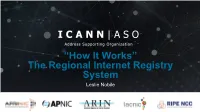
The Regional Internet Registry System Leslie Nobile
“How It Works” The Regional Internet Registry System Leslie Nobile v Overview • The Regional Internet Registry System • Internet Number Resource Primer: IPv4, IPv6 and ASNs • Significant happenings at the RIR • IPv4 Depletion and IPv6 Transition • IPv4 transfer market • Increase in fraudulent activity • RIR Tools, technologies, etc. 2 The Regional Internet Registry System 3 Brief History Internet Number Resource Administration • 1980s to 1990s • Administration of names, numbers, and protocols contracted by US DoD to ISI/Jon Postel (eventually called IANA) • Registration/support of this function contracted to SRI International and then to Network Solutions • Regionalization begins - Regional Internet Registry system Jon Postel forms • IP number resource administration split off from domain name administration • US Govt separates administration of commercial Internet (InterNIC) from the military Internet (DDN NIC) 4 What is an RIR? A Regional Internet Registry (RIR) manages the allocation and registration of Internet number resources in a particular region of the world and maintains a unique registry of all IP numbers issued. *Number resources include IP addresses (IPv4 and IPv6) and autonomous system (AS) numbers 5 Who Are the RIRs? 6 Core Functions of an RIR Manage, distribute -Maintain directory -Support Internet and register Internet services including infrastructure through Number Resources Whois and routing technical coordination (IPv4 & IPv6 registries addresses and Autonomous System -Facilitate community numbers (ASNs) -Provide -

Daniel Kreiss
DANIEL KREISS 110 Rock Spring Court Carrboro, NC 27510 377 Carroll Hall, Chapel Hill NC 27599 (c)415.238.6924 dkreiss@gmail.com Website: http://danielkreiss.com Twitter: @kreissdaniel EDUCATION Ph.D., Communication, 2010 Stanford University Department of Communication Stanford, California M.A., Communication (Journalism), 2004 Stanford University Department of Communication Stanford, California B.A., Political Science, 1999 Bates College Department of Political Science Lewiston, Maine ACADEMIC EXPERIENCE Assistant Professor, 2011 – Present University of North Carolina School of Journalism and Mass Communication Chapel Hill, North Carolina Adjunct Assistant Professor, 2014-Present University of North Carolina Department of Communication Studies Chapel Hill, North Carolina Faculty Affiliate, 2015-Present University of North Carolina UNC Center for Media Law and Policy Chapel Hill, North Carolina Affiliate Fellow,2011-Present Yale University Information Society Project at Yale Law School New Haven, Connecticut Postdoctoral Associate, 2010-2011 Yale University Yale Law School New Haven, Connecticut SCHOLARLY PUBLICATIONS AND PRESENTATIONS Note: Asterisk (*) indicates student at time research was conducted BOOKS Kreiss, D. (Under contract). Networked Ward Politics: Parties, Databases, and Campaigning in the Information Age. New York, NY: Oxford University Press, anticipated publication date August 2016. 31 March 2015 1 Kreiss, D. (2012). Taking Our Country Back: The Crafting of Networked Politics from Howard Dean to Barack Obama. New York, NY: Oxford University Press. Reviewed in The International Journal of Press Politics, LSE Review of Books, Presidential Studies Quarterly REFEREED PUBLICATIONS Kreiss, D. (2015). Structuring Political Engagement: The Formalization of Democratic Internet Campaigning, 2000-2008. In C.W. Lee, M. McQuarrie and E.T. Walker, Democratizing Inequalities: Pitfalls and Unrealized Promises of the New Public Participation. -
IANA Report on Recognition of Afrinic As a Regional Internet Registry
IANA Report Subject: Recognition of AfriNIC as a Regional Internet Registry Date: 6 April 2005 The Internet Assigned Numbers Authority (the IANA), as part of the administrative functions associated with management of the Internet Protocol (IP) address space, is responsible for evaluating applications for approval of new Regional Internet Registries. ICANN has received an application for final approval and recognition of the African Internet Numbers Registry (AfriNIC) as the fifth Regional Internet Registry (RIR). Background The role and responsibilities of ICANN/IANA in this area are defined in the Address Supporting Organization Memorandum of Understanding <http://www.icann.org/aso/aso- mou-29oct04.htm> (ASO MOU), and ICP-2 <http://www.icann.org/icp/icp-2.htm> ("Criteria for Establishment of New Regional Internet Registries"). In September 2004, an application was submitted by the AfriNIC organization for recognition, together with a detailed transition which included draft bylaws, policies, funding model, and staff resumes. On request of the ICANN President, the IANA staff conducted a preliminary evaluation. In September 2004 the President reported to the Board his conclusion that the application and transition plan constituted a reasonable basis for eventual recognition, though he noted that some adjustments would be necessary. Also in September 2004, the existing RIRs, APNIC, ARIN, LACNIC and RIPE NCC, through the Number Resource Organization (NRO), issued a statement expressing their ongoing and continuing support for AfriNIC, and recommending a favorable response to the application by recognizing AfriNIC's accomplishments thus far. Consistent with the IANA©s preliminary evaluation and the recommendations of the existing RIRs, the ICANN Board on 30 September 2004 gave provisional approval <http://www.icann.org/minutes/resolutions-30sep04.htm> to the AfriNIC application, with the expectation that the transition plan would be completed and an amended or revised application for recognition would be submitted. -

Pitchfork Politics Elections
failed to gain traction in national THE AME Pitchfork Politics elections. On the left, the countercultural protest movements of the 1960s and The Populist Threat to 1970s challenged the status quo but didn’t secure institutional representa- R I Liberal Democracy tion until their radicalism had subsided. C As the political scientists Seymour AN DISTEMPER Yascha Mounk Martin Lipset and Stein Rokkan famously observed, during the postwar years, the party structures of North America and ince Roman times, virtually every western Europe were “frozen” to an type of government that holds unprecedented degree. Between 1960 Scompetitive elections has experi- and 1990, the parties represented in the enced some form of populism—some parliaments of Amsterdam, Copenhagen, attempt by ambitious politicians to Ottawa, Paris, Rome, Stockholm, Vienna, mobilize the masses in opposition to an and Washington barely changed. For a establishment they depict as corrupt or few decades, Western political establish- self-serving. From Tiberius Gracchus and ments held such a firm grip on power the populares of the Roman Senate, to the that most observers stopped noticing champions of the popolo in Machiavelli’s just how remarkable that stability was sixteenth-century Florence, to the Jacobins compared to the historical norm. in Paris in the late eighteenth century, Yet beginning in the 1990s, a new to the Jacksonian Democrats who stormed crop of populists began a steady rise. nineteenth-century Washington—all Over the past two decades, populist based their attempts at mass mobilization movements in Europe and the United on appeals to the simplicity and goodness States have uprooted traditional party of ordinary people. -

Comparing Across Regions: Parties and Political Systems in Indonesia and the Pacific Islands1
centre for democratic institutions www.cdi.anu.edu.au CDI Policy Papers on Political Governance Comparing Across Regions: Parties and Political Systems in Indonesia and the Pacific Islands1 Jon Fraenkel & Edward Aspinall Abstract In contrast to Indonesia, politics in the Pacific Islands seems at first sight more parochial, more fluid and less party‐centred. Yet although party systems play a much more robust role at the national level in Indonesia, at the local level, Indonesian politics bears some similarity to those in the Pacific, especially in Melanesia. This paper seeks out patterns of similarity 2013/02 and difference in political competition in Indonesia and the Pacific Islands. We survey five major factors shaping the nature of the party systems in the PPS two regions: 1) broad context (size, geography and economic prosperity); 2) the role of electoral systems and the rules governing parties; 3) ethnic and CDI religious identities; 4) ideological issues or their absence; and 5) how patronage shapes political allegiances. Despite obvious differences, we find some similar patterns of loose and fluid political party allegiances at the local level. How do we begin to compare the political party systems of Indonesia and those of the Pacific Island states? At first glance, the differences appear immense. Indonesia is a single country, with (barring a few exceptions in special regions) a unified set of rules governing political parties, elections and parties. Its party system is relatively robust, with a moderate number of effective parties and considerable continuity between electoral cycles. Some of the major parties have 1 Access this CDI Policy Paper online @www.cdi.anu.edu.au In Comparing Across Regions: Parties and Political Systems in Indonesia and the Pacific Islandsxx 2 organisational histories that stretch back four decades or more, to the early period of authoritarian rule; a few can trace their roots, albeit less directly, back to the early and mid‐twentieth century, to the era of anti‐colonial politics and the early years after independence in 1945. -

A Critical Review of Recent Literature on Populism
Politics and Governance (ISSN: 2183–2463) 2017, Volume 5, Issue 4, Pages 177–186 DOI: 10.17645/pag.v5i4.1146 Review A Critical Review of Recent Literature on Populism John Abromeit Department of History, State University of New York, Buffalo State, Buffalo, NY 14216, USA; E-Mail: abromejd@buffalostate.edu Submitted: 19 August 2017 | Accepted: 18 September 2017 | Published: 29 December 2017 Abstract This is a review article of the following five recent studies on populism: 1) Ruth Wodak’s The Politics of Fear: What Right- Wing Populist Discourses Mean (Sage, 2015); 2) Benjamin Moffitt’s The Global Rise of Populism: Performance, Political Style and Representation (Stanford University Press, 2016); 3) Cas Mudde and Cristóbal Rovira Kaltwasser’s Populism: A Very Short Introduction (Oxford University Press, 2017); 4) Jan-Werner Müller’s What is Populism? (University of Pennsylvania Press, 2016); and 5) John B. Judis’ The Populist Explosion: How the Great Recession Transformed American and European Politics (Columbia Global Reports, 2016). The review argues for a return to early Frankfurt School Critical Theory to address some of the shortcomings of these studies. Keywords authoritarianism; Frankfurt School; left-wing populism; populism; right-wing populism Issue This review is part of the issue “Populism and the Remaking of (Il)Liberal Democracy in Europe”, edited by Lars Rensmann (University of Groningen, The Netherlands), Sarah de Lange (University of Amsterdam, The Netherlands) and Stefan Coupe- rus (University of Groningen, The Netherlands). © 2017 by the author; licensee Cogitatio (Lisbon, Portugal). This article is licensed under a Creative Commons Attribu- tion 4.0 International License (CC BY).