Asian Cinema and Media Culture Editors
Total Page:16
File Type:pdf, Size:1020Kb
Load more
Recommended publications
-

Download Download
Singapore Sidebar: Erotic Cinema By Toh, Hai Leong Fall 2004 Issue of KINEMA SIFF SIDEBAR: EROTIC CINEMA OF LI HAN HSIANG AND CHU YUAN The legendary directors, Li Han Hsiang and Chu Yuan, made chamber period films in the 1970s for the Shaw Studios in Hong Kong, helmed by the famous Shanghainese brothers Run Run and Runme. Those of us who lived through this period would remember it as prolific time of Hong Kong-made erotica. Films such as the 1973 Illicit Desire (Li Han Hsiang), which featured nudity, were routinely advertised in cinema trailers but were never shown intact. Singapore International Film Festival assembled several landmark erotic works from this period and showed them in the city for the first time on film, and uncut. The Chinese Courtesan films, a gentler but more fatalistic vision of producer Runme Shaw, began withChu Yuan’s first pugilistic - erotic masterpiece, Intimate Confessions Of A Chinese Courtesan (1972). It is the story of an older woman, Lady Chun, who loves her younger charge, Ai Nu (played with cold, distant sexual charisma by Lily Ho, one of Shaw’s beauty legends). This was Hong Kong’s first film with lesbianism as its theme. Chu Yuan pulls out all the stops in this film and the melding of the martial arts and erotic film is near perfect. As the madam of a brothel, Lady Chun hates men but kidnaps young girlstoworkas prostitutes for her. When Ai Nu (literally translated as love slave) is introduced to the brothel, Lady Chun is attracted by her defiance, and sees herself in her. -
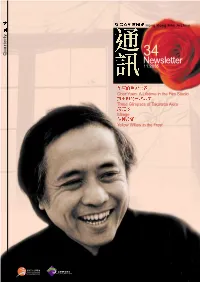
Newsletter 34
Hong Kong Film Archive Quarterly 34 Newsletter 11.2005 Chor Yuen: A Lifetime in the Film Studio Three Glimpses of Takarada Akira Mirage Yellow Willow in the Frost 17 Editorial@ChatRoom English edition of Monographs of HK Film Veterans (3): Chor Yuen is to be released in April 2006. www.filmarchive.gov.hk Hong Kong Film Archive Head Angela Tong Section Heads Venue Mgt Rebecca Lam Takarada Akira danced his way in October. In November, Anna May Wong and Jean Cocteau make their entrance. IT Systems Lawrence Hui And comes January, films ranging from Cheung Wood-yau to Stephen Chow will be revisited in a retrospective on Acquisition Mable Ho Chor Yuen. Conservation Edward Tse Reviewing Chor Yuen’s films in recent months, certain scenes struck me as being uncannily familiar. I realised I Resource Centre Chau Yu-ching must have seen the film as a child though I couldn’t have known then that the director was Chor Yuen. But Research Wong Ain-ling coming to think of it, he did leave his mark on silver screen and TV alike for half a century. Tracing his work brings Editorial Kwok Ching-ling Programming Sam Ho to light how Cantonese and Mandarin cinema evolved into Hong Kong cinema. Today, in the light of the Chinese Winnie Fu film market and the need for Hong Kong cinema to reorient itself, his story about flowers sprouting from the borrowed seeds of Cantonese opera takes on special meaning. Newsletter I saw Anna May Wong for the first time during the test screening. The young artist was heart-rendering. -

CHEUNG Wood-Yau 張活游(1910–1985.12.10)
CHEUNG Wood-yau 張活游(1910–1985.12.10) Actor A native of Meixian, Guangdong, Cheung was born in Guangzhou with the original name Cheung Kin-yu. Cheung made ends meet as a worker and theatre attendant before enrolling in the Cantonese Opera Actors Training School ran by The Chinese Artists Association in Guangzhou. Earning the recognition of Cantonese opera maestro Pak Yuk-tong, he became a principal actor upon graduation and had collaborated with celebrated opera artists such as Sit Kok-sin and Ma Si-tsang. He joined the Hong Kong film industry in 1939 and was immediately cast as the lead in his debut work, Breaking Through the Bronze Net (1939). Cheung later starred in over 20 titles, including Triple Flirtation of the White Chrysanthemum (1939), Grave of the Sisters-in-Law (1939), When Will You Return? (1940) and Love in Another Life (1941); and became a well-known actor before the war. After Hong Kong fell into Japanese occupation, he returned to the Mainland and performed Cantonese operas to earn his keep. He came back to Hong Kong after the war and resumed his screen career. His two-part film series, Crime Doesn’t Pay (1949) broke box-office records and catapulted him to mega-stardom. His prominent works from this period include Black Heaven (1950), A Girl Named Leung Lang-yim (in two parts, 1950), Red and White Peonies (1952), etc. In 1952, Cheung co-founded The Union Film Enterprise Ltd with numerous film workers and took part in features such as Family (1953), Spring (1953), Autumn (1954), Father and Son (1954), Anna (1955), Romance at the Western Chamber (1956), A Beautiful Corpse Comes to Life (1956), Human Relationships (1959) and Long Live Money (1961). -

Download Heroic Grace: the Chinese Martial Arts Film Catalog (PDF)
UCLA Film and Television Archive Hong Kong Economic and Trade Office in San Francisco HEROIC GRACE: THE CHINESE MARTIAL ARTS FILM February 28 - March 16, 2003 Los Angeles Front and inside cover: Lau Kar-fai (Gordon Liu Jiahui) in THE 36TH CHAMBER OF SHAOLIN (SHAOLIN SANSHILIU FANG ) present HEROIC GRACE: THE CHINESE MARTIAL ARTS FILM February 28 - March 16, 2003 Los Angeles Heroic Grace: The Chinese Martial Arts Film catalog (2003) is a publication of the UCLA Film and Television Archive, Los Angeles, USA. Editors: David Chute (Essay Section) Cheng-Sim Lim (Film Notes & Other Sections) Designer: Anne Coates Printed in Los Angeles by Foundation Press ii CONTENTS From the Presenter Tim Kittleson iv From the Presenting Sponsor Annie Tang v From the Chairman John Woo vi Acknowledgments vii Leaping into the Jiang Hu Cheng-Sim Lim 1 A Note on the Romanization of Chinese 3 ESSAYS Introduction David Chute 5 How to Watch a Martial Arts Movie David Bordwell 9 From Page to Screen: A Brief History of Wuxia Fiction Sam Ho 13 The Book, the Goddess and the Hero: Sexual Bérénice Reynaud 18 Aesthetics in the Chinese Martial Arts Film Crouching Tiger, Hidden Dragon—Passing Fad Stephen Teo 23 or Global Phenomenon? Selected Bibliography 27 FILM NOTES 31-49 PROGRAM INFORMATION Screening Schedule 51 Print & Tape Sources 52 UCLA Staff 53 iii FROM THE PRESENTER Heroic Grace: The Chinese Martial Arts Film ranks among the most ambitious programs mounted by the UCLA Film and Television Archive, taking five years to organize by our dedicated and intrepid Public Programming staff. -

Newsletter 63 More English Translation
Hong Kong Film Archive e-Newsletter 63 More English translation Publisher: Hong Kong Film Archive © 2013 Hong Kong Film Archive All rights reserved. No part of the content of this document may be reproduced, distributed or exhibited in any form or by any electronic, mechanical, or other means, now known or hereafter invented, or in any information storage or retrieval system, without permission in writing from the publisher. Research Golden Harvest and the Generational Change in 1970s Hong Kong Cinema Po Fung The 1970s were a period of pivotal transitions in Hong Kong cinema. It was also the era of Golden Harvest, from its birth to becoming the main pillar of the film industry. In changing times, Golden Harvest had the flexibility to move with the times, but on the other hand its success came from it spearheading much of the change. Looking at the changes in the company itself, one can see some of significant movements in Hong Kong cinema back then. A New Crop of Homegrown Directors Founded in 1970, Golden Harvest released its debut production The Invincible Eight in 1971. Before The Big Boss hit the screens on 31 October, 1971, Golden Harvest’s productions and distributions include Lo Wei’s The Invincible Eight; Zatoichi and the One-Armed Swordsman, co-directed by Hsu Tseng-hung and Yasuda Kimiyoshi; Hsu Tseng-hung’s The Last Duel, Yip Wing-cho’s The Blade Spares None; Huang Feng’s The Angry River and The Fast Sword; Lo Wei’s The Comet Strikes; Wong Tin-lam’s The Chase; Hsu Tseng-hung’s The Invincible Sword and Law Chi’s Thunderbolt.1 On genre, these were all martial arts, or wuxia films from the ‘new wuxia era’ trend driven by the Shaw Brothers. -

Destination Hong Kong: Negotiating Locality in Hong Kong Novels 1945-1966 Xianmin Shen University of South Carolina - Columbia
University of South Carolina Scholar Commons Theses and Dissertations 2015 Destination Hong Kong: Negotiating Locality in Hong Kong Novels 1945-1966 Xianmin Shen University of South Carolina - Columbia Follow this and additional works at: https://scholarcommons.sc.edu/etd Part of the Comparative Literature Commons Recommended Citation Shen, X.(2015). Destination Hong Kong: Negotiating Locality in Hong Kong Novels 1945-1966. (Doctoral dissertation). Retrieved from https://scholarcommons.sc.edu/etd/3190 This Open Access Dissertation is brought to you by Scholar Commons. It has been accepted for inclusion in Theses and Dissertations by an authorized administrator of Scholar Commons. For more information, please contact dillarda@mailbox.sc.edu. DESTINATION HONG KONG: NEGOTIATING LOCALITY IN HONG KONG NOVELS 1945-1966 by Xianmin Shen Bachelor of Arts Tsinghua University, 2007 Master of Philosophy of Arts Hong Kong Baptist University, 2010 Submitted in Partial Fulfillment of the Requirements For the Degree of Doctor of Philosophy in Comparative Literature College of Arts and Sciences University of South Carolina 2015 Accepted by: Jie Guo, Major Professor Michael Gibbs Hill, Committee Member Krista Van Fleit Hang, Committee Member Katherine Adams, Committee Member Lacy Ford, Vice Provost and Dean of Graduate Studies © Copyright by Xianmin Shen, 2015 All Rights Reserved. ii ACKNOWLEDGEMENTS Several institutes and individuals have provided financial, physical, and academic supports that contributed to the completion of this dissertation. First the Department of Literatures, Languages, and Cultures at the University of South Carolina have supported this study by providing graduate assistantship. The Carroll T. and Edward B. Cantey, Jr. Bicentennial Fellowship in Liberal Arts and the Ceny Fellowship have also provided financial support for my research in Hong Kong in July 2013. -

Martial Arts Cinema and Hong Kong Modernity
Martial Arts Cinema and Hong Kong Modernity Aesthetics, Representation, Circulation Man-Fung Yip Hong Kong University Press Th e University of Hong Kong Pokfulam Road Hong Kong www.hkupress.org © 2017 Hong Kong University Press ISBN 978-988-8390-71-7 (Hardback) All rights reserved. No portion of this publication may be reproduced or transmitted in any form or by any means, electronic or mechanical, including photocopy, recording, or any infor- mation storage or retrieval system, without prior permission in writing from the publisher. An earlier version of Chapter 2 “In the Realm of the Senses” was published as “In the Realm of the Senses: Sensory Realism, Speed, and Hong Kong Martial Arts Cinema,” Cinema Journal 53 (4): 76–97. Copyright © 2014 by the University of Texas Press. All rights reserved. British Library Cataloguing-in-Publication Data A catalogue record for this book is available from the British Library. 10 9 8 7 6 5 4 3 2 1 Printed and bound by Paramount Printing Co., Ltd. in Hong Kong, China Contents Acknowledgments viii Notes on Transliteration x Introduction: Martial Arts Cinema and Hong Kong Modernity 1 1. Body Semiotics 24 2. In the Realm of the Senses 56 3. Myth and Masculinity 85 4. Th e Diffi culty of Diff erence 115 5. Marginal Cinema, Minor Transnationalism 145 Epilogue 186 Filmography 197 Bibliography 203 Index 215 Introduction Martial Arts Cinema and Hong Kong Modernity Made at a time when confi dence was dwindling in Hong Kong due to a battered economy and in the aft ermath of the SARS epidemic outbreak,1 Kung Fu Hustle (Gongfu, 2004), the highly acclaimed action comedy by Stephen Chow, can be seen as an attempt to revitalize the positive energy and tenacious resolve—what is commonly referred to as the “Hong Kong spirit” (Xianggang jingshen)—that has allegedly pro- pelled the city’s amazing socioeconomic growth. -

香港電影資料館 編者的話 Editorial@Chatroom
香港電影資料館 編者的話 Editorial@ChatRoom 館長 林覺聲 部門主管 行政及場地管理組 孫毅思 資訊系統組 許錦全 搜集組 何美寶 修復組 勞啟明 資源中心 周宇菁 研究組 蒲鋒 編輯組 郭靜寧 節目組 何思穎 傅慧儀 《通訊》 第54期(2010年11月) 2001 年本館舉辦了一次大型的「長鳳新作品大展」,並以國語片公司長城和鳳凰為研究專 編輯 郭靜寧 題出版書籍。今年是從「長鳳新」走到銀都機構的第六十個年頭,資料館今次特別將焦點放在 執行編輯 劉勤銳 助理編輯 單識君 新聯粵語電影,再續上次未及仔細探討的範疇。(見頁 3 至 7 本館節目策劃何思穎先生文章) 那邊廂,資料館響應國泰機構成立七十五周年之喜,十月舉行紀念展,有別於過往的國 香港西灣河鯉景道50號 泰回顧展,專題選映左几導演的粵語片,探索其作品風格。(見頁 8 至 10 舒琪先生文章) 電話:2739 2139 傳真:2311 5229 資料館多年來深得影人支持和幫忙,陳耀成導演早前為「影人口述歷史計劃」訪問江青女 電郵:hkfa@lcsd.gov.hk 士,並應邀撰寫文章(見頁 10 至 14),展現這位集影與舞於一身的藝術家的歷程。 設計:TomSenga Design 2011 年 1 月,香港電影資料館便踏進十周年了!儘管時日可不算長,也是一個「回顧前 印刷:新風印務有限公司 瞻」的良機,忙於籌備相關活動及製作的同時,迎向下一階段。[clkwok@lcsd.gov.hk] © 2010 香港電影資料館 版權所有,翻印必究。 Back in 2001, the HKFA put together a major programme ‘The Progressive Tradition: Films of Great Wall, Feng Huang, Sun Luen’ and brought out a book on the Mandarin- www.filmarchive.gov.hk speaking films by Great Wall and Feng Huang. This year marks the 60th anniversary of Sil-Metropole Organisation Ltd, into which the three studios were regrouped. We Hong Kong Film Archive are shedding light on Sun Luen’s Cantonese pictures to go into the area we had to leave out last time (see essay by Sam Ho, pp 3–7). Head Richie Lam This past October, the HKFA also dedicated a commemorative programme to Cathay Organisation on its 75th birthday. Unlike the other Cathay retrospectives in the Section Heads past, we feature this time a select number of Cantonese films by Tso Kea and look into Admin & Venue Mgt Alex Suen his art (see essay by Shu Kei, pp 8–10). -

Critical and Creative Approaches Ed. Jan Shaw, Philippa Kelly, LE Semler
Published in Storytelling: Critical and Creative Approaches ed. Jan Shaw, Philippa Kelly, L. E. Semler (Basingstoke: Palgrave, 2013), pp. 83-113. Transnational Glamour, National Allure: Community, Change and Cliché in Baz Luhrmann’s Australia. Meaghan Morris What are the links between stories and the wider social world—the contextual conditions for stories to be told and for stories to be received? What brings people to give voice to a story at a particular historical moment? … and as the historical moment shifts, what stories may lose their significance and what stories may gain in tellability? (Plummer 25). The vantage points from which we customarily view the world are, as William James puts it, ‘fringed forever by a more’ that outstrips and outruns them (Jackson 23-24). Poetry from the future interrupts the habitual formation of bodies, and it is an index of a time to come in which what today exists potently—even if not (yet) effectively— but escapes us will find its time. (Keeling, ‘Looking for M—’ 567) 1 The first time I saw Baz Luhrmann’s Australia I laughed till I cried. To be exact, I cried laughing at dinner after watching the film with a group of old friends at an inner suburban cinema in Sydney. During the screening itself I laughed and I cried. As so often in the movies, our laughter was public and my tears were private, left to dry on my face lest the dabbing of a tissue or an audible gulp should give my emotion away. The theatre was packed that night with a raucously critical audience groaning at the dialogue, hooting at moments of high melodrama (especially Jack Thompson’s convulsive death by stampeding cattle) and cracking jokes at travesties of history perceived on screen. -

University of Southampton Research Repository Eprints Soton
University of Southampton Research Repository ePrints Soton Copyright © and Moral Rights for this thesis are retained by the author and/or other copyright owners. A copy can be downloaded for personal non-commercial research or study, without prior permission or charge. This thesis cannot be reproduced or quoted extensively from without first obtaining permission in writing from the copyright holder/s. The content must not be changed in any way or sold commercially in any format or medium without the formal permission of the copyright holders. When referring to this work, full bibliographic details including the author, title, awarding institution and date of the thesis must be given e.g. AUTHOR (year of submission) "Full thesis title", University of Southampton, name of the University School or Department, PhD Thesis, pagination http://eprints.soton.ac.uk UNIVERSITY OF SOUTHAMPTON FACULTY OF HUMANITIES Film Studies Hong Kong Cinema Since 1997: The Response of Filmmakers Following the Political Handover from Britain to the People’s Republic of China by Sherry Xiaorui Xu Thesis for the degree of Doctor of Philosophy December 2012 UNIVERSITY OF SOUTHAMPTON ABSTRACT FACULTY OF HUMANITIES Film Studies Doctor of Philosophy HONG KONG CINEMA SINCE 1997: THE RESPONSE OF FILMMAKERS FOLLOWING THE POLITICAL HANDOVER FROM BRITAIN TO THE PEOPLE’S REPUBLIC OF CHINA by Sherry Xiaorui Xu This thesis was instigated through a consideration of the views held by many film scholars who predicted that the political handover that took place on the July 1 1997, whereby Hong Kong was returned to the sovereignty of the People’s Republic of China (PRC) from British colonial rule, would result in the “end” of Hong Kong cinema. -

A Different Brilliance—The D & B Story
1. Yes, Madam (1985): Michelle Yeoh 2. Love Unto Wastes (1986): (left) Elaine Jin; (right) Tony Leung Chiu-wai 3. An Autumn’s Tale (1987): (left) Chow Yun-fat; (right) Cherie Chung 4. Where’s Officer Tuba? (1986): Sammo Hung 5. Hong Kong 1941 (1984): (from left) Alex Man, Cecilia Yip, Chow Yun-fat 6. It’s a Mad, Mad, Mad World (1987): (front row from left) Loletta Lee, Elsie Chan, Pauline Kwan, Lydia Sum, Bill Tung; (back row) John Chiang 7. The Return of Pom Pom (1984): (left) John Sham; (right) Richard Ng 8. Heart to Hearts (1988): (from left) Dodo Cheng, George Lam, Vivian Chow Pic. 1-8 © 2010 Fortune Star Media Limited All Rights Reserved Contents 4 Foreword Kwok Ching-ling, Wong Ha-pak 〈Chapter I〉 Production • Cinema Circuits 10 D & B’s Development: From Production Company to Theatrical Distribution Po Fung Circuit 19 Retrospective on the Big Three: Dickson Poon and the Rise-and-Fall Story of the Wong Ha-pak D & B Cinema Circuit 29 An Unconventional Filmmaker—John Sham Eric Tsang Siu-wang 36 My Days at D & B Shu Kei In-Depth Portraits 46 John Sham Diversification Strategies of a Resolute Producer 54 Stephen Shin Targeting the Middle-Class Audience Demographic 61 Linda Kuk An Administrative Producer Who Embodies Both Strength and Gentleness 67 Norman Chan A Production Controller Who Changes the Game 73 Terence Chang Bringing Hong Kong Films to the International Stage 78 Otto Leong Cinema Circuit Management: Flexibility Is the Way to Go 〈Chapter II〉 Creative Minds 86 D & B: The Creative Trajectory of a Trailblazer Thomas Shin 92 From -

Diplomarbeit Schwert & Faust
View metadata, citation and similar papers at core.ac.uk brought to you by CORE provided by OTHES DIPLOMARBEIT SCHWERT & FAUST Kultureller Austausch OST-WEST / WEST-OST Am Beispiel physischer Techniken asiatischer Kampf-Kunst-Filme Verfasserin Mag. Art. Hannelore Hanja Dirnbacher angestrebter akademischer Grad Magistra der Philosophie Wien, 2009 Studienkennzahl lt. Studienblatt: A 317 295 Studienrichtung lt. Studienblatt: Theater- Film- und Medienwissenschaft Betreuerin / Betreuer: Prof. Dr. Ulf Birbaumer INHALT Zugang zur Thematik………………..……………………………….……1 1. Kontakte Ost-West Historischer Überblick...……………………….17 1.1. Japonisme………………………………………………………….....18 1.2. Kontakte Ost West in der Theaterkonzeption………………………..22 1.3. Ost-West Kontakte im Film der 1920-er Jahre………………………23 1.4. Fernöstliche Kultur, und Filmschnitt Technik……………………….24 1.5. Japanische Filmkultur und der Westen………………………………25 1.6. Der Japonisme martialer Körperkünste……………………………...26 Filmliste chronologisch…………………………………...................28 2. Beeinflussungen – der Western – die 1950-er und 60-er Jahre…... ..29 2.1. Der Deutsche Western……………………………………………….29 2.2. Der Italo Western – „Spaghetti Western“………………………........30 2.3. „Yojimbo“ ( 1961 ) „Per un pugno die Dollari“ ( 1964 )…………....32 2.3.1. Yojimbo Ken Do……………………………………………......33 2.3.2. Die Thematik…………………………………………………...34 2.4. Western in Italia……………………………………………………...36 2.5. Der neue Rollen Typ…………………………………………………37 2.6. Gesichter im Italo Western…………………………………………...39 2.7. Der zweite Film in Sereie…………………………………………….41 2.7.1. Ein Ken Do Duell……………………………………………….42 2.7.2. Der italienische Folgefilm Sergio Leones……………………....43 2.8. Der Weg des „Spaghetti Western“…………………………………...45 2.8.1. Das Schweigen im Schnee……………………………………...45 2.8.2. Italo Stile………………………………………………………..46 2.9. Il Western „Buffone“………………………………………………...49 2.9.1. Diverse Techniken……………………………………………...50 2.9.2.