Antoine-Jean Gros's Hercules and Diomedes
Total Page:16
File Type:pdf, Size:1020Kb
Load more
Recommended publications
-

Fighting for France's Political Future in the Long Wake of the Commune, 1871-1880
University of Pennsylvania ScholarlyCommons Publicly Accessible Penn Dissertations 2013 Long Live the Revolutions: Fighting for France's Political Future in the Long Wake of the Commune, 1871-1880 Heather Marlene Bennett University of Pennsylvania, heathero@sas.upenn.edu Follow this and additional works at: https://repository.upenn.edu/edissertations Part of the European History Commons Recommended Citation Bennett, Heather Marlene, "Long Live the Revolutions: Fighting for France's Political Future in the Long Wake of the Commune, 1871-1880" (2013). Publicly Accessible Penn Dissertations. 734. https://repository.upenn.edu/edissertations/734 This paper is posted at ScholarlyCommons. https://repository.upenn.edu/edissertations/734 For more information, please contact repository@pobox.upenn.edu. Long Live the Revolutions: Fighting for France's Political Future in the Long Wake of the Commune, 1871-1880 Abstract The traumatic legacies of the Paris Commune and its harsh suppression in 1871 had a significant impact on the identities and voter outreach efforts of each of the chief political blocs of the 1870s. The political and cultural developments of this phenomenal decade, which is frequently mislabeled as calm and stable, established the Republic's longevity and set its character. Yet the Commune's legacies have never been comprehensively examined in a way that synthesizes their political and cultural effects. This dissertation offers a compelling perspective of the 1870s through qualitative and quantitative analyses of the influence of these legacies, using sources as diverse as parliamentary debates, visual media, and scribbled sedition on city walls, to explicate the decade's most important political and cultural moments, their origins, and their impact. -

The London Times Perspective on Napoleon Bonaparte's Invasion
East Tennessee State University Digital Commons @ East Tennessee State University Electronic Theses and Dissertations Student Works 8-2012 “We Have to Record the Downfall of Tyranny”: The London imesT Perspective on Napoleon Bonaparte’s Invasion of Russia Julia Dittrich East Tennessee State University Follow this and additional works at: https://dc.etsu.edu/etd Part of the European History Commons, and the Journalism Studies Commons Recommended Citation Dittrich, Julia, "“We Have to Record the Downfall of Tyranny”: The London Times Perspective on Napoleon Bonaparte’s Invasion of Russia" (2012). Electronic Theses and Dissertations. Paper 1457. https://dc.etsu.edu/etd/1457 This Thesis - Open Access is brought to you for free and open access by the Student Works at Digital Commons @ East Tennessee State University. It has been accepted for inclusion in Electronic Theses and Dissertations by an authorized administrator of Digital Commons @ East Tennessee State University. For more information, please contact digilib@etsu.edu. “We Have to Record the Downfall of Tyranny”: The London Times Perspective on Napoleon Bonaparte’s Invasion of Russia _______________________ A thesis presented to the faculty of the Department of History East Tennessee State University In partial fulfillment of the requirements for the degree Master of Arts in History _______________________ by Julia Dittrich August 2012 _______________________ Dr. Stephen G. Fritz, Chair Dr. Henry J. Antkiewicz Dr. Brian J. Maxson Keywords: Napoleon Bonaparte, The London Times, English Identity ABSTRACT “We Have to Record the Downfall of Tyranny”: The London Times Perspective on Napoleon Bonaparte’s Invasion of Russia by Julia Dittrich “We Have to Record the Downfall of Tyranny”: The London Times Perspective on Napoleon Bonaparte’s Invasion of Russia aims to illustrate how The London Times interpreted and reported on Napoleon’s 1812 invasion of Russia. -

Hwang, Yin (2014) Victory Pictures in a Time of Defeat: Depicting War in the Print and Visual Culture of Late Qing China 1884 ‐ 1901
Hwang, Yin (2014) Victory pictures in a time of defeat: depicting war in the print and visual culture of late Qing China 1884 ‐ 1901. PhD Thesis. SOAS, University of London http://eprints.soas.ac.uk/18449 Copyright © and Moral Rights for this thesis are retained by the author and/or other copyright owners. A copy can be downloaded for personal non‐commercial research or study, without prior permission or charge. This thesis cannot be reproduced or quoted extensively from without first obtaining permission in writing from the copyright holder/s. The content must not be changed in any way or sold commercially in any format or medium without the formal permission of the copyright holders. When referring to this thesis, full bibliographic details including the author, title, awarding institution and date of the thesis must be given e.g. AUTHOR (year of submission) "Full thesis title", name of the School or Department, PhD Thesis, pagination. VICTORY PICTURES IN A TIME OF DEFEAT Depicting War in the Print and Visual Culture of Late Qing China 1884-1901 Yin Hwang Thesis submitted for the degree of Doctor of Philosophy in the History of Art 2014 Department of the History of Art and Archaeology School of Oriental and African Studies, University of London 2 Declaration for PhD thesis I have read and understood regulation 17.9 of the Regulations for students of the School of Oriental and African Studies concerning plagiarism. I undertake that all the material presented for examination is my own work and has not been written for me, in whole or in part, by any other person. -

The Faces of History. the Imagined Portraits of the Merovingian Kings at Versailles (1837-1842)
The faces of history. The imagined portraits of the Merovingian kings at Versailles (1837-1842) Margot Renard, University of Grenoble ‘One would expect people to remember the past and imagine the future. But in fact, when discoursing or writing about history, they imagine it in terms of their own experience, and when trying to gauge the future they cite supposed analogies from the past; till, by a double process of repeti- tion, they imagine the past and remember the future’. (Namier 1942, 70) The historian Christian Amalvi observes that during the first half of the nine- teenth century, most of the time history books presented a ‘succession of dyn- asties (Merovingians, Carolingians, Capetians), an endless row of reigns put end to end (those of the ‘rois fainéants’1 and of the last Carolingians especially), without any hierarchy, as a succession of fanciful portraits of monarchs, almost interchangeable’ (Amalvi 2006, 57). The Merovingian kings’ portraits, exhib- ited in the Museum of French History at the palace of Versailles, could be de- scribed similarly: they represent a succession of kings ‘put end to end’, with imagined ‘fanciful’ appearances, according to Amalvi. However, this vision dis- regards their significance for early nineteenth-century French society. Replac- ing these portraits in the broader context of contemporary history painting, they appear characteristic of a shift in historical apprehension. The French history painting had slowly drifted away from the great tradition established by Jacques-Louis David’s moralistic and heroic vision of ancient history. The 1820s saw a new formation of the historical genre led by Paul De- laroche's sentimental vision and attention to a realistic vision of history, restored to picturesqueness. -
The Petite Commande of 1664: Burlesque in the Gardens of Versailles Thomasf
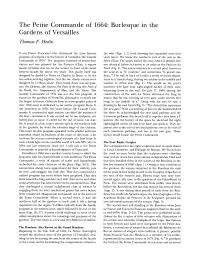
The Petite Commande of 1664: Burlesque in the Gardens of Versailles ThomasF. Hedin It was Pierre Francastel who christened the most famous the west (Figs. 1, 2, both showing the expanded zone four program of sculpture in the history of Versailles: the Grande years later). We know the northern end of the axis as the Commande of 1674.1 The program consisted of twenty-four Allee d'Eau. The upper half of the zone, which is divided into statues and was planned for the Parterre d'Eau, a square two identical halves, is known to us today as the Parterre du puzzle of basins that lay on the terrace in front of the main Nord (Fig. 2). The axis terminates in a round pool, known in western facade for about ten years. The puzzle itself was the sources as "le rondeau" and sometimes "le grand ron- designed by Andre Le N6tre or Charles Le Brun, or by the deau."2 The wall in back of it takes a series of ninety-degree two artists working together, but the two dozen statues were turns as it travels along, leaving two niches in the middle and designed by Le Brun alone. They break down into six quar- another to either side (Fig. 1). The woods on the pool's tets: the Elements, the Seasons, the Parts of the Day, the Parts of southern side have four right-angled niches of their own, the World, the Temperamentsof Man, and the Poems. The balancing those in the wall. On July 17, 1664, during the Grande Commande of 1674 was not the first program of construction of the wall, Le Notre informed the king by statues in the gardens of Versailles, although it certainly was memo that he was erecting an iron gate, some seventy feet the largest and most elaborate from an iconographic point of long, in the middle of it.3 Along with his text he sent a view. -

Fw ^Ifjljtlintii \^Jfflti4rij the METROPOLITAN MUSEUM of ART
4 awfw ^ifjljtLintii \^Jfflti4rij THE METROPOLITAN MUSEUM OF ART Succeeding the majesty of the Sun King's reign, the courts oi Louis XV and XVI turned artistic canons from splendid pomp to the quintessence of grace. Charming refinements ruled manners and tastes throughout the eighteenth cen tury until, with the monarchy, they were overthrown and re placed by the austere classicism of Napoleon's Empire. Eighteenth-century art ists, many of whom de pended upon royal pa tronage, were masters at recording and popu larizing the balls and banquets, the theatrical per formances, the hunts and picnics that were the daily distractions of a pleasure-hungry court. Highly creative and receptive to a wide range of subject matter these artists found inspiration as readily on OF THE EIGHTEENTH CENTURY Mount Olympus as in the shepherd's bower or the rococo drawing room. A shift in interest from the lives of gods and heroes to the pleasures of contemporary life, particularly the delights of the privileged classes, is evident in the estampes galantes, elaborately engraved after designs by Moreau Le Jeune, Baudouin, and Lavreince. They are the most illuminating documents of aristocratic manners, of costume, and of the decoration of houses and palaces. These documents of not acquire original drawings. And reproduc worldly pleasures were complemented by a tions of paintings were produced by skilled pro vigorous academic tradition concerned with fessional engravers to meet the demands of an large-scale historical and mythological paint increasingly avid public. ing, splendidly exemplified in this exhibition Etching, a process more rapid and free by Carle Van Loo's large drawn model for a than engraving and in many ways akin to picture painted for Frederick the Great of drawing, provides some of the most interesting Prussia (no. -

The Baroque Era 1. Title 2. Anthony Van Dyke, Charles I Dismounted, Oil on Canvas, 1635 3. Diego Velázquez, King Philip IV Of
The Baroque Era 1. Title 2. Anthony van Dyke, Charles I Dismounted, oil on canvas, 1635 3. Diego Velázquez, King Philip IV of Spain (Fraga Philip), oil on canvas, 1644 4. Charles leBrun, Apotheosis of Louis XIV, oil on canvas, 1677 5. Hyacinthe Rigaud, Portrait of Louis XIV, oil on canvas, 1701; 6. Aerial view, Palace of Versailles, Louis Le Vau and Jules Hardouin-Mansart, architects; interior design Le Vau and Hardouin-Mansart with Charles LeBrun, masonry, stone, wood, iron and gold leaf; sculpture in bronze and marble; original gardens designed by André LeNôtre, Versailles, France, begun 1669 7. Plan of Versailles and gardens 8. “Le Vau envelop,” courtyard 9. alternate view of above 10. Louis Le Vau, Jules Hardouin-Mansart, and Charles LeBrun, Hall of Mirrors, Chateau de Versailles, ca. 1680 11. Louis Le Vau, Jules Hardouin-Mansart, and Charles LeBrun, Hall of Mirrors, Chateau de Versailles, ca. 1680 (after 2007 restoration) 12. Charles LeBrun, The King Governs by Himself, from the ceiling of the Hall of Mirrors 13. Jules Hardouin-Mansart and Charles Le Brun, Salon de la Guerre, Chateau de Versailles, ca. 1680 14. Jules Hardouin-Mansart and Charles Le Brun, detail of bas relief of Louis XIV on Horseback, Salon de la Guerre, Chateau de Versailles, ca. 1680 15. Jules Hardouin-Mansart and Charles Le Brun, Salon de la Paix, Chateau de Versailles, ca. 1681-1686 16. Charles LeBrun, La Salle des Gardes de la Reine 17. Jules Hardouin-Mansart, Royal Chapel, upper level, Chateau de Versailles, 1698 18. Palace of Versailles, gardens originally designed by André LeNôtre 19. -
Meteorological Aspects of the Battle O
J N e Great Historical Events That Were De p a~ Significantly Affected by the rsrSSSS Weather. Part 11: Meteorological Jerusalem lsrael Aspects of the Battle of Waterloo* Abstract Napoleon's forces. The emperor was forced to sign his abdication (April 1814) and the victorious allies ban- The Waterloo Campaign extended from 15 to 18 June 1815, with ished him into exile on the island of Elba, off the west the decisive Battle of Waterloo taking place on the 18th. The coast of Italy. The French Senate reinstated the Bour- campaign involved the "Army of the North" of Napoleon on the one hand, and the Anglo-Dutch and Prussian armies on the other. The bon dynasty in the person of Louis XVI's brother, latter were commanded, respectively, by the Duke of Wellington and styled as Louis XVIII. However, before long, person- Prince Blucher. A shallow but active low and associated warm and ages loyal to Napoleon sent him messages informing cold fronts crossed the battle area on the 16th and 17th. him of dissatisfaction in the country and suggested his The weather had important effects on the battles. On the 16th, return. On 20 March 1815, the former emperor entered in a battle between part of the French army and part of the Prussian army, at the village of Ligny, about 40 km south-southeast of Paris, where he was received by enthusiastic crowds. Brussels, thunderstorms connected with the passage of the afore- With this began Napoleon's "one hundred days' rule." mentioned warm front made the use of muskets impracticable. -
Waterloo in Myth and Memory: the Battles of Waterloo 1815-1915 Timothy Fitzpatrick
Florida State University Libraries Electronic Theses, Treatises and Dissertations The Graduate School 2013 Waterloo in Myth and Memory: The Battles of Waterloo 1815-1915 Timothy Fitzpatrick Follow this and additional works at the FSU Digital Library. For more information, please contact lib-ir@fsu.edu FLORIDA STATE UNIVERSITY COLLEGE OF ARTS AND SCIENCES WATERLOO IN MYTH AND MEMORY: THE BATTLES OF WATERLOO 1815-1915 By TIMOTHY FITZPATRICK A Dissertation submitted to the Department of History in partial fulfillment of the requirements for the degree of Doctor of Philosophy Degree Awarded: Fall Semester, 2013 Timothy Fitzpatrick defended this dissertation on November 6, 2013. The members of the supervisory committee were: Rafe Blaufarb Professor Directing Dissertation Amiée Boutin University Representative James P. Jones Committee Member Michael Creswell Committee Member Jonathan Grant Committee Member The Graduate School has verified and approved the above-named committee members, and certifies that the dissertation has been approved in accordance with university requirements. ii For my Family iii ACKNOWLEDGMENTS I would like to thank Drs. Rafe Blaufarb, Aimée Boutin, Michael Creswell, Jonathan Grant and James P. Jones for being on my committee. They have been wonderful mentors during my time at Florida State University. I would also like to thank Dr. Donald Howard for bringing me to FSU. Without Dr. Blaufarb’s and Dr. Horward’s help this project would not have been possible. Dr. Ben Wieder supported my research through various scholarships and grants. I would like to thank The Institute on Napoleon and French Revolution professors, students and alumni for our discussions, interaction and support of this project. -

Louis XIV: Art As Persuasion Supporting the Dominance of France in 17Th Century Europe
Lindenwood University Digital Commons@Lindenwood University Student Research Papers Research, Scholarship, and Resources Fall 11-30-2010 Louis XIV: Art as Persuasion Supporting the Dominance of France in 17th Century Europe Matthew Noblett mnoblett@drury.edu Follow this and additional works at: https://digitalcommons.lindenwood.edu/student-research-papers Part of the Arts and Humanities Commons Recommended Citation Noblett, Matthew, "Louis XIV: Art as Persuasion Supporting the Dominance of France in 17th Century Europe" (2010). Student Research Papers. 1. https://digitalcommons.lindenwood.edu/student-research-papers/1 This Research Paper is brought to you for free and open access by the Research, Scholarship, and Resources at Digital Commons@Lindenwood University. It has been accepted for inclusion in Student Research Papers by an authorized administrator of Digital Commons@Lindenwood University. For more information, please contact phuffman@lindenwood.edu. Louis XIV: Art as Persuasion Supporting the Dominance of France in 17th Century Europe Matthew D. Noblett 11/30/10 Dr. James Hutson ART 55400.31 Lindenwood University Noblett 1 In 17th century France there was national funding combined with strict controls placed on the arts and all areas of the administration of Louis XIV. This was imperative to present the country as one of the greatest European powers of its time. It was done by creating personas of Louis as the Sun King, sole administrator of France or “'L'etat c' est moi” (I am the State) and conqueror. All were reinforced and often invented in rigid confines through state funded propaganda. His name has become synonymous with the French arts of the 17th century through significant investments in all forms of media, from poetry, music and theatre to painting, sculpture and architecture. -

December 1904
tlbe VOL XVI. DECEMBER, 1904. No. 6. CHANTILLY CASTLE. 'X every country there are a certain number of resi- dences palaces or castles which are known to all, whose names are bound up with the nation's story, and which are representative, if I may use the term, of the different periods of civilization through which they have come down to us. The picturesque outlines of their towers, balustrades and terraces illus- trate and embellish the pages of history. They tell us of the private life of those who for a short while have occupied the world's stage, showing us what were those persons' ideas of comfort and luxury, their artistic tastes, how they built their habitations and laid out their parks and gardens. Thus these edifices belong to the history of architecture using this word not in its strict meaning of con- struction, but in that of mother and protectress of all the plastic arts. They evoke a vanished past, a past, however, of which we are the outcome. One cannot look without emotion upon such ancient and historical edifices as those at Blois, Fontainebleau, Versailles and Chantilly, not to mention others. Ibis article proposes to deal with Chantilly Castle, in order to show the parts it has successively played in French history during the last four hundred years. Chantilly was never a royal residence. In the sixteenth century it belonged to one of the leading families of France, the Montmorencys, and from the seventeenth to a ;'younger branch of the royal family, viz., the Conde branch. Its 'history is as dramatic as the history of France itself, being, in fact, 'an epitome of the latter. -

Full Press Release
Press Contacts Michelle Perlin 212.590.0311, mperlin@themorgan.org f Patrick Milliman 212.590.0310, pmilliman@themorgan.org MASTER DRAWINGS FROM SEVENTEENTH-CENTURY FRANCE FEATURED IN NEW EXHIBITION AT THE MORGAN Poussin, Claude, and French Drawing in the Classical Age June 16 through October 15, 2017 New York, NY, May, 22, 2017 — The French refer to the seventeenth century as the Grand Siècle, or the Great Century. Under the rule of Louis XIII and Louis XIV, the period saw a dramatic increase in French political and military power, the maturation of French courtly life at Versailles, and an unparalleled flourishing of the arts. Poussin, Claude, and French Drawing in the Classical Age, a new exhibition opening at the Morgan Library & Museum on June 16, explores the work of some of the most celebrated artists of the time. More than fifty drawings largely from the Morgan’s collections—including works by Claude Lorrain, Nicolas Poussin, Jacques Callot, and Charles Le Brun—will be on view. Together they demonstrate the era’s distinctive approach to composition and subject matter, informed by principles of rationalism, respect for the art of classical antiquity, and by a belief in a natural world governed by divine order. The exhibition runs through October 15. Nicolas Poussin (1594–1665), Death of Hippolytus, 1645, pen and brown ink and wash over black chalk. The Morgan Library & Museum; Purchased by Pierpont Morgan in 1909, I, 267. “The Grand Siècle saw artistic development unlike any before it in France,” said Colin B. Bailey, director of the Morgan Library & Museum. “The visual arts, literature, music, drama, and architecture all prospered.