LAWRENCE E. REEVES Lereeves@Ufl.Edu February 2021
Total Page:16
File Type:pdf, Size:1020Kb
Load more
Recommended publications
-

Noctuoidea: Erebidae: Others
Staude et al. / Metamorphosis 27: S165–S188 S165 ____________________________________________________________________________________________________________________________ Noctuoidea: Erebidae: Others Reference/ Lepidoptera Host plant Locality rearing no. Taxon Subfamily Family Taxon Family M1148 Anoba angulilinea Anobinae Erebidae Dalbergia Fabaceae Tshukudu Game melanoxylon Reserve, Hoedspruit M998 Anoba atripuncta Anobinae Erebidae Ormocarpum Fabaceae Tshukudu Game trichocarpum Reserve, Hoedspruit Gv71 Baniana arvorum Anobinae Erebidae Elephantorrhiza Fabaceae Steenkoppies, farm, elephantina Magaliesburg 14HSS52 Baniana arvorum Anobinae Erebidae Elephantorrhiza Fabaceae Steenkoppies, farm, elephantina Magaliesburg 13HSS84 Plecoptera arctinotata Anobinae Erebidae Senegalia caffra Fabaceae Steenkoppies, farm, Magaliesburg M1020a Plecoptera flaviceps Anobinae Erebidae Dalbergia Fabaceae Casketts, farm, melanoxylon Hoedspruit M317 Bareia incidens Calpinae Erebidae Ficus lutea Moraceae Casketts, farm, (unplaced as to Hoedspruit tribe) 14HSS87 Egnasia vicaria Calpinae Erebidae Afrocanthium Rubiaceae Dlinsa Forest, (unplaced as to mundianum Eshowe tribe) 12HSS163 Exophyla multistriata Calpinae Erebidae Celtis africana Cannabaceae Golden Valley, (unplaced as to Magaliesburg tribe) M416 Exophyla multistriata Calpinae Erebidae Trema orientalis Cannabaceae Sekororo, Tzaneen (unplaced as to (Fed on Celtis tribe) africana) M743 Lacera alope Calpinae Erebidae Pterolobium Fabaceae Moholoholo Rehab (unplaced as to stellatum Centre, Hoedspruit tribe) -

MOSQUITOES of the SOUTHEASTERN UNITED STATES
L f ^-l R A R > ^l^ ■'■mx^ • DEC2 2 59SO , A Handbook of tnV MOSQUITOES of the SOUTHEASTERN UNITED STATES W. V. King G. H. Bradley Carroll N. Smith and W. C. MeDuffle Agriculture Handbook No. 173 Agricultural Research Service UNITED STATES DEPARTMENT OF AGRICULTURE \ I PRECAUTIONS WITH INSECTICIDES All insecticides are potentially hazardous to fish or other aqpiatic organisms, wildlife, domestic ani- mals, and man. The dosages needed for mosquito control are generally lower than for most other insect control, but caution should be exercised in their application. Do not apply amounts in excess of the dosage recommended for each specific use. In applying even small amounts of oil-insecticide sprays to water, consider that wind and wave action may shift the film with consequent damage to aquatic life at another location. Heavy applications of insec- ticides to ground areas such as in pretreatment situa- tions, may cause harm to fish and wildlife in streams, ponds, and lakes during runoff due to heavy rains. Avoid contamination of pastures and livestock with insecticides in order to prevent residues in meat and milk. Operators should avoid repeated or prolonged contact of insecticides with the skin. Insecticide con- centrates may be particularly hazardous. Wash off any insecticide spilled on the skin using soap and water. If any is spilled on clothing, change imme- diately. Store insecticides in a safe place out of reach of children or animals. Dispose of empty insecticide containers. Always read and observe instructions and precautions given on the label of the product. UNITED STATES DEPARTMENT OF AGRICULTURE Agriculture Handbook No. -

And Haemagogus Mosquitoes in Southern Brazil (Diptera: Culicidae)*
BITING ACTIVITY OF AEDES SCAPULARIS (RONDANI) AND HAEMAGOGUS MOSQUITOES IN SOUTHERN BRAZIL (DIPTERA: CULICIDAE)* Oswaldo Paulo Forattini** Almério de Castro Gomes** FORATTINI, O. P. & GOMES, A. de C. Biting activity of Aedes scapularis (Rondani) and Haemagogus mosquitoes in Southern Brazil (Diptera: Culicidae). Rev. Saúde públ., S. Paulo, 22:84-93, 1988. ABSTRACT: The biting activity of a population of Aedes scapularis (Rondani), Hae- magogus capricornii Lutz and Hg. leucocelaenus (Dyar and Shannon) in Southern Brazil was studied between March 1980 and April 1983. Data were obtained with 25-hour human bait catches in three areas with patchy residual forests, named "Jacaré-Pepira", "Lupo" Farm, and "Sta. Helena" Farm, in the highland region of S. Paulo State (Brazil). Data obtained on Ae. scapularis were compared with those formerly gathered in the "Ribeira'' Valley lowlands, and were similar, except in the "Lupo" Farm study area, where a pre- crepuscular peak was observed, not recorded at the "Jacaré-Pepira" site or in the "Ribeira" Valley. In all the areas this mosquito showed diurnal and nocturnal activity, but was most active during the evening crepuscular period. These observations support the hypo- thesis about the successful adaptation of Ae. scapularis to man-made environments and have epidemiological implications that arise from it. As for Haemagogus, results obtained on the "Lupo" and "Sta. Helena" regions agree with previous data obtained in several other regions and show its diurnal activity. The proximity of "Lupo" Farm, where Hg. capricornii and Hg. leucocelaenus showed considerable activity, to "Araraquara" city where Aedes aegypti was recently found, raises some epidemiological considerations about the possibility of urban yellow fever resurgence. -

Lepidoptera: Noctuidae: Calpinae)
University of Nebraska - Lincoln DigitalCommons@University of Nebraska - Lincoln Center for Systematic Entomology, Gainesville, Insecta Mundi Florida September 2008 World Checklist of Tribe Calpini (Lepidoptera: Noctuidae: Calpinae) J. M. Zaspel University of Florida, Gainesville, FL M. A. Branham University of Florida, Gainesville, FL Follow this and additional works at: https://digitalcommons.unl.edu/insectamundi Part of the Entomology Commons Zaspel, J. M. and Branham, M. A., "World Checklist of Tribe Calpini (Lepidoptera: Noctuidae: Calpinae)" (2008). Insecta Mundi. 575. https://digitalcommons.unl.edu/insectamundi/575 This Article is brought to you for free and open access by the Center for Systematic Entomology, Gainesville, Florida at DigitalCommons@University of Nebraska - Lincoln. It has been accepted for inclusion in Insecta Mundi by an authorized administrator of DigitalCommons@University of Nebraska - Lincoln. INSECTA MUNDI A Journal of World Insect Systematics 0047 World Checklist of Tribe Calpini (Lepidoptera: Noctuidae: Calpinae) J. M. Zaspel and M. A. Branham Department of Entomology and Nematology University of Florida P.O. Box 110620 Natural Area Drive Gainesville, FL 32611, USA Date of Issue: September 26, 2008 CENTER FOR SYSTEMATIC E NTOMOLOGY, INC., Gainesville, FL J. M. Zaspel and M. A. Branham World Checklist of Tribe Calpini (Lepidoptera: Noctuidae: Calpinae) Insecta Mundi 0047: 1-15 Published in 2008 by Center for Systematic Entomology, Inc. P. O. Box 141874 Gainesville, FL 32614-1874 U. S. A. http://www.centerforsystematicentomology.org/ Insecta Mundi is a journal primarily devoted to insect systematics, but articles can be published on any non-marine arthropod taxon. Manuscripts considered for publication include, but are not limited to, systematic or taxonomic studies, revisions, nomenclatural changes, faunal studies, book reviews, phylo- genetic analyses, biological or behavioral studies, etc. -

Investigations on the Vampire Moth Genus Calyptra Ochsenheimer, Incorporating Taxonomy, Life History, and Bioinformatics (Lepidoptera: Erebidae: Calpinae) Julia L
Purdue University Purdue e-Pubs Open Access Theses Theses and Dissertations 12-2016 Investigations on the vampire moth genus Calyptra Ochsenheimer, incorporating taxonomy, life history, and bioinformatics (Lepidoptera: Erebidae: Calpinae) Julia L. Snyder Purdue University Follow this and additional works at: https://docs.lib.purdue.edu/open_access_theses Part of the Bioinformatics Commons, Biology Commons, and the Entomology Commons Recommended Citation Snyder, Julia L., "Investigations on the vampire moth genus Calyptra Ochsenheimer, incorporating taxonomy, life history, and bioinformatics (Lepidoptera: Erebidae: Calpinae)" (2016). Open Access Theses. 897. https://docs.lib.purdue.edu/open_access_theses/897 This document has been made available through Purdue e-Pubs, a service of the Purdue University Libraries. Please contact epubs@purdue.edu for additional information. Graduate School Form 30 Updated 12/26/2015 PURDUE UNIVERSITY GRADUATE SCHOOL Thesis/Dissertation Acceptance This is to certify that the thesis/dissertation prepared By Julia L Snyder Entitled INVESTIGATION ON THE VAMPIRE MOTH GENUS CALYPTRA OCHSENHEIMER, INCORPORATING TAXONOMY, LIFE HISTORY, AND BIOINFORMATICS (LEPIDOPTERA: EREBIDAE: CALPINAE) For the degree of Master of Science Is approved by the final examining committee: Jennifer M. Zaspel Chair Catherine A. Hill Stephen L. Cameron To the best of my knowledge and as understood by the student in the Thesis/Dissertation Agreement, Publication Delay, and Certification Disclaimer (Graduate School Form 32), this thesis/dissertation adheres to the provisions of Purdue University’s “Policy of Integrity in Research” and the use of copyright material. Jennifer M. Zaspel Approved by Major Professor(s): Stephen L. Cameron 12/01/2016 Approved by: Head of the Departmental Graduate Program Date INVESTIGATIONS ON THE VAMPIRE MOTH GENUS CALYPTRA OCHSENHEIMER, INCORPORATING TAXONOMY, LIFE HISTORY, AND BIOINFORMATICS (LEPIDOPTERA: EREBIDAE: CALPINAE) A Thesis Submitted to the Faculty of Purdue University by Julia L. -

Possible Non-Sylvatic Transmission of Yellow Fever Between Non-Human Primates in São Paulo City, Brazil, 2017–2018
www.nature.com/scientificreports OPEN Possible non‑sylvatic transmission of yellow fever between non‑human primates in São Paulo city, Brazil, 2017–2018 Mariana Sequetin Cunha1*, Rosa Maria Tubaki2, Regiane Maria Tironi de Menezes2, Mariza Pereira3, Giovana Santos Caleiro1,4, Esmenia Coelho3, Leila del Castillo Saad5, Natalia Coelho Couto de Azevedo Fernandes6, Juliana Mariotti Guerra6, Juliana Silva Nogueira1, Juliana Laurito Summa7, Amanda Aparecida Cardoso Coimbra7, Ticiana Zwarg7, Steven S. Witkin4,8, Luís Filipe Mucci3, Maria do Carmo Sampaio Tavares Timenetsky9, Ester Cerdeira Sabino4 & Juliana Telles de Deus3 Yellow Fever (YF) is a severe disease caused by Yellow Fever Virus (YFV), endemic in some parts of Africa and America. In Brazil, YFV is maintained by a sylvatic transmission cycle involving non‑human primates (NHP) and forest canopy‑dwelling mosquitoes, mainly Haemagogus‑spp and Sabethes-spp. Beginning in 2016, Brazil faced one of the largest Yellow Fever (YF) outbreaks in recent decades, mainly in the southeastern region. In São Paulo city, YFV was detected in October 2017 in Aloutta monkeys in an Atlantic Forest area. From 542 NHP, a total of 162 NHP were YFV positive by RT-qPCR and/or immunohistochemistry, being 22 Callithrix-spp. most from urban areas. Entomological collections executed did not detect the presence of strictly sylvatic mosquitoes. Three mosquito pools were positive for YFV, 2 Haemagogus leucocelaenus, and 1 Aedes scapularis. In summary, YFV in the São Paulo urban area was detected mainly in resident marmosets, and synanthropic mosquitoes were likely involved in viral transmission. Yellow Fever virus (YFV) is an arbovirus member of the Flavivirus genus, family Flaviviridae and the causative agent of yellow fever (YF)1. -
A List of Cuban Lepidoptera (Arthropoda: Insecta)
TERMS OF USE This pdf is provided by Magnolia Press for private/research use. Commercial sale or deposition in a public library or website is prohibited. Zootaxa 3384: 1–59 (2012) ISSN 1175-5326 (print edition) www.mapress.com/zootaxa/ Article ZOOTAXA Copyright © 2012 · Magnolia Press ISSN 1175-5334 (online edition) A list of Cuban Lepidoptera (Arthropoda: Insecta) RAYNER NÚÑEZ AGUILA1,3 & ALEJANDRO BARRO CAÑAMERO2 1División de Colecciones Zoológicas y Sistemática, Instituto de Ecología y Sistemática, Carretera de Varona km 3. 5, Capdevila, Boyeros, Ciudad de La Habana, Cuba. CP 11900. Habana 19 2Facultad de Biología, Universidad de La Habana, 25 esq. J, Vedado, Plaza de La Revolución, La Habana, Cuba. 3Corresponding author. E-mail: rayner@ecologia. cu Table of contents Abstract . 1 Introduction . 1 Materials and methods. 2 Results and discussion . 2 List of the Lepidoptera of Cuba . 4 Notes . 48 Acknowledgments . 51 References . 51 Appendix . 56 Abstract A total of 1557 species belonging to 56 families of the order Lepidoptera is listed from Cuba, along with the source of each record. Additional literature references treating Cuban Lepidoptera are also provided. The list is based primarily on literature records, although some collections were examined: the Instituto de Ecología y Sistemática collection, Havana, Cuba; the Museo Felipe Poey collection, University of Havana; the Fernando de Zayas private collection, Havana; and the United States National Museum collection, Smithsonian Institution, Washington DC. One family, Schreckensteinidae, and 113 species constitute new records to the Cuban fauna. The following nomenclatural changes are proposed: Paucivena hoffmanni (Koehler 1939) (Psychidae), new comb., and Gonodontodes chionosticta Hampson 1913 (Erebidae), syn. -
The Vartian Collection Part I. Noctuoidea. Fibigeriana
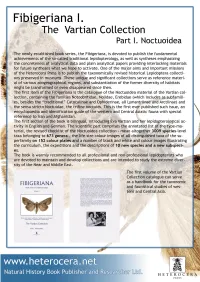
1 2 3 4 5 6 7 8 9 10 11 12 13 Plate 1: 1. Dudusa nobilis; 2. Anticyra combusta; 3—4. Cerura vinula; 5—6. C. iberica; 7-8. C. delavoiei delavoiei; 9—11. C. delavoiei canariensis; 12—13. C. intermedia. 12 3 4 5 67 8 9 10 11 12 13 14 15 16 17 18 19 20 21 22 23 24 25 26 27 28 29 30 31 32 33 Plate 102: 1—2. Dryobotodes carbonis europaea; 3—4. D. tenebrosa; 5. Blepharosis paspa; 6—7. B. grumi; 8—9. Bryopolia chamaeleon; 10—11. B. holosericea; 12—13. B. tsvetaevi; 14—15. B. virescens; 15. Bryoxena constricta; 16—17. B.tribulis; 18—20. B. centralasiae; 21—22. B. boursini; 23—26. Antitype chi; 27—28. A. jonis; 29—30. A. suda suda; 31—32. A. suda astfaelleri. 123 4 5 6 7 8 91011 12 13 14 15 16 17 18 19 20 21 22 23 24 25 26 27 28 29 30 Plate 30: 1—2. Zanclognatha zelleralis; 3. Hydrillodes repugnalis; 4. Plusiodonta coelonota; 5. Oresia emarginata; 6. O. excavata; 7—8. Calyptra thalictri thalictri; 9—10. C. thalictri pallida; 11. C. hokkaida; 12. Eudocima okurai; 13. E. materna; 14—15. E. falonia; 16—17. Hypenodes humidalis; 18—19. H. orientalis; 20. H. turcomanica; 21. Schrankia balneorum; 22. S. costaestrigalis costaestrigalis; 23—24. S. costaestrigalis ssp. from Canary Islands; 25—26. S. taenialis; 27—28. Neachrostia kasyi; 29—30. Parascotia robiginosa. 1234 5 6 7 8 9 10 11 12 13 14 17 16 15 18 19 20 21 22 23 24 25 26 27 28 29 30 31 Plate 58: 1—2. -

Moth Taxa Families.Pdf
Suborder Superfamily Family Subfamily Tribe Zeugloptera Micropterigoidea Micropterigidae [Micropteriginae] [Micropterigini] Dacnonypha Eriocranoidea Eriocraniidae [Eriocraniinae] [Eriocraniini] Acanthopteroctetoidea Acanthopteroctetidae [Acanthopteroctetinae] [Acanthopteroctetini] Exoporia Hepialoidea Hepialidae [Hepialinae] [Hepialini] Monotrysia Nepticuloidea Nepticulidae Nepticulinae Trifurculini Nepticulini Opostegidae Oposteginae [Opostegini] Opostegoidinae [Opostegoidini] Tischerioidea Tischeriidae [Tischeriinae] [Tischeriini] Incurvarioidea Incurvariidae [Incurvariinae] [Incurvariini] Prodoxidae Lamproniinae [Lamproniini] Prodoxinae [Prodoxini] Adelidae Adelinae [Adelini] Heliozelidae [Heliozelinae] [Heliozelini] Ditrysia Tineoidea Tineidae Nemapogoninae [Nemapogonini] Meessiinae [Meessiini] Erechthiinae [Erechthiini] Dryadaulinae [Dryadaulini] Scardiinae [Scardiini] Myrmecozelinae [Myrmecozelini] Tineinae [Tineini] Hapsiferinae [Hapsiferini] Setomorphinae [Setomorphini] Hieroxestinae [Hieroxestini] Acrolophidae [Acrolophinae] [Acrolophini] Psychidae Taleporiinae [Taleporiini] Psychinae [Psychini] Oiketicinae [Oiketicini] Yponomeutoidea Ypsolophidae Ochsenheimeriinae [Ochsenheimeriinae] Lyonetiidae Lyonetiinae [Lyonetiini] Cemiostominae [Cemiostomini] Bedelliidae [Bedelliinae] [Bedelliini] Glyphipterigidae Glyphipteriginae [Glyphipterigini] Acrolepiidae [Acrolepiinae] [Acrolepiini] Yponomeutidae Yponomeutinae [Yponomeutinae] Attevinae [Attevini] Praydinae [Praydini] Argyresthiinae [Argyresthiini] Ypsolophidae Ypsolophinae [Ypsolophini] -

American En Tomoiogica/ Institute
Contributions of the American En tomoIogica/ Institute Volume 13, Number 3, 1976 MOSQUITO STUDIES (Diptera, Culicidae) XXXIII. A REVISION OF THE SCAPULARIS GROUP 0~ AEDES (OCHLEROTATUS) By J. Hal Arnell MOSQUITO STUDIES (Diptera, Culicidae) XxX111. A REVISION OF THE SCAPULARIS GROUP OF AEDES (OCHLEROTATUS)’ BY J. Hal Arnell* CONTENTS INTRODUCTION 2 MATERIAL AND ME+Hobs : : : : : : : : : : : : : : : : : : : 3 SYSTEMATICS ......................... 4 Taxonomic History ....................... 4 Taxonomic Characters, ..................... 4 Proposed Classification ..................... 6 Distribution .......................... 6 Affinities ..... 6 MEDICAL IMPORTAN& : : : : : : : : : : : : : : : : : : : : : 7 TAXONOMIC TREATMENT .................... 9 Scapular-is Group ........................ 9 Keys to Subgroups and Species ................. 15 Incomptus Subgroup ...................... 20 1. Aedes (0.) incomptus ................... 20 Bogotanus Subgroup ...................... 22 2. Aedes (0. ) bogotanus ................... 22 3. Aedes (0.) deficiens ................... 24 Trivittatus Subgroup ...................... 25 4. Aedes (0.) atactavittatus. ................. 26 5. Aedes (0.) meprai .................... 28 6. Aedes (0.) angustivittatus ................. 29 7. Aedes (0.) trivittatus ................... 35 Tortilis Subgroup ....................... 38 8. Aedes (0.) tortilis .................... 39 9. Aedes (0. ) auratus .................... 44 ‘Contribution from project “Mosquitoes of Middle America” supported by U.S. Public Health Service -

County Genus Species Species Author Common
County Genus Species Species Author Common Name Tribe Subfamily Family Superfamily Howard County Agrotis volubilis Harvey, 1874 Voluble Dart Noctuini Noctuinae Noctuidae Noctuoidea Howard County Amphipoea americana (Speyer, 1875) American Ear Moth Phlogophorini Noctuinae Noctuidae Noctuoidea Howard County Amphipyra tragopoginis (Clerck, 1759) Mouse Moth Amphipyrini Amphipyrinae Noctuidae Noctuoidea Howard County Anagrapha falcifera (Kirby, 1837) Celery Looper Moth Plusiini Plusiinae Noctuidae Noctuoidea Howard County Autographa precationis (Guenee, 1852) The Common Looper Moth Plusiini Plusiinae Noctuidae Noctuoidea Howard County Caenurgina erechtea (Cramer, 1780) Forage Looper Moth Euclidiini Erebinae Erebidae Noctuoidea Howard County Callosamia promethea (Drury, 1773) Promethea Moth Attacini Saturniinae Saturniidae Bombycoidea Howard County Calyptra canadensis (Bethune, 1865) Canadian Owlet Moth Calpini Calpinae Erebidae Noctuoidea Howard County Chlorochlamys chloroleucaria (Guenee, 1857) Blackberry Looper Moth Hemitheini Geometrinae Geometridae Geometroidea Howard County Chrysoteuchia topiarius (Zeller, 1866) Cranberry Girdler Moth Crambini Crambinae Crambidae Pyraloidea Howard County Cisseps fulvicollis (Hubner, 1818) Yellow-Collared Scape Moth Arctiini Arctiinae Erebidae Noctuoidea Howard County Ctenucha virginica (Esper, 1794) Virginia Ctenucha Moth Arctiini Arctiinae Erebidae Noctuoidea Howard County Diacme elealis (Walker, 1859) None Spilomelini Pyraustinae Crambidae Pyraloidea Howard County Euchlaena johnsonaria (Fitch, 1869) -

Die Gattung Gonodonta Hübner, 1818 in Panguana, Provinz Huánuco, Peru (Lepidoptera, Noctuoidea, Erebidae, Calpinae, Calpini)1
©Entomologischer Verein Apollo e.V. Frankfurt am Main; download unter www.zobodat.at Nachr. entomol. Ver. Apollo, N. F. 35 (1/2): 47–52 (2014) 47 Die Gattung Gonodonta Hübner, 1818 in Panguana, Provinz Huánuco, Peru (Lepidoptera, Noctuoidea, Erebidae, Calpinae, Calpini)1 Hubert Thöny Hubert Thöny, Reserva Serra Bonita, P.O. Box 1, Cep 45.880000 Camacan, Bahia, Brasilien; hubert_thony@yahoo.de Zusammenfassung: Es werden die bisher nachgewiesenen große Gebiet ist leicht hügelig und auch heute noch in 22 Ar ten der Gattung Gonodonta Hübner, 1818 von der For ei nem sehr naturnahen Zustand. schungs station Panguana aufgelistet und ab ge bildet. Go no- don ta latimacula Guenée, 1852, Gonodonta si nal dus Gue née, Die mittlere Meereshöhe beträgt 230–250 m. Das Gebiet 1852, Gonodonta parens Guenée, 1852, Go no donta holo se ri cea ist sehr wasserreich und besteht aus ver schiedenen Bio Guenée, 1852, Gonodonta fulvidens Fel der & Ro gen ho fer, toptypen. Die mittlere Temperatur beträgt 26°C, bei 1872, Gonodonta chorinea (Stoll, 1782), Gonodonta in dentata ei ner Luft feuch tigkeit im Mittel von 80%. (Hampson, 1926), Gonodonta in curva (Sepp, [1840]) und Gonodonta primulina Druce, 1887 sind Neunac h weise für Als charakteristisch sind die Palmen süm pfe zu bezeic h Peru. nen; diese sind sehr schwer bezie hungs wei se in der Re gen zeit überhaupt nicht zu begehen. Im übrigen ist es The genus Gonodonta Hübner, 1818 in Panguana, ein typischer Regenwald, wie er auch im wesentlichen im Province Huánuco, Peru (Lepidoptera, Noctuoidea, Erebidae, Calpinae, Calpini) ganzen Amazonasbecken vorkommt. Abstract: In this first list, 22 species of the genus Go no- Im Laufe der Jahre wurden mehr als 150 wis sen schaft li don ta Hübner, 1818 are reported and illustrated from the che Publikationen verfaßt, darunter zahlreiche Diplom Pan gua na Re search Complex, Huánuco, Peru.