Entomofauna Ansfelden/Austria; Download Unter
Total Page:16
File Type:pdf, Size:1020Kb
Load more
Recommended publications
-

July 12, 2019
Iran Sanctions Updated July 12, 2019 Congressional Research Service https://crsreports.congress.gov RS20871 SUMMARY RS20871 Iran Sanctions July 12, 2019 Successive Administrations have used sanctions extensively to try to change Iran’s behavior. Sanctions have had a substantial effect on Iran’s economy but little, if any, Kenneth Katzman observable effect on Iran’s conventional defense programs or regional malign activities. Specialist in Middle During 2012-2015, when the global community was relatively united in pressuring Iran, Eastern Affairs Iran’s economy shrank as its crude oil exports fell by more than 50%, and Iran had limited ability to utilize its $120 billion in assets held abroad. The 2015 multilateral nuclear accord (Joint Comprehensive Plan of Action, JCPOA) provided Iran broad relief through the waiving of relevant sanctions, revocation of relevant executive orders (E.O.s), and the lifting of U.N. and EU sanctions. Remaining in place were a general ban on U.S. trade with Iran and U.S. sanctions on Iran’s support for regional governments and armed factions, its human rights abuses, its efforts to acquire missile and advanced conventional weapons capabilities, and the Islamic Revolutionary Guard Corps (IRGC). Under U.N. Security Council Resolution 2231, which enshrined the JCPOA, nonbinding U.N. restrictions on Iran’s development of nuclear-capable ballistic missiles and a binding ban on its importation or exportation of arms remain in place for several years. JCPOA sanctions relief enabled Iran to increase its oil exports to nearly pre-sanctions levels, regain access to foreign exchange reserve funds and reintegrate into the international financial system, achieve about 7% yearly economic growth (2016-17), attract foreign investment, and buy new passenger aircraft. -
Of Turkey Part II: the Genera Haetosmia, Osmia and Protosmia
Atatürk Üniv. Ziraat Fak. Derg., 44 (2): 121-143, 2013 Atatürk Univ., J. of the Agricultural Faculty, 44 (2): 121-143, 2013 ISSN : 1300-9036 Araştırma Makalesi/Research Article Distribution of the tribe Osmiini bees (Hymenoptera: Megachilidae) of Turkey Part II: the genera Haetosmia, Osmia and Protosmia Hikmet ÖZBEK Department of Plant Protection, Faculty of Agriculture, Atatürk Üniversity, Erzurum, Turkey (hozbek1940@yahoo.com.tr) Geliş Tarihi : 23.03.2014 Kabul Tarihi : 17.12.2014 ABSTRACT: In the present study, research materials consisting of approximately 1200 bee samples, which have been collected from almost the entire country since the 1960s, but mainly from the eastern Anatolia region of Turkey, were evaluated, a total of 101 species and subspecies in three genera, Haetosmia (1), Osmia (87) and Protosmia (13) were recognized. Of these, Osmia (Helicosmia) labialis Pérez, 1879 is new for Turkey as well Asian Continenet. For the known species new distribution records were provided and the plant species visited were included. Majority of the Turkish species, about 70%, are associated with Europe, mainly Mediterranean basin. Therefore, many species are in Mediterranean and East-Mediterranean chorotypes. Where as about 30% are associated with Asia, most of them are in the Southwest-Asiatic chorotype, 13 species could be accepted as Anatolian endemics. Two taxa, Osmia (Hoplosmia) bidentata pallens (Tkalcu, 1979) and Protosmia (Protosmia) monstrosa (Pérez, 1895) occur in Asia and North Africa. Key words: Hymenoptera: Megachilidae, Osmiini, Haetosmia, Osmia, Protosmia, fauna, new record, chorotype, Turkey. Türkiye’de Osmiini tribüsüne giren arı türleri (Hymenoptera: Megachilidae) Bölüm II: Haetosmia, Osmia and Protosmia cinsleri Özet: Bu çalışmada; Türkiye’nin hemen her yöresinden, özellikle de Doğu Anadolu Bölgesi’nden 1960’lı yıllardan buyana toplanan 1200 civarındaki arı örneği değerlendirilmiş ve Haetosmia (1), Osmia (87 ) ve Protosmia (13) cinslerine ait 101 tür ve alttürün bulunduğu belirlenmiştir. -

Hymenovaria 15 Een Boekbespreking Te Maken Van Environmental Context
nummer 15 november 2017 Nieuwsbrief Sectie Hymenoptera Nederlandse Entomologische Vereniging In dit nummer onder meer: Meewerken aan de bijenatlas voor België Veldobservaties Bijen en wespen in het natte natuurgebied De Bruuk Ephialtes manifestator gekweekt uit nest van Ancistrocerus trifasciatus De Mexicaanse zwartsteel nestelt in mijn tuin Op zoek naar Leucospis dorsigera nr. 15, november 2017 ISSN 1387-1773 Foto voorpagina: Vespa velutina nigrithorax , werkster. Foto: Albert de Wilde. Nieuwsbrief sectie Hymenoptera van de Nederlandse Entomologische Vereniging Vormgeving: Jan Smit. Redactie J. D’Haeseleer, T. Peeters, J. Smit, E. van der Spek Redactieadres Voermanstraat 14, 6921 NP Duiven e-mail: smit.jan@hetnet.nl Website www.hymenovaria.nl Redactioneel Een redelijk gevuld en gevarieerd nummer. Bij ‘Literatuur’ de HymenoBiblio over 2016, twee Allereerst de aankondiging van de voorjaarsexcursie in boekbesprekingen door Theo Peeters en een 2018 naar de Peel in Brabant. Een verslag van de boekbespreking door Jan Smit. voorjaarsexcursie naar ’t Roegwold in Groningen, Bij ‘Oproepen’ de vraag om de bijdrage voor komend afgelopen voorjaar. Erik van der Spek doet verslag van jaar (2018) over te maken, gegevens op te sturen voor het Aculea-weekend, afgelopen zomer in België. Kort de rubriek ‘Leuke waarnemingen’ in HymenoVaria 16, verslag van de cursusdag ‘Bijen’, georganiseerd door de vraag om gegevens aan de deelnemers van de de NEV. En we hebben een viertal opmerkelijke excursie naar de Chaamse bossen, plus nog een ‘Veldobservaties’. oproep om medewerking aan De Wilde Bijenlinie. Bij ‘Artikelen’ vertelt Stijn Schreven over het Verder de aankondiging van de studiedag onderzoek in het natuurgebied De Bruuk, René ‘Goudwespen van de Chrysis ignita -groep’ op 13 januari Veenendaal kweekte een sluipwesp uit het nest van 2018, in Amsterdam. -

Redalyc.EVALUATION of NEW TOWNS CONSTRUCTION in THE
Journal of Urban and Environmental Engineering E-ISSN: 1982-3932 celso@ct.ufpb.br Universidade Federal da Paraíba Brasil Zali, Nader; Azadeh, Seyed reza; Ershadi Salman, Taravat EVALUATION OF NEW TOWNS CONSTRUCTION IN THE AROUND OF TEHRAN MEGACITIY Journal of Urban and Environmental Engineering, vol. 7, núm. 1, -, 2013, pp. 15-23 Universidade Federal da Paraíba Paraíba, Brasil Available in: http://www.redalyc.org/articulo.oa?id=283227995003 How to cite Complete issue Scientific Information System More information about this article Network of Scientific Journals from Latin America, the Caribbean, Spain and Portugal Journal's homepage in redalyc.org Non-profit academic project, developed under the open access initiative Zali, Azadeh and Salmani 15 Journal of Urban and Environmental Journal of urban and E Engineering, v.7, n.1, p.15-23 Environmental Engineering J E ISSN 1982-3932 U doi: 10.4090/juee.2013.v7n1.015023 WWW.JOURNAL-UEE.ORG EVALUATION OF NEW TOWNS CONSTRUCTION IN THE AROUND OF TEHRAN MEGACITIY Nader Zali1 , Seyed reza Azadeh2, Taravat Ershadi Salmani3 1Assistant professor, Department of Urban Planning, University of Guilan, Iran 2 M.A Student, Department of Regional Planning, University of Guilan, Iran 3 M.A Student, Department of Regional Planning, University of Guilan, Iran Received 09 May2012; received in revised form 1 June 2012; accepted 20 January 2013 Abstract: Rapid pace of urbanization which has affected third world countries is a by-product of the post-1945 period. In most developing countries like Iran, spatial population distribution is not balanced, leading to the deficiencies in services, hygiene, formation of slums, and etc. -
Flower Preferences and Pollen Transport Networks for Cavity‐Nesting Solitary Bees: Implications for the Design of Agri‐Envir
Received: 14 February 2018 | Revised: 22 April 2018 | Accepted: 23 April 2018 DOI: 10.1002/ece3.4234 ORIGINAL RESEARCH Flower preferences and pollen transport networks for cavity- nesting solitary bees: Implications for the design of agri- environment schemes Catherine E. A. Gresty1 | Elizabeth Clare2 | Dion S. Devey3 | Robyn S. Cowan3 | Laszlo Csiba3 | Panagiota Malakasi3 | Owen T. Lewis1 | Katherine J. Willis1,3 1Department of Zoology, University of Oxford, Oxford, UK Abstract 2School of Biological and Chemical Floral foraging resources are valuable for pollinator conservation on farmland, and Sciences, Queen Mary University of London, their provision is encouraged by agri- environment schemes in many countries. Across London, UK Europe, wildflower seed mixtures are widely sown on farmland to encourage pollina- 3Royal Botanic Gardens, Kew, Richmond, UK tors, but the extent to which key pollinator groups such as solitary bees exploit and Correspondence benefit from these resources is unclear. We used high- throughput sequencing of 164 Catherine E. A. Gresty, Department of Zoology, New Radcliffe House, Radcliffe pollen samples extracted from the brood cells of six common cavity- nesting solitary Observatory Quarter, 6GG, Woodstock Rd, bee species (Osmia bicornis, Osmia caerulescens, Megachile versicolor, Megachile Oxford OX2, UK. Email: Catherine.e.a.gresty@gmail.com ligniseca, Megachile centuncularis and Hylaeus confusus) which are widely distributed across the UK and Europe. We documented their pollen use across 19 farms in south- ern England, UK, revealing their forage plants and examining the structure of their pollen transport networks. Of the 32 plant species included currently in sown wild- flower mixes, 15 were recorded as present within close foraging range of the bees on the study farms, but only Ranunculus acris L. -

Differential Evolutionary History in Visual and Olfactory Floral Cues of the Bee-Pollinated Genus Campanula (Campanulaceae)
plants Article Differential Evolutionary History in Visual and Olfactory Floral Cues of the Bee-Pollinated Genus Campanula (Campanulaceae) Paulo Milet-Pinheiro 1,*,† , Pablo Sandro Carvalho Santos 1, Samuel Prieto-Benítez 2,3, Manfred Ayasse 1 and Stefan Dötterl 4 1 Institute of Evolutionary Ecology and Conservation Genomics, University of Ulm, Albert-Einstein Allee, 89081 Ulm, Germany; pablo.santos@uni-ulm.de (P.S.C.S.); manfred.ayasse@uni-ulm.de (M.A.) 2 Departamento de Biología y Geología, Física y Química Inorgánica, Universidad Rey Juan Carlos-ESCET, C/Tulipán, s/n, Móstoles, 28933 Madrid, Spain; samuel.prieto@urjc.es 3 Ecotoxicology of Air Pollution Group, Environmental Department, CIEMAT, Avda. Complutense, 40, 28040 Madrid, Spain 4 Department of Biosciences, Paris-Lodron-University of Salzburg, Hellbrunnerstrasse 34, 5020 Salzburg, Austria; stefan.doetterl@sbg.ac.at * Correspondence: paulo.milet@upe.br † Present address: Universidade de Pernambuco, Campus Petrolina, Rodovia BR 203, KM 2, s/n, Petrolina 56328-900, Brazil. Abstract: Visual and olfactory floral signals play key roles in plant-pollinator interactions. In recent decades, studies investigating the evolution of either of these signals have increased considerably. However, there are large gaps in our understanding of whether or not these two cue modalities evolve in a concerted manner. Here, we characterized the visual (i.e., color) and olfactory (scent) floral cues in bee-pollinated Campanula species by spectrophotometric and chemical methods, respectively, with Citation: Milet-Pinheiro, P.; Santos, the aim of tracing their evolutionary paths. We found a species-specific pattern in color reflectance P.S.C.; Prieto-Benítez, S.; Ayasse, M.; and scent chemistry. -

Chelostoma (Prochelostoma) Philadelphi with Additional Notes on Nesting Biology (Hymenoptera: Megachilidae: Megachilinae: Osmiini)
AMERICAN MUSEUM NOVITATES Number 3844, 7 pp. December 7, 2015 Descriptions of the Egg and Mature Larva of the Bee Chelostoma (Prochelostoma) philadelphi with Additional Notes on Nesting Biology (Hymenoptera: Megachilidae: Megachilinae: Osmiini) JEROME G. ROZEN, JR.,1 AND HADEL H. GO1 ABSTRACT The egg of Chelostoma (Prochelostoma) philadelphi (Robertson) and its last larval instar, which had been preserved while defecating, are described and illustrated. The egg was collected from nests constructed in frass-filled burrows of the beetle Xylobiops basilaris (Say) in a dead branch of Ficus carica L. Nests consisting of a short linear arrangement of cells are described as is the provisioning behavior of the bee. Although distinguishable, the last stage larva is simi- lar to that of another species belonging to a different subgenus of Chelostoma. The two larvae will be compared in a subsequent publication. INTRODUCTION The following describes the mature larva and egg of Chelostoma (Prochelostoma) philadel- phi (Robertson), a small, slender bee that nests in the narrow confines of vacated beetle galler- ies in dead trees. Krombein (1967) reported on its nest and nesting biology and briefly described the egg. Parker (1988) presented information on the biology of several other species of Chelos- toma and cites the works of others who contributed to our present understanding of the genus. We also add here additional biological observations. The egg was recovered by H.H.G. from the nest site, and the larva was collected by Krombein in 1959. 1 Division of Invertebrate Zoology, American Museum of Natural History. Copyright © American Museum of Natural History 2015 ISSN 0003-0082 2 AMERICAN MUSEUM NOVITATES NO. -
Competition Between Honeybees and Wild Danish Bees in an Urban Area
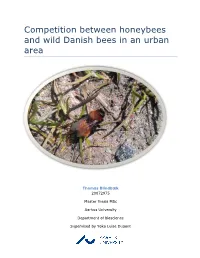
Competition between honeybees and wild Danish bees in an urban area Thomas Blindbæk 20072975 Master thesis MSc Aarhus University Department of bioscience Supervised by Yoko Luise Dupont 60 ECTS Master thesis English title: Competition between honeybees and wild Danish bees in an urban area Danish title: Konkurrence mellem honningbier og vilde danske bier i et bymiljø Author: Thomas Blindbæk Project supervisor: Yoko Luise Dupont, institute for bioscience, Silkeborg department Date: 16/06/17 Front page: Andrena fulva, photo by Thomas Blindbæk 2 Table of Contents Abstract ........................................................................................................ 5 Resumé ........................................................................................................ 6 Introduction .................................................................................................. 7 Honeybees .............................................................................................. 7 Pollen specialization and nesting preferences of wild bees .............................. 7 Competition ............................................................................................. 8 The urban environment ........................................................................... 10 Study aims ............................................................................................ 11 Methods ...................................................................................................... 12 Pan traps .............................................................................................. -
Decades of Native Bee Biodiversity Surveys at Pinnacles National Park Highlight the Importance of Monitoring Natural Areas Over Time
Utah State University DigitalCommons@USU All PIRU Publications Pollinating Insects Research Unit 1-17-2019 Decades of Native Bee Biodiversity Surveys at Pinnacles National Park Highlight the Importance of Monitoring Natural Areas Over Time Joan M. Meiners University of Florida Terry L. Griswold Utah State University Olivia Messinger Carril Independent Researcher Follow this and additional works at: https://digitalcommons.usu.edu/piru_pubs Part of the Life Sciences Commons Recommended Citation Meiners JM, Griswold TL, Carril OM (2019) Decades of native bee biodiversity surveys at Pinnacles National Park highlight the importance of monitoring natural areas over time. PLoS ONE 14(1): e0207566. https://doi.org/10.1371/journal. pone.0207566 This Article is brought to you for free and open access by the Pollinating Insects Research Unit at DigitalCommons@USU. It has been accepted for inclusion in All PIRU Publications by an authorized administrator of DigitalCommons@USU. For more information, please contact digitalcommons@usu.edu. RESEARCH ARTICLE Decades of native bee biodiversity surveys at Pinnacles National Park highlight the importance of monitoring natural areas over time 1 2 3 Joan M. MeinersID *, Terry L. Griswold , Olivia Messinger Carril 1 School of Natural Resources and Environment, University of Florida, Gainesville, Florida, United States of a1111111111 America, 2 USDA-ARS Pollinating Insects Research Unit (PIRU), Utah State University, Logan, Utah, United States of America, 3 Independent Researcher, Santa Fe, New Mexico, United States of America a1111111111 a1111111111 * joan.meiners@gmail.com a1111111111 a1111111111 Abstract Thousands of species of bees are in global decline, yet research addressing the ecology OPEN ACCESS and status of these wild pollinators lags far behind work being done to address similar impacts on the managed honey bee. -

Hymenoptera: Vespoidea) Filippo Ceccolini 1, Fabio Cianferoni 1,2,*
Fragmenta entomologica, 50 (2): 111-115 (2018) eISSN: 2284-4880 (online version) pISSN: 0429-288X (print version) Research article Submitted: September 2nd, 2018 - Accepted: November 29th, 2018 - Published: December 31st, 2018 Review of the distribution of Sapygidae in Italy and new records (Hymenoptera: Vespoidea) Filippo CECCOLINI 1, Fabio CIANFERONI 1,2,* 1 Natural History Museum of the University of Florence, Zoological Section “La Specola” - Via Romana 17, I-50125 Florence, Italy ceccolinif@virgilio.it; fabio.cianferoni@unifi.it 2 Research Institute on Terrestrial Ecosystems, CNR - National Research Council of Italy - Via Salaria km 29,300, I-00015 Monteroton- do (Rome), Italy * Corresponding author Abstract The distribution of the Italian species of Sapygidae is reviewed and new occurrence records for some species are given. Monosapyga clavicornis (Linnaeus, 1758) is recorded for the first time in Lazio and Abruzzo, Polochrum repandum Spinola, 1806 in Abruzzo, and Sapygina decemguttata (Jurine, 1807) in Veneto. Due to insufficient sampling efforts in Italy, all the Italian species of Sapygidae should be currently considered as Data Deficient (DD) according to the IUCN Red List Categories and Criteria. Key words: Sapygidae, Italy, faunistics, new records, IUCN categories of risk. Introduction The nomenclature adopted follows Generani et al. (2005). Existing synonymies used in the references quot- The family Sapygidae is a small group of either ectopara- ing Italian records are reported under the accepted name. sitoids or cleptoparasites (mainly of Apoidea) wasps, in- Abbreviations used in material examined: cluding about 70 species in the world (van Achterberg MZUF Natural History Museum of the University of 2014; Fernández & Sarmiento 2015) and 33 in the Palae- Florence, Italy. -

Bees and Wasps of the East Sussex South Downs
A SURVEY OF THE BEES AND WASPS OF FIFTEEN CHALK GRASSLAND AND CHALK HEATH SITES WITHIN THE EAST SUSSEX SOUTH DOWNS Steven Falk, 2011 A SURVEY OF THE BEES AND WASPS OF FIFTEEN CHALK GRASSLAND AND CHALK HEATH SITES WITHIN THE EAST SUSSEX SOUTH DOWNS Steven Falk, 2011 Abstract For six years between 2003 and 2008, over 100 site visits were made to fifteen chalk grassland and chalk heath sites within the South Downs of Vice-county 14 (East Sussex). This produced a list of 227 bee and wasp species and revealed the comparative frequency of different species, the comparative richness of different sites and provided a basic insight into how many of the species interact with the South Downs at a site and landscape level. The study revealed that, in addition to the character of the semi-natural grasslands present, the bee and wasp fauna is also influenced by the more intensively-managed agricultural landscapes of the Downs, with many species taking advantage of blossoming hedge shrubs, flowery fallow fields, flowery arable field margins, flowering crops such as Rape, plus plants such as buttercups, thistles and dandelions within relatively improved pasture. Some very rare species were encountered, notably the bee Halictus eurygnathus Blüthgen which had not been seen in Britain since 1946. This was eventually recorded at seven sites and was associated with an abundance of Greater Knapweed. The very rare bees Anthophora retusa (Linnaeus) and Andrena niveata Friese were also observed foraging on several dates during their flight periods, providing a better insight into their ecology and conservation requirements. -

Oil Plant Pollination Systems
BIONOMY AND HOST PLANT FINDING IN OIL COLLECTING BEES Dissertation zur Erlangung des Doktorgrades Dr. rer. nat. an der Fakultät Biologie/Chemie/Geowissenschaften der Universität Bayreuth vorgelegt von Irmgard Schäffler Bayreuth, 2012 Die vorliegende Arbeit wurde von August 2008 bis Januar 2012 am Lehrstuhl Pflanzensystematik der Universität Bayreuth unter Betreuung von Herrn PD Dr. Stefan Dötterl angefertigt. Sie wurde von der Deutschen Forschungsgemeinschaft gefördert (DO 1250/3-1). Dissertation eingereicht am: 8. Februar 2012 Zulassung durch die Prüfungskommission: 16. Februar 2012 Wissenschaftliches Kolloquium: 16. Mai 2012 Amtierende Dekanin: Prof. Dr. Beate Lohnert Prüfungsausschuss: PD Dr. Stefan Dötterl (Erstgutachter) PD Dr. Gregor Aas (Zweitgutachter) PD Dr. Ulrich Meve (Vorsitz) Prof. Dr. Konrad Dettner Prof. Dr. Karlheinz Seifert Prof. Dr. Klaus H. Hoffmann This dissertation is submitted as a ‘Cumulative Thesis’ that includes four publications: two published articles, one submitted article, and one article in preparation for submission. List of Publications 1) Schäffler I., Dötterl S. 2011. A day in the life of an oil bee: phenology, nesting, and foraging behavior. Apidologie, 42: 409-424. 2) Dötterl S., Milchreit K., Schäffler I. 2011. Behavioural plasticity and sex differences in host finding of a specialized bee species. Journal of Comparative Physiology A: Neuroethology, Sensory, Neural, and Behavioral Physiology, 197: 1119-1126. 3) Schäffler I., Balao F., Dötterl S. Floral and vegetative cues in oil-secreting and non-oil secreting Lysimachia species. Annals of Botany, doi: 10.1093/aob/mcs101. In preparation for submission to Proceedings of the National Academy of Sciences: 4) Schäffler I., Steiner K. E., Haid M., Gerlach G., Johnson S.