Megachurches and Social Engagement
Total Page:16
File Type:pdf, Size:1020Kb
Load more
Recommended publications
-

The Charismatic Movement and Lutheran Theology [1972]
THE CHARISMATIC MOVEMENT AND LUTHERAN THEOLOGY Pre/ace One of the significant developments in American church life during the past decade has been the rapid spread of the neo-Pentecostal or charis matic movement within the mainline churches. In the early sixties, experi ences and practices usually associated only with Pentecostal denominations began co appear with increasing frequency also in such churches as the Roman Catholic, Episcopalian, and Lutheran. By the mid-nineteen-sixties, it was apparent that this movement had also spread co some pascors and congregations of The Lutheran Church - Missouri Synod. In cerrain areas of the Synod, tensions and even divisions had arisen over such neo-Pente costal practices as speaking in tongues, miraculous healings, prophecy, and the claimed possession of a special "baptism in the Holy Spirit." At the request of the president of the Synod, the Commission on Theology and Church Relations in 1968 began a study of the charismatic movement with special reference co the baptism in the Holy Spirit. The 1969 synodical convention specifically directed the commission co "make a comprehensive study of the charismatic movement with special emphasis on its exegetical aspects and theological implications." Ie was further suggested that "the Commission on Theology and Church Relations be encouraged co involve in its study brethren who claim to have received the baptism of the Spirit and related gifts." (Resolution 2-23, 1969 Pro ceedings. p. 90) Since that time, the commission has sought in every practical way co acquaint itself with the theology of the charismatic movement. The com mission has proceeded on the supposition that Lutherans involved in the charismatic movement do not share all the views of neo-Pentecostalism in general. -
Amos Yong Complete Curriculum Vitae
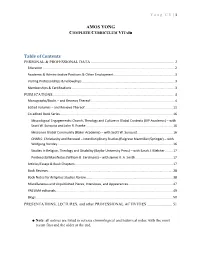
Y o n g C V | 1 AMOS YONG COMPLETE CURRICULUM VITAE Table of Contents PERSONAL & PROFESSIONAL DATA ..................................................................................... 2 Education ................................................................................................................................................... 2 Academic & Administrative Positions & Other Employment .................................................................... 3 Visiting Professorships & Fellowships ....................................................................................................... 3 Memberships & Certifications ................................................................................................................... 3 PUBLICATIONS ............................................................................................................................ 4 Monographs/Books – and Reviews Thereof.............................................................................................. 4 Edited Volumes – and Reviews Thereof .................................................................................................. 11 Co-edited Book Series .............................................................................................................................. 16 Missiological Engagements: Church, Theology and Culture in Global Contexts (IVP Academic) – with Scott W. Sunquist and John R. Franke ................................................................................................ -

Theological Reflections on the Charismatic Movement – Part 1 Churchman 94/1 1980
Theological Reflections on the Charismatic Movement – Part 1 Churchman 94/1 1980 J. I. Packer I My subject is a complex and still developing phenomenon which over the past twenty years has significantly touched the entire world church, Roman Catholic, Orthodox, Anglican and non-episcopal Protestant, at all levels of life and personnel and across a wide theological spectrum.1 Sometimes it is called Neo-Pentecostalism because, like the older Pentecostalism which ‘spread like wildfire over the whole world’2 at the start of this century, it affirms Spirit-baptism as a distinct post-conversion, post-water-baptism experience, universally needed and universally available to those who seek it. The movement has grown, however, independently of the Pentecostal denominations, whose suspicions of its non-separatist inclusiveness have been—and in some quarters remain—deep, and its own preferred name for itself today is ‘charismatic renewal’.3 For it sees itself as a revitalizing re-entry into a long-lost world of gifts and ministries of the Holy Spirit, a re-entry which immeasurably deepens individual spiritual lives, and through which all Christendom may in due course find quickening. Charismatic folk everywhere stand on tiptoe, as it were, in excited expectation of great things in store for the church as the movement increasingly takes hold. Already its spokesmen claim for it major ecumenical significance. ‘This movement is the most unifying in Christendom today’, writes Michael Harper; ‘only in this movement are all streams uniting, and all ministries -

British-African Pentecostal Megachurches and Postmodern Worship: Comparative and Contemporary Influence and Impact
British-African Pentecostal Megachurches and Postmodern Worship: Comparative and Contemporary Influence and Impact “British-African Pentecostal Megachurches and Postmodern Worship: Comparative and Contemporary Influence and Impact” By Mark Amadi A thesis submitted to the University of Birmingham for the degree of DOCTOR OF PHILOSOPHY Department of Theology and Religion College of Arts and Law Graduate School/Theology & Religion University of Birmingham August 2016 i University of Birmingham Research Archive e-theses repository This unpublished thesis/dissertation is copyright of the author and/or third parties. The intellectual property rights of the author or third parties in respect of this work are as defined by The Copyright Designs and Patents Act 1988 or as modified by any successor legislation. Any use made of information contained in this thesis/dissertation must be in accordance with that legislation and must be properly acknowledged. Further distribution or reproduction in any format is prohibited without the permission of the copyright holder. British-African Pentecostal Megachurches and Postmodern Worship: Comparative and Contemporary Influence and Impact Abstract To what extent is British African Pentecostal Megachurch (BAPMC) a postmodern phenomenon, and has APMC influenced the western Pentecostal worship style in any way? The plethora of literature on Megachurches reveals a gap in knowledge about African Pentecostal Megachurche (APMC) worship and its influences, especially within the UK. Consequently, there is a need to -

Att Skapa En Motkultur.” – En Religionspsykologisk Undersökning Av Livets Ord Som Religiös Minoritet I En Sekulär Kulturell Kontext
UPPSALA UNIVERSITET Teologiska institutionen Religionshistoria och religionsbeteendevetenskap C, 15 hp HT 2012 Handledare: Valerie DeMarinis Betygsbestämmande lärare: Önver Cetrez ”Att skapa en motkultur.” – En religionspsykologisk undersökning av Livets Ord som religiös minoritet i en sekulär kulturell kontext. Edward Vallingstam 870204-0091 vallingstam@live.se 1 Abstract In this textual analysis I have examined the book Att följa Jesus by Ulf Ekman and information from Word of Life's official website. The aim of this study is to see how a religious leader is shaping the identity of the groups members after a certain pattern that differs from the surrounding, secular society. The research focus of this essay includes several aspects: how a culture is formed in a reli- gious minority in contrast to the prevailing cultural context; how the material can be explained by Paul Pruyser’s theory on the psychological worlds; how what Ulf Ekman writes about distinguishing themselves from the environment differs from how other religious minority groups distinguish their identity; and, how the psy- chological world, expected behavior, and context of Word of Life can be struc- tured by Valerie DeMarinis’ model of assessment. I have placed Word of Life in a realistic illusionistic world developed from Paul Pruyser’s theory of psychological worlds. I have also used Valerie DeMarinis’ orientation model for meaning mak- ing systems for placing Word of Life in its cultural context. The investigation re- vealed that the group is a religious minority in Sweden. After this, I compared Word of Life with other religious minority groups. I chose to focus on Jewish identity in the American South and in Copenhagen, which showed that the indi- viduals who were interviewed who felt that their Jewish identities were under attack became defensive. -
Vol. 3 Issue 1 JULY 2020
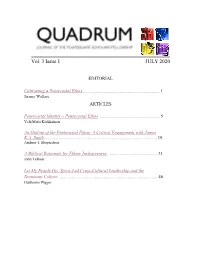
Vol. 3 Issue 1 JULY 2020 EDITORIAL Cultivating a Pentecostal Ethos .................................................................... 1 Jeremy Wallace ARTICLES Pentecostal Identity – Pentecostal Ethos ..................................................... 5 Veli-Matti Kärkkäinen An Outline of the Pentecostal Ethos: A Critical Engagement with James K.A. Smith.................................................................................................... 19 Andrew I. Shepardson A Biblical Rationale for Ethnic Inclusiveness ............................................ 31 John Telman Let My People Go: Spirit-Led Cross-Cultural Leadership and the Dominant Culture ...................................................................................... 46 Guillermo Puppo Cultivating a Pentecostal Ethos Jeremy Wallace, D.Min.1 Looking Back, Thinking Forward I have found myself reflecting on a peculiar, yet common, phenomenon: when we’re young we spend a considerable amount of time thinking about and dreaming of the future, what life will be like when we are “older.” Our focus is heavily upon things which are to come. Yet the older we get we find ourselves thinking more about life as it was in the days of our youth. The proverbial “good old days,” when demands upon us were fewer and, in the minds of many, we were able to live a generally carefree life.2 The more I ponder this, the more I wonder how many of us simply underappreciate our present context, where we are at in the here-and-now of our lives. It seems that we are prone to either dwell on the past or dream future hopes. With four children of my own, I wonder, from time to time, what their childhood experience is like. Is it like mine? Is it better or worse than mine was? They may tell me they enjoy their lives, but part of me always wonders what their experience is really like compared to my own. -

THE GLOBALISATION of CHARISMATIC CHRISTIANITY Spreading the Gospel of Prosperity
THE GLOBALISATION OF CHARISMATIC CHRISTIANITY Spreading the Gospel of Prosperity SIMON COLEMAN University of Durham The Pitt Building, Trumpington Street, Cambridge, United Kingdom The Edinburgh Building, Cambridge , UK www.cup.cam.ac.uk West th Street, New York, –, USA www.cup.org Stamford Road, Oakleigh, Melbourne , Australia Ruiz de Alarcón , Madrid, Spain © Simon Coleman This book is in copyright. Subject to statutory exception and to the provisions of relevant collective licensing agreements, no reproduction of any part may take place without the written permission of Cambridge University Press. First published Printed in the United Kingdom at the University Press, Cambridge Typeface Monotype Baskerville /. pt. System QuarkXPress™ [] A catalogue record for this book is available from the British Library hardback Contents List of illustrations page x Acknowledgements xi Introduction A ‘weird babel of tongues’: charisma in the modern world ‘Faith which conquers the world’: globalisation and charisma Sweden: national ‘state’ and global ‘site’ The Word of Life: organising global culture Words: from narrative to embodiment Aesthetics: from iconography to architecture Broadcasting the faith Expansive agency Contesting the nation The Word and the world References Index ix Illustrations The new Word of Life building page Baptism in Uppsala swimming baths Christ as body-builder ‘Word of Death’ graffiti x A ‘weird babel of tongues’: charisma in the modern world I vividly remember my first encounter with a charismatic church. It occurred during my final year of studying for an anthropology degree. During a particularly boring undergraduate lecture, a fellow student slipped me a note enquiring if I believed in God. When I scrawled a noncommittal reply, she asked if I wanted to accompany her to a local church that Sunday. -
Information to Users
INFORMATION TO USERS The most advanced technology has been used to photograph and reproduce this manuscript from the microfilm master. UMI films the text directly from the original or copy submitted. Thus, some thesis and dissertation copies are in typewriter face, while others may be from any type of computer printer. The quality of this reproduction is dependent upon the quality of the copy submitted. Broken or indistinct print, colored or poor quality illustrations and photographs, print bleedthrough, substandard margins, and improper alignment can adversely affect reproduction. In the unlikely event that the author did not send UMI a complete manuscript and there are missing pages, these will be noted. Also, if unauthorized copyright material had to be removed, a note will indicate the deletion. Oversize materials (e.g., maps, drawings, charts) are reproduced by sectioning the original, beginning at the upper left-hand corner and continuing from left to right in equal sections with small overlaps. Each original is also photographed in one exposure and is included in reduced form at the back of the book. Photographs included in the original manuscript have been reproduced xerographically in this copy. Higher quality 6" x 9” black and white photographic prints are available for any photographs or illustrations appearing in this copy for an additional charge. Contact UMI directly to order. University Microfilms International A Bell & Howell Information Company 300 North Zeeb Road, Ann Arbor, Ml 48106-1346 USA 313/761-4700 800/521-0600 Order Number 9031074 The institutionalization of Aimee Semple McPherson: A study in the rhetoric of social intervention Grindstaff, Roy Arthur, Ph.D. -

2020 Maine SAT School Day Student Answer Sheet Instructions
2020 MAINE SAT® SCHOOL DAY Student Answer Sheet Instructions This guide will help you fill out your SAT® School Day answer you need to provide this information so that we can mail sheet—including where to send your four free score reports. you a copy of your score report.) College Board may Be sure to record your answers to the questions on the contact you regarding this test, and your address will answer sheet. Answers that are marked in this booklet will be added to your record. If you also opt in to Student not be counted. Search Service (Field 16), your address will be shared with If your school has placed a personalized label on your eligible colleges, universities, scholarships, and other answer sheet, some of your information may have already educational programs. been provided. You may not need to answer every question. If you live on a U.S. military base, in Field 10, fill in your box Your instructor will read aloud and direct you to fill out the number or other designation. Next, in Field 11, fill in the appropriate questions. letters “APO” or “FPO.” In Field 12, find the “U.S. Military Confidentiality Bases/Territories” section, and fill in the bubble for the two- letter code posted for you. In Field 13, fill in your zip code. Your high school, school district, and state may receive your Otherwise, for Field 10, fill in your street address: responses to some of the questions. Institutions that receive Include your apartment number if you have one. your SAT information are required to keep it confidential and to Indicate a space in your address by leaving a blank follow College Board guidelines for using information. -
Culture and Urban Space in a European Church Planting Network
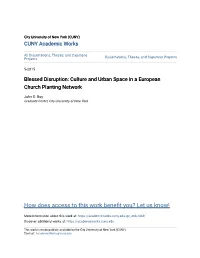
City University of New York (CUNY) CUNY Academic Works All Dissertations, Theses, and Capstone Projects Dissertations, Theses, and Capstone Projects 5-2015 Blessed Disruption: Culture and Urban Space in a European Church Planting Network John D. Boy Graduate Center, City University of New York How does access to this work benefit ou?y Let us know! More information about this work at: https://academicworks.cuny.edu/gc_etds/869 Discover additional works at: https://academicworks.cuny.edu This work is made publicly available by the City University of New York (CUNY). Contact: AcademicWorks@cuny.edu Blessed Disruption: Culture and Urban Space in a European Church Planting Network by John D. Boy A dissertation submitted to the Graduate Faculty in Sociology in partial fulfillment of the requirements for the degree of Doctor of Philosophy, The City University of New York. 2015 2015 JOHN D. BOY Some rights reserved. cbd This work is licensed under a Creative Commons Attribution–NoDerivates 4.0 International License. creativecommons.org/licenses/by-nd/4.0/ ii This manuscript has been read and accepted for the Graduate Faculty in Sociology in satisfaction of the dissertation requirement for the degree of Doctor of Philosophy. John Torpey Chair of Examining Committee Philip Kasinitz Executive Officer Date Professor Stanley Aronowitz Professor Marnia Lazreg Professor Bryan S. Turner Supervisory Committee THE CITY UNIVERSITY OF NEW YORK Abstract Blessed Disruption: Culture and Urban Space in a European Church Planting Network by John D. Boy Adviser: Professor John Torpey New Protestant churches are being founded in cities around the world. They are the product of a conscious effort on the part of evangelicals to found, or “plant,” new churches inur- ban areas. -

Speaking in Tongues and Other Gifts of the Holy Spirit: a Study in Possession
University of Montana ScholarWorks at University of Montana Graduate Student Theses, Dissertations, & Professional Papers Graduate School 1984 Speaking in tongues and other gifts of the Holy Spirit: A study in possession Steven G. Herbert The University of Montana Follow this and additional works at: https://scholarworks.umt.edu/etd Let us know how access to this document benefits ou.y Recommended Citation Herbert, Steven G., "Speaking in tongues and other gifts of the Holy Spirit: A study in possession" (1984). Graduate Student Theses, Dissertations, & Professional Papers. 5562. https://scholarworks.umt.edu/etd/5562 This Thesis is brought to you for free and open access by the Graduate School at ScholarWorks at University of Montana. It has been accepted for inclusion in Graduate Student Theses, Dissertations, & Professional Papers by an authorized administrator of ScholarWorks at University of Montana. For more information, please contact scholarworks@mso.umt.edu. COPYRIGHT ACT OF 1976 Th i s i s an unpublished m a n u s c r ip t in w h ic h c o p y r ig h t s u b s i s t s . A ny f u r t h e r r e p r in t in g of it s c o n t e n t s m u st b e a p p r o v e d BY THE AUTHOR. Ma n s f ie l d L ib r a r y U n i v e r s i t y of Mo n ta n a Da t e : ^ — 4 - & # 4 ---------- SPEAKING IN TONGUES AND OTHER GIFTS OF THE HOLY SPIRIT: A STUDY IN POSSESSION By Steven G, Herbert B.S., University of New Hampshire, 1980 Presented in partial fulfillm ent of the requirements for the degree of Master of Arts University of Montana 1984 Approved by: Chair, Board of Examiners Deffn, Graduate ScScWffT Date ^ / UMI Number: EP41026 All rights reserved INFORMATION TO ALL USERS The quality of this reproduction is dependent upon the quality of the copy submitted. -
Megachurches and 'Reverse Mission'
Chapter 11 Megachurches and ‘Reverse Mission’ Richard Burgess 1 Introduction The presence of African Christian communities in Europe and North America represents one of the most significant developments within world Christianity over the past three decades (Adogame 2013; Gornik 2011; Hanciles 2008; Olupo na and Gemignani (eds.) 2007; Ter Haar 2001). In Europe, African churches are becoming an increasingly important addition to the urban religious landscape, especially in globalising cities such as London, Amsterdam and Berlin. The majority are Pentecostal or Charismatic, which represents the fastestgrowing Christian tradition worldwide (Johnson 2013). Gerrie Ter Haar (2001: 13) re gards it as a fresh phase in European religious history, adding a new dimension to the multicultural society which Europe has become since the end of the Second World War. Whereas in the past, mission has been understood as a movement from the North to the South, now it is happening in the opposite direction, a phenomenon commonly referred to as ‘reverse mission’ (Burgess 2011; Freston 2010; Koning 2009; WährischOblau 2009). This chapter examines ‘reverse mission’ as it relates to megachurches of Nigerian provenance. In the literature, megachurches are defined as Protestant churches having at least 2,000 attendees per week (Ellingson 2016; Thumma and Travis 2007). The field of megachurch studies originated in the usa, where the largest number of megachurches are located (Ellingson 2016; Thumma 1996; Thumma and Travis 2007). However, there is now a growing recognition that megachurches are a global religious phenomenon exerting significant so cial influence in urban contexts around the world (James 2015; Thumma and Bird 2015a).