Mariposa in the Rhythms of Happiness
Total Page:16
File Type:pdf, Size:1020Kb
Load more
Recommended publications
-
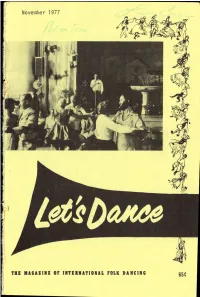
THE MAGAZINE of INTEKNATIONAL FOLK DANCING 650 U^ ^Etk
F November 1977 r THE MAGAZINE OF INTEKNATIONAL FOLK DANCING 650 u^ ^etk. T^OHce TNE littAZIIIE OF INTEIIN tTIONtl FOLK OANCma November 1977 Vol 34, Ho. 9 TABLE OF CONTENTS OFFICIAL PUBLICATION OF THE FOLK DANCE FEDERATION OF CALIFORNIA, INC. TREASURER'S BALL.................1 EDITOR.........................Linda Horn ASSOCIATE EDITOR.................Max Horn Making a Polish Bodice...........2 DANCE RESEARCH EDITOR...Dorothy Tamburini COSTUME RESEARCH EDITOR.....Eleanor Bacon Folk Arts of Poland..............5 BUSINESS MANAGER.................Max Horn Easy Does It!....................8 NOVEMBER CONTRIBUTORS Fiesta de Sonoma.................9 Miriam Lidster Ruth Miller Vera Jones Virginia Wilder Food in the Polish Manner.......10 Mona Verzi Ruth Ruling Larry Miller_________ Vi Dexhelmer Let's do Squares................12 FEDERATION OFFICERS Polish Folk Dance...............15 (North) Dance Descriptions: PRESIDENT...................Raymond Olson ^ilald RzMzoiAJ-ilU (Poland)......18 24013 Fairlands Road, Hayward, CA 94541 Kujawiak t*3 (Poland).........20 VICE PRESIDENT..............Bruce Wyckoff TREASURER........................Al Lisin Poland, a land of Changing RECORDING SECRETARY.....Genevieve Pereira Boundaries........24 DIRECTOR OF PUBLICATIONS.........Max Horn DIRECTOR OF EXTENSION...........Walt Lang DIRECTOR OF PUBLICITY.......Leonore Fifer Kolo Kalendar...................26 HISTORIAN.....................Leona Faoro (South) Party Places....................27 PRESIDENT......................Ed Feldman Council Clips...................30 -
The History of Joint-Stock Companies in the Second
STUDIA HISTORIAE OECONOMICAE UAM Vol. 36 Poznań 2018 zhg.amu.edu.pl/sho Mariusz W. M a j e w s k i (Katowice) ORCID 0000-0002-9599-4006 wmmajewski@interia.pl THE HISTORY OF JOINT-STOCK COMPANIES IN THE SECOND POLISH REPUBLIC AS EXEMPLIFIED BY WSPÓLNOTA INTERESÓW GÓRNICZO–HUTNICZYCH SA (MINING AND METALLURGY COMMUNITY OF INTERESTS JOINT STOCK COMPANY) Abstract: The article focuses on problems related to capital in Katowicka Spółka Akcyjna dla Gór nictwa i Hutnictwa SA (Katowice Mining and Metallurgy Joint Stock Company) and Górnośląskie Zjednoczone Huty “Królewska” i “Laura” (Upper Silesian United Metallurgical Plants “Królewska” and “Laura”) in the years 1918–1939. The article examines particular issues of the Upper Silesian industry after the Great War, namely: concentration of foreign capital in the mining and metallur gical industries; great mining and metallurgical enterprises in the periods of both industrial pros perity and crisis; attempts to limit the influence of foreign capital following the introduction of ju dicial supervision over Katowicka Spółka Akcyjna dla Górnictwa i Hutnictwa SA and Górnośląskie Zjednoczone Huty “Królewska” i “Laura” SA; the emergence of Wspólnota Interesów Górniczo– Hutniczych SA (Mining and Metallurgy Community of Interests Joint Stock Company) in the fi nal years of the Second Polish Republic. Key words: Second Polish Republic, mining and metallurgical industry, foreign capital, Wspólnota Interesów Górniczo–Hutniczych SA. doi:10.2478/sho-2018-0003 INTRODUCTION. THE CONDITION OF INDUSTRY IN UPPER SILESIA AFTER THE GREAT WAR On May 15, 1922, the Geneva convention on Upper Silesia was signed. As a result, mining and metallurgical enterprises, which up to that point had successfully functioned within the same structures, found themselves 44 Mariusz W. -

Poland, the Knight Among Nations;
POLAND THE KNIGHTAMONG NATIONS pw£ ZRAV* POLAND THE KNIGHT AMONG NATIONS NICHOLAS COPERNICrs THE FATHER OF MODERN ASTRON.MV. (This view of the Polish astronomer, (who w;is the first to propound the theory that the earth moves aroun 1 the sun) surrounded by the scientists and other worthies of his time, is reproduced from a rare old si pel em ing made in 1843, at the celebration of the three- hundredth anniversary of his death.) POLAND THE KNIGHT AMONG NATIONS LOUIS ifc VAN NORMAN With an Introduction by Helena Modjeska a illustrated n ^ * At i New Yohk Chicago Toronto Fleming H. Revell Company London and Edinburgh Copyright, 1907, by •FLEMING H. REVELL COMPANY All rights reserved SECOND EDITION New York: 158 Fifth Avenue Chicago : 80 Wabash Avenue Toronto : 15 Richmond St., W. London : 21 Paternoster Square Edinburgh : 100 Princes Street TO MY WIFE who taught me all the noble qualities of the Poles and made me very hopeful of their national destiny INTRODUCTORY fine characteristic I have especially ONEnoted in the American people. As a gen- eral rule, they are not led to an opinion by the verdict of any other nation. Of recent years, particularly, their popular verdicts have been based upon their own independent judg- ment, and some of these verdicts have afterwards been accepted by the whole world. They were the first to "discover" Sienkiewicz. They did not accept him on the claims of French, or Ger- man, or English criticism. By their own native perception they knew he was great, and now the whole world has accepted their judgment. -
Course Title: Introduction to Polish History and Culture*
Course Lecturer Hours ECTS Semester Introduction to Polish History and Culture (till 1795) prof. Robert Bubczyk 30 4 winter Introduction to Polish Modern and Contemporary History and Culture prof. Robert Bubczyk 30 4 summer Polish Modern and Contemporary History in Film prof. Robert Bubczyk 30 4 summer Course title: Introduction to Polish History and Culture* Course code: PHC/2017/2018 Number of didactic hours: 30 (15 sessions, 90 mins each) Course duration: 1st semester; classes on Thursdays, from 14:40 to 16:10, starting from 5th October 2017**. Note: it is possible to change this timetable following the arrangement with the participants in the first meeting Venue: classroom no. 226, 2nd floor (important: the ‘old’ building with a clock on the wall of the Faculty of the Humanities) ECTS credits: 4 Course description The aims of the course are the following: To provide the participants with the knowledge of major aspects of the history of Poland down through the centuries To offer students an opportunity of better understanding the challenging process of creating and sustaining a civil society and liberal democracy in post-Communist Poland To foster a creative comparison between Poland and the participants’ own country To compare the Polish political, social and cultural arrangements with other EU member states The classes have been devised to be conducted in a interactive lecture format, consisting of lectures and possible follow-up discussions on the respective subjects which cover the history of Polish society and civilization from the origins of the nation and state until the collapse of the Polish state at the end of the 18th century.* Since Lublin and the Lublin region are historic areas with lots of historical monuments and artefacts (a number of them dating from the Middle Ages), students’ individual excursions to such sights are highly recommended, which should facilitate a deeper insight into the history of Polish society and culture of the area. -

By Miriam Wojtas a THESIS Submitted to Oregon State University Honors
Histories of Trauma, Futures of Identity, As Told by the Kitchens of the Polish Diaspora by Miriam Wojtas A THESIS submitted to Oregon State University Honors College in partial fulfillment of the requirements for the degree of Honors Baccalaureate of Arts in Women, Gender, and Sexuality Studies and Spanish (Honors Scholar) Presented May 31, 2019 Commencement June 2019 AN ABSTRACT OF THE THESIS OF Miriam Wojtas for the degree of Honors Baccalaureate of Arts in Women, Gender, and Sexuality Studies and Spanish presented on May 31, 2019. Title: Histories of Trauma, Futures of Identity, As Told by the Kitchens of the Polish Diaspora. Abstract approved:_____________________________________________________ Bradley Boovy A recipe as a piece of text can tell a variety of stories as well as any other. Using a feminist rhetorical analysis, I read my grandmother’s personal recipe journal to show that her writings contain valuable information about women’s lives in twentieth century Poland. Through the close examination of three recipes, I argue that family knowledges inherited through cooking serve as a larger commentary on the social, political, and economic conditions of their lived experiences. The use of recipes especially prioritizes Polish women as cultural stewards and knowledge producers, as their work in kitchens is fundamental to the maintenance of the family and state. Key Words: food studies, feminist rhetorics, recipes, memory, Poland, kitchen Corresponding e-mail address: wojtasm@oregonstate.edu ©Copyright by Miriam Wojtas May 31, 2019 Histories of Trauma, Futures of Identity, As Told by the Kitchens of the Polish Diaspora by Miriam Wojtas A THESIS submitted to Oregon State University Honors College in partial fulfillment of the requirements for the degree of Honors Baccalaureate of Arts in Women, Gender, and Sexuality Studies and Spanish (Honors Scholar) Presented May 31, 2019 Commencement June 2019 Honors Baccalaureate of Arts in Women, Gender, and Sexuality Studies and Spanish project of Miriam Wojtas presented on May 31, 2019. -

Chopin and Poland Cory Mckay Departments of Music and Computer Science University of Guelph Guelph, Ontario, Canada, N1G 2W 1
Chopin and Poland Cory McKay Departments of Music and Computer Science University of Guelph Guelph, Ontario, Canada, N1G 2W 1 The nineteenth century was a time when he had a Polish mother and was raised in people were looking for something new and Poland, his father was French. Finally, there exciting in the arts. The Romantics valued is no doubt that Chopin was trained exten- the exotic and many artists, writers and sively in the conventional musical styles of composers created works that conjured im- western Europe while growing up in Poland. ages of distant places, in terms of both time It is thus understandable that at first glance and location. Nationalist movements were some would see the Polish influence on rising up all over Europe, leading to an em- Chopin's music as trivial. Indeed, there cer- phasis on distinctive cultural styles in music tainly are compositions of his which show rather than an international homogeneity. very little Polish influence. However, upon Fryderyk Franciszek Chopin used this op- further investigation, it becomes clear that portunity to go beyond the conventions of the music that he heard in Poland while his time and introduce music that had the growing up did indeed have a persistent and unique character of his native Poland to the pervasive influence on a large proportion of ears of western Europe. Chopin wrote music his music. with a distinctly Polish flare that was influ- The Polish influence is most obviously ential in the Polish nationalist movement. seen in Chopin's polonaises and mazurkas, Before proceeding to discuss the politi- both of which are traditional Polish dance cal aspect of Chopin's work, it is first neces- forms. -

60 Years of Diplomatic Relations Between Poland and the People’S Republic of China Historical Review
POLISH POLITICAL SCIENCE VOL XL 2011 PL ISSN 0208-7375 60 YEARS OF DIPLOMATIC RELATIONS BETWEEN POLAND AND THE PEOPLE’S REPUBLIC OF CHINA HISTORICAL REVIEW by Marceli Burdelski ! e diplomatic relations between Poland and China had been estab- lished before World War II. ! e new stage in the relations has started on October 7, 1949, when Poland o" cially recognized the People’s Republic of China (PRC), which was declared on October 1, 1949. 1 ! erefore, in 2009, we had two anniversaries: the 60 th anniversary of the founding of the People’s Republic of china and the 60 th anniversary of establishing the diplomatic relations between Poland and PRC. ! is gives the opportunity to summarize mutual relations. ! ose 60 years have been # lled with positive stories, which had signi# cant in$ uence on the development of bilateral relations. However, one can also # nd di" cult, even tragic moments during the history of these two nations. ! ose uneasy moments had also direct impact on mutual relations. 1 J. Rowiński, Wahadło, czyli stosunki polityczne PRL–ChRL , [in:] Polska–Chiny Wczo raj, dziś, jutro , ed. B. Góralczyk, Toruń 2009, p. 19. 212 MARCELI BURDELSKI 1. THE INTERWAR PERIOD 1918 1939 AND THE POSTWAR ERA AFTER 1945 When Poland restored its independence in 1918, China was immersed in post-revolution chaos. A! er the Revolution of 1911, which overthrown the Qing dynasty, the attempts to implement multi-parties, parliamentary democracy based on the western model have failed completely. As a result the informal dissolution of the state – that transformed into smaller and greater quasi-state entities controlled by local warlords, sometimes waging wars against each other – took place. -

Chwastek Eugeniusz. (2008)
Title: Zbiorowiska segetalne Pogórza Cieszyńskiego Author: Eugeniusz Chwastek Citation style: Chwastek Eugeniusz. (2008). Zbiorowiska segetalne Pogórza Cieszyńskiego. Praca doktorska. Katowice : Uniwersytet Śląski Uniwersytet Śląski w Katowicach Wydział Biologii i Ochrony Środowiska Eugeniusz Chwastek Zbiorowiska segetalne Pogórza Cieszyńskiego Praca doktorska wykonana pod kierunkiem Prof. dr. hab. Stanisława Wiki w Katedrze Geobotaniki i Ochrony Przyrody Katowice 2008 Zbiorowiska segetalne Pogórza Cieszyńskiego WSTĘP....................................................................................................................................... 5 1. CHARAKTERYSTYKA BADANEGO TERENU............................................................... 7 1.1. Położenie i granice .............................................................................................................. 7 1.2. Rzeźba terenu i geomorfologia ......................................................................................... 12 1.3. Bogactwa naturalne ........................................................................................................... 14 1.4. Gleby ................................................................................................................................. 16 1.5. Klimat i stosunki wodne....................................................................................................17 1.6. Współczesna gospodarka rolna i zagrożenia ze strony przemysłu ................................... 22 1.6.1. Gospodarka -

The Selected Aspects of Strategic Management in the City Divided By
2019 POLISH JOURNAL OF MANAGEMENT STUDIES Vol.19 No.1 Dacko-Pikiewicz Z. THE SELECTED ASPECTS OF STRATEGIC MANAGEMENT IN THE CITY DIVIDED BY THE BORDER IN THE CONTEXT OF THE DEVELOPMENT OF THE CROSS-BORDER MARKET OF CULTURAL SERVICES Dacko-Pikiewicz Z. * Abstract: The article is of research nature. The analysis of strategic documents of the city of Cieszyn-Český Těšín divided by the state border, as well as individual in-depth interviews with the directors of all local government cultural institutions in this city allowed for the identification of opportunities for further development of the common Polish-Czech cross-border market of cultural services. The research conducted proves that despite the dynamically developing Polish-Czech cross-border cooperation in the field of culture, there are still no mentions in the strategic documents pointing directly to the need to intensify common Polish-Czech cultural activities, and thus indicating the need to develop the cross-border market of cultural services. Therefore, by following the interview results, actions in the area of strategic management were specified, which could significantly contribute to the so-called "blurring of the border" and the development of this market in the city of Cieszyn-Český Těšín. The recommendations may be useful not only for the authorities of the city of Cieszyn-Český Těšín, but also for decision-makers and cultural managers of other European cities in the Schengen area that are divided by the state border. Key words: city divided by the border, cross-border market of cultural services, development, strategic management, Cieszyn-Český Těšín DOI: 10.17512/pjms.2019.19.1.10 Article history: Received January 20, 2019; Revised March 12, 2019; Accepted March 20, 2019 Introduction The management of the city which has been divided by the state border is a complicated process, which requires interdisciplinary knowledge of many diverse issues, based, among others, on culture, economics, spatial management, environmental protection or different two independent states. -

OFF Festival Katowice 2018 Announcing the First Artists We’Re Pleased to Announce the First Artists That Are Confirmed to Perform at the Next OFF Festival
OFF Festival Katowice 2018 Announcing the First Artists We’re pleased to announce the first artists that are confirmed to perform at the next OFF Festival. They’re original, they’re psychedelic and they’re kaleidoscopic: Grizzly Bear, Clap Your Hands Say Yeah performing Some Loud Thunder, John Maus and Marlon Williams are coming to Katowice in August. Get your OFF Festival passes now at a special early- bird prices. There’s no better Christmas gift than that! Grizzly Bear If there’s one band on the US indie scene today that can blaze new trails in American folk music while remaining faithful to the lessons of the Beach Boys, and that can be as catchy as they are challenging, blending jazz and art rock with pop, then that band is, without a doubt, Grizzly Bear. But it would be unfair to brand this Brooklyn quartet as a group of savvy counterfeiters: their music — a dense web of gripping and at times slightly psychedelic sonic ideas — is a purely original invention. It’s also one that’s garnered rave reviews from audiences and critics alike since their debut Horn of Plenty (2004). Grizzly Bear’s follow-up Yellow House (ranked among the top albums of 2006 by The New York Times and Pitchfork) secured their spot in the top echelons of alternative rock, while later efforts, including this year’s Painted Ruins, only reinforced their status. But as we’ll all see on a warm summer night this August, this bear’s natural habitat is the stage. John Maus His music has been described as a mash-up of punk, catchy soundtracks to ‘80s blockbusters, the unremitting poppiness of Moroder, and the spiritual qualities of Medieval and Baroque music. -

Food Sector in Poland
Food Sector in Poland Economic Information Department Polish Information and Foreign Investment Agency Warsaw 2011 Food Sector in Poland 2011 :: s. 2 Market Description and Structure The food sector is one of the most important It entailed a significant growth in the Polish and fastest-growing branches of the Polish economy. foreign trade that allowed availing on the competitive The share of the sector in the sale value of the entire advantage of the Polish manufacturers of agricultural national industry amounts to almost 24% and it is by and food products. As a result of market changes the about 9 percentage points higher than in 15 countries branch structure of the food industry has become sig- of the European Union where it equals on average nificantly similar to the structure of this industry in 15%. Within the EU countries a higher share of the the developed countries. It is also reflected by food industry than in Poland is present in Denmark changes in the nutrition model and the structure of (28%) and Greece (27%). demand for groceries. An important increase factor of the food sec- tor was Poland's accession to the European Union. :: Table 1 Dynamics of grocery production indicators 2005=100 2006 2007 2008 2009 Sold production Industry in general 107,3 114,3 115,0 120,2 Industrial processing 113,8 127,9 133,0 127,8 Grocery production 107,3 114,3 115,0 120,2 Average employment Industry in general 102,1 106,9 110,4 104,1 Industrial processing 102,9 108,8 112,5 104,6 Grocery production 100,8 102,5 104,6 103,2 Average salary Industry in general 105,2 113,8 125,4 131,0 Industrial processing 106,0 115,8 127,8 131,8 Grocery production 104,7 114,4 126,6 131,0 Source: Own work on the basis of the data of GUS [Central Statistical Office]. -

A Centennial of Dialectology in Poznań
Gwary Dziś – vol. 13 – 2020, pp. 43–63 DOI 10.14746/gd.2020.13.3 ISSN 1898-9276 Jerzy Sierociuk Adam Mickiewicz University in Poznań Institute of Polish Philology ORCID: 0000-0001-9069-6117; e-mail: jasier@amu.edu.pl A centennial of dialectology in Poznań Abstract: This article presents the most relevant information on the history of dialectological research in Poznań and its context, the academic achievements of the Poznań University enjoyed in cooperation with the Poznań Society for the Advancement of Arts and Sciences. The two institutions have greatly contributed to the development of Polish studies including dialectology. The presented information pertains chiefly to the relatively unknown accomplishments of the dialectology team, for example a phonographic archive containing recordings of utterances of informants born in the second half of the 19th century (the oldest interlocutor was born in 1855). Together with contemporary recordings, the collection contains approximately 3,700 hours of rural speech. The entire archive is available in a digital version. The text is supplemented with information about the history of Poznań dialectology and the contemporary activities of the team of the Dialectology Workshop at the Poznań University, mainly lexicographic works. Key words: history of dialectology in Poznań, Polish studies at the AMU, Poznań Society for the Advancement of Arts and Sciences, lexicography of Wielkopolska dialects. Abstrakt: Sto lat dialektologii w Poznaniu. W artykule przedstawione są najważniejsze informacje dotyczące historii badań dialektologicznych w Poznaniu. Podano też istotne dane, szkicując kontekst tych działań – działalność naukowa Uniwersytetu Poznańskiego ściśle powiązana jest z Poznańskim To- wa rzystwem Przyjaciół Nauk. Te dwie instytucje naukowe mają wielkie zasługi w rozwoju studiów polonistycznych, a w tym dialektologii.