Národopisná Revue 18, No
Total Page:16
File Type:pdf, Size:1020Kb
Load more
Recommended publications
-

Eastern Europe
NAZI PLANS for EASTE RN EUR OPE A Study of Lebensraum Policies SECRET NAZI PLANS for EASTERN EUROPE A Study of Lebensraum Policies hy Ihor Kamenetsky ---- BOOKMAN ASSOCIATES :: New York Copyright © 1961 by Ihor Kamenetsky Library of Congress Catalog Card Number 61-9850 MANUFACTURED IN THE UNITED STATES OF AMERICA BY UNITED PRINTING SERVICES, INC. NEW HAVEN, CONN. TO MY PARENTS Preface The dawn of the twentieth century witnessed the climax of imperialistic competition in Europe among the Great Pow ers. Entrenched in two opposing camps, they glared at each other over mountainous stockpiles of weapons gathered in feverish armament races. In the one camp was situated the Triple Entente, in the other the Triple Alliance of the Central Powers under Germany's leadership. The final and tragic re sult of this rivalry was World War I, during which Germany attempted to realize her imperialistic conception of M itteleuropa with the Berlin-Baghdad-Basra railway project to the Near East. Thus there would have been established a transcontinental highway for German industrial and commercial expansion through the Persian Gull to the Asian market. The security of this highway required that the pressure of Russian imperi alism on the Middle East be eliminated by the fragmentation of the Russian colonial empire into its ethnic components. Germany· planned the formation of a belt of buffer states ( asso ciated with the Central Powers and Turkey) from Finland, Beloruthenia ( Belorussia), Lithuania, Poland to Ukraine, the Caucasus, and even to Turkestan. The outbreak and nature of the Russian Revolution in 1917 offered an opportunity for Imperial Germany to realize this plan. -

The Linguacultural View of Polish Słoma 'Straw': an Ethnolinguistic Account
Ethnolinguistic 29 Lublin 2018 I. Research articles DOI: 10.17951/et.2017.29.111 Jerzy B a r t m i ń s k i ORCID: 0000-0003-2252-6516 (UMCS, Lublin, Poland) Agata B i e l a k ORCID: 0000-0001-5898-2826 (Institute of Slavic Studies, Polish Academy of Sciences, Warsaw, Poland) The linguacultural view of Polish słoma ‘straw’: An ethnolinguistic account∗ Abstract. The conceptualisations of straw in Polish urban culture (and the literary variety of Polish) and in the folk variety of the language are different. In the former, straw has a low position and symbolises that which is mediocre, impermanent, or of little value. In contrast, in Polish folk culture, based on traditional farming and cultivation of cereals, straw enjoys a much higher status: it is valued as a material in insulation and production of useful artefacts, such as mats, baskets, grain containers, shoes, beehives, toys, or decorations. Its linguacultural image is rich in positive associations. In customs and auguries straw is treated as a magical medium operating between what is alive and what is dead. It is linked with fertility and has erotic symbolism. The reconstruction of the folk stereotype of straw proposed here is based on the tenets of the cognitive definition. Key words: Polish national and folk linguaculture; linguacultural view of straw; cognitive definition; magical medium; symbolism of straw ∗ Research partially funded by the Polish Ministry of Science and Higher Education, the National Programme for the Development of Humanities (2015–2020). Project “The world of plants in folk and colloquial Polish (trees, corn, flowers, herbs, mushrooms, etc.). -
Primitivism" In2 0 T H Century
TH THE MUSEUM OF MODERN ART PRIMITIVISM" IN 20 CENTURY ART 11 WEST 53 STREET NEW YORK, NY 10019 Affinity of the Tribal and the Modern (212) 708-940U FOR IMMEDIATE RELEASE August, 1984 No. 17 NEW EXHIBITION OPENING SEPTEMBER 27 AT MUSEUM OF MODERN ART EXAMINES "PRIMITIVISM" IN 20TH CENTURY ART Few if any external influences on the work of modern painters and sculptors have been more critical than that of the tribal arts of Africa, Oceania and North America. Since the turn of the century when Gauguin, Picasso, Matisse, and others first acquainted themselves with masks and sculptures from these areas, modern artists have continued to display strong interest in the art and culture of tribal societies. The term "primitivism" is used to describe the Western response to tribal cultures as revealed in the work and thought of modern artists. Recognizing the importance of this issue in modern art history--and the relative lack of serious research devoted to it--The Museum of Modern Art in New York this fall presents a groundbreaking exhibition that underscores the parallelisms that exist between the two arts. Entitled "PRIMITIVISM" IN 20TH CENTURY ART: Affinity of the Tribal and the Modern, the exhibition, which opens on September 27 and runs through January 15, 1985, is the first ever to juxtapose modern and tribal objects in the light of informed art history. William Rubin, head of the Museum's Department of Painting and Sculpture and director of the landmark 1980 Pablo Picasso: A Retrospective, has organized the show in collaboration with Professor Kirk Varnedoe of New York University's more/ The exhibition and its national tour are sponsored by Philip Morris Incorporated. -
OAC Members Page 1 Name Profile Address Location Country School
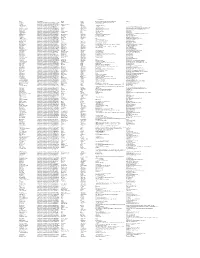
OAC Members Name Profile Address Location Country School/Organization/Current anthropological attachment Website Erik Cohen http://openanthcoop.ning.com/xn/detail/u_0q3436294e00n Bangkok Thailand Hebrew University of Jerusalem Israel (Emeritus) - Liviu Chelcea http://openanthcoop.ning.com/xn/detail/u_13fm1mp3j3ec0 Romania economic anth, kinship - Fiza Ishaq http://openanthcoop.ning.com/xn/detail/u_257csvwenh01d Bangalore, Karnataka India -- -- Budi Puspa Priadi http://openanthcoop.ning.com/xn/detail/u_2chvjykjv4cz8 Yogyakarta Indonesia Gadjah Mada University ---- E. Paul Durrenberger http://openanthcoop.ning.com/xn/detail/u_3l4ha53wqxfjt United States Penn State //www.personal.psu.edu/faculty/e/p/epd2/ Joe Long http://openanthcoop.ning.com/xn/detail/u_0b6vedfu8to4e Aberdeen United Kingdom University of Aberdeen /www.abdn.ac.uk/anthropology/postgrad/details.php?id=anp037 Louise de la Gorgendiere http://openanthcoop.ning.com/xn/detail/u_1w9frbg5i32ep Ottawa Canada Carleton University, Ottawa, Canada /www.carleton.ca/socanth/faculty/gorgendiere.html Sebnem Ugural http://openanthcoop.ning.com/xn/detail/u_0h8qc5txfeu01 london United Kingdom University of Essex /www.seb-nem.com/ millo mamung http://openanthcoop.ning.com/xn/detail/u_0cs1x9hd3jmlk arunachal pradesh India rajiv gandhi university @yahoo.com Mangi Lal Purohit http://openanthcoop.ning.com/xn/detail/u_0r5sad7imypae Rajasthan India Aakar Trust aakartrust.org Hakan Ergül http://openanthcoop.ning.com/xn/detail/u_2o9ookbjyxvcv Turkey Anadolu University academy.anadolu.edu.tr/xdisplayx.asp?kod=0&acc=hkergul -

Ethnic and Regional Identity in Polish Part of Spiš Region (On the Example of Jurgów Village)
78 ETHNOLOGIA ACTUALIS Vol. 14, No. 1/2014 VOJTECH BAGÍN Ethnic and Regional Identity in Polish Part of Spiš Region (on the Example of Jurgów Village) Ethnic and Regional Identity in Polish Part of Spiš Region (On the Example of Jurgów Village) VOJTECH BAGÍN Department of Ethnology and Museology, Comenius University in Bratislava vojtechbaginn@gmail.com ABSTRACT In my study I am focusing on the issue of national and regional identity of Spiš region inhabitants. The researched Jurgów village belongs to territory situated on the frontier between two states and at the same time between two regions. In the study I analyze the question of stereotypes present in the locality concerning gorals from the neighbouring Podhale region and Slovak part of Spiš region. In addition to that I deal with analysis of importance and understanding of space and border for the identity of local population. On the basis of the empirical data analysis results I observe that the identity of the researched village population is shaped by the fact that it belongs to the frontier territory where cross- border cultural and social interaction occurs. KEY WORDS: ethnic identity, stereotypes, space, Jurgów, Spiš region Introduction In Slovak ethnological science, the area of Slovak-Polish borderlands of Spiš region has been researched only to a small extent. However, on the Polish side of the border occurs quite the opposite. In Polish science there have been issued various publications DOI: 10.2478/eas-2014-0005 © University of SS. Cyril and Methodius in Trnava. All rights reserved. 79 ETHNOLOGIA ACTUALIS Vol. 14, No. 1/2014 VOJTECH BAGÍN Ethnic and Regional Identity in Polish Part of Spiš Region (on the Example of Jurgów Village) concerned with this region not only in the past but also in the present1. -
Arts in the Margins of World Encounters
Arts in the Margins of World Encounters Edited by Willemijn de Jong University of Zurich, Switzerland Eriko Aoki Ryukoku University, Japan John Clammer O.P. Jindal Global University, India Curating and Interpreting Culture Copyright © 2021 Vernon Press, an imprint of Vernon Art and Science Inc, on behalf of the authors. All rights reserved. No part of this publication may be reproduced, stored in a retrieval system, or transmitted in any form or by any means, electronic, mechanical, photocopying, recording, or otherwise, without the prior permission of Vernon Art and Science Inc. www.vernonpress.com In the Americas: In the rest of the world: Vernon Press Vernon Press 1000 N West Street, Suite 1200, C/Sancti Espiritu 17, Wilmington, Delaware 19801 Malaga, 29006 United States Spain Curating and Interpreting Culture Library of Congress Control Number: 2021933073 ISBN: 978-1-62273-602-7 Product and company names mentioned in this work are the trademarks of their respective owners. While every care has been taken in preparing this work, neither the authors nor Vernon Art and Science Inc. may be held responsible for any loss or damage caused or alleged to be caused directly or indirectly by the information contained in it. Every effort has been made to trace all copyright holders, but if any have been inadvertently overlooked the publisher will be pleased to include any necessary credits in any subsequent reprint or edition. Cover design by Vernon Press. Cover photo by Eriko Aoki, 2015: “Clay works by Masami Yamagiwa in the Atelier Yamanami.” Table of Contents List of figures v Prologue Arts, world encounters, markets and marginality: a decolonising perspective vii Willemijn de Jong University of Zurich, Switzerland Eriko Aoki Ryukoku University, Japan John Clammer O.P. -

Cultural Policy Landscapes a Guide to Eighteen Central and South Eastern European Countries
ERSTE Stiftung Cultural policy landscapes Studies A guide to eighteen Central and South Eastern European countries Cultural policy landscapes. A guide to eighteen Central and South Eastern European countries Authors: Veronika Ratzenböck, Katharina Okulski, Xenia Kopf Proof reading: David Westacott Editing: Andrea Huemer Vienna 2012, 116 pages All rights reserved. © ERSTE Foundation and österreichische kulturdokumentation. internationales archiv für kulturanalysen, Schultergasse 5/15, 1010 Vienna 0043 (0)1 535 27 05 office@kulturdokumentation.org www.kulturdokumentation.org Despite careful checking, errors cannot be excluded and no claim is made to the exhaustive completeness of the data. Cultural policy landscapes A guide to eighteen Central and South Eastern European countries Veronika Ratzenböck Katharina Okulski Xenia Kopf CONTENTS 7 Preface 9 Introduction 11 1. Country profiles: 18 outlines of cultural policy development 12 Albania 15 Bosnia and Herzegovina 19 Bulgaria 22 Croatia 26 Czech Republic 30 Estonia 34 Hungary 38 Kosovo 42 Latvia 46 Lithuania 50 The Former Yugoslav Republic of Macedonia 53 Moldova 57 Poland 61 Romania 65 Serbia 69 Slovakia 73 Slovenia 77 Ukraine 81 2. Country profiles in comparison 82 2.1 A comparison of figures: cultural budgets and expenditure 85 2.2 Common issues and characteristics 87 2.2.1 Transformation and (de)centralisation 89 2.2.2 International relations and cross-regional alliances 93 2.2.3 The status of contemporary art 96 Sources 102 Annex 5 PREFACE ERSTE Foundation develops its projects in cooperation with non-profit organisations (NPOs) in East- ern Europe. As a result, we are very much involved in the local NPO scene and often learn about deci- sions on budgetary issues and political priorities first hand through our contacts. -

Expedition Evan M
Washington University in St. Louis Washington University Open Scholarship Graduate School of Art Theses Graduate School of Art Spring 5-16-2014 Expedition Evan M. Crankshaw Washington University in St Louis, evancrankshaw@gmail.com Follow this and additional works at: https://openscholarship.wustl.edu/samfox_art_etds Part of the Art and Design Commons Recommended Citation Crankshaw, Evan M., "Expedition" (2014). Graduate School of Art Theses. ETD 19. https://doi.org/10.7936/K7MS3QN3. This Thesis is brought to you for free and open access by the Graduate School of Art at Washington University Open Scholarship. It has been accepted for inclusion in Graduate School of Art Theses by an authorized administrator of Washington University Open Scholarship. For more information, please contact digital@wumail.wustl.edu. Expedition by EVan Crankshaw 1 Contents Abstract.........................................................................................................3 Part One: Exotic.......................................................................................4 1. “Exotic”......................................................................................................5 2. The Exot.....................................................................................................6 3. Time and the Primitive..................................................................................9 4. A New Exot...............................................................................................13 Part Two: Exotica...................................................................................15 -

Social Impact of Emigration and Rural-Urban Migration in Central and Eastern Europe Final Country Report Czech Republic
On behalf of the European Commission DG Employment, Social Affairs and Inclusion Social Impact of Emigration and Rural-Urban Migration in Central and Eastern Europe Final Country Report Czech Republic April 2012 Authors: Dušan Drbohlav Miroslava Rákoczyová Neither the European Commission nor any person acting on behalf of the Commission may be held responsible for the use that may be made of the information contained in this publication. Social Impact of Emigration and Rural-Urban Migration in Central and Eastern Europe VT/2010/001 CONTENT Foreword .............................................................................................................................. 3 1. Political and Socio-Economic Overview (vis-à-vis emigration) ................................... 3 2. Main emigration and internal migration trends and patterns ....................................... 5 2.1. Main emigration trends ................................................................................................ 5 2.2. Main internal migration trends ..................................................................................... 7 2.3. Main characteristics of migrants .................................................................................11 3. Nation-wide labour market and social development trends under the influence of emigration .......................................................................................................................... 14 3.1 Economic and labour market developments ................................................................14 -

Gorali-O-Goraloch-Oravy-Liptova-Kysuc-1-105.Pdf
GORALI VEĽKÁ KNIHA O GORALOCH ORAVY, LIPTOVA A KYSÚC BIG BOOK ABOUT GORALOCH ORAVY, LIPTOVA A KYSÚC Miloš Jesenský a kolektív MATICA SLOVENSKÁ GORALI VEĽKÁ KNIHA O GORALOCH ORAVY, LIPTOVA A KYSÚC BIG BOOK ABOUT GORALOCH ORAVY, LIPTOVA A KYSÚC Miloš Jesenský a kolektív GORALI Veľká kniha o goraloch Oravy, Liptova a Kysúc Vydala Matica slovenská Námestie J. Cígera Hronského 1, 032 52 Martin www.matica.sk Rozširuje Vydavateľstvo Matice slovenskej, s. r. o. Mudroňova 1, 036 52 Martin, Slovensko Tel. (+ 421 43) 490 68 76, fax: (+ 421 43) 490 68 74 e-mail: info@vydavatel.sk www.vydavatel.sk Grafická úprava a návrh obálky Peter Ďurík Zodpovedná redaktorka Juliana Krébesová Text © Miloš Jesenský a kolektív Fotografie © © Matica slovenská 2013 Vytlačila Tlačiareň ISBN 978– 80–8128– Fotografia na prednej strane obálky: Blanka Šperková: Politička, antikorový drôt, 2008, Považské múzeum v Žiline Blanka Šperková: Politician - woman, stainless wire, 2008, Museum of Považie Region in Žilina. Fotografia na 1. strane Jozef Kerak: Kohút, kolorovaný drôt a plech, okolo roku 1940, Považské múzeum v Žiline Jozef Kerak: Cock, colour wire and plate, around 1940, Museum of Považie Region in Žilina. Fotografia na 4. – 5. strane: Silvia Fedorová: Viacvrstvový náramok, medený drôt, sklenené korálky, 1995, majetok autorky Silvia Fedorová: Multilayer bracelet, copper wire, glass beads, 1995, in author’s ownership. Zadná strana obálky: Vladimír Majerský: Stará topánka, pozinkovaný drôt, textilná šnúrka, 2004, majetok autora Vladimír Majerský: Old shoe, zinc-coated wire, shoelace, 2004, in author’s ownership. OBSAH / CONTENTS ÚVODOM 6 INTRODUCTION HORSKÝ ĽUD SPOD ZNAMENIA MUŠLE 8 (Miloš Jesenský) I. ORAVSKÍ GORALI NA SCÉNE DEJÍN 9 GORALS OF ORAVA ON THE SCENE OF HISTORY Originálna kultúra spod Beskýd 34 Original culture from the Beskydy mountains (Peter Huba) II. -

Ceemr@Uw.Edu.Pl © Copyright by Centre of Migration Research, Polish Academy of Sciences, Warsaw 2019
Editor in Chief Editorial Board Agata Górny Zuzanna Brunarska Kathy Burrell Piotr Koryś Associate Editor in Chief Yana Leontiyeva Magdalena Lesińska Aleksandra Grzymała-Kazłowska Stefan Markowski Inta Mierina Chris Moreh Managing Editor Justyna Nakonieczna-Bartosiewicz Renata Stefańska Joanna Nestorowicz Aneta Piekut Paolo Ruspini Paweł Strzelecki Anne White Advisory Editorial Board Marek Okólski, Chairman Solange Maslowski SWPS, UW, Warsaw ChU, Prague Olga Chudinovskikh Ewa Morawska MSU, HSE, Moscow UE, Essex Barbara Dietz Mirjana Morokvasic IOS, Regensburg CNRS, Paris Boris Divinský Jan Pakulski Bratislava UTAS, Hobart Dušan Drbohlav Dorota Praszałowicz ChU, Prague JU, Cracow Elżbieta Goździak Krystyna Romaniszyn GU, Washington, CeBaM, Poznan JU, Cracow Agnes Hars John Salt Kopint-Tárki, Budapest UCL, London Romuald Jończy Dumitru Sandu WUE, Wroclaw UB, Bucharest Paweł Kaczmarczyk Krystyna Slany UW, Warsaw JU, Cracow Olga Kupets Dariusz Stola NaUKMA, Kyiv PAS, CC, Warsaw Cezary Żołędowski UW,Warsaw ISSN 2300–1682 Editorial office: Centre of Migration Research, University of Warsaw, Pasteura 7, 02–093 Warsaw, e-mail: ceemr@uw.edu.pl © Copyright by Centre of Migration Research, Polish Academy of Sciences, Warsaw 2019 Contents Central and Eastern European Migration Review Vol. 8, No. 1, 2019 Special section: International Migration and Socio-Economic Transition in Central and Eastern Europe (part 1) Agata Górny, Paweł Kaczmarczyk Introduction: Migration and Mobility in the Context of Post-Communist Transition in Central and Eastern Europe 5 Russell King, Marek Okólski Diverse, Fragile and Fragmented: The New Map of European Migration 9 Anne White, Izabela Grabowska Social Remittances and Social Change in Central and Eastern Europe: Embedding Migration in the Study of Society 33 Iryna Lapshyna Do Diasporas Matter? The Growing Role of the Ukrainian Diaspora in the UK and Poland in the Development of the Homeland in Times of War 51 Tibor T. -

Emigration in Europe
EMIGRATION IN EUROPE ANNUAL REPORT 2020 MERCATOR FORUM MIGRATION AND DEMOCRACY EMIGRATION IN EUROPE MIDEM ANNUAL REPORT 2020 ISSN 2748-8454 Editor: Editorial Staff: Prof. Dr. Hans Vorländer, Director Dr. Oliviero Angeli Mercator Forum Migration and Democracy (MIDEM) Johanna Haupt TU Dresden Institute of Political Science Design: Centre for the Study of Constitutionalism and Vollblut GmbH & Co. KG Democracy 01062 Dresden © MIDEM 2021 Germany Phone.: +49 351 463 35811 MIDEM is a research centre at the Technische Universität midem@mailbox.tu-dresden.de Dresden (TUD), funded by Stiftung Mercator. www.forum-midem.de Citation: MIDEM 2021: Emigration in Europe. Annual Report 2020, Mercator Forum Migration and Democracy, ed. by Hans Vorländer, Dresden. CONTENTS FOREWORD 7 FINDINGS 8 A EMIGRATION IN EUROPE: SOCIOECONOMIC AND POLITICAL CONSEQUENCES 10 B EMIGRATION, OUT-MIGRATION AND RIGHT-WING POPULISM 1 Emigration and voting for the AFD in Germany: Shrinking regions – frustrated citizens? 18 2 Emigration and the election results of far-right parties in Europe 32 C EMIGRATION IN EUROPEAN COUNTRIES 1 Bulgaria 42 2 Czech Republic 56 3 Greece 72 4 Hungary 86 5 Italy 102 6 Poland 118 7 Portugal 132 8 Romania 148 9 Spain 164 LIST OF FIGURES 180 AUTHORS 186 IMPRINT 187 EMIGRATION FOREWORD Migration has been one of the dominant topics in European politics and pub- lic debate in the past years. However the focus was mostly on immigration. Until now much less attention has been paid to emigration. That has changed: According to a 2019 survey conducted by the European Council of Foreign Re- lations, people in economically weaker regions of Europe now feel less threat- ened by immigration than by emigration.