Earth-Science Reviews 171 (2017) 58–77
Total Page:16
File Type:pdf, Size:1020Kb
Load more
Recommended publications
-
Documentation for the 2007 Update of the National Seismic Hazard Maps
Documentation for the Southeast Asia Seismic Hazard Maps By Mark Petersen, Stephen Harmsen, Charles Mueller, Kathleen Haller, James Dewey, Nicolas Luco, Anthony Crone, David Lidke, and Kenneth Rukstales Administrative Report September 30, 2007 U.S. Department of the Interior U.S. Geological Survey U.S. Department of the Interior 1 DIRK KEMPTHORNE, Secretary U.S. Geological Survey Mark D. Myers, Director U.S. Geological Survey, Reston, Virginia 2007 Revised and reprinted: 200x For product and ordering information: World Wide Web: http://www.usgs.gov/pubprod Telephone: 1-888-ASK-USGS For more information on the USGS—the Federal source for science about the Earth, its natural and living resources, natural hazards, and the environment: World Wide Web: http://www.usgs.gov Telephone: 1-888-ASK-USGS Suggested citation: Author1, F.N., Author2, Firstname, 2001, Title of the publication: Place of publication (unless it is a corporate entity), Publisher, number or volume, page numbers; information on how to obtain if it’s not from the group above. Any use of trade, product, or firm names is for descriptive purposes only and does not imply endorsement by the U.S. Government. Although this report is in the public domain, permission must be secured from the individual copyright owners to reproduce any copyrighted material contained within this report. 2 Contents Overview of Project............................................................................................................................. 5 Project Activities in Thailand........................................................................................................ -

Shangrila Discovery Is Your Opportunity for a Breathtaking, Picturesque Day 3 Guilin – Kunming (AB, L, D) Adventure Through China’S Yunnan Province
Stone Forest EXOTIC TRIP Itinerary AB: American Breakfast, L: Lunch, D: Dinner, SD: Specialty Dinner Day 1 Guilin g You arrive in Guilin. Once we escort you to your hotel, the rest of the day Shan rila Discovery is free for you to explore. Tour Code: TQ Day 2 Guilin (AB, D) 12 days, 11 nights | Guilin, Kunming, Dali, Lijiang, Shangrila, Chengdu Cruise down the Li River and arrive at Yangshuo free market for local crafts and artworks. The Shangrila Discovery is your opportunity for a breathtaking, picturesque Day 3 Guilin – Kunming (AB, L, D) adventure through China’s Yunnan Province. Depart on a sparkling Li River In the morning, explore Elephant Trunk Hill. Later, marvel at the Cruise and venture to the Kunming Stone Forest with immense, colorful stalagmites in the Reed Flute Cave before catching a flight to Kunming, “The Spring City.” limestone structures. View China from atop the sacred Jade Dragon Mountain Day 4 Kunming (AB, L, D) near Lijiang and experience the mighty Yangtze River passing through the Visit the Stone Forest, created by ancient winds and water erosion. fantastic Tiger Leaping Gorge. Afterwards, visit the bustling economy of The Stone Forest is filled with limestone cliffs and peaks. On the way Three Pagodas Shanghai, home of the 2010 World Expo. You will be inspired by “The Land of back, visit Dragon’s Gate and Huating Temple. Sacredness and Peace” throughout your Shangrila Discovery. Day 5 Kunming – Dali (AB, L, D) Catch a flight to Dali, home of the Bai minority, where you will visit the Three Pagodas and the Dali Museum. -

Thai-Burmese Warfare During the Sixteenth Century and the Growth of the First Toungoo Empire1
Thai-Burmese warfare during the sixteenth century 69 THAI-BURMESE WARFARE DURING THE SIXTEENTH CENTURY AND THE GROWTH OF THE FIRST TOUNGOO EMPIRE1 Pamaree Surakiat Abstract A new historical interpretation of the pre-modern relations between Thailand and Burma is proposed here by analyzing these relations within the wider historical context of the formation of mainland Southeast Asian states. The focus is on how Thai- Burmese warfare during the sixteenth century was connected to the growth and development of the first Toungoo empire. An attempt is made to answer the questions: how and why sixteenth century Thai-Burmese warfare is distinguished from previous warfare, and which fundamental factors and conditions made possible the invasion of Ayutthaya by the first Toungoo empire. Introduction As neighbouring countries, Thailand and Burma not only share a long border but also have a profoundly interrelated history. During the first Toungoo empire in the mid-sixteenth century and during the early Konbaung empire from the mid-eighteenth to early nineteenth centuries, the two major kingdoms of mainland Southeast Asia waged wars against each other numerous times. This warfare was very important to the growth and development of both kingdoms and to other mainland Southeast Asian polities as well. 1 This article is a revision of the presentations in the 18th IAHA Conference, Academia Sinica (December 2004, Taipei) and The Golden Jubilee International Conference (January 2005, Yangon). A great debt of gratitude is owed to Dr. Sunait Chutintaranond, Professor John Okell, Sarah Rooney, Dr. Michael W. Charney, Saya U Myint Thein, Dr. Dhiravat na Pombejra and Professor Michael Smithies. -

Beijing Essence Tour 【Tour Code:OBD4(Wed./Fri./Sun.) 、OBD5(Tues./Thur./Sun.)】
Beijing Essence Tour 【Tour Code:OBD4(Wed./Fri./Sun.) 、OBD5(Tues./Thur./Sun.)】 【OBD】Beijing Essence Tour Price List US $ per person Itinerary 1: Beijing 3N4D Tour Itinerary 2: Beijing 4N5D Tour Tour Fare Itinerary 1 3N4D Itinerary 2 4N5D O Level A Level B Level A Level B B OBD4A OBD4B OBD5A OBD5B D Valid Date WED/FRI WED/FRI/SUN TUE/THU TUE/THU/SUN 2011.3.1-2011.8.31 208 178 238 198 Beijing 2011.9.1-2011. 11.30 218 188 258 208 2011.12.1-2012. 2.29 188 168 218 188 Single Room Supp. 160 130 200 150 Tips 32 32 40 40 1) Price excludes tips. The tips are for tour guide, driver and bell boys in hotel. Children should pay as much as adults. 2) Specified items(self-financed): Remarks Beijing/Kung Fu Show (US $28/P); [Half price (no seat) for child below 1.0m; full price for child over 1.0m. Only one child without seat is allowed for two adults.] 3) Total Fare: tour fare + specified self-financed fee(US $28/P) The price is based on adults; the price for children can be found on Page 87 Detailed Start Dates (The Local Date in China) Date Every Tues. Every Wed. Every Thur. Every Fri. Every Sun. Month OBD5A/5B OBD4A/4B OBD5A/5B OBD4A/4B OBD4B/OBD5B 2011. 3. 01, 08, 15, 22, 29 02, 09, 16, 23, 30 03, 10, 17, 24, 31 04, 11, 18, 25 06, 13, 20, 27 2011. 4. 05, 12, 19, 26 06, 13, 20, 27 07, 14, 21, 28 01, 08, 15, 22, 29 03, 10, 17, 24 Tour Highlights Tour Code:OBD4A/B Wall】 of China. -

Exploring the Ethnic Art & Culture of Yunnan Province
Exploring the Ethnic Art & Culture of Yunnan Province And Kicking Off the Inaugural Denver-Kunming Sister Cities Art Exchange in Kunming A Denver Sister Cities tour supporting the first Denver-Kunming Art Exchange and focusing on traditional minority group arts such as weaving, dying, ceramics and painting in the exotic areas of Kunming, Dali, Xizhou and Shaxi 12 Days / 10 Nights October 30–November 10, 2018 Optional Beijing Add-on Tour Also Available Tour Program Summary Yunnan Province, located in Southwest China, stands distinctly apart from other regions of China. Within this single province—unmatched in the complexity and scope of its history, landscape and peoples—you will find a mix of geography, climates and nationalities that elsewhere it would take an entire continent to express. Yunnan, which translates to “South of the Clouds,” was traversed by the fabled Tea Horse Road, an important trading network that rivaled the importance of the Silk Road. Home to almost half of China's 54 minority groups, Yunnan offers a wide range of traditional culture, arts and dress. This trip coincides with the inaugural Denver-Kunming Art Exchange which kicks off November 2, 2018, with an opening reception at a Kunming gallery. The exhibit’s theme of “Women Artists of the American West” will feature acrylic paintings by women artists from the Denver-Boulder Metro area. Artists from Kunming will exhibit in Denver the following year. Beginning with several days exploring beautiful, cosmopolitan Kunming (the “City of Eternal Spring”) and enjoying the Art Exchange festivities, this guided 12-day trip will take you to several cities and towns in Yunnan, including the ancient independent Kingdom of Dali and the magical Shaxi and Xizhou towns. -

ECOTOURISM in the GREATER MEKONG SUBREGION Special
Page 1 of 25 ADB RETA 5771 Poverty Reduction & Environmental Management in Remote Greater Mekong Subregion Watersheds Project (Phase I) ECOTOURISM IN THE GREATER MEKONG SUBREGION Special Report By Jorma Mattsson CONTENTS 1. Regional Report 1.1 Introduction 1.2 Types of Tourism 1.3 Potential for Ecotourism 1.4 Constraints to Tourism 1.5 Revenues from Ecotourism 2. Country Surveys 2.1 Cambodia 2.2 Lao PDR 2.3 Myanmar 2.4 Thailand 2.5 Viet Nam 2.6 Yunnan (Province of China) 1. REGIONAL REPORT Page 2 of 25 1.1 Introduction This report is an independent component of the project. Its findings are based principally upon desk research that drew on recent trekking-type literature and articles, the Internet and informative material obtained from relevant governmental departments and NGOs. The report has been edited after readings by other project consultants. Because changes in the application of tourism policy and the activities of travel operators change frequently (especially rules and prices) some information in this report may go out of date rapidly. Nature tourism is a fast growing sector of the tourism industry. The countries of the Greater Mekong Subregion (GMS) have long been famous for their cultural heritage sites but also have considerable potential for nature- related ecotourism. The geographical area they cover is vast. There are many aesthetically pleasing landscapes and areas of high scenic amenity and, on a global scale, high levels of biological diversity and endemism. The GMS is home to numerous minority peoples, who have their distinctive languages, cultures and specialised knowledge of the environments in which they live. -

Dinosaur Odyssey with Australian Museum Palaeontologist Educational Travel Specialists Since 1983! PROUDLY NOT for Dr Yong Yi Zhen PROFIT
Exclusive to Australian Museum Members DINOSAUR ODYSSEY WITH AUSTRALIAN MUSEUM PALAEONTOLOGIST Educational travel specialists since 1983! PROUDLY NOT FOR DR YONG YI ZHEN PROFIT 14 DAYS TOP 5 THINGS 15 - 28 OCTOBER 2013 WE'LL EXPERIENCE During our Dinosaur Odyssey study program, Visit Zigong Dinosaur Museum, one of the we will visit two of the most exciting dinosaur sites 1 richest dinosaur fossil burial sites in in China - Zigong Dinosaur Museum, in the Sichuan China and one of the top 3 dinosaurs Province and Dinosaur Valley, in the Yunnan Province. museums in the world. Our Program Leader,Yongyi Zhen, palaeontologist from the Australian Museum, will take us to behind- 2 First-hand experience at an archaeological the-scenes places, attend lectures with researchers Dinosaur dig and lectures with researchers. and field studies at the dig sites, with first-hand Encounter several World Heritage sites experience at an archaeological Dinosaur dig. 3 including the Leshan Grand Buddha, built This program also explores several World Heritage during the Tang Dynasty. sites including: the Leshan Grand Buddha, one of the largest stone cut Buddhas in the world; the Jinsha 4 Explore Dinosaur Valley in Lufeng with the Museum site; a geological phenomena - the Stone largest concentration of dinosaur fossils Forest near Kunming; the Old city of Dali, the beautiful and best conservation program in the old township of Lijiang; and of course a visit to the world. Panda Sanctuary. 5 Experience some of the most beautiful and diverse landscapes in China, from Tiger Leaping Gorge, Erhai Lake and Cangshan Mountain. www.odysseytraveller.com 1300 888 225 info@odysseytravel.com.au ITINERARY DAY 1 CHENGDU kingdoms, this ancient street has now been fully restored Today we board our international flight from Sydney to in traditional Sichuan style. -

If You Have Time for but One Province in China, Yúnn
© Lonely Planet Publications 216 云南 YÚNNÁN YÚNNÁN Y ú n n á n We’ve said it before and we’ll say it again: if you have time for but one province in China, Yúnnán should be it. Strong words but hyperbole is remarkably understated when describ- ing Yúnnán. No other province can rival Yúnnán’s diversity in land and people. Guìzhoū is also an ethnic mosaic, Sìchuān’s rivers garner much of the Southwest’s glory and Guǎngxī’s scenery leaps from every encyclopaedia’s entry on China. Yet Yúnnán can top ’em all. Just gaze at a map. Yúnnán’s majestic, and often sacred, peaks thrust from the Tibetan ranges to the north, lush jungle lies a two-day bus ride south and a fertile plain spreads through the rest of the province. It’s also home to China’s highest number of species of flora and fauna – including 2500 varieties of wild flowers and plants – and known for its mild climate year-round. Indeed, the province’s nicknames include ‘Kingdom of Plants’ and ‘Garden of Heavenly Marvellous Flowers’; the capital’s nickname is ‘Spring City’. A huge attraction is the province’s astonishingly diverse populace. Home to nearly half of all China’s ethnic minorities, nearly 50% of the province is non-Han (Han are China’s main ethnic group). Village-hop this breathtaking province and greet a new minority group each day, many in time-capsule towns that you’ll never forget. Smacks of PR pulp? Well, just be prepared that if you start here, you may never get to another province. -
A Decade of GPS in Southeast Asia: Resolving Sundaland Motion and Boundaries W
JOURNAL OF GEOPHYSICAL RESEARCH, VOL. 112, B06420, doi:10.1029/2005JB003868, 2007 Click Here for Full Article A decade of GPS in Southeast Asia: Resolving Sundaland motion and boundaries W. J. F. Simons,1 A. Socquet,1,9 C. Vigny,2 B. A. C. Ambrosius,1 S. Haji Abu,3 Chaiwat Promthong,4 C. Subarya,5 D. A. Sarsito,6 S. Matheussen,1 P. Morgan,7 and W. Spakman8 Received 6 June 2005; revised 16 January 2007; accepted 2 March 2007; published 29 June 2007. [1] A unique GPS velocity field that spans the entire Southeast Asia region is presented. It is based on 10 years (1994–2004) of GPS data at more than 100 sites in Indonesia, Malaysia, Thailand, Myanmar, the Philippines, and Vietnam. The majority of the horizontal velocity vectors have a demonstrated global accuracy of 1 mm/yr (at 95% confidence level). The results have been used to (better) characterize the Sundaland block boundaries and to derive a new geokinematic model for the region. The rotation pole of the undeformed core of the Sundaland block is located at 49.0°N–94.2°E, with a clockwise rotation rate of 0.34°/Myr. With respect to both geodetically and geophysically defined Eurasia plate models, Sundaland moves eastward at a velocity of 6 ± 1 to 10 ± 1 mm/yr from south to north, respectively. Contrary to previous studies, Sundaland is shown to move independently with respect to South China, the eastern part of Java, the island of Sulawesi, and the northern tip of Borneo. The Red River fault in South China and Vietnam is still active and accommodates a strike-slip motion of 2 mm/yr. -

Beyond Borders: Stories of Yunnanese Chinese Migrants of Burma
Beyond Borders Beyond Borders Stories of Yunnanese Chinese Migrants of Burma Wen-Chin Chang Cornell University Press Ithaca and London Cover photograph: Chinese school in Kengtung, a major Chinese migrant town in eastern Shan State. Photograph 2008 by Wen-Chin Chang. The publisher gratefully acknowledges the generous support of the Harvard-Yenching Institute. All royalties earned from sales of this book are donated to the Thabyay Education Foundation (Yangon, Burma) and the Aung Myin Monastery School (Namaw village, Shwe Bo township, Sagaing Region, Burma) to assist their education projects. Copyright © 2014 by Cornell University All rights reserved. Except for brief quotations in a review, this book, or parts thereof, must not be reproduced in any form without permission in writing from the publisher. For information, address Cornell University Press, Sage House, 512 East State Street, Ithaca, New York 14850. First published 2014 by Cornell University Press First printing, Cornell Paperbacks, 2014 Printed in the United States of America Library of Congress Cataloging-in-Publication Data Chang, Wen-Chin, 1964– author. Beyond borders : stories of Yunnanese Chinese migrants of Burma / Wen-Chin Chang. pages cm Includes bibliographical references and index. ISBN 978-0-8014-5331-1 (cloth : alk. paper) — ISBN 978-0-8014-7967-0 (pbk. : alk. paper) 1. Burma—Emigration and immigration. 2. China—Emigration and immigration. 3. Thailand—Emigration and immigration. 4. Chinese— Migrations. 5. Chinese—Burma. 6. Muslims—Burma. I. Title. DS732. C439 2015 305.895'10591—dc23 2014019460 Cornell University Press strives to use environmentally responsible suppliers and materials to the fullest extent possible in the publishing of its books. -

China, Yunnan Province, HANDA Leprosy Rehabilitation
HANDA REHABILITATION & WELFARE ASSOCIATION 广东省汉达康福协会 D-201, Building A4, Lidu Garden, Zhucun, Qianjin Street, Tianhe District, Guangzhou, P.R. China 中国广州市天河区前进街珠村丽都花园 A4 栋 D-201 Tel: (86)(20)3223 6742 Fax:(86)(20)3223 6908 e-mail :office@HANDA-idea.org Website: www.HANDA-idea.org Annual Report of Yunnan Comprehensive Leprosy Rehabilitation 2014 1 Program Name Comprehensive Leprosy Rehabilitaion Program of Yunnan HANDA 2 Program Background HANDA Yunnan office is one of the pioneers Non-Government Organization (NGO) that started comprehensive leprosy rehabilitation in Yunnan in the early days. Yunnan is the province that have a relatively high incidence rate of leprosy in China, with new cases reported around 400 each year. 20% of the newly infected patients would have 2nd level of disability. Till 2013, the total number of living people affected by leprosy was 23193. This population was widely dispersed in many different counties and prefectures. Approximately 6000 people were having disability level of above level 2. Starting from March 2004, Yunnan HANDA have been carrying out physical, psychosocial, economical rehabilitation programs and education fund as well as rebuild program. Until 25 th of December 2014, 985 PAL from 45 villages in Yunnan were directly benefited from HANDA’s programs, together with 2200 immediate family members and 1500 non-immediate family members living outside the village. Besides, 500 volunteers participated in the activities and hundreds of thousand public had received information about leprosy and charity message through other channels of promotion. 3 Location of the Program 44 villages from 26 counties and 9 prefectures 4 Program Mission By carrying out programs such as physical, socio- psychosocial and economical rehabilitation in 44 villages in Yunnan with the utilization of social resources, improve the living standard and quality of life of people affected by leprosy. -
Tope and T Opos the Leifeng Pagoda and the Discourse of the Demonic
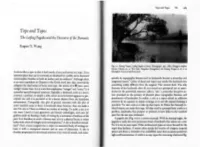
Tope and Topos Tope and T opos The Leifeng Pagoda and the Discourse of the Demonic Eugene Y. Wang Fig. 11.1 Huang Yanpei, Lafeng Pagoda at Sunset. Photograph. 1914. After Zhongguo mingshen (Scenic China), no. 4: West La/u, Hangchow [HangzhouJ, ed. Huang Yanpei ec aI., 2.: 19 A site is often a topos in that it both marks a locus and serves as a topic. It is a (Shanghai: Commercial Press, 1915). common place that can be traversed or inhabited by a public and a rhetorical commonplace familiar to both its ~uthor and his audience.l Although there quently its topographiC features and its landmarks become a secondary and 4 is no exact equivalent in Chinese to the Greek word topos that conveniently tangential matter. Cycles of decay and repair may render the landmark into collapses the dual senses of locus and topic, the notion ofji ~ (site, trace, something widely different from the original. That matters little. The only vestige) comes close. A ji is a site that emphasizes "vestiges" and "traces." It is function of the landmark, after all, is to stand as a perceptual cue or synec a peculiar spatial-temporal construct. Spatially, a landmark, such as a tower, doche for the proverbial construct called a "site," a somewhat deceptive no a terrace, a pavilion, or simply a stele, serves as its territorial signpost or per tion premised on the primacy of physical place, topographic features, and ceptual cue, and it is perceived to be a terrain distinct ftom the humdrum prominence of landmarks. In reality, a site is a topos etched in collective environment.