Cinemas in Crisis Syllabus
Total Page:16
File Type:pdf, Size:1020Kb
Load more
Recommended publications
-

La Mujer Es Cosa De Hombres-Isabel Coixet
50 años de... - La mujer, cosa de hombres. Isabel Coixet. Corto dirigido por Isabel Coixet en torno al tradicional papel de la mujer en la sociedad española y la repercusión que tienen en los medios los delitos por violencia de género. http://www.rtve.es/alacarta/videos/50-anos-de/50-anos-mujer-cosa- hombres/1491834/ Isabel Coixet nació en Sant Adrià del Besós el 9 de abril de 1960. Estudió Historia Contemporánea en la Universidad de Barcelona, trabajó como periodista en la revista Fotogramas . Su afición a la imagen le hace acercarse al mundo del cine, desempeñando diversas tareas y al mundo de la publicidad en el que, tras un tiempo, creará productora propia. Años más tarde, decidida a filmar su primer largometraje, se traslada a Estados Unidos a rodar Cosas que nunca te dije (1996). Un año después, nace su hija Zoe. Es un peso pesado de la industria publicitaria, y dirigió anuncios por todo el mundo: ha sido directora creativa de la agencia JWT, fundadora y directora creativa de la agencia Target y la productora Eddie Saeta, obteniendo los más prestigiosos premios por sus trabajos en este campo. En el año 2000 creó la productora Miss Wasabi Films desde donde también ha realizado destacados documentales -y vídeo clips a los más variados músicos En 2005 realiza La vida secreta de las palabras cuyos protagonistas son Tim Robbins y Sarah Polley. En 2006 formó, junto a otras cineastas como Inés París, Chus Gutiérrez o Icíar Bollaín, CIMA (Asociación de mujeres cineastas y de medios audiovisuales). Isabel ha contado con Penélope Cruz para el papel protagonista de su película Elegy, estrenada en 2008, y basada en una novela de Philip Roth. -

Marta Díaz De Lope Díaz: a Conversation with the Filmmaker
This work is on a Creative Commons Attribution-NonCommercial 4.0 International (CC BY-NC 4.0) license, https://creativecommons.org/licenses/by-nc/4.0/. Access to this work was provided by the University of Maryland, Baltimore County (UMBC) ScholarWorks@UMBC digital repository on the Maryland Shared Open Access (MD-SOAR) platform. Please provide feedback Please support the ScholarWorks@UMBC repository by emailing scholarworks-group@umbc.edu and telling us what having access to this work means to you and why it’s important to you. Thank you. 1 The Passion of Marta Díaz de Lope Díaz: A Conversation with the Filmmaker In her directorial debut, Ronda native Marta Díaz de Lope Díaz takes inspiration from the cartography of her origin for her filmic vision. Her cultural roots anchor her life and filmography, that she has been perfecting over the years of her study and teaching at the ESCAC film school in Barcelona. Her first feature-length film, Mi querida cofradía (Hopelessly Devout), clearly reflects this influence since it drinks and revels in the most traditional celebration of her hometown: Holy Week. Likewise, as can be seen in this interview, the feature establishes an interesting parallel between the passion of the protagonist Carmen (Gloria Muñoz) to realize her dream of leading her Catholic brotherhood and the aspiration of its own Marta Díaz to become a film director. With humor, her cinema masterfully delves into the experiences of women, of their sisterhood, in both the private and public spheres, displaying the obstacles that they encounter when trying to fulfill their goals in a man’s world and exhibiting their skills at overcoming interference. -

Download Press Notes
Strand Releasing presents LION’S DEN A film by PABLO TRAPERO Official Competition, Cannes Film Festival 2008 Official Selection, Toronto Film Festival 2008 Country of Origin: Argentina/In Spanish with English Subtitles Shooting format: Super 35mm / Color Aspect Ratio: 2:35 Sound: Dolby SRD Running Time: 113 minutes LA/National Publicity: Michael Berlin / Marcus Hu Strand Releasing phone: (310) 836-7500 fax: (310) 836-7500 michael@strandreleasing.com marcus@strandreleasing.com Please download photos from our website: http://extranet.strandreleasing.com/login.aspx Synopsis Julia wakes up in her apartment, surrounded by the bloody corpses of Ramiro and Nahuel. Ramiro is still alive; Nahuel is dead. Both have been, obscure and simultaneously, her lovers and one made Julia pregnant. Julia is sent to a prison housing mothers and pregnant inmates. There she spends her first days absorbed and aloof. Two characters enter her life. One is Marta, a fellow inmate who has reared two children in prison and who becomes her guide and counselor; the other is Sofía, Julia’s own mother, an ambiguous character who Julia meets up with again after many years. Sofía attempts to repair the mistakes of the past; she helps her daughter, gets her a good lawyer, sends her baby clothes, and slowly reestablishes her relationship with Julia. The legal case involving the death of Nahuel, has two possible guilty parties: Julia and Ramiro, both in prison in different penitentiaries. Their testimonies are contradictory, one incriminating the other. The child is born, a baby boy whose name is Tomás. Bringing up a child in prison is difficult. -

Walter Salles
Selenium Films / A Contracorriente films / Altiro Films Original title: “La contadora de películas” A film by Isabel Coixet Screenplay by Walter Salles & Isabel Coixet Based on the novel «La Contadora de Películas» of Hernán Rivera Letelier This is the captivating story of Maria Margarita, The story develops hand in hand with a young girl who lives in a mining town nestled relevant cultural events in the history of in the heart of Chile's Atacama Desert in the the town, like the arrival and success of 60s. She has a very special gift — an almost un- cinema exhibition, followed by its decline canny ability to retell movies. Her talent and as the TV arrives. On a broader passion soon spread beyond her impoverished perspective, ‘The Movie-Teller’ portrays the family circle — five siblings and their disabled decay of the historical salt-peter mining father confined to a wheel-chair, who can only towns in the North of Chile. The film afford a ticket for one at the local movie thea- reveals the untold memories buried deep tre— to reach the whole community. People get in our historical roots; we are taught how together to listen Maria Margarita with delight all the dreams and hopes of ordinary and amusement, so they can forget the harsh people are ultimately subjected to the routines of their day-to-day lives. tyranny of fate. « I was immediately touched « It has all the elements by its profound humanity, that fascinate me and that by the innate capacity to blend make me love cinema humor and drama, and, of course, above all things » by its utter passion for film » _ _ Isabel Coixet Walter Salles Production storytelling. -

SEATTLE SEATTLE INTERNATIONAL FILM FESTIVAL for More Information Go To
NEWS FROM EGEDA US Phone: 310 246 0531 Fax: 310 246 1343 Email: egeda-usa@egeda.com SPANISH MOVIES IN USA – JUNE 2013 LOS ANGELES LOS ANGELES INTERNATIONAL FILM FEST For more information go to http://filmguide.lafilmfest.com/tixSYS/2013/xslguide/eventnote.php?EventNumber=5446 I’m So Excited! Thu, June 13 – 7:30 PM (Opening Night) at Regal Cinemas, 1000 W. Olympic Blvd. Dir. Pedro Almodovar - Spain|2012|90 min. Cast: Antonio de la Torre, Hugo Silva, Miguel Ángel Silvestre, Laya Martí, Javier Cámara, Carlos Areces, Raúl Arévalo, José María Yazpik, Guillermo Toledo, José Luis Torrijo, Lola Dueñas, Cecilia Roth, Blanca Suárez When a passenger jet headed for Mexico--which you are free to take or leave as a metaphor for Spain today--develops dangerous mechanical problems, all hell breaks loose in business class. Here we meet an amazing assortment of Almodóvarian characters, including a psychic, a chic dominatrix, a crooked businessman and a soap star. Tending to their peculiar, increasingly frantic needs are a trio of high camp stewards who react to the crisis in ways only the mischievous director could dream up--like lacing their passengers drinks with mescaline. Fasten your seat belts as this bawdy, pointed farce takes us up, up and away. Opens on Friday june 28th in New York & Los Angeles…!!! SEATTLE SEATTLE INTERNATIONAL FILM FESTIVAL For more information go to http://www.siff.net/festival-2013/films-a-to-z?country=Spain Yesterday Never ends Sat, June 1 – 5:30 PM at SIFF Cinema Uptown, 511 Queen Anne Avenue N Dir. Isabel Coixet - Spain|2013|108 min. -
Introduction
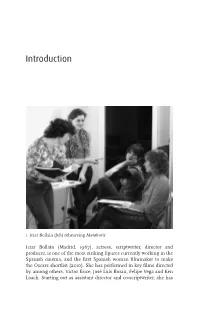
Introduction 1 Iciar Bollaín (left) rehearsing Mataharis Iciar Bollaín (Madrid, 1967), actress, scriptwriter, director and producer, is one of the most striking figures currently working in the Spanish cinema, and the first Spanish woman filmmaker to make the Oscars shortlist (2010). She has performed in key films directed by, among others, Víctor Erice, José Luis Borau, Felipe Vega and Ken Loach. Starting out as assistant director and coscriptwriter, she has Santaolalla_Bollain.indd 1 04/04/2012 15:38 2 The cinema of Iciar Bollaín gone on to make four short films and five feature films to date, all but one scripted or coscripted by her. She is also one of the founding members of Producciones La Iguana S. L., a film production company in existence since 1991. Her work raises questions about authorship, female agency and the mediation in film of social issues. It also highlights the tensions between creative and industrial priori ties in the cinema, and national and transnational allegiances, while prompting reflection on the contemporary relevance of cinéma engagé. Bollaín’s contribution to Spanish cinema has been acknowledged both by filmgoers and the industry. Te doy mis ojos (Take My Eyes, 2003) is one of a handful of Spanish films seen by over one million spectators, and was the first film made by a woman ever to receive a Best Film Goya Award (Spanish Goyaequivalent) from the Academia de las Artes y las Ciencias Cinematográficas de España (Spanish Film Academy).1 Recognition has also come through her election to the Executive Committee of the College of Directors and Scriptwriters of the SGAE (Sociedad General de Autores y Editores) in July 2007, and to the VicePresidency of the Spanish Film Academy in June 2009.2 The varied range of Bollaín’s contribution to Spanish cinema, and the extent to which she is directly involved in key roles associated with filmmaking, inevitably lead to speculation on the extent to which she may be regarded as an auteur. -

La Vida Secreta De Las Palabras, Galardonada Con El XI Premio Cinematográfico José María Forqué
EGEDA BOLETIN 42-43 8/6/06 11:44 Página 1 No 42-43. 2006 Entidad autorizada por el Ministerio de Cultura para la representación, protección y defensa de los intereses de los productores audiovisuales, y de sus derechos de propiedad intelectual. (Orden de 29-10-1990 - B.O.E., 2 de Noviembre de 1990) La vida secreta de las palabras, galardonada con el XI Premio Cinematográfico José María Forqué Una historia de soledad e incomunicación, La vida secreta de las palabras, producida por El Deseo y Mediapro y dirigida por Isabel Coixet, ha sido galardonada con el Premio José María Forqué, que este año ha llegado a su undécima edición. En la gala, celebrada en el Teatro Real el 9 de mayo, La vida secreta de las palabras compartió homenaje con el documental El cielo gira, que se llevó el IV Premio Especial EGEDA, y con el productor Andrés Vicente Gómez, galardonado con la Medalla de Oro (Foto: Pipo Fernández) (Foto: de EGEDA por el conjunto de su carrera. La gala tuvo como maestros de ceremo- cida por Maestranza Films, ICAIC y Pyra- vertirán a los creadores españoles en los nias a Concha Velasco y Jorge Sanz, y con- mide Productions, y dirigida por Benito más protegidos de Europa. tó con la actuación musical del Grupo Sil- Zambrano; Obaba, producida por Oria ver Tones, que interpretó temas de rock Films, Pandora Film y Neue Impuls Film, y Por su parte, el presidente de EGEDA, En- and roll de los años 50 y 60. Esto supone dirigida por Montxo Armendáriz, y Prince- rique Cerezo, entregó la Medalla de Oro una novedad en el escenario del Teatro sas, producida por Reposado PC y Media- de la entidad al veterano productor An- Real, pues es la primera vez que acoge este pro, y dirigida por Fernando León de Ara- drés Vicente Gómez en reconocimiento “a género musical. -

CURRICULUM VITAE Name: María Camí-Vela University
CURRICULUM VITAE Name: María Camí-Vela University Address: University of North Carolina-Wilmington 601 S. College Rd. Wilmington, NC 28403-5954 Tel: (910)962-3342 E-mail: CAMIVELAM@UNCW.EDU I. EDUCATION Ph.D. in Spanish Literature Spring 1995 Romance Languages and Literatures University of Florida Dissertation: La búsqueda de la identidad en la obra de Carme Riera (The Search for Identity in Carme Rieras’s Narrative) Summer 1993 Universidad Complutense Madrid, Spain Course title: “Mujeres Creadoras” (“Women Creators”) M.A. in Spanish Fall 1989 Romance Languages and Literatures University of Florida Master’s Thesis: El feminismo en la obra periodística de Emilia Pardo Bazán (Feminism in Emilia Pardo Bazán’s Journalistic Works) B.A. in Spanish Fall 1986, Romance Languages and Literatures University of Florida Other Studies Fall 1975-Fall 1976 Universidad de Murcia, Spain II. TEACHING EXPERIENCE Professor: 2007- Associate Professor: 2003- 2007 Department of Foreign Languages and Literatures, U. of North Carolina -Wilmington. Assistant Professor: 1997-2003 Department of Foreign Languages and Literatures, U. of North Carolina -Wilmington. III.PUBLICATIONS AND ACADEMIC PRESENTATIONS A. Publications Books Mujeres detrás de la cámara: Entrevistas con cineastas españolas 1990-2004. (Women Behind the Camera: Interviews with Spanish Women Filmmakers 1990-2004.) Madrid: Madrid/Ocho y Medio, 2005. Mujeres detrás de la cámara: Entrevistas con cineastas españolas de la década de los 90. (Women Behind the Camera: Interviews with Spanish Women Filmmakers of the 90’s.) Madrid: Festival de Cine Experimental de Madrid/Ocho y Medio, 2001. La búsqueda de la identidad en la obra literaria de Carme Riera. (The Search for Identity in the Narrative Works of Carme Riera.) Madrid: Pliegos, 2000. -

Elefante Blanco
Rituals of Performance: Ricardo Darín as Father Julián in Elefante blanco Beatriz Urraca Revista de Estudios Hispánicos, Tomo XLVIII, Número 2, Junio 2014, pp. 353-372 (Article) Published by Washington University in St. Louis DOI: https://doi.org/10.1353/rvs.2014.0031 For additional information about this article https://muse.jhu.edu/article/548212 Access provided by University of Washington @ Seattle (8 Jan 2017 05:25 GMT) Shortened Title 353 BEATRIZ URRACA Rituals of Performance: Ricardo Darín as Father Julián in Elefante blanco El actor argentino Ricardo Darín es indiscutiblemente la cara más conocida del cine de su país. Su personalidad pública es un retrato compuesto por elementos intrafílmicos y extrafílmicos, y se caracteriza principalmente por presentarse como una imagen del argentino medio, del hombre de la calle que opina sobre los problemas sociales de su país, interpelando directamente al poder político desde tribunas mediáticas controvertidas. Este artículo analiza cómo estos factores contribuyen a dar forma al papel del Padre Julián en Elefante blanco (Pablo Trapero, 2012) y cómo, a su vez, la marca de celebridad creada por Darín in- teractúa con la figura histórica del Padre Carlos Mugica y con el trabajo de los curas villeros en las villas de emergencia que la película describe. Al igual que el sacerdote a quien representa en la película, el actor habita el espacio entre lo ordinario y lo excepcional, entre la vida privada cotidiana y la actuación como figura pública. Dada la casi total ausencia de estudios sobre el estrellato y el tra- bajo actoral en el cine latinoamericano, este artículo se apoya en textos teóricos referentes a Hollywood, complementándolos con entrevistas con Darín y estudios sociológicos y periodísticos sobre el trabajo de los curas villeros en Argentina. -

Half Title>NEW TRANSNATIONALISMS in CONTEMPORARY LATIN AMERICAN
<half title>NEW TRANSNATIONALISMS IN CONTEMPORARY LATIN AMERICAN CINEMAS</half title> i Traditions in World Cinema General Editors Linda Badley (Middle Tennessee State University) R. Barton Palmer (Clemson University) Founding Editor Steven Jay Schneider (New York University) Titles in the series include: Traditions in World Cinema Linda Badley, R. Barton Palmer, and Steven Jay Schneider (eds) Japanese Horror Cinema Jay McRoy (ed.) New Punk Cinema Nicholas Rombes (ed.) African Filmmaking Roy Armes Palestinian Cinema Nurith Gertz and George Khleifi Czech and Slovak Cinema Peter Hames The New Neapolitan Cinema Alex Marlow-Mann American Smart Cinema Claire Perkins The International Film Musical Corey Creekmur and Linda Mokdad (eds) Italian Neorealist Cinema Torunn Haaland Magic Realist Cinema in East Central Europe Aga Skrodzka Italian Post-Neorealist Cinema Luca Barattoni Spanish Horror Film Antonio Lázaro-Reboll Post-beur Cinema ii Will Higbee New Taiwanese Cinema in Focus Flannery Wilson International Noir Homer B. Pettey and R. Barton Palmer (eds) Films on Ice Scott MacKenzie and Anna Westerståhl Stenport (eds) Nordic Genre Film Tommy Gustafsson and Pietari Kääpä (eds) Contemporary Japanese Cinema Since Hana-Bi Adam Bingham Chinese Martial Arts Cinema (2nd edition) Stephen Teo Slow Cinema Tiago de Luca and Nuno Barradas Jorge Expressionism in Cinema Olaf Brill and Gary D. Rhodes (eds) French Language Road Cinema: Borders,Diasporas, Migration and ‘NewEurope’ Michael Gott Transnational Film Remakes Iain Robert Smith and Constantine Verevis Coming-of-age Cinema in New Zealand Alistair Fox New Transnationalisms in Contemporary Latin American Cinemas Dolores Tierney www.euppublishing.com/series/tiwc iii <title page>NEW TRANSNATIONALISMS IN CONTEMPORARY LATIN AMERICAN CINEMAS Dolores Tierney <EUP title page logo> </title page> iv <imprint page> Edinburgh University Press is one of the leading university presses in the UK. -

Spanish Language Films in the Sfcc Library
SPANISH LANGUAGE FILMS IN THE SFCC LIBRARY To help you select a movie that you will enjoy, it is recommended that you look at the description of films in the following pages. You may scroll down or press CTRL + click on any of the titles below to take you directly to the description of the movie. For more information (including some trailers), click through the link to the Internet Movie Database (www.imdb.com). All films are in general circulation and in DVD format unless otherwise noted. PLEASE NOTE: Many of these films contain nudity, sex, violence, or vulgarity. Just because a film has not been rated by the MMPA, does not mean it does not contain these elements. If you are looking for a film without those elements, consider viewing one of the films on the list on the last page of the document. A Better Life (2011) Age of Beauty / Belle epoque (1992) DVD/VHS All About My Mother / Todo sobre mi madre (1999) Alone / Solas (1999) And Your Mama Too / Y tu mamá también (2001) Aura, The / El aura (2005) Bad Education / La mala educación (2004) Before Night Falls / Antes que anochezca (2000) DVD/VHS Biutiful (2010) Bolivar I Am / Bolívar soy yo (2002) Broken Embraces / Abrazos rotos (2009) Broken Silence / Silencio roto (2001) Burnt Money / Plata quemada (2000) Butterfly / La lengua de las mariposas (1999) Camila (1984) VHS media office Captain Pantoja and the Special Services / Pantaleón y las visitadoras (2000) Carancho (2010) Cautiva (2003) Cell 211 / Celda 211 (2011) Chinese Take-Out(2011) Chronicles / Crónicas (2004) City of No Limits -

La Poética De Pablo Trapero: Impotencia, Catábasis Y Corrosión De La Ley
FOTOCINEMA, nº 21 (2020) E-ISSN: 2172-0150 | | La poética de Pablo Trapero: impotencia, catábasis y corrosión de la ley Pablo Trapero’s poetics: impotence, cathabasis and corrosion of the law Alfredo Dillon Universidad Católica Argentina, Argentina adillon@uca.edu.ar Resumen: El objetivo de este artículo es analizar algunos rasgos de la poética de Pablo Trapero, uno de los directores más relevantes y prolíficos del cine argentino contemporáneo. Para eso se recorta un corpus de cuatro films –El bonaerense (2002), Leonera (2008), Carancho (2010) y El clan (2015)–, representativos de distintas etapas de su filmografía. El estudio apela a una perspectiva autoral, conciliándola con una lectura sociológica de los films. El análisis de la poética autoral de Trapero se despliega en función de tres ejes: la construcción de los personajes, la configuración diegética del hogar familiar y la emergencia de un diagnóstico sobre lo social signado por la corrosión de la ley y la normalización de la transgresión en la Argentina post crisis de 2001. El abordaje autoral aporta a la comprensión del llamado “Nuevo Cine Argentino” y del devenir industrial de algunos de sus representantes, entre quienes Trapero ocupa un lugar destacado. Abstract: The aim of this article is to analyze some features of the poetics of Pablo Trapero, one of the most relevant and prolific directors of contemporary Argentine cinema. For this purpose, we have selected four films –El bonaerense (2002), Lion’s Den (2008), Carancho (2010) and The Clan (2015)– that are representative of different stages of his filmography. The study appeals to an authorial perspective, as well as a sociological approach of the films.