Ukraine's Upcoming Elections: a Pivotal Moment Hearing
Total Page:16
File Type:pdf, Size:1020Kb
Load more
Recommended publications
-

Natural-Gas Trade Between Russia, Turkmenistan, and Ukraine
Asian Cultures and Modernity Research Reports Editorial Board Birgit N. Schlyter (Editor-in-chief) Merrick Tabor (Associate editor) Mirja Juntunen (Associate editor) Johan Fresk (Assistant) International Advisory Board Prof. Ishtiaq Ahmed (Stockholm University, Sweden) Dr. Bayram Balcı (Inst. français d’étude sur l’Asie centrale, Uzbekistan) Dr. Ooi Kee Beng (Institute of Southeast Asian Studies, Singapore) Datuk Prof. Dr. Shamsul A.B. (Universiti Kebangsaan Malaysia) The Asian Cultures and Modernity Research Group A plethora of state- and nation-building programmes are being developed in present- day Asia, where governments have to consider the regionality of old ethno-cultural identities. While the cohesive power of traditions must be put into use within a particular nation, that same power challenges its national boundaries. To soften this contradiction, economic and/or political regionalism, in contrast to isolationism and globalism, becomes a solution, suggesting new and exciting routes to modernity. In studies conducted by the Asian Cultures and Modernity Research Group at Stockholm University, sociolinguistic and culture-relativistic perspectives are applied with the support of epistemological considerations from the field of political science. Department of Oriental Languages Stockholm University SE-106 91 Stockholm E-mail: asiancultures@orient.su.se ISSN 1651-0666 ISBN 978-91-976907-2-0 Asian Cultures and Modernity Research Report No. 15 Natural-Gas Trade between Russia, Turkmenistan, and Ukraine Agreements and Disputes by Michael Fredholm Department of South and Central Asian Studies Stockholm University Editorial Note The author has written extensively on the history, defence and security policies, and energy sector developments of Eurasia. He also heads the business research company Team Ippeki. -

Draft Version
DRAFT VERSION Table of Contents Recent Trends and Patterns in FCPA Enforcement Enforcement Actions and Strategies 1 Statistics 1 Geography & Industries 10 Types of Settlements 12 Elements of Settlements 14 Case Developments 16 Perennial Statutory Issues 18 Jurisdiction 18 Foreign Officials 19 Public International Organizations 19 Parent-Subsidiary Liability 20 Anything of Value 21 Compliance Guidance 23 FCPA Pilot Program 23 Yates Memo – One Year Later 24 Finding the Right Amount of Voluntary Disclosure 25 Effective Internal Controls and Declinations 25 Confidentiality Clauses in Termination Agreements and Other Restrictions on Whistleblowers 25 Slow Compliance Program Rollouts 26 Unusual Developments 27 Trump’s Impact on FCPA Enforcement 27 Biomet DPA Breach 28 DOJ Returns $1.5 Million in Forfeited Proceeds 29 Limits on SEC’s Pursuit of Disgorgement and Declaratory Relief: SEC v. Graham 29 Disclosure of Compliance Monitor Reports: 100Reporters LLC v. DOJ & United States v. HSBC Bank United States, NA 30 Private Litigation 31 i Table of Contents Recent Trends and Patterns in FCPA Enforcement Enforcement in the United Kingdom 32 U.K. Government Creating New “Failure to Prevent” Offences 32 SFO Update – Second UK DPA Approved 32 SFO Admits One-Third Discounts on DPA Penalties Insufficient to Incentivize Self-Reporting and Offers Practical Guidance on DPAs 33 SFO – Continuing Uncertainty Over Approach to Internal Investigations 34 SFO – Former Sweett Group Executive Convicted for Destroying Evidence 35 Conclusion 36 ii Recent Trends and Patterns in FCPA Enforcement The 2016 FCPA enforcement year has left us no shortage of topics to discuss. By nearly any measure, 2016 has been a banner year for FCPA enforcement. -

The Pennsylvania State University Schreyer Honors College
THE PENNSYLVANIA STATE UNIVERSITY SCHREYER HONORS COLLEGE DEPARTMENT OF GLOBAL AND INTERNATIONAL STUDIES OLIGARCHIC PLURALISM IN THE 2014 EUROMAIDAN: HOW THE RISE OF OLIGARCHS IN GOVERNMENT SHAPED DEMOCRACY UN UKRAINE SIOBHAN FRANCES LEONARD SPRING 2020 A thesis Submitted in partial fulfillment of the requirements for a baccalaureate degree with honors in Comparative Literature and International Studies with honors in Global and International Studies Reviewed and approved* by the following: JOSEPH WRIGHT PROFESSOR OF POLITICAL SCIENCE Thesis Supervisor JONATHAN ABEL PROFESSOR OF COMPARATIVE LITERATURE AND JAPANESE Honors Adviser * Electronic approvals are on file. ABSTRACT During the 1990s, Ukraine experienced a change in its political system, becoming a nominal liberal democratic with contested multiparty elections in combination with post-Soviet oligarch community. These newly established dimensions impacted two major revolutionary periods in Ukraine, dating from 1992-2004 and 2005-2014, reaching a climax of violent civil unrest during the Ukrainian Revolution of 2014. The Ukrainian Revolution, also known as the Euromaidan and Revolution of Dignity, illustrates the stages of modernization in a post-Soviet society. The Euromaidan mobilized a variety of regional and ethno-linguistic groups to demand political and economic reform. Members of oligarch clans, consisting mostly of ethnically Russian economic elites, are often appointed in regional government positions largely in the East, and hold substantial power in Ukrainian politics. My research question poses: “How did oligarchic concentration of economic and media power influence government functions such as public service delivery, and shape corruption patterns preceding the protest uprising in 2014?” In my thesis, I seek to study the impact of oligarch clans as holding centralized power, and how this system may affect Ukrainian national politics as seen under the leadership of former democratically elected, Pro-Russian president, Viktor Yanukovych, during the Ukrainian Revolution of 2014. -

Ukrainian Oil and Gas Wars: a History of Corruption, a Future of Doubts
Ukrainian Oil and Gas Wars: A History of Corruption, a Future of Doubts If anyone knows the ins and outs of Ukraine’s oil and gas industry, it’s Olena Tregub. Tregub, originally from the Ukraine, has spent the past several years working in Washington, DC as an independent political analyst and expert on Ukrainian oil and gas. She has written on topics about the Ukrainian economy for the Institute for Euro-Atlantic Cooperation in the Ukraine, a political action group supporting Ukraine’s EU integration. And when asked for her opinion on the current state of the country’s oil and gas business, she doesn’t mince words. “Traditionally, the industry has been about as transparent as a black box,” she says. “Only a few analysts in the whole country of Ukraine understand the oil and gas business. It’s been so complex and corrupt that it’s considered a state secret.” That may sound like an exaggeration, but to the handful of analysts familiar with the country’s history of government and business corruption, especially among oil and gas barons who have stolen billions from deals with Russia’s Gazprom, “black box” is an apt description. Ever since Ukraine established independence in the early 1990s, the country has struggled for economic viability, losing manufacturing market share and accumulating massive oil and gas debt. Most experts agree that the key to Ukraine’s long-term stability is a combination of energy independence and massive economic and democratic reforms. Ukraine is home to Europe’s third-largest shale gas reserves at 42 trillion cubic feet, according to the U.S. -
UPDATE: Developments in the Ukraine
22 April 2014 UPDATE: Developments in the Ukraine Practice Group(s): Further to the alerts circulated on 10, 18, and 21 March 2014, below is an update on International developments in the EU and U.S. regarding sanctions. Arbitration European Regulatory/ EU Sanctions UK Regulatory On 14 April 2014, the EU Foreign Affairs Ministers identified four additional individuals as International Trade responsible for misappropriation of Ukrainian state funds and added them to the list, Global Government subject to restrictive measures in view of the situation in Ukraine. The individuals, Solutions together with the reasons for their inclusion in the list of persons subject to the restrictive measures as described in the EU legislation, are as follows: 1. Serhiy Arbuzov (d.o.b 24.03.1976, former Prime Minister of Ukraine) Person subject to investigation in Ukraine for involvement in crimes in connection with the embezzlement of Ukrainian State funds and their illegal transfer outside Ukraine. 2. Yuriy Ivanyushchenko (d.o.b 21.02.1959, Party of Regions MP.) Person subject to investigation in Ukraine for involvement in crimes in connection with the embezzlement of Ukrainian State funds and their illegal transfer outside Ukraine. 3. Oleksandr Klymenko (d.o.b 16.11.1980, former Minister of Revenues and Charges.) Person subject to investigation in Ukraine for involvement in crimes in connection with the embezzlement of Ukrainian State funds and their illegal transfer outside Ukraine. 4. Edward Stavytskyi (d.o.b 4.10.1972, former Minister of Fuel and Energy of Ukraine.) Person subject to investigation in Ukraine for involvement in crimes in connection with the embezzlement of Ukrainian State funds and their illegal transfer outside Ukraine. -

The Battle for Ukraine's Energy Allegiance
>> POLICY BRIEF ISSN: 1989-2667 Nº 55 - SEPTEMBER 2010 The battle for Ukraine’s energy allegiance Natalia Shapovalova As the main route for Russian gas into Europe, Ukraine is vital to >> both European and Russian energy security. The European Union (EU) seeks to secure gas supplies through Ukraine by integrating its east - HIGHLIGHTS ern neighbour into the European energy market.Russia is seeking to pre - vent EU-led reforms in Ukraine in order to secure stable gas export • Ukraine has taken some steps incomes and continue exerting power over its ‘sphere of privileged inter - to reform its energy sector and est’. Ukraine’s elite does not wish for reform, but maintaining the status integrate in the EU market, but quo is no longer tenable either. Ukraine is increasingly forced to choose reform goes too slowly; the between the energy security guarantees of the EU and Russia. country's energy sector remains ineffective, opaque and corrupt. UKRAINE MOVES CLOSER TO EUROPEAN ENERGY MARKETS... • Russia is looking to take over Ukraine's energy market: Ukraine’s new president Victor Yanukovych is often represented as pro- energy-inefficient Ukraine Russian in contrast with his predecessor Victor Yushchenko and ex- remains one of Gazprom’s prime minister Yulia Tymoshenko. But in terms of relations with the largest client s. EU, his government has managed to fulfil some promises that were not upheld by his ostensibly pro-European predecessors. In July, the • Energy is in the centre of Ukrainian parliament adopted a new law on the Ukrainian gas sector, EU policy and aid to Ukraine, aligning Ukraine with EU requirements and legislation. -
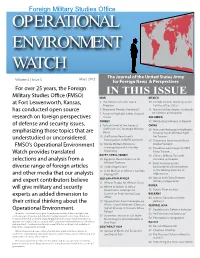
Operational Environment Watch
Foreign Military Studies Office OPERATIONAL ENVIRONMENT WATCH May | 2012 The Journal of the United States Army Volume 2 | Issue 5 for Foreign News & Perspectives For over 25 years, the Foreign IN THIS ISSUE Military Studies Office (FMSO) IRAN MEXICO 3 The Genesis of Iran’s Space 29 Female Sicarias Working at the at Fort Leavenworth, Kansas, Program Service of Los Zetas has conducted open source 5 Khamenei Permits Facebook? 31 Narcos Utilize Snipers in Attacks 7 Protests Highlight Labor Discord on Soldiers and Marines research on foreign perspectives in Iran COLOMBIA TURKEY 33 Ratcheting Violence in Bogota of defense and security issues, 8 Turkish Chief of the General CHINA Staff visits U.S. Strategic Military 35 National Newspaper Highlights emphasizing those topics that are Bases Finding: Youth Will Not Fight 10 Did Turkey Veto Israel’s For Taiwan understudied or unconsidered. Participation in NATO Summit? 37 Taiwanese Concerned About FMSO’s Operational Environment 12 Media-Military Relations: Media Freedom Training Journalists for War 39 Troubles Loom Large for KMT Watch provides translated Reporting Party, Taiwan EGYPT, SYRIA, YEMEN 40 China’s Military Ties with selections and analysis from a 14 Egyptian Media Reacts to US Australia to Deepen Military Training 41 Brief Analysis on the diverse range of foreign articles 16 Syria’s Eager Lion? Environment of Investment 18 Is Ali Muhsin al-Ahmar’s Gamble in the Mining Industry in and other media that our analysts Paying Off? Afghanistan SUB-SAHARAN AFRICA 44 Russia and China Deepen and expert contributors believe 21 African Troops for African Crises Military Cooperation will give military and security 24 Where to Watch in Africa: KOREA Mauritania’s Attempts to 46 Putin’s Pivot to Asia experts an added dimension to Launch an Arab Spring Coup BALKANS d’Etat 48 Islamic Transversal in the their critical thinking about the 25 Perspectives from Francophone Balkans? Africa: Does Hollande’s Election CENTRAL ASIA Operational Environment. -

Russia's Cutoff of Natural Gas to Ukraine
Order Code RS22378 February 15, 2006 CRS Report for Congress Received through the CRS Web Russia’s Cutoff of Natural Gas to Ukraine: Context and Implications Jim Nichol and Steven Woehrel Foreign Affairs, Defense, and Trade Division Bernard A. Gelb Resources, Science, and Industry Division Summary This report examines issues surrounding Russia’s request for higher prices for natural gas that it exports to Ukraine, which culminated in Russia’s temporary cutoff of supplies to Ukraine in January 2006. Implications for the two countries and for U.S. interests are explored. The report may be updated as events warrant. Related products include CRS Report RL32845, Ukraine’s Orange Revolution and U.S. Policy, by Steven Woehrel; and CRS Issue Brief IB92089, Russia, by Stuart D. Goldman. Background: Russian Energy and Pipelines Russia is a major player in world energy markets. In 2004, its 1,700 trillion cubic feet (tcf) of natural gas reserves were the largest of any country; they are 74% greater than those of Iran, holder of the next largest reserves. Russia also is the world’s largest gas producer, the world’s largest gas exporter, and the second largest oil exporter. Energy exports have been a major driver of Russia’s economic growth in recent years, making the Russian economy vulnerable to energy price fluctuations. The natural gas sector, however, is impaired by ageing fields, near total domination by Gazprom (the state-run gas monopoly), government regulation, and inadequate export pipelines, which are operated by Gazprom. Thus, Russia’s gas production has risen only modestly since the late 1990s. -

Ukraine Sliding from Oligarchy to Cronyism
Ukraine Sliding From Oligarchy to Cronyism Publication: Eurasia Daily Monitor Volume: 10 Issue: 8 January 16, 2013 04:41 PM Age: 2 hrs By: Taras Kuzio President Viktor Yanukovych (Source: president.gov.ua) The recent appointment of a second government led by Prime Minister Nikolai Azarov confirms Ukraine’s evolution from an oligarchy to a cronyist state whereby positions of power are increasingly being accorded to “the Family,” composed of President Viktor Yanukovych’s close relatives and loyal associates from his home town of Yenakiyeve in Donetsk oblast (see EDM, December 2, 2011). “The Family” is orchestrated by the president’s eldest son, Oleksandr (http://www.pravda.com.ua/articles/2012/12/25/6980434/). Azarov is not a “Family” member and heads a caretaker government. However, twelve positions have been allocated to “The Family,” facilitating the privatization of the state budget and security forces. Illustratively, former National Bank of Ukraine (NBU) Chairman Serhiy Arbuzov was made first deputy prime minister, a position from which he is likely to rise to prime minister. The new NBU Chairman Ihor Sorkin was born in Donetsk and in 2002–2010 headed the Donetsk branch of NBU. Sorkin’s wife, Angela, is the deputy head of UkrBiznesBank, now owned by Oleksandr Yanukovych but headed by Arbuzov until 2010. Both Angela Arbuzov and Oleksandr Yanukovych are (bizarrely) dentists by profession, and Oleksandr entered Ukraine’s top 100 wealthiest people in 2011, a year after his father came to power. Ihor Sorkin’s parents live in Moscow and his father is employed by a Gazprom entity whose affiliate in Donetsk employs Ihor’s sister (http://www.pravda.com.ua/articles/2013/01/11/6981269/). -

Energy Politics of Ukraine: Domestic and International Dimensions
ENERGY POLITICS OF UKRAINE: DOMESTIC AND INTERNATIONAL DIMENSIONS A THESIS SUBMITTED TO THE GRADUATE SCHOOL OF SOCIAL SCIENCES OF MIDDLE EAST TECHNICAL UNIVERSITY BY ANASTASIYA STELMAKH IN PARTIAL FULFILLMENT OF THE REQUIREMENTS FOR THE DEGREE OF DOCTOR OF PHILOSOPHY IN THE DEPARTMENT OF INTERNATIONAL RELATIONS MAY 2016 i ii Approval of the Graduate School of Social Sciences Prof. Dr. Meliha B. Altunışık Director I certify that this thesis satisfies all the requirements as a thesis for the degree of Doctor of Philosophy. Prof. Dr. Özlem Tür Head of Department This is to certify that we have read this thesis and that in our opinion it is fully adequate, in scope and quality, as a thesis for the degree of Doctor of Philosophy. Prof. Dr. Oktay F. Tanrısever Supervisor Examining Committee Members Prof. Dr. Meliha B. Altunışık (METU, IR) Prof. Dr. Oktay F. Tanrısever (METU, IR) Prof. Dr. Hüseyin Bağcı (METU, IR) Prof. Dr. Fırat Purtaş (GAZI U., IR) Assist. Prof. Dr. Yuliya Biletska (KARABÜK U., IR) iii I hereby declare that all information in this document has been obtained and presented in accordance with academic rules and ethical conduct. I also declare that, as required by these rules and conduct, I have fully cited and referenced all material and results that are not original to this work. Name, Last name : Anastasiya Stelmakh Signature : iii ABSTRACT ENERGY POLITICS OF UKRAINE: DOMESTIC AND INTERNATIONAL DIMENSIONS Stelmakh, Anastasiya Ph.D., Department of International Relations Supervisor: Prof. Dr. Oktay F. Tanrısever May 2016, 349 pages This PhD thesis aims to analyze domestic and international dimensions of Ukraine’s energy politics. -

Eu Misappropriation Sanctions Ten Years on Factsheet 2021
CIVIL FORUM FOR ASSET RECOVERY Köpenicker Str. 147, 10997 Berlin, Germany Registry Number VR 34993 B Amtsgericht Berlin, Charlottenburg EU MISAPPROPRIATION SANCTIONS TEN YEARS ON FACTSHEET 2021 1. BACKGROUND Following the revolutions in 2011 in Tunisia and Egypt and 2014 in Ukraine, the Council of the European Union imposed misappropriation sanctions on people suspected of corruption from the ousted regimes. These require that any assets relating to people on the list, including real estate and bank accounts, are frozen in all EU Member States and that no funds or economic resources shall be made available to them. These sanctions were imposed on former rulers, as well as on their families and entourages, in order to prevent these assets from being transferred outside of the EU and hidden again and had the purpose of: • Preventing the flight of suspected stolen public assets by former regime elites, through freezing the assets, thereby making it possible to recover the assets at a later stage; • Stabilising the post-revolutionary leaderships and new governments in Cairo, Tunis and Kiev. Sanctions are imposed by the Council of the EU to promote the objectives of the Common Foreign and Security Policy: peace, democracy, and the respect for the rule of law, human rights and international law. Each year, the Council of the EU decides whether these sanctions should be renewed, amended or lifted. 2. EVOLUTION OF LISTINGS Due to the need of the EU to rely on third countries to provide evidence of corruption, and crucially, the high number of legal challenges that sanctioned individuals have brought in front of European courts, which often ruled in favour of annulling listings due to insufficient substantiation, the number of listed individuals has significantly decreased over the years. -

Oligarchs After the Maidan: the Old System in a 'New' Ukraine
Centre for Eastern Studies NUMBER 162 | 16.02.2015 www.osw.waw.pl Oligarchs After The Maidan: The Old System In A ‘New’ Ukraine Wojciech Konończuk There have been major changes in the balance of forces among the key Ukrainian oligarchs, rep- resentatives of big business with strong political influence, since the victory of the Maidan revo- lution. However, these changes have not undermined the oligarchic system per se. Over the past decade or so, the oligarchs have been key players in Ukrainian politics and economy, and they have retained this position until the present. One of the effects of the change of the government in Kyiv and the war in the Donbas was the elimination of the influence of ‘the family’ – the people from Viktor Yanukovych’s inner circle who formed the most expansive oligarchic group in Ukraine at the time of his presidency. The influence of Rinat Akhmetov, the country’s wealthiest man, has also weakened significantly; Akhmetov was one of the most influential people in Ukraine for more than ten years, partly owing to his close bonds with Yanukovych. Dmytro Firtash’s group has also lost a great deal of its influence since Firtash was arrested in Austria in March 2014. The elimination (‘the family’) or the reduction in influence (Akhmetov and Firtash) of what were until recently the most powerful oligarchic groups has been accompanied over the past few months by an unprecedented increase in the influence of Ihor Kolomoyskyi. The present governor of Dnipropetrovsk oblast has become Ukraine’s most powerful oligarch, and has am- bitions to expand his influence.