District Climate and Energy Plan for Bardiya District 1 ` DISTRICT
Total Page:16
File Type:pdf, Size:1020Kb
Load more
Recommended publications
-

Code Under Name Girls Boys Total Girls Boys Total 010290001
P|D|LL|S G8 G10 Code Under Name Girls Boys Total Girls Boys Total 010290001 Maiwakhola Gaunpalika Patidanda Ma Vi 15 22 37 25 17 42 010360002 Meringden Gaunpalika Singha Devi Adharbhut Vidyalaya 8 2 10 0 0 0 010370001 Mikwakhola Gaunpalika Sanwa Ma V 27 26 53 50 19 69 010160009 Phaktanglung Rural Municipality Saraswati Chyaribook Ma V 28 10 38 33 22 55 010060001 Phungling Nagarpalika Siddhakali Ma V 11 14 25 23 8 31 010320004 Phungling Nagarpalika Bhanu Jana Ma V 88 77 165 120 130 250 010320012 Phungling Nagarpalika Birendra Ma V 19 18 37 18 30 48 010020003 Sidingba Gaunpalika Angepa Adharbhut Vidyalaya 5 6 11 0 0 0 030410009 Deumai Nagarpalika Janta Adharbhut Vidyalaya 19 13 32 0 0 0 030100003 Phakphokthum Gaunpalika Janaki Ma V 13 5 18 23 9 32 030230002 Phakphokthum Gaunpalika Singhadevi Adharbhut Vidyalaya 7 7 14 0 0 0 030230004 Phakphokthum Gaunpalika Jalpa Ma V 17 25 42 25 23 48 030330008 Phakphokthum Gaunpalika Khambang Ma V 5 4 9 1 2 3 030030001 Ilam Municipality Amar Secondary School 26 14 40 62 48 110 030030005 Ilam Municipality Barbote Basic School 9 9 18 0 0 0 030030011 Ilam Municipality Shree Saptamai Gurukul Sanskrit Vidyashram Secondary School 0 17 17 1 12 13 030130001 Ilam Municipality Purna Smarak Secondary School 16 15 31 22 20 42 030150001 Ilam Municipality Adarsha Secondary School 50 60 110 57 41 98 030460003 Ilam Municipality Bal Kanya Ma V 30 20 50 23 17 40 030460006 Ilam Municipality Maheshwor Adharbhut Vidyalaya 12 15 27 0 0 0 030070014 Mai Nagarpalika Kankai Ma V 50 44 94 99 67 166 030190004 Maijogmai Gaunpalika -
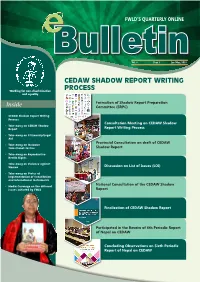
CEDAW Shadow Report Writing Process Consultation Meeting on CEDAW Shadow • Take Away on CEDAW Shadow Report Report Writing Process
FWLD’S QUARTERLY ONLINE BulletinVol. 8 Year 3 Jan-Mar, 2019 CEDAW SHADOW REPORT WRITING Working for non-discrimination PROCESS and equality Formation of Shadow Report Preparation Inside Committee (SRPC) • CEDAW Shadow Report Writing Process Consultation Meeting on CEDAW Shadow • Take away on CEDAW Shadow Report Report Writing Process • Take away on Citizenship/Legal Aid Provincial Consultation on draft of CEDAW • Take away on Inclusive Transitional Justice Shadow Report • Take away on Reproductive Health Rights • Take away on Violence against Women Discussion on List of Issues (LOI) • Take away on Status of Implementation of Constitution and International Instruments National Consultation of the CEDAW Shadow • Media Coverage on the different issues initiated by FWLD Report Finalization of CEDAW Shadow Report Participated in the Reveiw of 6th Periodic Report of Nepal on CEDAW Concluding Observations on Sixth Periodic Report of Nepal on CEDAW Take away on CEDAW SHADOW REPORT A productive two days consultative meeting on CEDAW obligations on 2nd and 3rd October 2018. Submission of CEDAW Press meet on CEDAW Shadow Report CEDAW Shadow Report Preparation Committee coordinated by FWLD has submitted the CEDAW Shadow Report and the A press meet was organized on 11th Oct. 2018 to report has been inform media about reporting process of Shadow uploaded in Report on Sixth Periodic Report of Nepal on CEDAW. The timeline of review of the report and its OHCHR’s website on outcome was also discussed. October 1st 2018. NGO Briefs and Informal Country meeting on the Lunch Meeting role of civil society in the 71st Session of CEDAW A country meeting was organized to discuss about the role of civil society in the 71st Session of CEDAW on 11th Oct, 2018. -

Unicef Nepal
-.;*• la 8 2 2 N P 7 5 '\ gà| UNICEF NEPAL WATER RESOURCE AVAILABILITY By S. Radojicic •••-• <*, 1975 LIB RA a Y !»<; • ¿I Roiere'iee Centre for GuiiiiM unity VVaier Supply WATER SUPPLY MD SANITATION SECTOR STUDY - NEPAL NP I'S WATER RESOURCE AVAILABILITY by S. RODOJICIC UNICEF Hy&rodeologist 1975 Li;:-- •' tnj -: • ••.•..V¡..*¡ t , ; :• . ,¡w »'.;•<;f- supply CONTENTS SUMMARY 1 - V RECOMMENDATIONS VI - IX INTRODUCTION ...,..,,, 1 1. SURFACE WATER OCCURRENCES „(liijàt ! 2. GROUND WATER OCCURRENCES ,..***,*. 5 2.1. Mountain complex ..............,..,........*.****,»*«** 5 2.1.1. High Himalayas *..*..*.. 6 2.1.2. Midland Zone 7 2.1.3. Mahabharat Range 13 2.1.4. Churia Hills „,., 14 2.2. Terai Region 15 2.2.1. Eastern Terai 17 2.2.2. Central Terai 18 2.3-2. Western Terai 19 2.2.3.1. Lumbini Zone 19 2.2.3.2. .Bkeri Zone 22 2.2.3.3. Seti-Mahakali Zone 24 3. FEASIBILITY OF TAPPING GROUND WATER IN THE TJ3RAI BY SHlJjLOW TUBE WELLS 24 3.1. Hydrogeological Conditions 26 3.2. Drilling Method and Equipment Required 29 3.3. Well Design, Construction and Cost .....30 4. GOVERNMENT AGENCIES INVOLVED IN THE WATER RESOURCES EXPLORATION AND EXPLOITATION . .*, 35 4.1. Water Supply and Sewerage Board ,.35 4.2. Water Supply and Sewerage Department 36 4.3. Remote Area and Local Development Department 39 4.4. Ground Water Section 40 4.5. Nepal Resettlement Co ,42 4.6 Constractors Service Available in Nepal ...4...42 REFERENCES SUMMARY x I. In Nepal there are real feasibilities the water supply of people to be settled by developing two water resources: surface and ground waters. -

Logistics Capacity Assessment Nepal
IA LCA – Nepal 2009 Version 1.05 Logistics Capacity Assessment Nepal Country Name Nepal Official Name Federal Democratic Republic of Nepal Regional Bureau Bangkok, Thailand Assessment Assessment Date: From 16 October 2009 To: 6 November 2009 Name of the assessors Rich Moseanko – World Vision International John Jung – World Vision International Rajendra Kumar Lal – World Food Programme, Nepal Country Office Title/position Email contact At HQ: WFP.LogisticsFSU@wfp.org 1/105 IA LCA – Nepal 2009 Version 1.05 TABLE OF CONTENTS 1. Country Profile....................................................................................................................................................................3 1.1. Introduction / Background.........................................................................................................................................5 1.2. Humanitarian Background ........................................................................................................................................6 1.3. National Regulatory Departments/Bureau and Quality Control/Relevant Laboratories ......................................16 1.4. Customs Information...............................................................................................................................................18 2. Logistics Infrastructure .....................................................................................................................................................33 2.1. Port Assessment .....................................................................................................................................................33 -

Maternal Health Care in Nepal: Trends and Determinants
Maternal Health Care in Nepal: Trends and Determinants DHS Further Analysis Reports No. 118 DHS Further Analysis Reports No. 118 Maternal Health Care in Nepal: Trends and Determinants Krishna Kumar Aryal1 Sharad K Sharma2 Mukti Nath Khanal3 Bihungum Bista4 Shiv Lal Sharma2 Shambhu Kafle5 Mona Mehta Steffen6 ICF Rockville, Maryland, USA January 2019 1 DFID/NHSP3/MEOR, Abt Associates 2 Department of Health Services, Ministry of Health and Population, Nepal 3 Population Division, Ministry of Health and Population, Nepal 4 Nepal Health Research Council 5 Health Coordination Division, Ministry of Health and Population, Nepal 6 The DHS Program, ICF Corresponding author: Krishna Kumar Aryal, DFID Nepal Health Sector Programme 3 (NHSP3), Monitoring, Evaluation and Operational Research (MEOR) Project, Abt Associates, Lalitpur-10, Lalitpur, Nepal; phone: +977 9851123730; email: krishna.aryal@abtassoc.com.au. Ministry of Health and Population Acknowledgments: The authors would like to thank DFID Nepal for its support and technical assistance in producing this report. We would like to sincerely acknowledge the support from Joseph James (Abt Britain), Scott Roantree (Abt Britain), and Peter Godwin (DFID/NHSP3/MEOR Project) to produce this report. Special thanks are extended to Dr. Sharad K Sharma and Mr. Mukti Nath Khanal from MoHP for steering the overall report write up. We also extend our gratitude to Tom Fish (ICF) for creating a comparable Province indicator for the 2011 Nepal DHS survey, and to Kerry MacQuarrie (Avenir Health) and Jennifer Yourkavitch (ICF) for their assistance with the tables and graphics in the report. We further express gratitude to the reviewers of this study, Lindsay Mallick (Avenir Health), Sabita Tuladhar and Shilu Adhikari (USAID), and Punya Paudel (Family Welfare Division/MoHP). -

Achhame, Banke, Chitwan, Kathmandu, and Panchthar Districts
Technical Assistance Consultant’s Report Project Number: 44168-012 Capacity Development Technical Assistance (CDTA) October 2013 Nepal: Mainstreaming Climate Change Risk Management in Development (Financed by the Strategic Climate Fund) District Baseline Reports: Department of Local Infrastructure Development and Agricultural Roads (DOLIDAR) Achhame, Banke, Chitwan, Kathmandu, and Panchthar Districts Prepared by ICEM – International Centre for Environmental Management This consultant’s report does not necessarily reflect the views of ADB or the Government concerned, and ADB and the Government cannot be held liable for its contents. (For project preparatory technical assistance: All the views expressed herein may not be incorporated into the proposed project’s design. MOSTE | Mainstreaming climate change risk management in development | DoLIDAR District Baseline TA – 7984 NEP October, 2013 Mainstreaming Climate Change Risk Management in Development 1 Main Consultancy Package (44768-012) ACHHAM DISTRICT BASELINE: DEPARTMENT OF LOCAL INFRASTRUCTURE DEVELOPMENT & AGRICULTURAL ROADS (DOLIDAR) Prepared by ICEM – International Centre for Environmental Management METCON Consultants APTEC Consulting Prepared for Ministry of Science, Technology and Environment, Government of Nepal Environment Natural Resources and Agriculture Department, South Asia Department, Asian Development Bank Version B 1 MOSTE | Mainstreaming climate change risk management in development | DoLIDAR District Baseline TABLE OF CONTENTS 1 ACHHAM DISTRICT .......................................................................................................... -
Forests and Watershed Profile of Local Level (744) Structure of Nepal
Forests and Watershed Profile of Local Level (744) Structure of Nepal Volumes: Volume I : Forest & Watershed Profile of Province 1 Volume II : Forest & Watershed Profile of Province 2 Volume III : Forest & Watershed Profile of Province 3 Volume IV : Forest & Watershed Profile of Province 4 Volume V : Forest & Watershed Profile of Province 5 Volume VI : Forest & Watershed Profile of Province 6 Volume VII : Forest & Watershed Profile of Province 7 Government of Nepal Ministry of Forests and Soil Conservation Department of Forest Research and Survey Kathmandu July 2017 © Department of Forest Research and Survey, 2017 Any reproduction of this publication in full or in part should mention the title and credit DFRS. Citation: DFRS, 2017. Forests and Watershed Profile of Local Level (744) Structure of Nepal. Department of Forest Research and Survey (DFRS). Kathmandu, Nepal Prepared by: Coordinator : Dr. Deepak Kumar Kharal, DG, DFRS Member : Dr. Prem Poudel, Under-secretary, DSCWM Member : Rabindra Maharjan, Under-secretary, DoF Member : Shiva Khanal, Under-secretary, DFRS Member : Raj Kumar Rimal, AFO, DoF Member Secretary : Amul Kumar Acharya, ARO, DFRS Published by: Department of Forest Research and Survey P. O. Box 3339, Babarmahal Kathmandu, Nepal Tel: 977-1-4233510 Fax: 977-1-4220159 Email: info@dfrs.gov.np Web: www.dfrs.gov.np Cover map: Front cover: Map of Forest Cover of Nepal FOREWORD Forest of Nepal has been a long standing key natural resource supporting nation's economy in many ways. Forests resources have significant contribution to ecosystem balance and livelihood of large portion of population in Nepal. Sustainable management of forest resources is essential to support overall development goals. -

The Kamaiya System of Bonded Labour in Nepal
Nepal Case Study on Bonded Labour Final1 1 THE KAMAIYA SYSTEM OF BONDED LABOUR IN NEPAL INTRODUCTION The origin of the kamaiya system of bonded labour can be traced back to a kind of forced labour system that existed during the rule of the Lichhabi dynasty between 100 and 880 AD (Karki 2001:65). The system was re-enforced later during the reign of King Jayasthiti Malla of Kathmandu (1380–1395 AD), the person who legitimated the caste system in Nepali society (BLLF 1989:17; Bista 1991:38-39), when labourers used to be forcibly engaged in work relating to trade with Tibet and other neighbouring countries. In the 18th and 19th centuries, the Gorkhali and Rana rulers introduced and institutionalised new forms of forced labour systems such as Jhara,1 Hulak2, Beth3 and Begar4 (Regmi, 1972 reprint 1999:102, cited in Karki, 2001). The later two forms, which centred on agricultural works, soon evolved into such labour relationships where the workers became tied to the landlords being mortgaged in the same manner as land and other property. These workers overtimes became permanently bonded to the masters. The kamaiya system was first noticed by anthropologists in the 1960s (Robertson and Mishra, 1997), but it came to wider public attention only after the change of polity in 1990 due in major part to the work of a few non-government organisations. The 1990s can be credited as the decade of the freedom movement of kamaiyas. Full-scale involvement of NGOs, national as well as local, with some level of support by some political parties, in launching education classes for kamaiyas and organising them into their groups culminated in a kind of national movement in 2000. -
Chapter 3 the Missing and Needs of Families
. Addressing the needs of families of the Missing: A test of contemporary approaches to transitional justice Simon Robins PhD Post-war Recovery Studies University of York Post-war Reconstruction and Development Unit (PRDU), Department of Politics June 2011 Abstract This thesis aims to interrogate the current practice of transitional justice from the viewpoint of the victims of the violations that it seeks to address. The study challenges approaches to legacies of violence that are rooted solely in the human rights discourse and that emerge from national and international elites, remote from those most impacted by conflict. The needs of victims of one of the most serious and intractable violations, disappearance, are investigated in two contexts emerging from conflict, Nepal and Timor-Leste, and the impact of ongoing transitional justice process on those needs evaluated. The aim is to understand how a victim-centred transitional justice process can be constructed. Victims of conflict in both Nepal and Timor-Leste have little understanding of rights, articulating the needs, often the most basic, with which they are confronted on a daily basis. Whilst rights are the product of a discourse that claims to be global and universal, needs are necessarily local and particular, the product of culture and context. This drives the methodology of the study which is ethnographic, using qualitative research methods with families of the Missing. The research was conducted in a participatory way with Associations of Families of the Missing, with the aim of empowering victims‟ organisations, and the results published in relevant languages in both contexts with the aim of impacting policy. -
Food Insecurity and Undernutrition in Nepal
SMALL AREA ESTIMATION OF FOOD INSECURITY AND UNDERNUTRITION IN NEPAL GOVERNMENT OF NEPAL National Planning Commission Secretariat Central Bureau of Statistics SMALL AREA ESTIMATION OF FOOD INSECURITY AND UNDERNUTRITION IN NEPAL GOVERNMENT OF NEPAL National Planning Commission Secretariat Central Bureau of Statistics Acknowledgements The completion of both this and the earlier feasibility report follows extensive consultation with the National Planning Commission, Central Bureau of Statistics (CBS), World Food Programme (WFP), UNICEF, World Bank, and New ERA, together with members of the Statistics and Evidence for Policy, Planning and Results (SEPPR) working group from the International Development Partners Group (IDPG) and made up of people from Asian Development Bank (ADB), Department for International Development (DFID), United Nations Development Programme (UNDP), UNICEF and United States Agency for International Development (USAID), WFP, and the World Bank. WFP, UNICEF and the World Bank commissioned this research. The statistical analysis has been undertaken by Professor Stephen Haslett, Systemetrics Research Associates and Institute of Fundamental Sciences, Massey University, New Zealand and Associate Prof Geoffrey Jones, Dr. Maris Isidro and Alison Sefton of the Institute of Fundamental Sciences - Statistics, Massey University, New Zealand. We gratefully acknowledge the considerable assistance provided at all stages by the Central Bureau of Statistics. Special thanks to Bikash Bista, Rudra Suwal, Dilli Raj Joshi, Devendra Karanjit, Bed Dhakal, Lok Khatri and Pushpa Raj Paudel. See Appendix E for the full list of people consulted. First published: December 2014 Design and processed by: Print Communication, 4241355 ISBN: 978-9937-3000-976 Suggested citation: Haslett, S., Jones, G., Isidro, M., and Sefton, A. (2014) Small Area Estimation of Food Insecurity and Undernutrition in Nepal, Central Bureau of Statistics, National Planning Commissions Secretariat, World Food Programme, UNICEF and World Bank, Kathmandu, Nepal, December 2014. -

Enterprises for Self Employment in Banke and Dang
Study on Enterprises for Self Employment in Banke and Dang Prepared for: USAID/Nepal’s Education for Income Generation in Nepal Program Prepared by: EIG Program Federation of Nepalese Chambers of Commerce and Industry Shahid Sukra Milan Marg, Teku, Kathmandu May 2009 TABLE OF CONTENS Page No. Acknowledgement i Executive Summary ii 1 Background ........................................................................................................................ 9 2 Objective of the Study ....................................................................................................... 9 3 Methodology ...................................................................................................................... 9 3.1 Desk review ............................................................................................................... 9 3.2 Focus group discussion/Key informant interview ..................................................... 9 3.3 Observation .............................................................................................................. 10 4 Study Area ....................................................................................................................... 10 4.1 Overview of Dang and Banke district ...................................................................... 10 4.2 General Profile of Five Market Centers: .................................................................. 12 4.2.1 Nepalgunj ........................................................................................................ -
Program Areas/Program Elements: A06/A025, A08/A036, A06/A026, A08/A025, A08/A036, A18/A074 Submitted To
SAJHEDARI BIKAAS PROGRAM Quarterly Conflict Assessment (November 2013) Produced by Pact (Contract No: AID-367-C-13-00003) Program Areas/Program Elements: A06/A025, A08/A036, A06/A026, A08/A025, A08/A036, A18/A074 Submitted to THE DEMOCRACY AND GOVERNANCE OFFICE THE UNITED STATES AGENCY FOR INTERNATIONAL DEVELOPMENT (USAID) NEPAL MISSION Maharajgunj, Kathmandu, Nepal Submitted to USAID November, 2013 Contracting Officer Represenative Meghan T. Nalbo Submitted to the DEC by Nick Langton, Chief of Party, Sajhedari Bikaas Program PACT Inc. Nepal Sushma Niwas, Sallaghari, Bansbari, House No 589 Budhanilkantha Sadad, Kathmandu, Ward No 3 Post Box No. 24200, Kathmandu, Nepal This report was produced and converted to pdf format using Microsoft Word 2010. The images included in the report are jpg files. The language of the document is English. Sajhedari Bikaas Project Partnership for Local Development Quarterly Conflict Assessment (November 2013) An initial perception assessment of conflicts, tensions and insecurity in Sajhedari Bikaas project districts in Nepal’s Far West and Mid-West regions. Sajhedari Bikaas Project Partnership for Local Development Quarterly Conflict Assessment A initial perception assessment of conflicts, tensions and insecurity in Sajhedari Bikaas project districts in Nepal’s Far West and Mid-West regions (November 2013) Prepared by Saferworld for the Sajhedari Bikaas Project (Under Contract no. AID-367-C-13-00003) This study/assessment is made possible by the generous support of the American people through the United States Agency for International Development (USAID). The contents are the responsibility of Saferworld and do not necessarily reflect the views of USAID or the United States Government. Introduction Sajhedari Bikaas Project is a USAID-funded 5-year project aimed at empowering communities to direct their own development.