Inloop Document Talanta 12-02-2015 19:50 Pagina 25
Total Page:16
File Type:pdf, Size:1020Kb
Load more
Recommended publications
-

Tlos, Oinoanda and the Hittite Invasion of the Lukka Lands. Some Thoughts on the History of North-Western Lycia in the Late Bronze and Iron Ages
Zurich Open Repository and Archive University of Zurich Main Library Strickhofstrasse 39 CH-8057 Zurich www.zora.uzh.ch Year: 2014 Tlos, Oinoanda and the Hittite Invasion of the Lukka lands: Some Thoughts on the History of North-Western Lycia in the Late Bronze and Iron Ages Gander, Max DOI: https://doi.org/10.1515/klio-2014-0039 Posted at the Zurich Open Repository and Archive, University of Zurich ZORA URL: https://doi.org/10.5167/uzh-119374 Journal Article Published Version Originally published at: Gander, Max (2014). Tlos, Oinoanda and the Hittite Invasion of the Lukka lands: Some Thoughts on the History of North-Western Lycia in the Late Bronze and Iron Ages. Klio. Beiträge zur Alten Geschichte, 96(2):369-415. DOI: https://doi.org/10.1515/klio-2014-0039 Klio 2014; 96(2): 369–415 Max Gander Tlos, Oinoanda and the Hittite Invasion of the Lukka lands. Some Thoughts on the History of North-Western Lycia in the Late Bronze and Iron Ages Summary: The present article contains observations on the invasion of Lycia by the Hittite king Tudhaliya IV as described in the Yalburt inscription. The author questions the commonly found identification of the land of VITIS/Wiyanwanda with the city of Oinoanda on account of the problems raised by the reading of the sign VITIS as well as of archaeological and strategical observations. With the aid of Lycian and Greek inscriptions the author argues that the original Wiya- nawanda/Oinoanda was located further south than the city commonly known as Oinoanda situated above İncealiler. These insights lead to a reassessment of the Hittite-Luwian sources concerning the conquest of Lycia. -
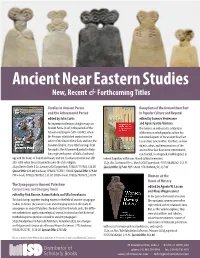
Ancient Near Eastern Studies
Ancient Near Eastern Studies Studies in Ancient Persia Receptions of the Ancient Near East and the Achaemenid Period in Popular Culture and Beyond edited by John Curtis edited by Lorenzo Verderame An important collection of eight essays on and Agnès Garcia-Ventura Ancient Persia (Iran) in the periods of the This book is an enthusiastic celebration Achaemenid Empire (539–330 BC), when of the ways in which popular culture has the Persians established control over the consumed aspects of the ancient Near East whole of the Ancient Near East, and later the to construct new realities. It reflects on how Sasanian Empire: stone relief carvings from objects, ideas, and interpretations of the Persepolis; the Achaemenid period in Baby- ancient Near East have been remembered, lon; neglected aspects of biblical archaeol- constructed, re-imagined, mythologized, or ogy and the books of Daniel and Isaiah; and the Sasanian period in Iran (AD indeed forgotten within our shared cultural memories. 250–650) when Zoroastrianism became the state religion. 332p, illus (Lockwood Press, March 2020) paperback, 9781948488242, $32.95. 232p (James Clarke & Co., January 2020) paperback, 9780227177068, $38.00. Special Offer $27.00; PDF e-book, 9781948488259, $27.00 Special Offer $31.00; hardcover, 9780227177051, $98.00. Special Offer $79.00 PDF e-book, 9780227907061, $31.00; EPUB e-book, 9780227907078, $30.99 Women at the Dawn of History The Synagogue in Ancient Palestine edited by Agnete W. Lassen Current Issues and Emerging Trends and Klaus Wagensonner edited by Rick Bonnie, Raimo Hakola and Ulla Tervahauta In the patriarchal world of ancient This book brings together leading experts in the field of ancient-synagogue Mesopotamia, women were often studies to discuss the current issues and emerging trends in the study of represented in their relation to men. -

Amarna Period Down to the Opening of Sety I's Reign
oi.uchicago.edu STUDIES IN ANCIENT ORIENTAL CIVILIZATION * NO.42 THE ORIENTAL INSTITUTE OF THE UNIVERSITY OF CHICAGO Thomas A. Holland * Editor with the assistance of Thomas G. Urban oi.uchicago.edu oi.uchicago.edu Internet publication of this work was made possible with the generous support of Misty and Lewis Gruber THE ROAD TO KADESH A HISTORICAL INTERPRETATION OF THE BATTLE RELIEFS OF KING SETY I AT KARNAK SECOND EDITION REVISED WILLIAM J. MURNANE THE ORIENTAL INSTITUTE OF THE UNIVERSITY OF CHICAGO STUDIES IN ANCIENT ORIENTAL CIVILIZATION . NO.42 CHICAGO * ILLINOIS oi.uchicago.edu Library of Congress Catalog Card Number: 90-63725 ISBN: 0-918986-67-2 ISSN: 0081-7554 The Oriental Institute, Chicago © 1985, 1990 by The University of Chicago. All rights reserved. Published 1990. Printed in the United States of America. oi.uchicago.edu TABLE OF CONTENTS List of M aps ................................ ................................. ................................. vi Preface to the Second Edition ................................................................................................. vii Preface to the First Edition ................................................................................................. ix List of Bibliographic Abbreviations ..................................... ....................... xi Chapter 1. Egypt's Relations with Hatti From the Amarna Period Down to the Opening of Sety I's Reign ...................................................................... ......................... 1 The Clash of Empires -
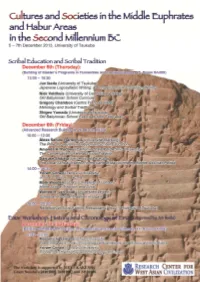
Habur Abstract.Pdf
0 CULTURES AND SOCIETIES IN THE MIDDLE EUPHRATES AND HABUR AREAS IN THE SECOND MILLENNIUM BC 5TH‐7TH DECEMBER 2013, UNIVERSITY OF TSUKUBA PROGRAM AND ABSTRACTS December 4 (Wed) 18:00‐20:00: Welcome Party at University Hall Restaurant SCRIBAL EDUCATION AND SCRIBAL TRADITION December 5 (Thu) Building of Master’s Programs in Humanities and Social Sciences, Room 8A409 13:00‐16:30 S. Yamada, Opening Address J. Ikeda, “Japanese Logosyllabic Writing: A Comparison with Cuneiform Writing” N. Veldhuis, “Old Babylonian School Curricula” (break) G. Chambon, “Metrology and scribal traditions” S. Yamada, “Old Babylonian School Exercises from Tell Taban” December 6 (Fri) Advanced Research Building A, Room A107 10:00‐12:30 A. Bartelmus, “The Role of Babylon in Babylonian Scribal Education” A. Podany, “The Conservatism of Hana Scribal Tradition” (break) D. Shibata, “The Local Scribal Tradition in the Land of Mari during the Middle Assyrian Period” Lunch 14:00‐16:30 Y. Cohen, “Scribal Traditions at Emar” M. Weeden, “Hittite Scribal Tradition and Syria” (break) W. van Soldt, “School and Scribal Tradition in Ugarit” D. Shibata, Concluding Remarks 18:00‐20:00: Reception at Soup‐Factory Restaurant EMAR WORK SHOP: HISTORY AND CHRONOLOGY OF EMAR (organized by J. Ikeda) December 7 (Sat) Building of Master’s Programs in Humanities and Social Sciences, Room 8A409 9:00‐12:00 (time and program provisional) M. Yamada “The Emar Texts: Their Chronological Framework and Historical Implications” Y. Cohen, “Problems in the History and Chronology of Emar” Lunch and the excursion to the Shinto‐temple at Mt. Tsukuba (until 17:00) 1 ABSTRACTS Thursday, 5th December Scribal Education and Scribal Tradition Jun Ikeda (University of Tsukuba) “Japanese Logosyllabic Writing: A Comparison with Cuneiform Writing” It is well known in scholarly circles that early Japanese and early Akkadian writing systems exhibit striking parallels. -

Asher-Greve / Westenholz Goddesses in Context ORBIS BIBLICUS ET ORIENTALIS
Zurich Open Repository and Archive University of Zurich Main Library Strickhofstrasse 39 CH-8057 Zurich www.zora.uzh.ch Year: 2013 Goddesses in Context: On Divine Powers, Roles, Relationships and Gender in Mesopotamian Textual and Visual Sources Asher-Greve, Julia M ; Westenholz, Joan Goodnick Abstract: Goddesses in Context examines from different perspectives some of the most challenging themes in Mesopotamian religion such as gender switch of deities and changes of the status, roles and functions of goddesses. The authors incorporate recent scholarship from various disciplines into their analysis of textual and visual sources, representations in diverse media, theological strategies, typologies, and the place of image in religion and cult over a span of three millennia. Different types of syncretism (fusion, fission, mutation) resulted in transformation and homogenization of goddesses’ roles and functions. The processes of syncretism (a useful heuristic tool for studying the evolution of religions and the attendant political and social changes) and gender switch were facilitated by the fluidity of personality due to multiple or similar divine roles and functions. Few goddesses kept their identity throughout the millennia. Individuality is rare in the iconography of goddesses while visual emphasis is on repetition of generic divine figures (hieros typos) in order to retain recognizability of divinity, where femininity is of secondary significance. The book demonstrates that goddesses were never marginalized or extrinsic and thattheir continuous presence in texts, cult images, rituals, and worship throughout Mesopotamian history is testimony to their powerful numinous impact. This richly illustrated book is the first in-depth analysis of goddesses and the changes they underwent from the earliest visual and textual evidence around 3000 BCE to the end of ancient Mesopotamian civilization in the Seleucid period. -

Pre-Publication Proof
Contents List of Figures and Tables vii Preface xi List of Contributors xiii proof Introduction: Long-Distance Communication and the Cohesion of Early Empires 1 K a r e n R a d n e r 1 Egyptian State Correspondence of the New Kingdom: T e Letters of the Levantine Client Kings in the Amarna Correspondence and Contemporary Evidence 10 Jana Myná r ̌ová Pre-publication 2 State Correspondence in the Hittite World 3 2 Mark Weeden 3 An Imperial Communication Network: T e State Correspondence of the Neo-Assyrian Empire 64 K a r e n R a d n e r 4 T e Lost State Correspondence of the Babylonian Empire as Ref ected in Contemporary Administrative Letters 94 Michael Jursa 5 State Communications in the Persian Empire 112 Amé lie Kuhrt Book 1.indb v 11/9/2013 5:40:54 PM vi Contents 6 T e King’s Words: Hellenistic Royal Letters in Inscriptions 141 Alice Bencivenni 7 State Correspondence in the Roman Empire: Imperial Communication from Augustus to Justinian 172 Simon Corcoran Notes 211 Bibliography 257 Index 299 proof Pre-publication Book 1.indb vi 11/9/2013 5:40:54 PM Chapter 2 State Correspondence in the Hittite World M a r k W e e d e n T HIS chapter describes and discusses the evidence 1 for the internal correspondence of the Hittite state during its so-called imperial period (c. 1450– 1200 BC). Af er a brief sketch of the geographical and historical background, we will survey the available corpus and the generally well-documented archaeologi- cal contexts—a rarity among the corpora discussed in this volume. -

Here, I Will Argue That the of Neo-Assyrian Success Reach Back
7 ûsslriolagiqueinternationøle,Miünchen,zg.Juni bisj.J:ulirgTo,ed.DierzO.Edzard, zo9-t6. Munich: Verlag der Bayerischen Akadamie der \ffissenschaft. Zaccagnini, Carlo. 1989. "Asiatic Mode of Production and Ancient Near East: Notes towards a Discussion."In Production and Consumption in the AncientNear Eøst,ed. Carlo Zaccagnini, r-126. Budapest: University of Budapest. Zadok Ran. 1995. "The Ethno-Linguistic Character of the Jezireh and Adjacent Regions in the 9th7th Centuries (Assyria Proper vs. Periphery)." In Me o-,l.ssyrian Geography, ed. Mario Liverani, zt7-8z.Rome: IJniversità di Roma "LaSapienza.,' 2 Zeh.nder, Markus. zoo5. Umgang mit Fremden in Israel und Assyrien: Ein Beitrag zur Anthropologie des "F¡emden" im Licht antiker Q¡ellen. Stuttgart: arglrably the first world- Åt the Root of the Møtter Kohlhammer. The Neo-Assyrian Empire, often presented by scholars as a fundamen- Zehnder,Markus. zoo7."Die Aramaisierung'Assyriens als Folge der Expansion des empire, is phenornenon. Here, I will argue that the The Middle Assyrian assyrischen Reiches." In In . der seine Lust hat øm Wort des flerrn! FætscÌrift tally new of Neo-Assyrian success reach back in Prelude ta Ernpire fiir ErnstJenni zum 8o: Geùartstag, ed.Jürg Luchsinger, F{ans-Peter Mathys, and foundations preceding Middle Assyrian Markus Saur,417-39. Münster, Germany: Ugarit Vedag. D^rt iîto the short-lived state. This continuity can be seen in a range Zimansl<y, Paul E. 1995. "fhe Kingdom of Urartu in Ðastern Anatolia."In CANE, imperi^l and in a Brpoa S. DünrNc n35-46. of imperial practices in conquered territories the Late Btonze (Lnroar Uurvnnsrrv) "ôulture of empire" that has its roots in Age. -
The Cuneiform Texts from the 2007 Excavations at Tell Taban: a Preliminary Report*
87 THE CUNEIFORM TEXTS FROM THE 2007 EXCAVATIONS AT TELL TABAN: A PRELIMINARY REPORT* Daisuke SHIBATA** and Shigeo YAMADA*** The excavations of Tell Taban, the ancient city of T.ābatum (in the Old Babylonian period)/ T.ābetu (in the Middle Assyrian period), have discovered various sorts of cuneiform texts during the previous seasons. The texts so far found can be roughly divided into three groups: (1) The Old Babylonian texts written on clay tablets, which contain letters, administrative and legal documents and school exercises. These texts, which date to the late 18th century (in the middle chronology) in the so-called post Hammu-rabi-period, were found in the summer season of 2005 and the season of 2006.1 (2) The Middle Assyrian inscriptions written on clay cylinders, clay nails and bricks. These inscriptions th th were made by local rulers of T.ābetu from the 12 century until the early 11 century, for commemoration of their building activities. Such commemorative inscriptions have been found in every season since the beginning of the excavations in 1997.2 (3) The Middle Assyrian texts written on clay tablets, which contain administrative and legal documents as well as letters. These texts, which date from the mid 13th century until the early 12th century and document the palace-administration of the aforementioned local rulers, were found in the winter season and the summer season of 2005.3 The season of 2007 discovered various types of cuneiform texts, which will be preliminarily presented below. All the texts including those edited here will be published with full editions and hand-copies in monographic volumes in the series of the final report on the cuneiform texts from Tell Taban. -

An Expedition of King Shalmaneser I and Prince Tukulti-Ninurta to Carchemish
An Expedition of King Shalmaneser I and Prince Tukulti-Ninurta to Carchemish 著者 Shibata Daisuke 図書名 At the Dawn of History : Ancient Near Eastern Studies in Honour of J. N. Postgate 開始ページ 491 終了ページ 506 出版年月日 2017 URL http://hdl.handle.net/2241/00145332 Offprint from At the Dawn of History Ancient Near Eastern Studies in Honour of J. N. Postgate Volume 1 edited by YAğmUR HEFFRON, ADAM STONE, and MARTIN WORTHINGTON Winona Lake, Indiana EISENBRAUNS 2017 Copyright © 2017 Eisenbrauns Inc. All rights reserved. Printed in the United States of America. www.eisenbrauns.com Library of Congress Cataloging-in-Publication Data Names: Heffron, Yağmur, editor. | Stone, Adam, 1981– editor. | Worthington, Martin, editor. | Postgate, J. N., honoree. Title: At the Dawn of History : Ancient Near Eastern Studies in Honour of J.N. Postgate / edited by Yağmur Heffron, Adam Stone, and Martin Worthington. Description: Winona Lake, Indiana : Eisenbrauns, 2017. | Includes bibliographical references. | Description based on print version record and CIP data provided by publisher; resource not viewed. Identifiers: LCCN 2016049835 (print) | LCCN 2016049136 (ebook) | ISBN 9781575064741 (ePDF 2-volume set) | ISBN 9781575064710 (cloth, set 2 volumes : alk. paper) | ISBN 9781575064727 (volume 1 : alk. paper) | ISBN 9781575064734 (volume 2 : alk. paper) Subjects: LCSH: Iraq—Civilization—To 634. | Iraq—History—To 634. | Iraq— Antiquities. | Civilization, Assyro-Babylonian. | Akkadian language—Texts. Classification: LCC DS69.5 (print) | LCC DS69.5 .A86 2017 (ebook) | DDC 935—dc23 LC record available at https://lccn.loc.gov/2016049835 The paper used in this publication meets the minimum requirements of the American National Standard for Information Sciences—Permanence of Paper for Printed Library Materials, ANSI Z39.48-1984.♾™ Contents Volume 1 Editors’ Preface . -

The Selected Synchronistic Kings of Assyria and Babylonia in the Lacunae of A.117
Appendix III The Selected Synchronistic Kings of Assyria and Babylonia in the Lacunae of A.117 1 Shamshi-Adad I / Ishme-Dagan I vs. Hammurabi The synchronization of Hammurabi and the ruling family of Shamshi-Adad I’s kingdom can be proven by the correspondence between them, including the letters of Yasmah-Addu, the ruler of Mari and younger son of Shamshi-Adad I, to Hammurabi as well as an official named Hulalum in Babylon1 and those of Ishme-Dagan I to Hammurabi.2 Landsberger proposed that Shamshi-Adad I might still have been alive during the first ten years of Hammurabi’s reign and that the first year of Ishme- Dagan I would have been the 11th year of Hammurabi’s reign.3 However, it was also suggested that Shamshi-Adad I would have died in the 12th / 13th4 or 17th / 18th5 year of Hammurabi’s reign and Ishme-Dagan I in the 28th or 31st year.6 If so, the reign length of Ishme-Dagan I recorded in the AKL might be unreliable and he would have ruled as the successor of Shamshi-Adad I only for about 11 years.7 1 van Koppen, MARI 8 (1997), 418–421; Durand, DÉPM, No. 916. 2 Charpin, ARM 26/2 (1988), No. 384. 3 Landsberger, JCS 8/1 (1954), 39, n. 44. 4 Whiting, OBOSA 6, 210, n. 205. 5 Veenhof, AP, 35; van de Mieroop, KHB, 9; Eder, AoF 31 (2004), 213; Gasche et al., MHEM 4, 52; Gasche et al., Akkadica 108 (1998), 1–2; Charpin and Durand, MARI 4 (1985), 293–343. -

Karduniaš. Babylonia Under the Kassites
Karduniaš. Babylonia Under the Kassites The Proceedings of the Symposium Held in Munich 30 June to 2 July 2011 Tagungsbericht des Münchner Symposiums 30. Juni bis 2. Juli 2011 edited by Alexa Bartelmus and Katja Sternitzke Volume 1 Philological and Historical Studies Bereitgestellt von | Universitaetsbibliothek der LMU München Angemeldet | jared.miller@lmu.de Heruntergeladen am | 16.08.17 09:30 ISBN 978-1-5015-1163-9 e-ISBN (PDF) 978-1-5015-0356-6 e-ISBN (ePub) 978-1-5015-0348-1 ISSN 0502-7012 Library of Congress Cataloging-in-Publication data A CIP catalog record for this book has been applied for at the Library of Congress. Bibliographic information published by the Deutsche Nationalbibliothek The Deutsche Nationalbibliothek lists this publication in the Deutsche Nationalbibliografie; detailed bibliographic data are available in the Internet at http://dnb.dnb.de. © 2017 Walter de Gruyter Inc., Boston/Berlin Typesetting: fidus Publikations-Service GmbH, Nördlingen Printing and binding: Druckerei Hubert & Co. GmbH und Co. KG ♾ Printed on acid-free paper Printed in Germany www.degruyter.com Bereitgestellt von | Universitaetsbibliothek der LMU München Angemeldet | jared.miller@lmu.de Heruntergeladen am | 16.08.17 09:30 Jared L. Miller 3 Political Interactions between Kassite Babylonia and Assyria, Egypt and Ḫatti during the Amarna Age Introduction This paper aims first to provide a concise overview of the political interactions between Kassite Babylonia and the other Great Powers of the Amarna Age, i.e. Egypt, Ḫatti, Mittani and Assyria, a subject which could naturally fill a sizable monograph, or rather, a series of monographs. In an attempt to justify yet another general introduction to the era,1 this paper will also discuss two items to which some minor novel contribution can be made. -

Hittite Rock Reliefs in Southeastern Anatolia As a Religious Manifestation of the Late Bronze and Iron Ages
HITTITE ROCK RELIEFS IN SOUTHEASTERN ANATOLIA AS A RELIGIOUS MANIFESTATION OF THE LATE BRONZE AND IRON AGES A Master’s Thesis by HANDE KÖPÜRLÜOĞLU Department of Archaeology İhsan Doğramacı Bilkent University Ankara September 2016 HITTITE ROCK RELIEFS IN SOUTHEASTERN ANATOLIA AS A RELIGIOUS MANIFESTATION OF THE LATE BRONZE AND IRON AGES The Graduate School of Economics and Social Sciences of İhsan Doğramacı Bilkent University by Hande KÖPÜRLÜOĞLU In Partial Fulfillment of the Requirements of the Degree of MASTER OF ARTS THE DEPARTMENT OF ARCHAEOLOGY İHSAN DOĞRAMACI BİLKENT UNIVERSITY September 2016 ABSTRACT HITTITE ROCK RELIEFS IN SOUTHEASTERN ANATOLIA AS A RELIGIOUS MANIFASTATION OF THE LATE BRONZE AND IRON AGES Köpürlüoğlu, Hande M.A., Department of Archaeology Supervisor: Assoc. Prof. Dr. Marie-Henriette Gates September 2016 The LBA rock reliefs are the works of the last three or four generations of the Hittite Empire. The first appearance of the Hittite rock relief is dated to the reign of Muwatalli II who not only sets up an image on a living rock but also shows his own image on his seals with his tutelary deity, the Storm-god. The ex-urban settings of the LBA rock reliefs and the sacred nature of the religion make the work on this subject harder because it also requires philosophical and theological evaluations. The purpose of this thesis is to evaluate the reasons for executing rock reliefs, understanding the depicted scenes, revealing the subject of the depicted figures, and to interpret the purposes of the rock reliefs in LBA and IA. Furthermore, the meaning behind the visualized religious statements will be investigated.