Olav of Norway
Total Page:16
File Type:pdf, Size:1020Kb
Load more
Recommended publications
-
Kart Og Publikasjoner Utgitt Av NGU 2019
ÅRSMELDING 2019 Innhold PUBLISERT AV NGU ................................................................................................. 3 Kart ............................................................................................................................ 3 Berggrunnskart ...................................................................................................... 3 Kvartærgeologiske kart ......................................................................................... 3 Berggrunnsgeologisk- og kvartærgeologisk kart .................................................. 3 Foreløpige kvartærgeologiske kart i bratt terreng ................................................. 4 Maringeologiske kart ............................................................................................ 4 Bøker ......................................................................................................................... 6 NGU-Tema 2 ......................................................................................................... 6 Brosjyrer .................................................................................................................... 6 Nett og sosiale medier ............................................................................................... 7 NGU-rapporter .......................................................................................................... 9 Byggeråstoffer ...................................................................................................... -

Pilgrimage to Nidaros
rway S o o Nidaros pirit N Path t ual Jo y to m’s ugust 4 urne gri A -13, 2020 e Pil Hiking th Hosted by P hoto cr edit: Vis it Norway The Rev Sonja Hagander Augsburg University Vice President, Highlights & Inclusions Mission & Identity Experience spiritual enrichment and fellowship as part of The Rev. Sonja Hagander served as pastor at Augsburg a traveling community under the leadership, teaching and University for 21 years and now leads a new Division of hospitality of The Rev. Sonja Hagander. Mission & Identity. She led an interfaith group of students to Norway in 2017. Ever since serving as a Boundary Waters Be inspired hiking part of the Nidaros Pilgrimage route, Canoe Area guide during college, she has been interested in the the beautiful Gudbrandsdalen path, one of the eight St. Olav’s intersection between sacred texts, spirituality and the out-door Paths ending at Nidaros Cathedral in Trondheim. world. Sonja recently experienced this pilgrim trail during a visit this past summer. Stay in select accommodations for nine nights, based on sharing a room in hotels and lodges described in the itinerary. Pilgrimage Hike Physical Journey throughout in a private, deluxe motorcoach from Lillehammer to Trondheim. Baggage along the hiking route and Gear Requirements is transported by the motorcoach daily. This travel program is for experienced hikers, preferably with Enjoy 21 meals including buffet breakfast, eight dinners and mountain hiking. The amount of hiking is up to 12.5 miles four boxed lunches. during a day (see August 7) and at steep inclines of up to 1,000 feet during a day (see August 9). -

Energy-Smart Nidaros Cathedral: Competition Manual
Energy-Smart Nidaros Cathedral: Competition Manual Energy-Smart Nidaros Cathedral Site information and energy data (v.13 april) Official competition website: http://climate-kic.org/nidaros 1 Energy-Smart Nidaros Cathedral: Competition Manual TABLE OF CONTENT General information about Nidaros Cathedral 4 Cultural heritage conservation and energy consumption 11 Energy consumption of Nidaros Cathedral 13 The surroundings in a historic neighborhood 17 A unique and important urban challenge for the City of Trondheim 24 List of attachments (to be downloaded separately) 01 Architecture and technical drawings 02 Energy consumption 2014 – 2017 03 Outdoor temperature Trondheim Voll station 2014-2017 04 Indoor temperature 03.2016-04.2018 05 Maps of district heating systems 2 Energy-Smart Nidaros Cathedral: Competition Manual Organizing partners Trondheim Municipality Nidaros Cathedral Restoration Workshop (NDR) EIT Climate-KIC Associated partners The Common Church Council in Trondheim Technoport 3 Energy-Smart Nidaros Cathedral: Competition Manual General information about Nidaros Cathedral History and architecture Nidaros Cathedral is the world’s northernmost medieval cathedral and Norway’s national sanctuary. It is the grave church of St. Olav, the patron Saint of Norway and has now become one of Europe’s major historical pilgrim destinations. Nidaros Cathedral is also where coronations and royal blessings take place. The cathedral is mainly built in soapstone. It is located on the foundations of former churches, and the oldest standing parts of the church, the transepts, are from about 1160-70. The church is rebuilt with brick vaults over the choir and western nave, and across the archways under the triforium. The copper-covered roof is carried by steel structures with the exception of the transepts, the chapter house and the extended chapels in the transepts which all have pure wood structures in the roof. -

The Origin, Development, and History of the Norwegian Seventh-Day Adventist Church from the 1840S to 1889" (2010)
Andrews University Digital Commons @ Andrews University Dissertations Graduate Research 2010 The Origin, Development, and History of the Norwegian Seventh- day Adventist Church from the 1840s to 1889 Bjorgvin Martin Hjelvik Snorrason Andrews University Follow this and additional works at: https://digitalcommons.andrews.edu/dissertations Part of the Christian Denominations and Sects Commons, Christianity Commons, and the History of Christianity Commons Recommended Citation Snorrason, Bjorgvin Martin Hjelvik, "The Origin, Development, and History of the Norwegian Seventh-day Adventist Church from the 1840s to 1889" (2010). Dissertations. 144. https://digitalcommons.andrews.edu/dissertations/144 This Dissertation is brought to you for free and open access by the Graduate Research at Digital Commons @ Andrews University. It has been accepted for inclusion in Dissertations by an authorized administrator of Digital Commons @ Andrews University. For more information, please contact repository@andrews.edu. Thank you for your interest in the Andrews University Digital Library of Dissertations and Theses. Please honor the copyright of this document by not duplicating or distributing additional copies in any form without the author’s express written permission. Thanks for your cooperation. ABSTRACT THE ORIGIN, DEVELOPMENT, AND HISTORY OF THE NORWEGIAN SEVENTH-DAY ADVENTIST CHURCH FROM THE 1840s TO 1887 by Bjorgvin Martin Hjelvik Snorrason Adviser: Jerry Moon ABSTRACT OF GRADUATE STUDENT RESEARCH Dissertation Andrews University Seventh-day Adventist Theological Seminary Title: THE ORIGIN, DEVELOPMENT, AND HISTORY OF THE NORWEGIAN SEVENTH-DAY ADVENTIST CHURCH FROM THE 1840s TO 1887 Name of researcher: Bjorgvin Martin Hjelvik Snorrason Name and degree of faculty adviser: Jerry Moon, Ph.D. Date completed: July 2010 This dissertation reconstructs chronologically the history of the Seventh-day Adventist Church in Norway from the Haugian Pietist revival in the early 1800s to the establishment of the first Seventh-day Adventist Conference in Norway in 1887. -

Even Ballangrud Andersen
Makt og maktsentre i vikingtid og middelalder Maktsentre på Østlandet fra ca. 800 til 1200 e. Kr. i Snorre og arkeologiske kilder Even Ballangrud Andersen Masteroppgave i historie Institutt for arkeologi, konservering og historie Universitetet i Oslo Vår 2012 1 Forord Jeg må selvfølgelig først takke min veileder professor Jon Vidar Sigurdsson for uvurderlig hjelp underveis i skrivingen av denne oppgaven. Takk også til medstudenter fra masterstudiet ved UiO og til kollegaer både ved Kommunearkivet i Fredrikstad og i Fredrikstad kommune ellers som har vært hjelpsomme og/eller har vist interesse for mine studier og undersøkelse. Kart over de mest kjente stormannsgårdene i vikingtidens Norge. Kilde: Kartet er hentet fra Kleivane (1981:129) og hans oversikt over lendmannsgårder i Norge. 2 Innholdsfortegnelse: 1. Maktstrukturene – undersøkelsens rammeverk – side 4 1.1 Problemstilling – side 4 1.2 Teoretisk fundament og rammeverk – side 6 1.3 Metode – side 8 1.4 Historiografi – side 9 1.5 Kilder – side 14 1.5.1 Skriftlige kilder – side 14 1.5.2 Arkeologiske kilder – side 17 1.5.3 Kildekritikk og de skriftlige kildene – side 19 2. Maktstrukturer og maktsentre i Østfold – side 22 2.1 Østfold og dets maktsentre i Snorre – side 23 2.1.1 Snorre forteller – side 23 2.1.2 Konkluderende bemerkninger til Snorres Østfold – side 32 2.2 Maktsentre i indre og ytre Østfold – side 33 2.2.1 Alvheim og Vingulmorkriket – side 33 2.2.2 Kongsgården Alvheim og dens omland – side 43 2.2.3 Alvheim og rikssamlingen – side 49 2.2.4 Maktsenteret Alvheim og vikingtidens stormanssamfunn – side 53 2.3 Maktsenteret Borg – side 55 2.3.1 Borg – side 56 2.3.2 Tingsted – side 57 2.3.3 Kirkens tilstedeværelse i Borg – side 57 2.3.4 Borg - maktsenter i middelalderens norske kongedømme – side 60 3. -

Playing History Play and Ideology in Spelet Om Heilag Olav
NORDIC THEATRE STUDIES Vol. 31, No. 1. 2019, 108-123 Playing History Play and ideology in Spelet om Heilag Olav JULIE RONGVED AMUNDSEN ABSTRACT Spelet om Heilag Olav, also called Stiklestadspelet, is Norway’s longest running historical spel. Spels are Norwegian annual outdoor performances about a historical event from the local place where the spel is performed. Spelet om Heilag Olav is about the martyr death of King Olav Harladsson at Stiklestad in 1030, which is said to have brought Christianity to Norway. The spel is subject to conservative aesthetics where both the history of medieval Norway and the spel’s own inherent history guarantees that there will not be big changes in the performance from year to year. This conservative aesthetics makes room for a certain form of nostalgia that can be linked to play. The spel makes use of more serious sides of play. In the theories of Victor Turner, play is connected to the liminoid that differs from the liminal because the liminoid is connected to choice while the liminal is duty. The spel is liminoid but it can be argued that the liminoid has a mimetic relationship to the liminal and through play the spel can make use of several liminal qualities without becoming an actually transforming event. One of the main aesthetic ideas of the spel is authenticity. That this today feels old fashioned is legitimized through the necessity of authenticity and authenticity’s connection to play. Through the use of Žižek’s theories of ideology and his term of failure, the article argues that the failure of creating totalities is inherent to theatre, and that this failure is play. -
Battle of Stiklestad: Supporting Virtual Heritage with 3D Collaborative Virtual Environments and Mobile Devices in Educational Settings
Archived at the Flinders Academic Commons http://dspace.flinders.edu.au/dspace/ Originally published at: Proceedings of Mobile and Ubiquitous Technologies for Learning (UBICOMM 07), Papeete, Tahiti, 04-09 November 2007, pp. 197-203 Copyright © 2007 IEEE. Published version of the paper reproduced here in accordance with the copyright policy of the publisher. Personal use of this material is permitted. However, permission to reprint/republish this material for advertising or promotional purposes or for creating new collective works for resale or redistribution to servers or lists, or to reuse any copyrighted component of this work in other works must be obtained from the IEEE. International Conference on Mobile Ubiquitous Computing, Systems, Services and Technologies Battle of Stiklestad: Supporting Virtual Heritage with 3D Collaborative Virtual Environments and Mobile Devices in Educational Settings Ekaterina Prasolova-Førland Theodor G. Wyeld Monica Divitini, Anders Lindås Norwegian University of Adelaide University Norwegian University of Science and Technology, Adelaide, Australia Science and Technology, Trondheim, Norway theodor.wyeld@adelaide.edu.au Trondheim, Norway ekaterip@idi.ntnu.no divitini@idi.ntnu.no, lindas@stud.ntnu.no Abstract sociological significance. From reconstructions recording historical information about these sites a 3D Collaborative Virtual Environments (CVEs) realistic image of how these places might have looked in the past can be created. This also allows inhabiting have been widely used for preservation of cultural of these reconstructed spaces with people and artifacts heritage, also in an educational context. This paper for users to interact with. All these features can act as a presents a project where 3D CVE is augmented with valuable addition to a ‘traditional’ educational process mobile devices in order to support a collaborative in history and related subjects. -

Church of Norway Pre
You are welcome in the Church of Norway! Contact Church of Norway General Synod Church of Norway National Council Church of Norway Council on Ecumenical and International Relations Church of Norway Sami Council Church of Norway Bishops’ Conference Address: Rådhusgata 1-3, Oslo P.O. Box 799 Sentrum, N-0106 Oslo, Norway Telephone: +47 23 08 12 00 E: post.kirkeradet@kirken.no W: kirken.no/english Issued by the Church of Norway National Council, Communication dept. P.O. Box 799 Sentrum, N-0106 Oslo, Norway. (2016) The Church of Norway has been a folk church comprising the majority of the popu- lation for a thousand years. It has belonged to the Evangelical Lutheran branch of the Christian church since the sixteenth century. 73% of Norway`s population holds member- ship in the Church of Norway. Inclusive Church inclusive, open, confessing, an important part in the 1537. At that time, Norway Church of Norway wel- missional and serving folk country’s Christianiza- and Denmark were united, comes all people in the church – bringing the good tion, and political interests and the Lutheran confes- country to join the church news from Jesus Christ to were an undeniable part sion was introduced by the and attend its services. In all people. of their endeavor, along Danish king, Christian III. order to become a member with the spiritual. King Olav In a certain sense, the you need to be baptized (if 1000 years of Haraldsson, and his death Church of Norway has you have not been bap- Christianity in Norway at the Battle of Stiklestad been a “state church” tized previously) and hold The Christian faith came (north of Nidaros, now since that time, although a permanent residence to Norway in the ninth Trondheim) in 1030, played this designation fits best permit. -

The Pilgrim Bracelet
«In the footsteps of S.t Olav» The short story of the Viking King St Olav 995 Olav Haraldsson was born The Pilgrim bracelet 1014 baptized in Rouen, France 1015/1016 elected king of Norway and introduced Christian law Designed and handmade by craftsmen along S:t Olavsleden in Sweden and Norway 1028 fl ed to Russia because of internal rebellion in the country 1030 returned by boat from Novgorod, Russia, and disembarked in the harbour of Selånger 1030 The Battle of Stiklestad. King Olav was killed 29.07.1030. 1031 King Olav was declared a martyr and a saint, and his remains were smuggled to Trondheim. The relics were later placed in the Nidaros Cathedral and the pilgrimages to the holy king’s relics started immediately. The Norwegian Saint King retained his status as the most esteemed Nordic Saint throughout the Middle Ages. St. Olav is the Patron Saint of Norway. At the pilgrimage centers along the St. Olav Ways you can experience the history of the last millennium history through exhibitions and guided tours. In the Pilgrim pod, you will meet researchers who can tell you more about vikings, saints and medieval pilgrims. Also, do not miss walking in the footsteps of St. Olav through a countryside rich in culture and beautiful woodland and pastoral sceneries. More information can be found at stolavsleden.com pilgrimutangranser.no Selanger Borgsjö 2 5 The bracelet is cut by hand in rough The S.t Olav’s Crown in silver symbo- leather using traditional techniques and lizes the king’s deed, but is also the symbolizes the continuous path from crown of the Lord he saw as Saviour. -

Trondheim's Nidaros Cathedral
August 2019 Walworth County, WI Greetings, fellow Norwegian Americans: Too soon we have to say goodbye to summer, but autumn is quite the best season. Too bad it is followed by winter. (Sigh) There will be a Sons of Norway leadership conference in In- diana Oc.t 18-20. I will be attending, but I’d like to know if any- one would like to attend with me. The cost including registra- Gratulare Med Dagen tion, room and meals is $320 , but $100 scholarships are availa- Bob Peterson 8th ble. I will attach some information , and if you’re interested, Ashley Wilson 17th please let me know. Cole Pepper 23rd Barb Ogne is looking for someone to replace her as treasur- Carol Anderson 27th er. So we are opening that job up to volunteers. If we are going INSIDE THIS ISSUE to maintain Norsemen of the Lakes, we will all need to do what Movie Review..................... 2 we can to sustain it. Please let me know if you are game to fill this position. Wind Turbine Tested ........ 2 Please note our next meeting will be at the Atrium in Wms. Russian Radiation Leak .... 3 Bay. 262-949-9191 norsemenofthelakes@gmail.com Corlene Shelter for the Dead .......... 3 Viking Women’s Indep ...... 4 Membership Committee News The Helm of Awe ............... 4 Nidaros Cathedral ............. 5 Remember the membership drive breakfast is planned for Oct. Fun Facts About Oslo ....... 6 5th at 9 a.m. at Perkins in Delavan. I can’t tell you how im- portant this is. We desperately need more members if we are to KALENDAR stay alive. -
Pagan to Christian
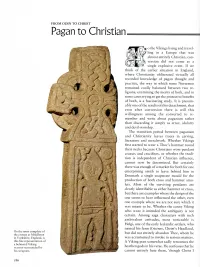
FROM ODIN TO CHRIST Pagan to Christian o the Vikings living and travel- ling in a Europe that was almost entirely Christian, con- version did not come äs a single explosive event. If we think of the earlier Situation in England, where Christianity obliterated virtually all recorded knowledge of pagan thought and practice, the way in which some Norsemen remained coolly balanced between two re- ligions, examining the merits of both, and in some cases trying to get the protective benefits of both, is a fascinating study. It is presum- ably one of the results of this detachment, that even after conversion there is still this willingness among the converted to re- member and write about paganism rather than discarding it simply äs error, idolatry and devil-worship. The transition period between paganism and Christianity leaves traces in carving, literature and metalwork. Whether Vikings first started to wear a Thor's hammer round their necks because Christians wore pendant crosses and crucifixes, or whether the tradi- tion is independent of Christian influence, cannot now be determined. But certainly there was enough of a market for both for one enterprising smith to leave behind him in Denmark a single soapstone mould for the production of both cross and hammer amu- lets. Most of the surviving pendants are clearly identifiable äs either hammer or cross, but there are examples where the design of the one seems to have influenced the other, even one example where we are not sure which it was meant to be. Whether the canny Viking who wore it intended the ambiguity is not certain. -

'Monumentalism' in Norway's Music 1930 –1945
Arnulf Christian Mattes ‘Monumentalism’ in Norway’s Music 1930 –1945 I. Building the Young Nation after 1905 The year 1905, when Norway eventually became a fully independent nation and a sovereign state, put an end to the uneasy political union with Sweden. Apparently, it marks the moment, when Norwegian cultural nationalism accomplished its goal. However, achieving independence in 1905 did not make the cultural nationalist movement obsolete, to the contrary: its protagonists were given the task to provide artistic expressions for cultural consensus and historical continuity of the young, Norwegian state at the turn of the 20th Century, aspiring to become a modern, economically thriving, and democratic society. This meant also to find the means of expression that suited this task. Therefore, many of the major artworks produced during the first decades of the 20. century tell a story about expressing ‘greatness’, in a specific Norwegian way. Additionally, there prevailed the strong ties to Germany in almost every aspect. German engineers helped to establish Norwegian infrastructure and industry, as well as Norwegians during most of the 19th century took advantage from the Germans’ world-leading academies and universities to educate its own cultural and academic elites. Calling this background into mind, one can understand better to which extend Norwegian artists felt ambivalent about their national responsibility: they had to acknowledge German cultural supremacy, at the same time they had to create artistic monuments which could match the standards of ‘advanced artworks’ equal to the German models, adopting the highly-developed techniques most of them had learned as students at the prestigious German institutions, the famous art- and music academies in Berlin and Leipzig.