DEEANA COPELAND KLEPPER Boston University 145 Bay State
Total Page:16
File Type:pdf, Size:1020Kb
Load more
Recommended publications
-

DEEANA COPELAND KLEPPER Boston University 145 Bay State Road Boston, Massachusetts 02215 (617) 358-0186 Dklepper@Bu.Edu EDUCATIO
DEEANA COPELAND KLEPPER Boston University 145 Bay State Road Boston, Massachusetts 02215 (617) 358-0186 dklepper@bu.edu EDUCATION: Ph.D., Northwestern University (History), 1995 M.A., Northwestern University (History), 1988 B.A., Northland College, Ashland, Wisconsin (Broadfield Social Science Education /Native American Studies), 1983 EMPLOYMENT: Associate Professor of Religion. Boston University, Boston, Massachusetts, September 2007 – Department Chair 2008-2012. Associate Professor of History. Boston University, Boston, Massachusetts, January 1, 2009- Assistant Professor of Religion. Boston University, Boston, Massachusetts, 2000 –2007 Visiting Assistant Professor of History. Williams College, Williamstown, Massachusetts, February 1999- June 2000 PUBLICATIONS: Books: The Insight of Unbelievers: Nicholas of Lyra and Christian Reading of Jewish Text in the Later Middle Ages. University of Pennsylvania Press, 2007. Articles and Essays: “Pastoral Literature in Local Context: Albert of Diessen’s Mirror of Priests on Christian-Jewish Co- existence,” Speculum. In press: forthcoming, 2017. “Theories of Interpretation," New Cambridge History of the Bible, Vol 3 1450-1750, Euan Cameron, ed. Cambridge University Press. In press: forthcoming 2016. “Historicizing Allegory: The Jew as Hagar in Medieval Christian Text and Image,” Church History: Studies in Christianity and Culture. June, 2015, 308-344. “The Encounter Between Christian Authority and Jewish Authority over Scriptural Truth: The Barcelona Disputation 1263,” Autorität und Wahrheit. Kirchliche Vorstellungen, Normen und Verfahren (13. – 15. Jahrhundert), Gian Luca Potestà, ed., Schriften des Historischen Kollegs, 2012, 1-19. “Literal versus Carnal: George of Siena’s Christian Reading of Jewish Exegesis,” Jewish Biblical Interpretation and Cultural Exchange: Comparative Exegesis in Context, ed. David Stern and Natalie Dohrmann. University of Pennsylvania Press, 2008, 196-213. -

Antonio Possevino and Jesuits of Jewish Ancestry John Donnelly Marquette University, John.P.Donnelly@Marquette.Edu
Marquette University e-Publications@Marquette History Faculty Research and Publications History, Department of 1-1-1986 Antonio Possevino and Jesuits of Jewish Ancestry John Donnelly Marquette University, john.p.donnelly@marquette.edu Published version. Archivum Historicum Societatis Iesu. Volume LV. (1986): 3-31. Publisher URL: http://www.sjweb.info/curiafrgen/archives.cfm. © 1986 Institutum Historicum Societatis Iesu. Used with permission. COMMENTARII HIS.TORICI ANTONIO POSSEVINO AND JESUITS OF JEWISH ANCESTRY JOHN PATRICK DONNELLY, S.J. - Marquette University, Milwaukee*. I. POSSEVINO'S PROBABLE JEWISH ANCESTRY Contrary to the attitudes of many Spaniards, indeed of many Christians of his time, Ignatius of Loyola was entirely without racial anti-Semitism. His desire to be conformed to Christ in the tiniest details even led him to regret he was not born of Jewish blood. During its formative era, unlike many reli gious orders of the sixteenth century, the Society of Jesus welcomed Chris tians of Jewish descent into its ranks. As is well known, some of Loyola's closest collaborators were of Jewish descent, for instance, Diego Lainez and l Juan Polanco . Many other Jesuits of Jewish descent made notable con 2 tributions, particularly in the foreign missions • It has not been noticed by scholars that Antonio Possevino (1533-1611), a famous figure in the second generation of Jesuit history, was probably born of Jewish Christian ancestry3. His probable Jewish descent seell1S to have affected his later Jesuit career at various stages. His autobiography, which was written for publication but remains in manuscript, says nothing about any Jewish background. He relates that his grandfather and his father mi grated from Piedmont to Milan, then after its capture by the Spaniards * The author wishes to thank Marquette University and the Gladys Krieble Delmas Founda tion for grants that made the archival research on this article possible. -

Building of the Berlin Wall
BUILDING OF THE BERLIN WALL a A CITY TORN APART b A CITY TORN APART OF BUILDING THE BERLIN WALL in conjunction with a symposium given on 27 OCTOBER 2011 at the NATIONAL ARCHIVES AND RECORDS ADMINISTRATION WASHINGTON, DC WASHINGTON, DC RECORDS ADMINISTRATION NATIONAL ARCHIVES AND at the 27 OCTOBER 2011 in conjunction with a symposium given on BUILDING BERLIN WALL OF ITY TORN APART A C BUILDING OF THE BERLIN WALL brandenburg gate Built in 1791, standing 85 feet high, 215 feet long and 36 feet wide, this former city gate is one of the most iconic symbols of Berlin and Germany. Throughout its existence it has served as a visual representation of various political ideologies, ranging from Prussia’s imperialism to East Germany’s communism. It was closed by the East Germans on 14 August 1961 in a response to West Berliners’ demonstration against the building of the wall dividing their city into East and West. It remained closed until 22 December 1989. Its design is based upon the gate way to the Propylaea, the entry into the Acropolis in Athens, Greece. It has 12 Doric columns, six to a side, forming five passageways. The central archway is crowned by the Quadriga, a statue consisting of a four horse chariot driven by Victoria, the Roman goddess of victory. After Napoleon’s defeat, the Quadriga was returned to Berlin and the wreath of oak leaves on Victoria was replaced with the new symbol of Prussia, the Iron Cross. i A CITYC ITY TORNTO RN APART a family divided A couple from Berlin may never see each other again because they became separated by the newly formed Berlin Wall. -

Nicholas of Lyra (And Paul of Burgos) on the Pauline Epistles
NICHOLAS OF LYRA (AND PAUL OF BURGOS) ON THE PAULINE EPISTLES Ian Christopher Levy Nicholas of Lyra was one of the most skilled and productive of the late medieval commentators on the Pauline Epistles, drawing together as he did significant strands of the tradition. Born in Normandy c. 1270, he entered the Franciscan Order in 1300. His most famous work was a com- mentary on the entire Bible known as the Postilla Litteralis begun in 1322 and completed by 1331. Popular as his work certainly was over the next two hundred years, Lyra did face some tough criticism. Many printed editions of his work circulated with corrective remarks in the form of the Additiones ad Postillas Nicolai Lyrani by Paul of Burgos (d. 1435), a converted rabbi who criticized Lyra’s use of Hebraic sources as well as Lyra’s reading of Thomas Aquinas. Yet fellow Franciscan Matthias Döring of Thuringia (d. 1469) came to Lyra’s aid when he countered Paul’s criti- cisms with his own Defensarium Nicolai Lyrani seu Replicationes contra Paulum Burgenssem.1 Paul of Burgos was right in detecting Lyra’s debt to Aquinas. Although Lyra’s Postilla was not intended to be a work of systematic theology, he did call upon Thomas’s Summa Theologiae to assist his biblical exege- sis. Lyra followed Thomas on the question of the Law as outlined in the Summa but, as Paul of Burgos pointed out, he would alter Aquinas when summarizing him in the Postilla, thereby simplifying his predecessor’s more complicated theological explanations. None of this is to say that Lyra was a mere disciple of Thomas. -

Gg the CONTEXT and RECEPTION HISTORY OF
THE CONTEXT AND RECEPTION HISTORY OF THE ILLUMINATIONS IN NICHOLAS OF LYRA’S POSTILLA LITTERALIS SUPER TOTAM BIBLIAM: FIFTEENTH-CENTURY CASE STUDIES by Sarah Emily Bromberg B.A., Brandeis University, 1995 M. A., Tufts University, 1999 Submitted to the Graduate Faculty of the Kenneth P. Dietrich School of Arts and Sciences in partial fulfillment of the requirements for the degree of Doctor of Philosophy University of Pittsburgh 2012 gg UNIVERSITY OF PITTSBURGH KENNETH P. DIETRICH SCHOOL OF ARTS AND SCIENCES This dissertation was presented by Sarah Emily Bromberg It was defended on April 30, 2012 and approved by Ann Sutherland Harris, Professor, History of Art & Architecture Adam Shear, Associate Professor, Religious Studies Bruce L. Venarde, Associate Professor, History Ryan McDermott, Assistant Professor, English Dissertation Advisor: M. Alison Stones, Professor, History of Art & Architecture ii Copyright © by Sarah Emily Bromberg 2012 iii THE CONTEXT AND RECEPTION HISTORY OF THE ILLUMINATIONS IN NICHOLAS OF LYRA’S POSTILLA LITTERALIS SUPER TOTAM BIBLIAM: FIFTEENTH-CENTURY CASE STUDIES Sarah Emily Bromberg, PhD University of Pittsburgh, 2012 ABSTRACT This dissertation traces the reception history of the Latin biblical commentary, the Postilla litteralis super totam bibliam (c.1333), originally written and illustrated by Nicholas of Lyra (1270-1349) in Paris. The Postilla was one of the most frequently copied texts during the later Middle Ages and Renaissance in Western and Central Europe, as evidenced by the approximately seven hundred extant manuscripts. The Postilla’s astounding popularity is often attributed to its thorough treatment of a fundamental issue in Christian thought: how to validate the authority and utility of Jewish exegetical traditions while asserting the truth of Christianity. -

2016-03-13 CHARIOTS on COINS Article.Htm
Ancient Greek and Roman Chariots on Coins See the different types of chariots depicted on coins of ancient Greece and Rome The ancient Greeks and Romans used the chariot for war, racing, processions and travel. On ancient coins, the chariot was featured being driven by emperors, important personages and even gods and goddesses. They were usually pulled by horses, but on ancient coins sometimes even by flying serpents and goats. There is a certain excitement associated with the chariot that is almost archetypal. The Latin word "carrus" is the root of the English word "chariot". Imagine the excitement the ancient spectators would feel as they saw chariots racing around the Circus Maximus in Rome or even other parts of the empire. Chariots are a fascinating topic of study and collecting. See the sights and feel the feeling with these authentic ancient coins depicting the chariot here. Click here to see all coins with a chariot. Biga, Triga and Quadriga chariots on ancient ancient Roman coins. Biga means a two horse, triga means a three horse and a quadriga means four horse chariot. A chariot pulled by goats! By winged serpents, with this depiction of Triptolemus. By even elephants! There is even a story about Pompey the Great who tried to use a chariot pulled by elephants for his triumphal march through Rome. It couldn't fit through the gates though, so he had to get on a regular chariot pulled by horses. There was a Greek general who had a battle on the streets of one of the Greek cities he tried to conquer. -
Relationship Groups
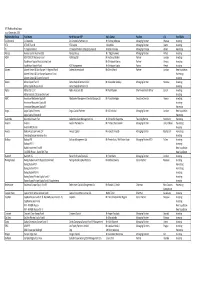
EFT Realtionship Groups as of December 2013 Relationship Group Fund Name Fund Manager/GP Main Contact Position City Fund Status 21 Concordia 21 Concordia 21 Concordia Partners Ltd Mr Andrzej Mierzwa Managing Partner Warsaw Investing 3TS 3TS CEE Fund III 3TS Capital Pekka Maki Managing Partner Vienna Investing 7 L 7L Capital Partners 7L Capital Partners Emergin Europe LP Aristides Fronistas Managing Principal Athens Harvesting Abraaj Aureos Central Asia Fund LLC Abraaj Group Mr. Talgat Kukenov Managing Partner Almaty Investing ADM ADM CEECAT Recovery Fund ADM Capital Mr Anthony Stalker Partner London Investing Kazakhstan Capital Restructuring Fund Mr Orinbasar Kuatov Partner Almaty Investing Kazakhstan Growth Fund KGF Management Mr Orinbasar Kuatov Partner Almaty Investing Advent Advent Central & East Europe II - Regional Fund Advent International Mr Chris Mruck Partner London Near liquidation Advent Central & East Europe Successor Fund Harvesting Advent Central & Eastern Europe IV Investing Almaz Almaz Capital Fund II Almaz Capital Partners II LLC Mr Alexander Galitsky Managing Partner Moscow Investing Almaz Capital Russia Fund I Almaz Capital Partners Ltd Investing Alpha Alpha CEE II, L.P. Alpha Associate Ltd Mr Petr Rojicek Chief Investment Officer Zurich Investing Alpha Russia & CIS Secondary Fund Investing AMC Accession Mezzanine Capital II Mezzanine Management Central Europe Ltd Mr Franz Hörhager Executive Director Vienna Investing Accession Mezzanine Capital III Investing Accession Mezzanine Capital LP Harvesting Argus Argus Capital Partners Argus Capital Partners Mr Ali Artunkal Managing Partner London Near liquidation Argus Capital Partners II Harvesting Askembla Askembla Growth Fund Askembla Asset Management Ltd Mr Christoffer Kurpatow Founding Partner Stockholm Harvesting Avallon Avallon Avallon Partners B.v Mr Tomasz Stamirowski Managing Partner Lodz, Poland Harvesting Avallon MBO Fund II Investing Axxess Balkan Accession Fund, C.V. -

Framing the Sun: the Arch of Constantine and the Roman Cityscape Elizabeth Marlowe
Framing the Sun: The Arch of Constantine and the Roman Cityscape Elizabeth Marlowe To illustrate sonif oi the key paradigm shifts of their disci- C^onstantine by considering the ways its topographical setting pline, art historians often point to the fluctuating fortunes of articulates a relation between the emperor's military \ictoiy ihe Arrh of Constantine. Reviled by Raphael, revered by Alois and the favor of the sun god.'' Riegl, condemned anew by the reactionary Bernard Beren- son and conscripted by the openly Marxist Ranucchio Bian- The Position of the Arch rhi Bandineili, the arch has .sened many agendas.' Despite In Rome, triumphal arches usually straddled the (relatively their widely divergent conclusions, however, these scholars all fixed) route of the triumphal procession.^ Constantine's share a focus on the internal logic of the arcb's decorative Arch, built between 312 and 315 to celebrate his victory over program. Time and again, the naturalism of the monument's the Rome-based usuiper Maxentius (r. 306-12) in a bloody spoliated, second-century reliefs is compared to the less or- civil war, occupied prime real estate, for the options along ganic, hieratic style f)f the fourth-<:entur\'canings. Out of that the "Via Triumphalis" (a modern term but a handy one) must contrast, sweeping theorie.s of regrettable, passive decline or have been rather limited by Constantine's day. The monu- meaningful, active transformation are constructed. This ment was built at the end of one of the longest, straightest methodology' has persisted at the expense of any analysis of stretches along the route, running from the southern end of the structure in its urban context. -

Humanism and Hebraism: Christian Scholars and Hebrew Sources in the Renaissance
Humanism and Hebraism: Christian Scholars and Hebrew Sources in the Renaissance Kathryn Christine Puzzanghera Submitted in Partial Fulfillment of the Prerequisite for Honors in Religion April 2016 © 2016 Kathryn C. Puzzanghera, All Rights Reserved This thesis is dedicated to the glory of God Who gave us reason, creativity, and curiosity, that they might be used AND To the mixed Protestant-Catholic family I was born into, and the Jewish family we chose Table of Contents Chapter I: Christian Humanist Hebraism in Context .................................... 1 Christian Thought and Biblical Exegesis ......................................................................... 8 Jewish-Christian Dialogue and Anti-Semitism .............................................................. 17 Scholastics and Humanists in dialogue .......................................................................... 29 Christian Hebraists: Medieval Exegetes, Renaissance Humanists, and Protestant Reformers ....................................................................................................................... 43 Renaissance Hebraists: Nicholas of Lyra, Johannes Reuchlin, and Philip Melanchthon ........................................................................................................................................ 55 Chapter II: Nicholas of Lyra ...........................................................................58 Nicholas in Dialogue: Influences and Critiques ............................................................. 71 Nicholas’s -
Chariot and Quadriga
Chariot and Quadriga There are many slaves across the Roman empire, but as you tug at the reins, feeling your chariot roll towards the arena gates, you listen to the growing roar of the crowds and contemplate how few who labour under the shadow of the Aquila command the attention you do now. A wheeled shrine will be doing the rounds about now, consecrating this race and its racers in the name of the gods. Thinking on the images of the twins Castor and Pollux dancing beneath the regal figure Jupiter puts you in a faithful state of mind as you make to offer up your own last-minute prayers. Castor and Pollux Many charioteers pray to the half-divine twins and many not native to the empire besides. Their ascension through willingness to self-sacrifice bespeaks a sort of humility that draws the lowly together in a shared will to greatness. Spying other staff at prayer breeds a kind of kinship, it may not be you in particular who seizes the wreath but neither will you be abandoned to face your greatest challenges alone. Jupiter You pay obeisance to no less that the sovereign of the skies himself. Some might say it’s not proper for slaves to presume audience with the all-father but you have seen that lightning and will not flinch from its brilliance. It’s hard to credit others of your station when your soul rises to such lofty goals and they in turn disdain a racer who is the very definition of uppity. You’ll only have yourself to rely on, but then, you wouldn’t have it any other way. -

Automotive Investments: Climate in Russia, Focus on St. Petersburg and Leningrad Region
Automotive Investments: Climate in Russia, Focus on St. Petersburg and Leningrad Region Dmitry Babiner Partner, Head of Tax and Legal Practice, Ernst & Young, St. Petersburg September 4, 2008 RussianRussian ProfileProfile forfor AutomotiveAutomotive InvestmentsInvestments Russian economy ► High oil prices support continued growth and strong ruble ► Domestic consumption surge (purchasing power grew by 13.5%) ► Most major ratings agencies - S&P, Moody’s and Fitch – have upgraded Russia’s investment rating ► Strong growth in the machine-building and automotive sectors (up to 10% and 5% in the last 5 years) and expected further growth of 12% to 2015 Source: Rosstat, Ministry of Economic Development of the Russian Federation, Ernst & Young September 4, 2008 3 Investment Climate in St. Petersburg and Leningrad Oblast Tax situation improved Tax Misery Index* ► If not a “tax heaven”, Russia is among less “tax miserable” places now France China ► A few problems still remain, primarily related to implementation Italy Spain ► Still many uncertainties in application of tax Turkey law Japan Poland ► “Form over substance” approach is usually USA (New York) taken by the tax authorities Ge r m a ny ► “Budgetary plans” for tax collection United Kingdom USA (Texas) ► Tax audits result in tax litigations in most Russia cases Ireland ► Practical difficulties in VAT refund India 0.0 50.0 100.0 150.0 200.0 2000 2007 *Tax Misery Index is a sum of sizes of major tax rates. The higher the Source: Forbes (May 2007), EY Research & Analysis index, the higher is the tax load September 4, 2008 4 Investment Climate in St. Petersburg and Leningrad Oblast Russian automotive market in global context ► Traditionally leading markets such as the US, Germany, and Japan showed a negative dynamic in car sales in 2007 ► China, India, and Russia surpass all sales forecasts ► In 2007 Russia turned out to be third in Europe and sixth in the world ► By 2012 the Russian Federation may sell more than 4.6 mln. -

6 Chariot Races and Water Shows
CHARIOT RACES AND WATER SHOWS 189 6 Chariot Races and Water Shows Chariot Races Roman tradition hailed the circus races as the oldest of Rome’s spectacles, established informally by Romulus, Rome’s legendary founder, himself. The first races afforded a key opportunity for the Romans in the extended narrative of the origins of Roman identity. Frustrated by his attempts to arrange inter- marriage with neighboring peoples like the Sabines, Romulus decided to work toward his goal using subterfuge, by hosting a regional festival in honor of the god Consus (a.k.a. Neptune) that included ludi circenses or chariot races. Source: Livy 1.9:1 Deliberately hiding his resentment, [Romulus] prepared to celebrate the Consualia, a solemn festival in honor of Neptune, patron of the horse, and sent notice of his intention all over the neighboring countryside. The better to advertise it, his people lavished upon their preparations for the spectacle all the resources – such as they were in those days – at their command . all the Sabines were there too, with their wives and children . Then the great moment came; the show began, and nobody had eyes or thoughts for anything else. This was the Romans’ opportunity: at a given signal all the able-bodied men burst through the crowd and seized the young women. Source: Ovid, Art of Love 1.103–108:2 You first, Romulus, did disturb the games, when the rape of Sabine women consoled the wifeless men. No awnings then hung over a marble theater, nor was the platform red with the spray of crocuses; there, artlessly arranged, were garlands which the leafy Palatine had brought forth; the stage was unadorned; the people sat on rows of turf, any chance leaves covering their unkempt hair.