Level 2 Yoga Teacher Training – Alignment & Adjustment
Total Page:16
File Type:pdf, Size:1020Kb
Load more
Recommended publications
-

Ashtanga Yoga As Taught by Shri K. Pattabhi Jois Copyright ©2000 by Larry Schultz
y Ashtanga Yoga as taught by Shri K. Pattabhi Jois y Shri K. Pattabhi Jois Do your practice and all is coming (Guruji) To my guru and my inspiration I dedicate this book. Larry Schultz San Francisco, Califórnia, 1999 Ashtanga Ashtanga Yoga as taught by shri k. pattabhi jois Copyright ©2000 By Larry Schultz All rights reserved. No part of this work may be reprinted without the written permission of the author. Published by Nauli Press San Francisco, CA Cover and graphic design: Maurício Wolff graphics by: Maurício Wolff & Karin Heuser Photos by: Ro Reitz, Camila Reitz Asanas: Pedro Kupfer, Karin Heuser, Larry Schultz y I would like to express my deepest gratitude to Bob Weir of the Grateful Dead. His faithful support and teachings helped make this manual possible. forward wenty years ago Ashtanga yoga was very much a fringe the past 5,000 years Ashtanga yoga has existed as an oral tradition, activity. Our small, dedicated group of students in so when beginning students asked for a practice guide we would TEncinitas, California were mostly young, hippie types hand them a piece of paper with stick figures of the first series with little money and few material possessions. We did have one postures. Larry gave Bob Weir such a sheet of paper a couple of precious thing – Ashtanga practice, which we all knew was very years ago, to which Bob responded, “You’ve got to be kidding. I powerful and deeply transformative. Practicing together created a need a manual.” unique and magical bond, a real sense of family. -

RIMYI Certification Course Guidlines Booklet
CERTIFICACERTIFICATIONTION AND ASASSESSMENTSESSMENT GUIDELINES AprilJuly 20202020 It is relatively easy to be a teacher of an academic subject, but to be a teacher in art is very difficult, and to be a yoga teacher is the hardest of all, because yoga teachers have to be their own critics and correct their own practice. — B.K.S. Iyengar Contents Introduction 04 Section A Certification Structure 06 Section B Becoming a Teacher 09 Section C Criteria for Assessors 11 Section D Assessment Process 12 Section E Feedback 28 Section F Syllabus 29 Notes 44 FAQs 50 Appendix 61 Introduction Don’t be exclusive, be inclusive… not only in asana but every walk of life. – B.K.S. Iyengar Guruji was a believer in tradition but at the same time, he was a great revolutionary. He discovered new paths for imparting objective knowledge of a philosophical subject like yoga. Paramparã was important to him but he recognised that as the community grew larger, a different framework for teaching and assessment would be needed. Over the past few years, Geetaji and Prashantji repeatedly pointed out that assessments are losing their basic purpose and teacher training is becoming a business. Their observation and criticism have immense value in Iyengar Yoga. Their concerns have motivated us to dig deeper into the process of yoga teaching worldwide. On behalf of RIMYI, we elicited feedback on the current methodology of teaching and assessment. The response was overwhelming. Letters, mails, What’s apps, messages….every corner of the world had something to contribute. We, at the institute, have taken cognisance of every conceptual contribution offered. -

FIND YOGA OM at HOME … Ashtanga First Series Asanas
FIND YOGA OM AT HOME … Ashtanga First Series Asanas Hi Brussels Yoga Loft Yogis, This document contains all the asanas of the Full Primary Series of Ashtanga. These asanas are the basis of many of our classes such as the ashtanga first series (short), the gentle flow, the Ashtanga+ and others. Maybe these images will help you in your home practice. As always in any of our yoga classes please make sure that you listen carefully to your body. Yoga is not about pushing yourself into positions that do not feel right not is it about achieving something. Yoga is about letting go, listening to what your body tells you feels good and allowing only that to happen, nothing more. You have no goal, nothing to prove, no-one to impress. All you look for is to ensure that your muscles stay healthy and fit, that you breathe with full intention and intensity and enjoy your practice. No need to stress !! Barbara and I hope that this guide is useluf and that you will enjoy it often during the self isolation. Barbara and Marc Please note that all images are our copyright and that you may not replicate or duplicate them without our prior written approval. 1 All images are copyright of The Brussels Yoga Loft A FEW SANSKRIT WORDS … Sanskrit Counting/Poses for Surya Namaskar A 1 ekam urdhva hastasana upward salute inhale 2 dve uttanasana forward fold exhale 3 trīṇi ardha uttanasana spine extension inhale 4 catvāri chaturanga dandasana plank to low plank exhale 5 pañca urdhva mukha svanasana upward facing dag inhale 6 ṣaṭ adho mukha svanasana downward facing -
Adho Mukha Baddha Konasana but If That Is Not Possible Go to Adho Mukha Swastikasana As Shown on the Previous Page
COVID 19 RECOVERY A SUGGESTED YOGA PROGRAMME Compiled by Iyengar Yoga (UK) Therapy Committee 2 1 ADHO MUKHA VIRASANA & PAVANMUKTASANA SERIES "Wherever space and stillness is created, prana flows.” BKS IYENGAR COVID 19 RECOVERY YOGA PROGRAMME IYENGAR YOGA (UK) THERAPY COMMITTEE Covid-19 is a highly infectious disease caused by the coronavirus. Most people infected will experience a mild to moderate respiratory illness, whilst others will show no symptoms at all. However for some the effects are severe and longer lasting. Our aim in this yoga programme is to play some role in aiding the process of recovery. By only requiring the use of mostly basic props and furniture, we have tried to make the poses as accessible as possible for everyone. By participating in this programme you agree do so at your own risk, are voluntarily participating in this activity, assume all risk of injury to yourself and agree to release and discharge the Therapy Committee from any or all claims or causes of action known or unknown arising out of this programme. If in doubt please consult with your physician before starting this practice. Iyengar Yoga (UK) Therapy Committee have given their time freely in the making of this publication and will continue to do so going forward. The designer Adrienne Bagnall also offered her time and expertise for free. If you wish to support the making of future ebooks then kindly feel free to support our work by making a donation to IY(UK). Any money donated will be used to help pay the production costs in the making of other Yoga Therapy projects. -

Science of Yoga Yoga in Professional Life. Much Can Be Understood About
Division 1: Science of Yoga Yoga in professional life. Much can be understood about our body by delving deep into the realms of yogic sciences. Yoga provides the answer in many inexplicable situations. If study of yoga is combined with study of modern medicines in learning about body and mind, new dimensions of healing can be unfolded. Effect of yoga on: *THE CARDIOVASCULAR SYSTEM. *THE RESPIRATORY SYSTEM *DIGESTIVE SYSTEM Our body: The body is like vehicle. Legs and hands are wheels of this vehicle of humans. Yet you are master controller of a body. Therefore, you should know the parts of the body. Why should we practice Asanas? As a temple is an abode of God, the body, like a temple, is the abode of soul. Therefore, we need to keep the body clean and sacred. ASANAS: Utthishta sthiti Utthishta sthiti are standing asanas. Utthitha means standing. Sthiti means position. You will learn the following asanas of Utthitha sthiti. # Tadasana # Urdhva Hastasana. # Urdhva Baddhangulyasana # Urdhva Namaskarasana # Utkatasana # Vrikshasana. # Utthitha trikonasana. # Virabhadrasana 2. # Garudasana. # Uttanasana. # Prasarita Padottanasana. UPAVISHTA STHITI Upavishta sthiti means sitting asanas. Now we are going to learn following asanas. _ Dandasana. _ swastikasana. _ Virasana. _ Siddhasana. _ Padmasana. _ Parvatasana. _ Gomukhasana. _ Upavishta konasans. _ Baddha konasana. _Simhasana-1 _ Simhasana-2. ----------------------------------------- Paschimapratana Sthiti Paschima pratana sthiti means forward bending asanas. Paschima means back. Pratana means extention. Sthiti means position. -Adho Mukha svanasana -Marichyasana -1. ------------------------------------------- SUPTA STHITI ASANAS. Supta means supine. Now we are going to learn supine position called Matsyasana. -------------------------------------------- PURVA PRATANA STHITI. Means backward bending asanas. -

Dog-Yoga-Ebook
Yoga GO TOGETHER The Doga Way An introduction to Dog Yoga with twelve starter poses Yoga Instruction by Holly LaRiviere Photography by Nicci Vivier Brought to you by Kurgo Table of Contents Why Dog Yoga Disclaimer Meet the Instructor Child’s Pose (Beginner) Half Spinal Twist Pose (Beginner) Supported Sitting Paws Pose (Beginner) Downward Dog Pose (Beginner) Crescent Lunge Pose (Beginner) Standing Half Bend Pose (Beginner) Shoulder Stand Pose (Intermediate) Boat Pose (Intermediate) Legs Up Wall Pose (Intermediate) Camel Pose (Advanced) Bow Pose (Advanced) Wheel Pose (Advanced) End Why Dog Yoga? Here at Kurgo we believe in trying to involve your dogs in all your activities. We are avid hikers, runners, bikers, surfers and climbers, and we’ve found yoga is the perfect way to unwind after those more strenuous activities. Dogs have a natural inclination to take part in yoga. As soon as you lay down on the ground, your dog will be curious and come over to your mat. In this book you’ll see a variety of poses. Some are mostly for you, with your dog acting as your physical and emotional anchor. Others require your dog to be involved and will require a bit of training. The trick is to pick and choose the poses that work for you both and create your own routine. Disclaimer Always consult your health care provider (and Vet!) and obtain full medical clearance before practicing yoga or any other exercise program. Yoga must always be practiced under the direct supervision of a qualified instructor. Practicing under the direct supervision and guidance of a qualified instructor may reduce the risk of injuries. -

Yoga Tools for Pilates Teachers
Yoga Tools for Pilates Teachers Learn seven key differences and takeaways between Pilates and yoga that you can use to enhance your teaching and your students’ practice. In one of my first Jivamukti yoga classes many years ago, I asked my teacher if she taught Pilates. She said no and asked “why?” I shared with her that her cueing for alignment was very similar to how I taught. This wise teacher laughed and said: “Good alignment is good alignment!” So true. Some students and teachers say “I do yoga” or “I do Pilates” as if they are mutually exclusive or cannot co-exist. Rather than think of yoga OR Pilates, learn to think about yoga and Pilates as complementary and enrich your teaching and your life with both practices. To the uninitiated, yoga and Pilates are often confused for one another, yet they are distinctly different. Yoga is an ancient practice dating back thousands of years, and its primary goal is reaching spiritual enlightenment. Meanwhile, Pilates is a modern mind/body discipline with a goal of developing the powerhouse and improving posture and movement. Just as there are different schools of Pilates, there are different schools of yoga. Vinyasa (flow) yoga – where asanas (postures) flow on the breath – is the most similar in structure to Pilates. But they are still very distinct and different practices; and it is because they are different that they can be very complementary practices! You do not need to become a certified yoga teacher to incorporate some of the basic yoga asanas into your teaching. -

Healthy Hips in Hatha Yoga by Nicole Deavilla Whiting
Healthy Hips in Hatha Yoga By Nicole DeAvilla Whiting Ask anyone—even a doctor—to put their hands on their hips, and chances are that all hands will go to their waists. Ask new yoga students to stand with their feet hip-joint distance apart, and you’ll see the legs widen beyond the typical, anatomically correct distance of 3-4 inches. Sadly, you’ll see some (yes, mostly women) with perhaps a not-so-good self-image, set their feet farther apart than the width of the entire pelvis. So where are those hips anyway? Hip Joints 101 The hip joint is the place where the femur (upper leg bone) connects to the pelvis. Both the iliac crest (i.e., the top of the ilium: upper part of the pelvis) and the greater trochanter (the large protrusion on the outer side of the femur, near but still Nicole leads Ananda below the hip joint) are often mistaken for the location of this Yoga Therapy Teacher elusive, but otherwise relatively simple, ball-and-socket joint. Training at The Expanding Light, You can find it by pressing your fingers deep into the crease Ananda’s retreat in that is formed when you bend forward from the hips and— northern California. Her oops, if you don’t know where your hips are, you will background also includes probably bend from your waist, and we’ll be right back where sports medicine and we started from. So instead, stand up and bring your knee to chiropractic your chest. (If your balance is not the best, or if you are physiotherapy. -

Communication As Yoga Kristen Caroline Blinne University of South Florida, Kblinne@Mail.Usf.Edu
University of South Florida Scholar Commons Graduate Theses and Dissertations Graduate School 3-20-2014 Communication as Yoga Kristen Caroline Blinne University of South Florida, kblinne@mail.usf.edu Follow this and additional works at: https://scholarcommons.usf.edu/etd Part of the Communication Commons, Other Education Commons, and the Other Religion Commons Scholar Commons Citation Blinne, Kristen Caroline, "Communication as Yoga" (2014). Graduate Theses and Dissertations. https://scholarcommons.usf.edu/etd/4986 This Dissertation is brought to you for free and open access by the Graduate School at Scholar Commons. It has been accepted for inclusion in Graduate Theses and Dissertations by an authorized administrator of Scholar Commons. For more information, please contact scholarcommons@usf.edu. Communication as Yoga by Kristen C. Blinne A dissertation submitted in partial fulfillment of the requirements for the degree of Doctor of Philosophy Department of Communication College of Arts and Sciences University of South Florida Major Professor: Mariaelena Bartesaghi, Ph.D. Elizabeth Bell, Ph.D. Michael LeVan, Ph.D. Gurleen Grewal, Ph.D. Date of Approval: March 20, 2014 Keywords: Mindfulness, Relationships, Diversity, Spirituality, Contemplative Pedagogy Copyright © 2014, Kristen C. Blinne DEDICATION With the deepest gratitude and love, I take no ownership for what is contained herein as every word, gesture, act, moment, interaction, and experience has shaped all that I am and all that I know. I am compelled to see this work as the expression of and honor to life as it pulses through me, but also to every teacher, family member, friend, partner, stranger, and being who has walked before me, with me, towards me, away from me, or near me, even if only briefly, as well as all that will walk after me towards futures unknown. -
Translating, Practicing and Commodifying Yoga in the Us
TRANSLATING, PRACTICING AND COMMODIFYING YOGA IN THE U.S. By SHREENA NIKETA DIVYAKANT GANDHI A DISSERTATION PRESENTED TO THE GRADUATE SCHOOL OF THE UNIVERSITY OF FLORIDA IN PARTIAL FULFILLMENT OF THE REQUIREMENTS FOR THE DEGREE OF DOCTOR OF PHILOSOPHY UNIVERSITY OF FLORIDA 2009 1 © 2009 Shreena Niketa Divyakant Gandhi 2 To My Dad and Mom 3 ACKNOWLEDGMENTS First and foremost, I am thankful for all the teachers that I have had over the years. Each member of my dissertation committee has been instrumental in how I have come to think about history and religion. Dr. Jon Sensbach (through Rebecca) has helped me think about the characters that create the history; that they are not merely pawns but agents that are emblematic of their times and contexts, which helped me realize that the various yogi characters in my dissertation are not only products but also producers of history. Dr. Manuel Vasquez introduced me to Maurice Merleau-Ponty and the fallacy of a Cartesian outlook especially when examining a bodily practice. Far beyond yoga, Dr. Vasudha Narayanan opened my eyes to the richness and variety of my own history, heritage and faith; her words have brought meaning and hope in times of extreme light and darkness over these past six years. Dr. David Hackett has patiently and meticulously worked with me on a variety of subjects; because of his dedicated teaching I have been able to think through and about the commodity and fetish, its place in culture, capitalism and American religious history. Without the guidance and teaching of Dr. Narayanan and Dr. -
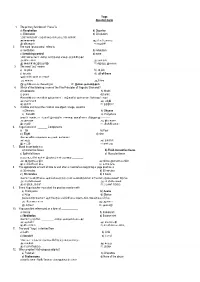
Yoga Question Bank 1. the Primary Function of “ Prana” Is A) Respiration
Yoga Question bank 1. The primary function of “Prana” is a) Respiration b) Digestion c) Elimination d) Circulation "ꮿரானாힿன் " 믁தன்மை செயல்பா翁 என்ன? அ) 毁வாசம் ஆ) செரிைானை் இ) நீக்埁தல் ஈ) 毁ழற்殿 2. The word “pranayama” refers to a) meditation b) relaxation c) breathing control d) none "ꮿராணயாைா" என்ற வார்த்மத எமத 埁잿க்垿ற鏁? அ) 鎿யானை் ஆ) தளர்ퟁ இ) 毁வாச கட்翁ப்பா翁 ஈ) எ鏁ퟁை் இல்மல 3. The word ‘’yuj’’ means a) to yoke b) to join c) to unite d) all of these '뿂ஜ்' என்பதன் சபா쏁ள் அ) ꏁகர்ퟁ ஆ) செர இ) ஐக்垿யப்பட சவண்翁ை் ஈ) இவவ அவைத்鏁ம் 4. Which of the following is one of the Five Principles of Yoga by Sivanandi? a) savasana b) bhakti c) jnana d) tantra 殿வநந்鎿 சயாகாힿன் ஐந்鏁 சகாட்பா翁களில் ஒன்றான ꮿன்வ쏁ை் எ鏁? அ) ெவாெனா ஆ) பக்鎿 இ) ஞான ஈ) தந்鎿ரை் 5. stabilize and focus the mind on one object, image, sound is a) Dharana b) Dhyana c) Samadhi d) Pratyahara ஒ쏁 சபா쏁ள் , படை் , ஒ쮿 இவற்잿ல் ைனமத ஒ쏁நிமலப翁த்鏁வ鏁 --------- அ) தாரண ஆ) 鎿யானா இ) ெை鎿 ஈ) ꮿரத்鎿யகரா 6. Yoga Consist of _______ Components a) Six b) Four c) Eight d) nine சயாகாힿல் எத்தமன 埂쟁கள் உள்ளன? அ) ஆ쟁 ஆ) நான்埁 இ) எட்翁 ஈ) ஒன்ப鏁 7. Blood in our body is a a)Connective tissue b) Fluid connective tissue c) Epithelial tissue d) Muscular tissue நை鏁 உட쮿ல் உள்ள இரத்தை் என்ப鏁 ஒ쏁 _______ அ) இமணப்ꯁ 鎿毁 ஆ) 鎿ரவ இமணப்ꯁ 鎿毁 இ) எꮿ鏀쮿யல் 鎿毁 ஈ) தமெ 鎿毁 8. -

Asana Families
Asanas "True yoga starts with radical self-acceptance. You are fully present with what is, observing the self without judgment. When the body knows that the mind is kind, it will open and release."1 Richard Faulds Asanas, or poses, are the third limb of the eight limb path of yoga. The primary role of asanas is to prepare the body and mind to be able to sit for meditation for long periods of time. Asanas open energy channels and chakras, allowing prana to flow more freely. Asanas can develop strength, flexibility, restore energy and a sense of wellbeing and may provide some relief from painful conditions. Asanas can be grouped into families of related poses. Families of yoga poses are listed below, along with their potential benefits, contraindications and variations, and where you might place a particular type of pose in a sequence.2,3 The lists are not exhaustive. Contraindications are conditions or factors that may serve as a reason to be cautious when attempting a pose. For example, a person with a hip replacement is contraindicated for hip openers that may dislodge their prosthetic hip joint. Yoga outreach classes are generally taught in a group setting where there can be a wide range of fitness and health levels, ages and flexibility. It is best to advise students to take responsibility for their own wellbeing and to pay attention to their bodies. Sensation is welcome, not pain. You might encourage students to find variety in their own poses, considering what the heart of a pose might be and asking for advice if they get stuck.