Public Place Names (Macgregor) Determination 2008 (No 1)
Total Page:16
File Type:pdf, Size:1020Kb
Load more
Recommended publications
-

Federal Hansard Acronyms List Remember: Ctrl+F for Quick Searches
Federal Hansard Acronyms List Remember: Ctrl+F for quick searches A B C D E F G H I J K L M N O P Q R S T U V W X Y Z A 2.5G [the first packet overlays on 2G networks] 2G second generation [the first generation of digital cellular networks, as opposed to analog] 3G third generation [next generation of cellular networks] 3GPP 3G Partnership Project [global standards body to oversee 3G] 4D meat from dead, dying, diseased or disabled animals 4GL fourth-generation language [computers] A&C automation and control A&D admission and disposition; alcohol and drugs A&E accident and emergency A&RMC formerly Austin & Repatriation Medical Centre [now Austin Health] AA anti-aircraft; Alcoholics Anonymous; Athletics Australia AAA Agriculture Advancing Australia; Australian Automobile Association; Australian Archaeological Association; Australian Airports Association AAAA Aerial Agricultural Association of Australia AAAE Australian Association of Automotive Electricians AAAGP Australian Association of Academic General Practice AAALAC Association for the Assessment and Accreditation of Laboratory Animal Care International AAB Australian Associated Brewers AAC Aboriginal advisory committee; Australian Arabic Council; AARNet Advisory Committee AACAP ATSIC-Army Community Assistance Program AACC Aboriginal Affairs Coordinating Committee [WA]; Australian Association of Career Counsellors AACM Australian Association for Computational Mechanics AACS Australian Associations of Christian Schools [note: Associations—plural] AACV Australian Association of Cattle Veterinarians AAD Australian Antarctic Division [Department of the Environment and Heritage] AADCP ASEAN-Australia Development Cooperation Program [taking over AAECP] AADS advanced air defence simulator AADT average annual daily traffic AaE Australian air Express Pty Ltd AAEC Antarctic Animal Ethics Committee AAECP ASEAN-Australia Economic Cooperation Program [finishes in 2005] AAFCANS Army and Air Force Canteen Service [now known as Frontline Defence Services] AAGP Australian Association of Group Psychotherapists Inc. -

Fred Hollows Fact Sheet
“ I believe that the basic attribute of mankind is to look after each other” Professor Fred Hollows Photo: Michael Amendolia Professor Fred Hollows Who was Fred Hollows? Fred Hollows was an eye doctor who spent his life helping those who couldn’t afford, or access, basic eye care. He worked really hard to end avoidable blindness and improve the health of Indigenous Australians. In the late 1960s and 1970s Fred was shocked to discover that Aboriginal Australians were suffering from some of the worst eye diseases he had ever seen. So he decided to do something about it. He What is an eye doctor? travelled with a team of 80 doctors to 465 remote communities, helping more than 60,000 Indigenous people and giving away over An eye doctor, also called an 10,000 pair of glasses. This was just the beginning of Fred’s long Ophthalmologist, is a campaign to improve health services for Aboriginal people. medical doctor who In the 1980s and 90s, Fred discovered that millions of people in poor specialises in the diagnosis communities around the world were also going blind because of eye and treatment of diseases of disease. Most of them were suffering from cataract blindness, an eye the eye. Eye doctors are disease that causes the lens of the eye to become cloudy and fuzzy. trained to provide a full Luckily, cataract blindness is easy to fix. Eye doctors just take out the range of eye care, old cloudy lens and replace it with a new plastic one, allowing people everything from prescribing to see again. -

National Capital Authority - Public Submission
NATIONAL CAPITAL AUTHORITY - PUBLIC SUBMISSION Joint Standing Committee on the National Capital and External Territories Inquiry into provision of amenity within the Parliamentary Triangle The role of the National Capital Authority 1. The National Capital Authority (NCA) manages the Australian Government’s continuing interest in Canberra as the National Capital. 2. The National Capital and Seat of Government is the legislative, judicial, administrative, executive, ceremonial and symbolic centre of the nation. Planning in the Central National Area 3. The Central National Area, which includes the Parliamentary Zone and its setting and the main diplomatic sites and national institutions, is the heart of the National Capital. 4. The NCA has direct responsibility for all aspects of planning and development approval in the Central National Area. 5. The planning system prescribes permitted land uses. Land Management and lease administration 6. Responsibility for land management and lease administration within the Central National Area is shared by the ACT Government, the Department of Finance and Deregulation (DoFD) and the NCA. 7. Each land manager, either directly or via leases they issue, is responsible for the extent to which they constrain, allow or mandate particular land uses from within those permitted under the planning system. 8. Land management decisions cannot be inconsistent with the planning system. 1 The changing nature of the working environment in the Parliamentary Triangle 9. The terms ‘Parliamentary Triangle’ and ‘National Triangle’ formally refer to the areas bounded by Commonwealth, Kings and Constitution Avenues. 10. The Triangle, however named, does not include the areas of Barton and Acton. 11. Given recent community debate about the provision of services and amenities in broader parts of the Central National Area, this submission has been prepared with reference to the Central National Areas of Parkes, Barton, Russell and Acton. -

100-Volunteer-Stories-Web-Version.Pdf
100 Volunteer STORIES www.volunteeringact.org.au © Volunteering ACT Inc 2013. December 2013 Celebrating the contribution of Canberra’s Volunteers Proudly sponsored by Beyond Bank Australia FOREWORD BY MAUREEN CANE Chief Executive Officer of Volunteering ACT Australia’s capital has a proud record for volunteering since it was founded. Services to the swiftly growing population were often first provided by volunteers. Volunteering is now in Canberra’s DNA, with many of her citizens, young and old and from all walks of life, actively volunteering at any one time. This book tells some of their stories — of care for others, of courage, of generosity and of application of skills and expertise. The stories are a testimony to the excellent work of Canberra’s community-based organisations and to the selfless contribution of individuals towards the general good. One such story, of the generous application of expertise, is from Sarah Wilson, the volunteer who compiled this book for Volunteering ACT! All the stories are a fitting legacy for Canberra’s Centenary year and engender a sure and certain confidence that our Maureen Cane, Volunteering ACT CEO future is in good hands. AUSTRALIA’S CAPITAL has a proud record for volunteering since it was founded. Services to the swiftly growing population were often firstprovided by volunteers. FOREWORD BY MARY PORTER Member of the ACT Legislative Assembly and Founder of Volunteering ACT As we all know the ACT has one of the highest rates of volunteering in Australia. When I arrived in the ACT in 1977 I was introduced to the communities training program that was sponsored by the Mental Health arm of the, then, Health Commission and supported by ACTOSS & Lifeline ACT. -

The Life and Times of the Remarkable Alf Pollard
1 FROM FARMBOY TO SUPERSTAR: THE LIFE AND TIMES OF THE REMARKABLE ALF POLLARD John S. Croucher B.A. (Hons) (Macq) MSc PhD (Minn) PhD (Macq) PhD (Hon) (DWU) FRSA FAustMS A dissertation submitted for the degree of Doctor of Philosophy University of Technology, Sydney Faculty of Arts and Social Sciences August 2014 2 CERTIFICATE OF ORIGINAL AUTHORSHIP I certify that the work in this thesis has not previously been submitted for a degree nor has it been submitted as part of requirements for a degree except as fully acknowledged within the text. I also certify that the thesis has been written by me. Any help that I have received in my research work and the preparation of the thesis itself has been acknowledged. In addition, I certify that all information sources and literature used are indicated in the thesis. Signature of Student: Date: 12 August 2014 3 INTRODUCTION Alf Pollard’s contribution to the business history of Australia is as yet unwritten—both as a biography of the man himself, but also his singular, albeit often quiet, achievements. He helped to shape the business world in which he operated and, in parallel, made outstanding contributions to Australian society. Cultural deprivation theory tells us that people who are working class have themselves to blame for the failure of their children in education1 and Alf was certainly from a low socio-economic, indeed extremely poor, family. He fitted such a child to the letter, although he later turned out to be an outstanding counter-example despite having no ‘built-in’ advantage as he not been socialised in a dominant wealthy culture. -
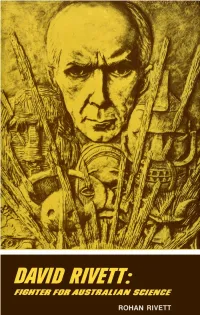
David Rivett
DAVID RIVETT: FIGHTER FOR AUSTRALIAN SCIENCE OTHER WORKS OF ROHAN RIVETT Behind Bamboo. 1946 Three Cricket Booklets. 1948-52 The Community and the Migrant. 1957 Australian Citizen: Herbert Brookes 1867-1963. 1966 Australia (The Oxford Modern World Series). 1968 Writing About Australia. 1970 This page intentionally left blank David Rivett as painted by Max Meldrum. This portrait hangs at the Commonwealth Scientific and Industrial Research Organisation's headquarters in Canberra. ROHAN RIVETT David Rivett: FIGHTER FOR AUSTRALIAN SCIENCE RIVETT First published 1972 All rights reserved No part of this book may be reproduced in any form without permission © Rohan Rivett, 1972 Printed in Australia at The Dominion Press, North Blackburn, Victoria Registered in Australia for transmission by post as a book Contents Foreword Vll Acknowledgments Xl The Attack 1 Carving the Path 15 Australian at Edwardian Oxford 28 1912 to 1925 54 Launching C.S.I.R. for Australia 81 Interludes Without Playtime 120 The Thirties 126 Through the War-And Afterwards 172 Index 219 v This page intentionally left blank Foreword By Baron Casey of Berwick and of the City of Westminster K.G., P.C., G.C.M.G., C.H., D.S.a., M.C., M.A., F.A.A. The framework and content of David Rivett's life, unusual though it was, can be briefly stated as it was dominated by some simple and most unusual principles. He and I met frequently in the early 1930's and discussed what we were both aiming to do in our respective fields. He was a man of the most rigid integrity and way of life. -

125 Years of Women in Medicine
STRENGTH of MIND 125 Years of Women in Medicine Medical History Museum, University of Melbourne Kathleen Roberts Marjorie Thompson Margaret Ruth Sandland Muriel Denise Sturtevant Mary Jocelyn Gorman Fiona Kathleen Judd Ruth Geraldine Vine Arlene Chan Lilian Mary Johnstone Veda Margaret Chang Marli Ann Watt Jennifer Maree Wheelahan Min-Xia Wang Mary Louise Loughnan Alexandra Sophie Clinch Kate Suzannah Stone Bronwyn Melissa Dunbar King Nicole Claire Robins-Browne Davorka Anna Hemetek MaiAnh Hoang Nguyen Elissa Stafford Trisha Michelle Prentice Elizabeth Anne McCarthy Fay Audrey Elizabeth Williams Stephanie Lorraine Tasker Joyce Ellen Taylor Wendy Anne Hayes Veronika Marie Kirchner Jillian Louise Webster Catherine Seut Yhoke Choong Eva Kipen Sew Kee Chang Merryn Lee Wild Guineva Joan Protheroe Wilson Tamara Gitanjali Weerasinghe Shiau Tween Low Pieta Louise Collins Lin-Lin Su Bee Ngo Lau Katherine Adele Scott Man Yuk Ho Minh Ha Nguyen Alexandra Stanislavsky Sally Lynette Quill Ellisa Ann McFarlane Helen Wodak Julia Taub 1971 Mary Louise Holland Daina Jolanta Kirkland Judith Mary Williams Monica Esther Cooper Sara Kremer Min Li Chong Debra Anne Wilson Anita Estelle Wluka Julie Nayleen Whitehead Helen Maroulis Megan Ann Cooney Jane Rosita Tam Cynthia Siu Wai Lau Christine Sierakowski Ingrid Ruth Horner Gaurie Palnitkar Kate Amanda Stanton Nomathemba Raphaka Sarah Louise McGuinness Mary Elizabeth Xipell Elizabeth Ann Tomlinson Adrienne Ila Elizabeth Anderson Anne Margeret Howard Esther Maria Langenegger Jean Lee Woo Debra Anne Crouch Shanti -
1 October 1998
Annual report of the Australian Meningococcal Surveillance Programme, 1997 The Australian Meningococcal Surveillance Programme 1 Abstract The National Neisseria Network (NNN) has undertaken meningococcal isolate surveillance by means of a collaborative laboratory based initiative since 1994. The phenotype (serogroup, serotype and serosubtype) and antibiotic susceptibility of 343 isolates of Neisseria meningitidis from invasive cases of meningococcal disease were determined in 1997. Ninety six percent of the invasive isolates were serogroup B or C. Serogroup B strains predominated in all States and Territories and were isolated from sporadic cases of invasive disease. Phenotypes B:4:P1.4 and B:15:P1.7 were prominent. Serogroup C isolates were most often encountered in New South Wales, especially in adolescents and young adults, and in that State were nearly as numerous as serogroup B strains. C:2a:P1.5 was the most frequently encountered phenotype and C:2b:P1.2 strains were also distributed widely. A number of clusters of cases of serogroup C disease were noted, mainly with phenotype C:2a:P1.5. About three quarters of all isolates showed decreased susceptibility to the penicillin group of antibiotics (MIC 0.06 to 0.5 mg/L). Three isolates showed reduced susceptibility to rifampicin and one was chloramphenicol resistant. Commun Dis Itell 1998;22:205-211. Introduction of disease in an individual patient, and the patterns of the infection within a community may Invasive meningococcal diseases, manifested be materially altered by the characteristics of the mainly as bacteraemia and/or meningitis, remain infecting organism. The public health response to a conspicuous cause of morbidity and mortality in an outbreak or cluster of cases is also influenced 1 Australia and in 1997 attracted considerable by certain features of the invasive meningococci, ISSN 0725-3141 public attention. -
The Australian Guidelines for the Prevention and Control of Infection
AUSTRALIAN GUIDELINES FOR THE Prevention and Control of Infection in Healthcare WORKING TO BUILD A HEALTHY AUSTRALIA © Australian Government 2010 Electronic documents This work is copyright. You may download, display, print and reproduce this material in unaltered form only (retaining this notice) for your personal, non-commercial use, or use within your organisation. Apart from any use as permitted under the Copyright Act 1968, all other rights are reserved. Requests for further authorisation should be directed to the Commonwealth Copyright Administration, Attorney-General’s Department, Robert Garran Offices, National Circuit, Canberra, ACT, 2600 or posted at www.ag.gov.au/cca. ISBN Online: 1864965223 © Australian Government 2010 Paper-based publication This work is copyright. Apart from any use permitted under the Copyright Act 1968, no part may be reproduced by any process without written permission from the Commonwealth available from the Attorney-General’s Department. Requests and inquiries concerning reproduction and rights should be addressed to the Commonwealth Copyright Administration, Attorney-General’s Department, Robert Garran Offices, National Circuit, Canberra, ACT, 2600 or posted at www.ag.gov.au/cca. ISBN Print: 1864965282 This document should be cited as: NHMRC (2010) Australian Guidelines for the Prevention and Control of Infection in Healthcare. Commonwealth of Australia. Acknowledgements Infection Control Guidelines Steering Committee The production of a document such as this requires a considerable effort over a long -
Annual Report 2003
ANNUAL REPORT 2003 Published by the Marketing and Communications Division The Australian National University Published by The Marketing and Communications Division The Australian National University Produced by ANU Publications Unit Marketing and Communications Division The Australian National University Printed by University Printing Service The Australian National University ISSN 1327-7227 April 2004 Contents Council and University Office rs 7 Review of 2003 10 Council and Council Committee Meetings 20 University Statistics 22 Cooperation with Government and other Public Institutions 30 Joint Research Projects undertaken with Universities, CSIRO and other Institutions 76 Principal Grants and Donations 147 University Public Lectures 168 Freedom of Information Act 1982 Statement 172 Auditor-General’s Report 175 Financial Statements 179 University Organisational Structure 222 Academic Structure 223 ANU Acronyms 224 Index 225 Further information about ANU Detailed information about the achievements of ANU in 2003, especially research and teaching outcomes, is contained in the annual reports of the University’s Research Schools, Faculties, Centres and Administrative Divisions. For course and other academic information, contact: Director Student and Academic Services The Australian National University Canberra ACT 0200 T: 02 6125 3339 F: 02 6125 0751 For general information, contact: Director Marketing and Communications Division The Australian National University Canberra ACT 0200 T: 02 6125 2229 F: 02 6125 5568 The Council and University -
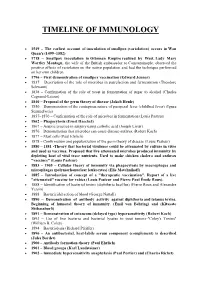
Timeline of Immunology
TIMELINE OF IMMUNOLOGY 1549 – The earliest account of inoculation of smallpox (variolation) occurs in Wan Quan's (1499–1582) 1718 – Smallpox inoculation in Ottoman Empire realized by West. Lady Mary Wortley Montagu, the wife of the British ambassador to Constantinople, observed the positive effects of variolation on the native population and had the technique performed on her own children. 1796 – First demonstration of smallpox vaccination (Edward Jenner) 1837 – Description of the role of microbes in putrefaction and fermentation (Theodore Schwann) 1838 – Confirmation of the role of yeast in fermentation of sugar to alcohol (Charles Cagniard-Latour) 1840 – Proposal of the germ theory of disease (Jakob Henle) 1850 – Demonstration of the contagious nature of puerperal fever (childbed fever) (Ignaz Semmelweis) 1857–1870 – Confirmation of the role of microbes in fermentation (Louis Pasteur) 1862 – Phagocytosis (Ernst Haeckel) 1867 – Aseptic practice in surgery using carbolic acid (Joseph Lister) 1876 – Demonstration that microbes can cause disease-anthrax (Robert Koch) 1877 – Mast cells (Paul Ehrlich) 1878 – Confirmation and popularization of the germ theory of disease (Louis Pasteur) 1880 – 1881 -Theory that bacterial virulence could be attenuated by culture in vitro and used as vaccines. Proposed that live attenuated microbes produced immunity by depleting host of vital trace nutrients. Used to make chicken cholera and anthrax "vaccines" (Louis Pasteur) 1883 – 1905 – Cellular theory of immunity via phagocytosis by macrophages and microphages (polymorhonuclear leukocytes) (Elie Metchnikoff) 1885 – Introduction of concept of a "therapeutic vaccination". Report of a live "attenuated" vaccine for rabies (Louis Pasteur and Pierre Paul Émile Roux). 1888 – Identification of bacterial toxins (diphtheria bacillus) (Pierre Roux and Alexandre Yersin) 1888 – Bactericidal action of blood (George Nuttall) 1890 – Demonstration of antibody activity against diphtheria and tetanus toxins. -

Encyclopedia of Women in Medicine.Pdf
Women in Medicine Women in Medicine An Encyclopedia Laura Lynn Windsor Santa Barbara, California Denver, Colorado Oxford, England Copyright © 2002 by Laura Lynn Windsor All rights reserved. No part of this publication may be reproduced, stored in a retrieval system, or transmitted, in any form or by any means, electronic, mechanical, photocopying, recording, or otherwise, except for the inclusion of brief quotations in a review, without prior permission in writing from the publishers. Library of Congress Cataloging-in-Publication Data Windsor, Laura Women in medicine: An encyclopedia / Laura Windsor p. ; cm. Includes bibliographical references and index. ISBN 1–57607-392-0 (hardcover : alk. paper) 1. Women in medicine—Encyclopedias. [DNLM: 1. Physicians, Women—Biography. 2. Physicians, Women—Encyclopedias—English. 3. Health Personnel—Biography. 4. Health Personnel—Encyclopedias—English. 5. Medicine—Biography. 6. Medicine—Encyclopedias—English. 7. Women—Biography. 8. Women—Encyclopedias—English. WZ 13 W766e 2002] I. Title. R692 .W545 2002 610' .82 ' 0922—dc21 2002014339 07 06 05 04 03 02 10 9 8 7 6 5 4 3 2 1 ABC-CLIO, Inc. 130 Cremona Drive, P.O. Box 1911 Santa Barbara, California 93116-1911 This book is printed on acid-free paper I. Manufactured in the United States of America For Mom Contents Foreword, Nancy W. Dickey, M.D., xi Preface and Acknowledgments, xiii Introduction, xvii Women in Medicine Abbott, Maude Elizabeth Seymour, 1 Blanchfield, Florence Aby, 34 Abouchdid, Edma, 3 Bocchi, Dorothea, 35 Acosta Sison, Honoria, 3 Boivin, Marie