1 November 2017 Curriculum Vitae Michael Zuckert 51891 W
Total Page:16
File Type:pdf, Size:1020Kb
Load more
Recommended publications
-
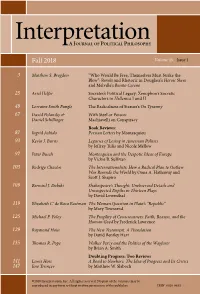
Fall 2018 Volume 45 Issue 1
Fall 2018 Volume 45 Issue 1 3 Matthew S. Brogdon “Who Would Be Free, Themselves Must Strike the Blow”: Revolt and Rhetoric in Douglass’s Heroic Slave and Melville’s Benito Cereno 25 Ariel Helfer Socrates’s Political Legacy: Xenophon’s Socratic Characters in Hellenica I and II 49 Lorraine Smith Pangle The Radicalness of Strauss’s On Tyranny 67 David Polansky & With Steel or Poison: Daniel Schillinger Machiavelli on Conspiracy Book Reviews: 87 Ingrid Ashida Persian Letters by Montesquieu 93 Kevin J. Burns Legacies of Losing in American Politics by Jeffrey Tulis and Nicole Mellow 97 Peter Busch Montesquieu and the Despotic Ideas of Europe by Vickie B. Sullivan 103 Rodrigo Chacón The Internationalists: How a Radical Plan to Outlaw War Remade the World by Oona A. Hathaway and Scott J. Shapiro 109 Bernard J. Dobski Shakespeare’s Thought: Unobserved Details and Unsuspected Depths in Thirteen Plays by David Lowenthal 119 Elizabeth C’ de Baca Eastman The Woman Question in Plato’s “Republic” by Mary Townsend 125 Michael P. Foley The Fragility of Consciousness: Faith, Reason, and the Human Good by Frederick Lawrence 129 Raymond Hain The New Testament: A Translation by David Bentley Hart 135 Thomas R. Pope Walker Percy and the Politics of the Wayfarer by Brian A. Smith Doubting Progress: Two Reviews 141 Lewis Hoss A Road to Nowhere: The Idea of Progress and Its Critics 147 Eno Trimçev by Matthew W. Slaboch ©2018 Interpretation, Inc. All rights reserved. No part of the contents may be reproduced in any form without written permission of the publisher. -

Impressive Start to the Kinder Forum at the University of Missouri
“An investment in knowledge pays the best interest.” Benjamin Franklin Winter 2015 CHAIRMAN’S MESSAGE Impressive Start to the Kinder From Forum at the University of Missouri Fundraiser to Steward aunched August 2014, the During the 2014-15 academic year, the Kinder Forum on Constitutional Forum developed or revised 16 courses, By Jack Miller Democracy at the University of including American Political Thought, LMissouri has already developed into an Constitutional Rights, Democracy About a year and impressive campus program dedicated in America, History of American a half ago, in the to excellence in teaching and nsti Law and The American midst of planning a Co tuti on on a major fundraising campaign to raise scholarship about the American m l Constitution. u D r an endowment fund of $100 million constitutional and democratic o e m F to make sure the Center continues r o In its first full semester, e traditions. It seeks to establish c r d a well into the future, one of our board n the Forum also hosted 12 c i a foundation for excellence in y members made a comment that K this education by providing completely changed our approach to donors. The comment had to do resources and innovative pro- with the idea that people would give grams that will engage faculty money if they were confident that we and students. would make sure that their money is used as they intended on campus. The Kinder Forum, a JMC That comment shifted our perspec- partner program, is made pos- tive, which then shifted our whole sible by a generous grant from approach to how we could fund our the Kinder Foundation, a family efforts to enrich college curricula foundation established by Rich and other efforts for the teaching and Nancy Kinder of Houston, Texas. -

Montesquieu on the History and Geography of Political Liberty
Montesquieu on the History and Geography of Political Liberty Author: Rebecca Clark Persistent link: http://hdl.handle.net/2345/bc-ir:103616 This work is posted on eScholarship@BC, Boston College University Libraries. Boston College Electronic Thesis or Dissertation, 2012 Copyright is held by the author, with all rights reserved, unless otherwise noted. Boston College Graduate School of Arts & Sciences Department of Political Science MONTESQUIEU ON THE HISTORY AND GEOGRAPHY OF POLITICAL LIBERTY A dissertation by REBECCA RUDMAN CLARK submitted in partial fulfillment of the requirements for the degree of Doctor of Philosophy December 2012 © Copyright by REBECCA RUDMAN CLARK 2012 Abstract Montesquieu on the History and Geography of Political Liberty Rebecca R. Clark Dissertation Advisor: Christopher Kelly Montesquieu famously presents climate and terrain as enabling servitude in hot, fertile climes and on the exposed steppes of central Asia. He also traces England’s exemplary constitution, with its balanced constitution, independent judiciary, and gentle criminal practices, to the unique conditions of early medieval northern Europe. The English “found” their government “in the forests” of Germany. There, the marginal, variegated terrain favored the dispersion of political power, and a pastoral way of life until well into the Middle Ages. In pursuing a primitive honor unrelated to political liberty as such, the barbaric Franks accidentally established the rudiments of the most “well-tempered” government. His turn to these causes accidental to human purposes in Parts 3-6 begins with his analysis of the problem of unintended consequences in the history of political reform in Parts 1-2. While the idea of balancing political powers in order to prevent any one individual or group from dominating the rest has ancient roots, he shows that it has taken many centuries to understand just what needs to be balanced, and to learn to balance against one threat without inviting another. -

Natural Right and Political Philosophy
Natural Right and Political Philosophy © 2013 University of Notre Dame Ward_FINAL.indd 1 5/15/13 10:10 AM © 2013 University of Notre Dame Ward_FINAL.indd 2 5/15/13 10:10 AM Natural Right and Political Philosophy v Essays in Honor of Catherine Zuckert and Michael Zuckert Edited by Ann Ward and Lee Ward v University of Notre Dame Press Notre Dame, Indiana © 2013 University of Notre Dame Ward_FINAL.indd 3 5/15/13 10:10 AM Copyright © 2013 by University of Notre Dame Press Notre Dame, Indiana 46556 www.undpress.nd.edu All Rights Reserved Manufactured in the United States of America Library of Congress Cataloging- in- Publication Data Natural right and political philosophy : essays in honor of Catherine Zuckert and Michael Zuckert / edited by Ann Ward and Lee Ward. pages cm Includes bibliographical references and index. ISBN 978-0-268-04427-5 (pbk. : alk. paper) — ISBN 0-268-04427-9 (pbk. : alk. paper) 1. Political science—Philosophy. 2. Natural law. I. Zuckert, Catherine H., 1942– honoree. II. Zuckert, Michael P., 1942– honoree. III. Ward, Ann, 1970– editor of compilation. IV. Ward, Lee, 1970– editor of compilation. JA71.N327 2013 320.01—dc23 2012050651 ∞ The paper in this book meets the guidelines for permanence and durability of the Committee on Production Guidelines for Book Longevity of the Council on Library Resources. © 2013 University of Notre Dame Ward_FINAL.indd 4 5/15/13 10:10 AM Contents Acknowledgments ix Introduction 1 Ann Ward and Lee Ward Part I. Classical Natural Right One. Virtue and Self- Control in Xenophon’s Socratic Thought 15 Lorraine Smith Pangle Two. -

Winter 2021 223 253 355 375 385 401 407 413 419 425
Winter 2021 Volume 47 Issue 2 223 Lewis Fallis The Political Significance of Friendship in Plato’s Lysis J. A. Colen & The First Walgreen Lectures by Leo Strauss (1949) 253 Anthony Vecchio An Exchange Edward J. Erler & Schaefer contra Political Philosophy 355 Ken Masugi David Lewis Schaefer Unretired: A Reply to “Schaefer contra Political Philosophy” 375 Review Essay Borys M. Kowalsky & Nietzsche and Modernist Art, Part I: The Value of Friedrich 385 Joseph Phelan Nietzsche and the Artists of the New Weimar Book Reviews Kevin J. Burns “From Reflection and Choice”: The Political Philosophy 401 of the Federalist Papers and the Ratification Debate, edited by Will R. Jordan Steven Forde Thucydides on the Outbreak of War: Character and Contest 407 by S. N. Jaffe Jerome C. Foss Good Things Out of Nazareth: The Uncollected Letters 413 of Flannery O’Connor and Friends, edited by Benjamin B. Alexander 419 Steven H. Frankel Power and Progress: Joseph Ibn Kaspi and the Meaning of History by Alexander Green 425 Thomas Powers Multiculturalism in Canada: Constructing a Model Multi- culture with Multicultural Values by Hugh Donald Forbes 431 Aaron Zubia Taking Comedy Seriously: Stand-Up’s Dissident Potential in Mass Culture by Jennalee Donian ©2021 Interpretation, Inc. All rights reserved. No part of the contents may be reproduced in any form without written permission of the publisher. ISSN 0020-9635 Editor-in-Chief Timothy W. Burns, Baylor University General Editors Charles E. Butterworth • Timothy W. Burns General Editors (Late) Howard B. White (d. 1974) • Robert Horwitz (d. 1987) Seth G. Benardete (d. 2001) • Leonard Grey (d. -

The Political Views and Political Legacies
Philosophical Radicals and Political Conservatives: The Political Views and Legacies of Eric Voegelin and Leo Strauss Remarks by Robert P. Kraynak, Colgate University APSA Panel, “Roundtable on Strauss and Voegelin” September 4, 2010 at 4:15pm, Washington, D. C. I. Introduction: Voegelin and Strauss were scholars in the field of political philosophy, yet they did not have an explicit political teaching. They wrote books about the great political philosophers of the past in order to learn lessons that might become living truths for today. But they did not write political treatises, defending a political ideology, for example, conservatism or liberalism, or a specific regime, such as liberal democracy or ancient Sparta or constitutional monarchy. Aside from early writings or occasional statements, their books do not contain a specific political doctrine.1 Nevertheless, their approach to philosophy is essentially “political” (rather than metaphysical or epistemological or ethical in the narrow sense). And they are widely regarded today as “conservatives,” with students and followers who are prominent conservatives of one kind or another. For example, Voegelin‟s legacy is carried on by scholars such as, John Hallowell, Ellis Sandoz, and David Walsh who defend the religious basis of the American founding and the Christian basis of liberal democracy. Strauss‟s legacy is carried on by a variety of followers – by Jaffaites defending the natural rights doctrine of the Declaration and Lincoln, by Mansfield defending the Aristotelian basis of politics, -

HERTOG POLITICAL STUDIES PROGRAM 2012 SUMMER FELLOWSHIP WEEK 6 – LEO STRAUSS and the ART of WRITING Washington, DC
HERTOG POLITICAL STUDIES PROGRAM 2012 SUMMER FELLOWSHIP WEEK 6 – LEO STRAUSS AND THE ART OF WRITING Washington, DC Section 1 – William Kristol, editor, The Weekly Standard Leo Strauss is famous for rediscovering “the art of writing.” What is it? Why is it important? What does its use suggest about politics and philosophy? What is the relation of the art of writing to some of Strauss’s other famous rediscoveries—including his revival of the tradition of political philosophy, and his emphasis of the clash between ancients and moderns? We’ll consider these questions through a close reading of Leo Strauss’s 1952 book, Persecution and the Art of Writing—especially Chapters 1 and 2. No previous knowledge of Strauss’s work is presupposed, but students unfamiliar with Strauss might want to read two essays about his work--“Leo Strauss and the History of Political Philosophy,” by Nathan Tarcov and Thomas Pangle, in Leo Strauss and Joseph Cropsey, eds., History of Political Philosophy, 3rd and revised edition (Chicago: University of Chicago Press, 1987), and “What Was Leo Strauss Up To?” Public Interest, Fall 2003 (longer version available in Perspectives in Political Science, Fall 2004). You might also enjoy a book review of Persecution and the Art of Writing by Irving Kristol in Commentary magazine, October 1952 (“The Philosophers’ Hidden Truth”). Those seeking more familiarity with Strauss might want to take a look at On Tyranny and Natural Right and History, two other books written around then by Strauss. Mr. Steven Lenzner of MIT, a leading expert on Strauss, will join the discussions. -
Postdoctoral Fellowship Program DIRECTORY
JACK MILLER CENTER “Partners in Higher Education for Citizenship” Postdoctoral Fellowship Program DIRECTORY JACK MILLER CENTER For Teaching America’s Founding Principles and History 1 BLUE COLOR FONTS CMYK Legacy Serif Bold Small Caps C-100 M-75 Y-0 K-0 Legacy Serif Book Italic PANTONE Reflex Blue JACK MILLER CENTER “Partners in Higher Education for Citizenship” 2 JACK MILLER CENTER “Partners in Higher Education for Citizenship” Faces Teaching the Great of the Future Ideas of the American Founding on Campus The Jack Miller Center (JMC) launched its postdoctoral fellowship program in 2008 as a result of a $1 million gift from a donor who wishes to remain anonymous. To date, 91 fellowships (one- or two-year appointments) have been awarded to 62 of our nation’s most promising young scholars who share JMC’s mission to reinvigorate education in our nation’s Founding Principles and history. Time has proven the project to be a major success. During their fellowships, these outstanding young scholars have taught over 250 courses, and their ability to impact students is only growing. Ninety-two percent of JMC’s postdoctoral fellows have secured new academic jobs, and over half of these jobs are tenure- track positions. Postdoctoral fellowships provide young professors, I wish to thank the Jack Miller Center for giving at a crucial juncture in their professional lives, with me the opportunity to do what I love. Happily, my the credentials and experience necessary to further passion converges nicely with the JMC’s ultimate their careers. Fellows have time to turn dissertations purpose: the teaching of America’s Founding into publishable manuscripts—an important first Principles. -

Curriculum Vitae Lorraine Smith Pangle Professor of Government
Curriculum Vitae Lorraine Smith Pangle Professor of Government Co-Director, Thomas Jefferson Center for the Study of Core Texts and Ideas University of Texas at Austin Office Dept. of Government Address: University of Texas at Austin 158 W 21st St., Stop A1800 Austin, TX 78712-1704 Email: lorrainepangle@utexas.edu Education University of Chicago, Committee on Social Thought: Ph.D., 1999. Thesis: The Philosophy of Friendship: Aristotle and the Classical Tradition on Friendship and Self-Love. Committee: Nathan Tarcov, Leon Kass, and Robert Pippin. University of Toronto: Bachelor of Education, 1985. Yale University: Bachelor of Arts in History, 1981. Senior Thesis: “Education and Liberty: A Study in the Thought of Thomas Jefferson.” Supervisor: Edmund S. Morgan. Professional Employment Professor (2011-present), and Associate Professor (2004-2011), Department of Government, University of Texas at Austin. Co-Director, 2009-present, Thomas Jefferson Center for the Study of Core Texts and Ideas. Associate Professor (2003-04), Postdoctoral Fellow (2001-03), and Adjunct Professor (2000-01) Department of Political Science, University of Toronto. Honors and Grants Fellow, Frank C. Erwin, Jr. Centennial Chair in Government, 2016-17 and 2018-19. University of Texas College of Liberal Arts College Research Fellowship, spring 2018. Fellow, Long Endowed Chair in Democratic Studies, 2017-18. National Endowment for the Humanities Fellowship, 2016. Fellow, George W. Littlefield Professorship in American History, 2013-16. Raymond Dickson Centennial Endowed Teaching Fellowship, 2014. University of Texas Subvention Grant for Virtue is Knowledge, 2013. American Freedom Alliance “Heroes of Conscience Award” for academic leaders, shared with Thomas Pangle (Los Angeles, CA, May 2012). -
The Key Texts of Political Philosophy: an Introduction Thomas L
Cambridge University Press 978-1-107-00607-2 - The Key Texts of Political Philosophy: An Introduction Thomas L. Pangle and Timothy W. Burns Frontmatter More information The Key Texts of Political Philosophy This book introduces readers to analytical interpretations of seminal writings and thinkers in the history of political thought, including Socrates, Plato, Aristotle, the Bible, Thomas Aquinas, Machiavelli, Bacon, Hobbes, Locke, Montesquieu, Rousseau, Tocqueville, Marx, and Nietzsche. Chronologically arranged, each chapter in the book is devoted to the work of a single thinker. The selected texts together engage with two thousand years of debate on fundamental questions, which include: What is the purpose of political life? What is the good life, for us as individuals and for us as a political commu- nity? What is justice? What is a right? Do human beings have rights? What kinds of human virtues are there and which regimes best promote them? The diffi culty of accessing the texts included in this volume is the result not only of their subtlety but also of the dramatic change in everyday life. The authors shed light on the texts’ vocabulary and complexities of thought and help students understand and weigh the various interpretations of each phi- losopher’s thought. • Contains accessible interpretive essays on the greatest texts in the history of political thought, from Plato to Nietzsche. • Includes key passages plus a succinct discussion that glosses the text, examines later-day interpretations, and guides students in forming their own interpretations. • Allows students to learn from, rather than only about, each thinker, and to apply their thought to the present day. -

Curriculum Vitae
TIMOTHY WILLIAM BURNS Baylor University Timothy_Burns@baylor.edu Waco, TX (254) 710-6237 Education Ph.D. (Political Science) University of Toronto Major Area: Political Theory Minor Areas: International Relations, Political Behavior Thesis: Religion and Politics: A Study of Thucydides Supervisor: Clifford Orwin M.A. (Political Science) University of Toronto Master’s Thesis: Xenophon’s Symposium B.A. (Political Science), magna cum laude Boston College Awards/Honors Senior Fellow, Alexander Hamilton Institute for the Study of Western Civilization, 2019-present CHOICE Outstanding Academic Title Award, 2014 (for Shakespeare’s Political Wisdom; awarded January 2015) Nominee, Best Paper Award, Midwest PSA, 2011 Nominee, Best Paper Award, Midwest PSA, 2010 Jon Ramsey Honors Forum Lecture, February 2007 Who’s Who Among America’s Teachers, 1998, 2007 “Teachers Who Make A Difference,” 2004 Nominee, Skidmore President’s Award, 2003, 2006 Nominee, Skidmore Commencement Speaker, 2002, 2006 Bradley Postdoctoral Fellowship, Boston College, 1997-98 Postdoctoral Fellowship, Program on Constitutional Government, Department of Government, Harvard University, 1996-97 Henry Salvatori Fellowship for Academic Leadership, 1995 Nominee, Presidential Award for Excellence In Teaching, Southwest Texas State University, 1994, 1995 Olin Graduate Fellowship, 1986-88; Lynn & Harry Bradley Fellowship, 1986-88 University of Toronto Open Fellowship, 1981-83, 1984-86 Ontario Graduate Scholarship, 1983-84 Richard M. Weaver Fellowship (ISI), 1980-81 Phi Beta Kappa, 1980 Teaching -
THE NANOVIC INSTITUTE for EUROPEAN STUDIES NEWSLETTER Spring Semester 2008 in This Issue
THE NANOVIC INSTITUTE FOR EUROPEAN STUDIES NEWSLETTER Spring Semester 2008 In this Issue Greetings from the Director........................................... 3 Spring 2008 Student Support ....................................... 4 The Nanovic Grant: What did it mean to you?.............. 4 Minors in European Studies .......................................... 9 Nanovic Seminar Abroad: Holocaust Remembered........ 10 Nanovic Faculty Fellows................................................. 12 Nanovic Fellows in the News......................................... 14 Major New Book Prize.................................................. 14 Visiting Scholars............................................................ 15 Nanovic Events Spring 2008.......................................... 16 Nanovic Institute Film Series: A Revolutionary Premiere 18 Upcoming for Fall 2008................................................. 20 2 The Nanovic Institute for European Studies Greetings from the Director Welcome to the spring 2008 issue of the Nanovic Institute newsletter! The institute experienced remarkable growth this year. We sponsored more symposia, lectures, and events than ever before. We intend to be just as ambitious during the coming academic year. This past spring, we helped fifteen students graduate with a minor in European studies. We established a successful new grant program to support senior research. We established new advanced language training grants at all levels. We tripled our budget for graduate studies. We awarded a record number