Southern African Marine Linefish Species Profiles
Total Page:16
File Type:pdf, Size:1020Kb
Load more
Recommended publications
-
Beware of Hidden Salt in Food
BEWARE OF HIDDEN SALT IN FOOD The information explosion in the science of nutrition very often creates the impression that available information is contradictory. Consequently, it is no longer easy to distinguish between fact, misinformation and fiction. The Nutrition Information Centre of the University of Stellenbosch (NICUS) was established to act as a reliable and independent source of nutrition information. 75% of the salt that we eat is hidden in the food that we buy. Eat less processed and ready prepared food. Evidence has shown that regularly eating too much salt puts us at increased risk of developing high blood pressure. High blood pressure is the main cause of strokes and a major cause of heart attacks and heart failures, the most common causes of death and illness in the world. 31.8% of South Africans have high blood pressure. Food regulation is not enough to reduce South Africans’ salt intake. Educating the public is crucial to the success of salt intake reduction. This year’s theme for World Salt Awareness Week is “Look out for Hidden Salt”. Many people unfortunately don't realise they are eating too much salt. The World Health Organisation recommends that adults eat less than 5g of salt (one teaspoon) per day. However, a reduction of salt intake by just two grams a day will reduce your risk of cardiovascular events by 20%. Thanks to efforts by the food industry, governments and health organisations like World Action on Salt and Health (WASH), salt is well and truly on the health agenda across many countries worldwide. -

Reef Fish Biodiversity in the Florida Keys National Marine Sanctuary Megan E
University of South Florida Scholar Commons Graduate Theses and Dissertations Graduate School November 2017 Reef Fish Biodiversity in the Florida Keys National Marine Sanctuary Megan E. Hepner University of South Florida, mhepner@mail.usf.edu Follow this and additional works at: https://scholarcommons.usf.edu/etd Part of the Biology Commons, Ecology and Evolutionary Biology Commons, and the Other Oceanography and Atmospheric Sciences and Meteorology Commons Scholar Commons Citation Hepner, Megan E., "Reef Fish Biodiversity in the Florida Keys National Marine Sanctuary" (2017). Graduate Theses and Dissertations. https://scholarcommons.usf.edu/etd/7408 This Thesis is brought to you for free and open access by the Graduate School at Scholar Commons. It has been accepted for inclusion in Graduate Theses and Dissertations by an authorized administrator of Scholar Commons. For more information, please contact scholarcommons@usf.edu. Reef Fish Biodiversity in the Florida Keys National Marine Sanctuary by Megan E. Hepner A thesis submitted in partial fulfillment of the requirements for the degree of Master of Science Marine Science with a concentration in Marine Resource Assessment College of Marine Science University of South Florida Major Professor: Frank Muller-Karger, Ph.D. Christopher Stallings, Ph.D. Steve Gittings, Ph.D. Date of Approval: October 31st, 2017 Keywords: Species richness, biodiversity, functional diversity, species traits Copyright © 2017, Megan E. Hepner ACKNOWLEDGMENTS I am indebted to my major advisor, Dr. Frank Muller-Karger, who provided opportunities for me to strengthen my skills as a researcher on research cruises, dive surveys, and in the laboratory, and as a communicator through oral and presentations at conferences, and for encouraging my participation as a full team member in various meetings of the Marine Biodiversity Observation Network (MBON) and other science meetings. -

Informe Final FIP Reineta N 2013-21 22-12-2015
1 UNIVERSIDAD DE CONCEPCION FACULTAD DE CIENCIAS NATURALES Y OCEANOGRAFICAS DEPARTAMENTO DE OCEANOGRAFIA INFORME FINAL PROYECTO DEL FONDO DE INVESTIGACION PESQUERA “ORIGEN NATAL Y DISTRIBUCION GEOGRAFICA DE REINETA EN CHILE” FIP N° 2013-21 PROPONENTE: DEPARTAMENTO DE OCEANOGRAFIA UNIVERSIDAD DE CONCEPCION REQUIRENTE: FONDO DE INVESTIGACIÓN PESQUERA CONCEPCION, DICIEMBRE 2015 2 JEFE DE PROYECTO Ricardo Galleguillos González AUTORES Sandra Ferrada Fuentes Cristian B. Canales-Aguirre Victoria Herrera Yáñez Marcelo E. Oliva M. Edwin J. Niklitschek Pamela Toledo C. Elson Leal F. Claudio Carrasco Milton J. Pedraza COLABORADORES Daniela Lazo Felix P. Leiva Yessica Robles Luis A. Ñacari E. Cristóbal Garcés Alicia Gallardo G. Christian Ibieta F. Cristian Vargas A. Jessica Gonzalez A. Jorge Sáteler G. Julio Uribe A. Patricio Galvez G. CONCEPCION, DICIEMBRE 2015 3 Índice Resumen ejecutivo ............................................................................................................................................. 9 1. Antecedentes generales ............................................................................................................................... 15 2. Objetivos ....................................................................................................................................................... 19 2.1 Objetivo general .................................................................................................................................... 19 2.2 Objetivos específicos ........................................................................................................................... -
Evaluation of the Status of the Recreational Fishery for Ulua in Hawai‘I, and Recommendations for Future Management
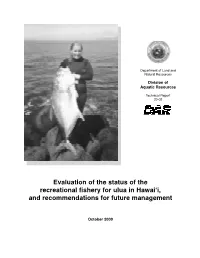
Department of Land and Natural Resources Division of Aquatic Resources Technical Report 20-02 Evaluation of the status of the recreational fishery for ulua in Hawai‘i, and recommendations for future management October 2000 Benjamin J. Cayetano Governor DIVISION OF AQUATIC RESOURCES Department of Land and Natural Resources 1151 Punchbowl Street, Room 330 Honolulu, HI 96813 November 2000 Cover photo by Kit Hinhumpetch Evaluation of the status of the recreational fishery for ulua in Hawai‘i, and recommendations for future management DAR Technical Report 20-02 “Ka ulua kapapa o ke kai loa” The ulua fish is a strong warrior. Hawaiian proverb “Kayden, once you get da taste fo’ ulua fishing’, you no can tink of anyting else!” From Ulua: The Musical, by Lee Cataluna Rick Gaffney and Associates, Inc. 73-1062 Ahikawa Street Kailua-Kona, Hawaii 96740 Phone: (808) 325-5000 Fax: (808) 325-7023 Email: captrick@kona.net 3 4 Contents Introduction . 1 Background . 2 The ulua in Hawaiian culture . 2 Coastal fishery history since 1900 . 5 Ulua landings . 6 The ulua sportfishery in Hawai‘i . 6 Biology . 8 White ulua . 9 Other ulua . 9 Bluefin trevally movement study . 12 Economics . 12 Management options . 14 Overview . 14 Harvest refugia . 15 Essential fish habitat approach . 27 Community based management . 28 Recommendations . 29 Appendix . .32 Bibliography . .33 5 5 6 Introduction Unique marine resources, like Hawai‘i’s ulua/papio, have cultural, scientific, ecological, aes- thetic and functional values that are not generally expressed in commercial catch statistics and/or the market place. Where their populations have not been depleted, the various ulua pop- ular in Hawai‘i’s fisheries are often quite abundant and are thought to play the role of a signifi- cant predator in the ecology of nearshore marine ecosystems. -

View/Download
SPARIFORMES · 1 The ETYFish Project © Christopher Scharpf and Kenneth J. Lazara COMMENTS: v. 4.0 - 13 Feb. 2021 Order SPARIFORMES 3 families · 49 genera · 283 species/subspecies Family LETHRINIDAE Emporerfishes and Large-eye Breams 5 genera · 43 species Subfamily Lethrininae Emporerfishes Lethrinus Cuvier 1829 from lethrinia, ancient Greek name for members of the genus Pagellus (Sparidae) which Cuvier applied to this genus Lethrinus amboinensis Bleeker 1854 -ensis, suffix denoting place: Ambon Island, Molucca Islands, Indonesia, type locality (occurs in eastern Indian Ocean and western Pacific from Indonesia east to Marshall Islands and Samoa, north to Japan, south to Western Australia) Lethrinus atkinsoni Seale 1910 patronym not identified but probably in honor of William Sackston Atkinson (1864-ca. 1925), an illustrator who prepared the plates for a paper published by Seale in 1905 and presumably the plates in this 1910 paper as well Lethrinus atlanticus Valenciennes 1830 Atlantic, the only species of the genus (and family) known to occur in the Atlantic Lethrinus borbonicus Valenciennes 1830 -icus, belonging to: Borbon (or Bourbon), early name for Réunion island, western Mascarenes, type locality (occurs in Red Sea and western Indian Ocean from Persian Gulf and East Africa to Socotra, Seychelles, Madagascar, Réunion, and the Mascarenes) Lethrinus conchyliatus (Smith 1959) clothed in purple, etymology not explained, probably referring to “bright mauve” area at central basal part of pectoral fins on living specimens Lethrinus crocineus -

A Practical Approach to the Nutritional Management of Chronic Kidney Disease Patients in Cape Town, South Africa Oluwatoyin I
Ameh et al. BMC Nephrology (2016) 17:68 DOI 10.1186/s12882-016-0297-4 CORRESPONDENCE Open Access A practical approach to the nutritional management of chronic kidney disease patients in Cape Town, South Africa Oluwatoyin I. Ameh1, Lynette Cilliers2 and Ikechi G. Okpechi3* Abstract Background: The multi-racial and multi-ethnic population of South Africa has significant variation in their nutritional habits with many black South Africans undergoing a nutritional transition to Western type diets. In this review, we describe our practical approaches to the dietary and nutritional management of chronic kidney disease (CKD) patients in Cape Town, South Africa. Discussion: Due to poverty and socio-economic constraints, significant challenges still exist with regard to achieving the nutritional needs and adequate dietary counselling of many CKD patients (pre-dialysis and dialysis) in South Africa. Inadequate workforce to meet the educational and counselling needs of patients, inability of many patients to effectively come to terms with changing body and metabolic needs due to ongoing kidney disease, issues of adherence to fluid and food restrictions as well as adherence to medications and in some cases the inability to obtain adequate daily food supplies make up some of these challenges. A multi-disciplinary approach (dietitians, nurses and nephrologists) of regularly reminding and educating patients on dietary (especially low protein diets) and nutritional needs is practiced. The South African Renal exchange list consisting of groups of food items with the same nutritional content has been developed as a practical tool to be used by dietitians to convert individualized nutritional prescriptions into meal plan to meet the nutritional needs of patients in South Africa. -

Early Stages of Fishes in the Western North Atlantic Ocean Volume
ISBN 0-9689167-4-x Early Stages of Fishes in the Western North Atlantic Ocean (Davis Strait, Southern Greenland and Flemish Cap to Cape Hatteras) Volume One Acipenseriformes through Syngnathiformes Michael P. Fahay ii Early Stages of Fishes in the Western North Atlantic Ocean iii Dedication This monograph is dedicated to those highly skilled larval fish illustrators whose talents and efforts have greatly facilitated the study of fish ontogeny. The works of many of those fine illustrators grace these pages. iv Early Stages of Fishes in the Western North Atlantic Ocean v Preface The contents of this monograph are a revision and update of an earlier atlas describing the eggs and larvae of western Atlantic marine fishes occurring between the Scotian Shelf and Cape Hatteras, North Carolina (Fahay, 1983). The three-fold increase in the total num- ber of species covered in the current compilation is the result of both a larger study area and a recent increase in published ontogenetic studies of fishes by many authors and students of the morphology of early stages of marine fishes. It is a tribute to the efforts of those authors that the ontogeny of greater than 70% of species known from the western North Atlantic Ocean is now well described. Michael Fahay 241 Sabino Road West Bath, Maine 04530 U.S.A. vi Acknowledgements I greatly appreciate the help provided by a number of very knowledgeable friends and colleagues dur- ing the preparation of this monograph. Jon Hare undertook a painstakingly critical review of the entire monograph, corrected omissions, inconsistencies, and errors of fact, and made suggestions which markedly improved its organization and presentation. -

Carcinus Maenas in South Africa: Status, Impacts and Management
Carcinus maenas in South Africa: status, impacts and management Clova Airth Mabin Dissertation presented for the degree of Doctor of Philosophy (Zoology) Department of Botany and Zoology Stellenbosch University Supervisor: Dr Tammy Robinson-Smythe Co-supervisors: Prof John Wilson Prof Jaco Le Roux March 2018 Stellenbosch University https://scholar.sun.ac.za Declaration By submitting this dissertation electronically, I declare that the entirety of the work contained therein is my own, original work, that I am the sole author thereof (save to the extent explicitly otherwise stated), that reproduction and publication thereof by Stellenbosch University will not infringe any third-party rights and that I have not previously in its entirety or in part submitted it for obtaining any qualification. I would like to declare that Dr Henning Winker at the Department of Agriculture, Forestry and Fisheries developed the code for the Bayesian depletion model used in Chapter 3. This allowed me to use the data collected during management of Carcinus to estimate the population’s response to the intervention. Throughout the thesis, the term Carcinus is used when referring to South African populations of crabs from this genus. This is a result of the detection of hybrids between C. maenas and C. aestuarii in Chapter 5, and the recognition that the results obtained in this thesis can thus not be ascribed to a particular Carcinus species. During the management programme, I played the role of lead scientist, co-ordinating the research and contributing to decisions regarding the management plan. During the course of my doctoral studies, I also completed the field work for and published the following paper: Mabin CA, Wilson JR, Robinson TB (2015) The Chilean black urchin, Tetrapygus niger (Molina, 1782) in South Africa: gone but not forgotten. -

Parasites of Coral Reef Fish: How Much Do We Know? with a Bibliography of Fish Parasites in New Caledonia
Belg. J. Zool., 140 (Suppl.): 155-190 July 2010 Parasites of coral reef fish: how much do we know? With a bibliography of fish parasites in New Caledonia Jean-Lou Justine (1) UMR 7138 Systématique, Adaptation, Évolution, Muséum National d’Histoire Naturelle, 57, rue Cuvier, F-75321 Paris Cedex 05, France (2) Aquarium des lagons, B.P. 8185, 98807 Nouméa, Nouvelle-Calédonie Corresponding author: Jean-Lou Justine; e-mail: justine@mnhn.fr ABSTRACT. A compilation of 107 references dealing with fish parasites in New Caledonia permitted the production of a parasite-host list and a host-parasite list. The lists include Turbellaria, Monopisthocotylea, Polyopisthocotylea, Digenea, Cestoda, Nematoda, Copepoda, Isopoda, Acanthocephala and Hirudinea, with 580 host-parasite combinations, corresponding with more than 370 species of parasites. Protozoa are not included. Platyhelminthes are the major group, with 239 species, including 98 monopisthocotylean monogeneans and 105 digeneans. Copepods include 61 records, and nematodes include 41 records. The list of fish recorded with parasites includes 195 species, in which most (ca. 170 species) are coral reef associated, the rest being a few deep-sea, pelagic or freshwater fishes. The serranids, lethrinids and lutjanids are the most commonly represented fish families. Although a list of published records does not provide a reliable estimate of biodiversity because of the important bias in publications being mainly in the domain of interest of the authors, it provides a basis to compare parasite biodiversity with other localities, and especially with other coral reefs. The present list is probably the most complete published account of parasite biodiversity of coral reef fishes. -

TNP SOK 2011 Internet
GARDEN ROUTE NATIONAL PARK : THE TSITSIKAMMA SANP ARKS SECTION STATE OF KNOWLEDGE Contributors: N. Hanekom 1, R.M. Randall 1, D. Bower, A. Riley 2 and N. Kruger 1 1 SANParks Scientific Services, Garden Route (Rondevlei Office), PO Box 176, Sedgefield, 6573 2 Knysna National Lakes Area, P.O. Box 314, Knysna, 6570 Most recent update: 10 May 2012 Disclaimer This report has been produced by SANParks to summarise information available on a specific conservation area. Production of the report, in either hard copy or electronic format, does not signify that: the referenced information necessarily reflect the views and policies of SANParks; the referenced information is either correct or accurate; SANParks retains copies of the referenced documents; SANParks will provide second parties with copies of the referenced documents. This standpoint has the premise that (i) reproduction of copywrited material is illegal, (ii) copying of unpublished reports and data produced by an external scientist without the author’s permission is unethical, and (iii) dissemination of unreviewed data or draft documentation is potentially misleading and hence illogical. This report should be cited as: Hanekom N., Randall R.M., Bower, D., Riley, A. & Kruger, N. 2012. Garden Route National Park: The Tsitsikamma Section – State of Knowledge. South African National Parks. TABLE OF CONTENTS 1. INTRODUCTION ...............................................................................................................2 2. ACCOUNT OF AREA........................................................................................................2 -

American Samoa Archipelago Fishery Ecosystem Plan 2017
ANNUAL STOCK ASSESSMENT AND FISHERY EVALUATION REPORT: AMERICAN SAMOA ARCHIPELAGO FISHERY ECOSYSTEM PLAN 2017 Western Pacific Regional Fishery Management Council 1164 Bishop St., Suite 1400 Honolulu, HI 96813 PHONE: (808) 522-8220 FAX: (808) 522-8226 www.wpcouncil.org The ANNUAL STOCK ASSESSMENT AND FISHERY EVALUATION REPORT for the AMERICAN SAMOA ARCHIPELAGO FISHERY ECOSYSTEM PLAN 2017 was drafted by the Fishery Ecosystem Plan Team. This is a collaborative effort primarily between the Western Pacific Regional Fishery Management Council, NMFS-Pacific Island Fisheries Science Center, Pacific Islands Regional Office, Division of Aquatic Resources (HI) Department of Marine and Wildlife Resources (AS), Division of Aquatic and Wildlife Resources (Guam), and Division of Fish and Wildlife (CNMI). This report attempts to summarize annual fishery performance looking at trends in catch, effort and catch rates as well as provide a source document describing various projects and activities being undertaken on a local and federal level. The report also describes several ecosystem considerations including fish biomass estimates, biological indicators, protected species, habitat, climate change, and human dimensions. Information like marine spatial planning and best scientific information available for each fishery are described. This report provides a summary of annual catches relative to the Annual Catch Limits established by the Council in collaboration with the local fishery management agencies. Edited By: Marlowe Sabater, Asuka Ishizaki, Thomas Remington, and Sylvia Spalding, WPRFMC. This document can be cited as follows: WPRFMC, 2018. Annual Stock Assessment and Fishery Evaluation Report for the American Samoa Archipelago Fishery Ecosystem Plan 2017. Sabater, M., Ishizaki, A., Remington, T., Spalding, S. (Eds.) Western Pacific Regional Fishery Management Council. -

Maldives Reef Survey Trip June 13-30Th 2008
Maldives Reef Survey - June 13-30th 2008 Jean-Luc Solandt, Biodiversity Policy Officer Chris Wood, Seasearch Co-ordinator Wolf Business Park Innovation House Alton Rd Boldero Rd Ross on Wye Bury St Edmunds HR9 5NB Suffolk IP32 7BS Tel: 01989 566 017 Tel: 01284 748010 Email:jls@mcsuk.org Email: webcontact@scubascuba.com Web: www.mcsuk.org Web: www.scubascuba.com 1. Introduction The Maldives archipelago lies in the heart of the Indian Ocean approximately 300nm SSW of the southern tip of India. The archipelago comprises approximately 1190 islands lying on a raised oceanic ridge, which is approximately 900km long, and straddles the equator between 00 45.00 0S (Addu atoll) to approximately 07 06.00 0N (Ihavandhippolhu atoll). The chain of atolls is relatively narrow (approximately 150km wide), with the capital Male situated in the centre of the archipelago at N 04 10.000; E 073 32.000. The reefs and islands of the Maldives are entirely comprised of raised reef limestone, built over thousands of years by billions of tiny corals laying down of calcium carbonate. There are 26 major atolls comprising a total of some 1190 islands – all entirely built by corals. Figure 1. Location of the Maldives in the central Indian Ocean (left), and Ari atoll (right) showing the variety of coral reefs found within any one atoll. (Maps by Steve Frampton) The structures these corals have created can broadly be divided into three geo- morphological features: i. Inner atoll reefs – (Thillas, Faros and Giris) Thillas are submerged reefs found in the middle of the atolls – which reach depths of around 80m in the largest lagoons, and rise to between 15 and 5m of the surface.