Download File (208.00 Kb)
Total Page:16
File Type:pdf, Size:1020Kb
Load more
Recommended publications
-
Dung Beetle Assemblages Attracted to Cow and Horse Dung: the Importance of Mouthpart Traits, Body Size, and Nesting Behavior in the Community Assembly Process
life Article Dung Beetle Assemblages Attracted to Cow and Horse Dung: The Importance of Mouthpart Traits, Body Size, and Nesting Behavior in the Community Assembly Process Mattia Tonelli 1,2,* , Victoria C. Giménez Gómez 3, José R. Verdú 2, Fernando Casanoves 4 and Mario Zunino 5 1 Department of Pure and Applied Science (DiSPeA), University of Urbino “Carlo Bo”, 61029 Urbino, Italy 2 I.U.I CIBIO (Centro Iberoamericano de la Biodiversidad), Universidad de Alicante, San Vicente del Raspeig, 03690 Alicante, Spain; jr.verdu@ua.es 3 Instituto de Biología Subtropical, Universidad Nacional de Misiones–CONICET, 3370 Puerto Iguazú, Argentina; gimenezgomezvictoria@conicet.gov.ar 4 CATIE, Centro Agronómico Tropical de Investigación y Enseñanza, 30501 Turrialba, Costa Rica; casanoves@catie.ac.cr 5 Asti Academic Centre for Advanced Studies, School of Biodiversity, 14100 Asti, Italy; mario.zunino@uniurb.it * Correspondence: mattia.tonelli@uniurb.it Abstract: Dung beetles use excrement for feeding and reproductive purposes. Although they use a range of dung types, there have been several reports of dung beetles showing a preference for certain feces. However, exactly what determines dung preference in dung beetles remains controversial. In the present study, we investigated differences in dung beetle communities attracted to horse or cow dung from a functional diversity standpoint. Specifically, by examining 18 functional traits, Citation: Tonelli, M.; Giménez we sought to understand if the dung beetle assembly process is mediated by particular traits in Gómez, V.C.; Verdú, J.R.; Casanoves, different dung types. Species specific dung preferences were recorded for eight species, two of which F.; Zunino, M. Dung Beetle Assemblages Attracted to Cow and prefer horse dung and six of which prefer cow dung. -
Dung Beetles: Key to Healthy Pasture? an Overview
Available online at www.worldscientificnews.com WSN 153(2) (2021) 93-123 EISSN 2392-2192 Dung beetles: key to healthy pasture? An overview Sumana Saha1,a, Arghya Biswas1,b, Avirup Ghosh1,c and Dinendra Raychaudhuri2,d 1Post Graduate Department of Zoology, Barasat Government College, 10, K.N.C. Road, Barasat, Kolkata – 7000124, India 2IRDM Faculty Centre, Department of Agricultural Biotechnology, Ramakrishna Mission Vivekananda University, Narendrapur, Kolkata – 700103, India a,b,c,dE-mail address: sahasumana2010@gmail.com, arghyabiswas72@gmail.com, avirupghosh1234@gmail.com, dinendrarccu@gmail.com ABSTRACT Dung beetles (Coleoptera: Scarabaeidae) do just what their name suggests: they use the manure, or dung of other animals in some unique ways! Diversity of the coprine members is reflected through the differences in morphology, resource relocation and foraging activity. They use one of the three broad nesting strategies for laying eggs (Dwellers, Rollers, Tunnelers and Kleptocoprids) each with implications for ecological function. These interesting insects fly around in search of manure deposits, or pats from herbivores like cows and elephants. Through manipulating faeces during the feeding process, dung beetles initiate a series of ecosystem functions ranging from secondary seed dispersal to nutrient cycling and parasite suppression. The detritus-feeding beetles play a small but remarkable role in our ecosystem. They feed on manure, use it to provide housing and food for their young, and improve nutrient cycling and soil structure. Many of the functions provide valuable ecosystem services such as biological pest control, soil fertilization. Members of the genus Onthophagus have been widely proposed as an ideal group for biodiversity inventory and monitoring; they satisfy all of the criteria of an ideal focal taxon, and they have already been used in ecological research and biodiversity survey and conservation work in many regions of the world. -

A Review of Phylogenetic Hypotheses Regarding Aphodiinae (Coleoptera; Scarabaeidae)
STATE OF KNOWLEDGE OF DUNG BEETLE PHYLOGENY - a review of phylogenetic hypotheses regarding Aphodiinae (Coleoptera; Scarabaeidae) Mattias Forshage 2002 Examensarbete i biologi 20 p, Ht 2002 Department of Systematic Zoology, Evolutionary Biology Center, Uppsala University Supervisor Fredrik Ronquist Abstract: As a preparation for proper phylogenetic analysis of groups within the coprophagous clade of Scarabaeidae, an overview is presented of all the proposed suprageneric taxa in Aphodiinae. The current knowledge of the affiliations of each group is discussed based on available information on their morphology, biology, biogeography and paleontology, as well as their classification history. With this as a background an attempt is made to estimate the validity of each taxon from a cladistic perspective, suggest possibilities and point out the most important questions for further research in clarifying the phylogeny of the group. The introductory part A) is not a scientific paper but an introduction into the subject intended for the seminar along with a polemic against a fraction of the presently most active workers in the field: Dellacasa, Bordat and Dellacasa. The main part B) is the discussion of all proposed suprageneric taxa in the subfamily from a cladistic viewpoint. The current classification is found to be quite messy and unfortunately a large part of the many recent attempts to revise higher-level classification within the group do not seem to be improvements from a phylogenetic viewpoint. Most recently proposed tribes (as well as -
Quick Guide for the Identification Of
Quick Guide for the Identification of Maryland Scarabaeoidea Mallory Hagadorn Dr. Dana L. Price Department of Biological Sciences Salisbury University This document is a pictorial reference of Maryland Scarabaeoidea genera (and sometimes species) that was created to expedite the identification of Maryland Scarabs. Our current understanding of Maryland Scarabs comes from “An Annotated Checklist of the Scarabaeoidea (Coleoptera) of Maryland” (Staines 1984). Staines reported 266 species and subspecies using literature and review of several Maryland Museums. Dr. Price and her research students are currently conducting a bioinventory of Maryland Scarabs that will be used to create a “Taxonomic Guide to the Scarabaeoidea of Maryland”. This will include dichotomous keys to family and species based on historical reports and collections from all 23 counties in Maryland. This document should be cited as: Hagadorn, M.A. and D.L. Price. 2012. Quick Guide for the Identification of Maryland Scarabaeoidea. Salisbury University. Pp. 54. Questions regarding this document should be sent to: Dr. Dana L. Price - dlprice@salisbury.edu **All pictures within are linked to their copyright holder. Table of Contents Families of Scarabaeoidea of Maryland……………………………………... 6 Geotrupidae……………………………………………………………………. 7 Subfamily Bolboceratinae……………………………………………… 7 Genus Bolbocerosoma………………………………………… 7 Genus Eucanthus………………………………………………. 7 Subfamily Geotrupinae………………………………………………… 8 Genus Geotrupes………………………………………………. 8 Genus Odonteus...……………………………………………… 9 Glaphyridae.............................................................................................. -

INSECTA MUNDI a Journal of World Insect Systematics
INSECTA MUNDI A Journal of World Insect Systematics 0132 The morphology of the labrum (epipharynx, ikrioma and aboral surface) of adult Aphodiini (Coleoptera: Scarabaeidae: Aphodiinae), and its implications for systematics Giovanni Dellacasa Via Talamone 31/19 I-16127 Genova, Italy Marco Dellacasa Museo di Storia Naturale e del Territorio, Università di Pisa Via Roma, 79 I-56011 Calci (Pisa) Italy Darren J. Mann Hope Entomological Collections Oxford University Museum of Natural History, Parks Road Oxford, OX1 3PW England Date of Issue:September 24, 2010 CENTER FOR SYSTEMATIC ENTOMOLOGY, INC., Gainesville, FL Giovanni Dellacasa, Marco Dellacasa, and Darren J. Mann The morphology of the labrum (epipharynx, ikrioma and aboral surface) of adult Aphodiini (Coleoptera: Scarabaeidae: Aphodiinae), and its implications for systematics Insecta Mundi 0132: 1-21 Published in 2010 by Center for Systematic Entomology, Inc. P. O. Box 141874 Gainesville, FL 32614-1874 U. S. A. http://www.centerforsystematicentomology.org/ Insecta Mundi is a journal primarily devoted to insect systematics, but articles can be published on any non-marine arthropod taxon. Manuscripts considered for publication include, but are not limited to, systematic or taxonomic studies, revisions, nomenclatural changes, faunal studies, phylogenetic analy- ses, biological or behavioral studies, etc. Insecta Mundi is widely distributed, and referenced or ab- stracted by several sources including the Zoological Record, CAB Abstracts, etc. As of 2007, Insecta Mundi is published irregularly throughout the year, not as quarterly issues. As manuscripts are completed they are published and given an individual number. Manuscripts must be peer reviewed prior to submission, after which they are again reviewed by the editorial board to insure quality. -
British Scarabs Guide to Aphodiini (Dweller Dung Beetles)
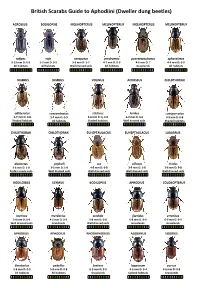
British Scarabs Guide to Aphodiini (Dweller dung beetles) ACROSSUS BODILOPSIS MELINOPTERUS MELINOPTERUS MELINOPTERUS MELINOPTERUS rufipes rufa consputus prodromus punctatosulcatus sphacelatus 9-13 mm D: 0-9 5-7 mm D: 0-9 3-6 mm D- 5-7 4-7 mm D: 0-9 4-6 mm D: 7 4-6 mm D: 0-9 All habitats All habitats Well drained soils All habitats Grasslands All habitats J F M A M J J A S O N D J F M A M J J A S O N D J F M A M J J A S O N D J F M A M J J A S O N D J F M A M J J A S O N D J F M A M J J A S O N D NIMBUS NIMBUS VOLINUS ACROSSUS CHILOTHORAX obliteratus contaminatus sticticus luridus conspurcatus 4-7 mm D: 0-8 5-7 mm D: 0-9 4-6 mm D: 0, 2-9 6-9 mm D: 0-9 4-5 mm D: 0-8 Shaded habitats All habitats Shaded habitats Well drained soils Shaded habitats J F M A M J J A S O N D J F M A M J J A S O N D J F M A M J J A S O N D J F M A M J J A S O N D J F M A M J J A S O N D CHILOTHORAX CHILOTHORAX EUHEPTAULACUS EUHEPTAULACUS LABARRUS distinctus paykulli sus villosus lividus 3-6 mm D: 1-8 3-5 mm D: 1-8 4-5 mm D: 6-8 3-5 mm D: 1-8 3-6 mm D: 5-8 Prefers sandy soils Well drained soils Well drained soils Well drained soils Well drained soils J F M A M J J A S O N D J F M A M J J A S O N D J F M A M J J A S O N D J F M A M J J A S O N D J F M A M J J A S O N D BODILOIDES ESYMUS BODILOPSIS APHODIUS COLOBOPTERUS ictericus merdarius sordida foetidus erraticus 3-6 mm D: 0-9 4-5 mm D: 0-9 5-8 mm D: 0-8 5-8 mm D: 0-9 6-9 mm D: 0-9 Well drained soils Grasslands Well drained soils Grasslands Grasslands J F M A M J J A S O N D J F M A M J J A S O N D J F M A M J -

Chapter 3 MATERIAL and METHODS
Chapter 3 MATERIAL AND METHODS 3.1. Introduction The study of flora consists of plant and situation of plant habitat. There are many definitions for word "flora". The word "flora" refers to the plants occurring within a given region. A Flora may contain anything from a simple list of the plants occurring in an area to a very detailed account of those plants. Floras are different from popular manuals in that they attempt to cover all of the plants, rather than only the most common or conspicuous ones. When a researcher wants to study Flora he/or she can understand many things from that. A Flora ahnost always contains scientific names, and it may also include common names, literature references, descriptions, habitats, geographical distribution, illustrations, flowering times, and notes. Less often, Floras includes such specialized information as data on plant chemistry, reproduction, chromosome numbers, and population occurrences. Sometimes, the plants are listed alphabetically, and sometimes they are represented within a classification system that indicates which plants are most similar or are thought to be related. Floras often also include devices called "keys" that enable the user to identify an unknown plant. Floristic elements are most often defined subjectively by grouping plant ranges into types based on descriptions provided by floras and manuals (McLaughlin and Bowers, 1990). By study of floristic traits of an area, it is possible to describe floristic province and phytogeographical regions. The delimitation of floristic provinces and sub-provinces is mainly based on the distribution boundaries of vascular plant species (Yurtsev, 1994) which is known as true plants. -
Обзорные Статьи ======Review Articles ======
Nature Conservation Research. Заповедная наука 2017. 2 (1): 2–32 ============== ОБЗОРНЫЕ СТАТЬИ =============== =============== REVIEW ARTICLES =============== ZOOGEOGRAPHICAL RESULTS OF THE BICENTENNIAL STUDY OF THE NORTHERN PART OF THE ASIAN POPULATION OF PHOENICOPTERUS ROSEUS Boris Yu. Kassal F.M. Dostoevsky Omsk State University, Russia e-mail: BY.Kassal@mail.ru Received: 27.07.2016 Over a period of 205 years, there have been carried out dozens of censuses of nests and nesting bird individuals, summerings and non-nesting bird individuals, winterings and wintering bird individuals, the determinations of migration routes in the Caspian region and across the Caspian Sea, in Central and Southern Kazakhstan, Turkmenistan, Azerbaijan and Russia. Until the early XXI century, the main flamingo nesting sites were located in the Caspian region and along the Caspian Sea within the Russian Empire / USSR / Commonwealth of Independent States. It was found that such a geographical distribution of flamingo nesting sites was established until 1930 by the relative stability of the global climate conditions in northern Eurasia that have caused the stand of water level in the Caspian Sea. During this period, in the northern part of the Asian population the monitoring of the flamingo had the form of collecting mainly qualitative information. Amongst these are the determination of the locations of breeding sites, summerings and winterings; the bird’s abundance was characterised mainly using the epithets. The next period (from 1931 to 1977) was caused by the development of anthropogenic influences and by changes of global climatic conditions in northern Eurasia, which have caused a decrease in the water level in the Caspian Sea. -

The Caspian Sea Encyclopedia
Encyclopedia of Seas The Caspian Sea Encyclopedia Bearbeitet von Igor S. Zonn, Aleksey N Kosarev, Michael H. Glantz, Andrey G. Kostianoy 1. Auflage 2010. Buch. xi, 525 S. Hardcover ISBN 978 3 642 11523 3 Format (B x L): 17,8 x 25,4 cm Gewicht: 967 g Weitere Fachgebiete > Geologie, Geographie, Klima, Umwelt > Anthropogeographie > Regionalgeographie Zu Inhaltsverzeichnis schnell und portofrei erhältlich bei Die Online-Fachbuchhandlung beck-shop.de ist spezialisiert auf Fachbücher, insbesondere Recht, Steuern und Wirtschaft. Im Sortiment finden Sie alle Medien (Bücher, Zeitschriften, CDs, eBooks, etc.) aller Verlage. Ergänzt wird das Programm durch Services wie Neuerscheinungsdienst oder Zusammenstellungen von Büchern zu Sonderpreisen. Der Shop führt mehr als 8 Millionen Produkte. B Babol – a city located 25 km from the Caspian Sea on the east–west road connecting the coastal provinces of Gilan and Mazandaran. Founded in the sixteenth century, it was once a heavy-duty river port. Since the early nineteenth century, it has been one of the major cities in the province. Ruins of some ancient buildings are found here. Food and cotton ginning factories are also located here. The population is over 283 thou as of 2006. Babol – a river flowing into the Caspian Sea near Babolsar. It originates in the Savadhuk Mountains and is one of the major rivers in Iran. Its watershed is 1,630 km2, its length is 78 km, and its width is about 50–60 m at its mouth down to 100 m upstream. Its average discharge is 16 m3/s. The river receives abundant water from snowmelt and rainfall. -

Assessing the Effect of Habitat, Location and Bait Treatment on Dung Beetle (Coleoptera: Scarabaeidae) Diversity in Southern Alberta, Canada
ASSESSING THE EFFECT OF HABITAT, LOCATION AND BAIT TREATMENT ON DUNG BEETLE (COLEOPTERA: SCARABAEIDAE) DIVERSITY IN SOUTHERN ALBERTA, CANADA GISELLE ARISSA BEZANSON Bachelor of Science in Forensic Science, Trent University, 2017 A Thesis Submitted to the School of Graduate Studies of the University of Lethbridge in Partial Fulfilment of the Requirements of the Degree MASTER OF SCIENCE Department of Biological Sciences University of Lethbridge LETHBRIDGE, ALBERTA, CANADA © Giselle Arissa Bezanson, 2019 ASSESSING THE EFFECT OF HABITAT, LOCATION AND BAIT TREATMENT ON DUNG BEETLE (COLEOPTERA: SCARABAEIDAE) DIVERSITY IN SOUTHERN ALBERTA, CANADA GISELLE ARISSA BEZANSON Date of Defence: March 27, 2019 Dr. Kevin Floate Research Scientist Ph.D. Co-supervisor Agriculture and Agri-Food Canada Lethbridge, Alberta Dr. Cameron Goater Professor Ph.D. Co-supervisor Dr. Robert Laird Associate Professor Ph.D. Thesis Examination Committee Member Dr. Steve Wiseman Associate Professor Ph.D. Thesis Examination Committee Member Dr. Igor Kovalchuk Professor Ph.D. Chair, Thesis Examination Committee ABSTRACT Dung beetles (Coleoptera: Scarabaeidae) are members of the coprophagous insect community and are important dung degraders in pasture ecosystems. To assess their distribution in North America, I created a checklist of over 300 beetle species known to colonize dung (Chapter 2). To assess the affect of habitat and location on dung beetle diversity, I conducted sampling at Purple Springs Grazing Reserve and Cypress Hills Interprovincial Park (Chapter 3). Each habitat and location was dominated by different species for both sampling years. The affect of bait treatment and age on the attractiveness of the coprophagous insect community was assessed using fresh and frozen dung baits, with frozen baits being more attractive for the first three days (Chapter 4). -
Pleistocene) Insect Assemblages from Illinois Kristine D
University of North Dakota UND Scholarly Commons Theses and Dissertations Theses, Dissertations, and Senior Projects 1985 Middle and Late Wisconsinan (Pleistocene) insect assemblages from Illinois Kristine D. Carter University of North Dakota Follow this and additional works at: https://commons.und.edu/theses Part of the Geology Commons Recommended Citation Carter, Kristine D., "Middle and Late Wisconsinan (Pleistocene) insect assemblages from Illinois" (1985). Theses and Dissertations. 52. https://commons.und.edu/theses/52 This Thesis is brought to you for free and open access by the Theses, Dissertations, and Senior Projects at UND Scholarly Commons. It has been accepted for inclusion in Theses and Dissertations by an authorized administrator of UND Scholarly Commons. For more information, please contact zeineb.yousif@library.und.edu. MIDDLE AND LATE WISCONSINAN (PLEISTOCENE) INSECT ASSEMBLAGES FROM ILLINOIS by Kristine D. Carter Bachelor of Science, North Dakota State University, 1981 B~chelor of Arts, Moorhead State University, 1978 A thesis submitted to the graduate faculty of the University of North Dakota in partial fulfillment of the requirements for the degree of Master of Arts Grand Forks, North Dakota May 1985 I" This thesis submitted by Kristine D. Carter in partial fulfillment of the requirements for the degree of Master of Arts from the University of North Dakota is hereby approved by the Faculty Advisory Committee under whom the work was done. This thesis meets the standards for appearance and conforms to the style and format requirements of the Graduate School of the University of North Dakota, and is hereby approved. Dean the Graduate School 55297:1 l. -

The Biodiversity of Terrestrial Arthropods in Azores Manual Versión Española
Revista IDE@ - SEA, nº 5B (30-06-2015): 1–24. ISSN 2386-7183 1 Ibero Diversidad Entomológica @ccesible www.sea-entomologia.org/IDE@ Introduction The biodiversity of terrestrial arthropods in Azores Manual Versión española The biodiversity of terrestrial arthropods in Azores Carla Rego1,2, Mário Boieiro1,2, Virgílio Vieira1,2,3 & Paulo A.V. Borges1,2 1 Azorean Biodiversity Group (GBA, CITA-A) and Platform for Enhancing Ecological Research & Sustainability (PEERS), Universidade dos Açores, Departamento de Ciências Agrárias, 9700 -042 Angra do Heroísmo, Açores, Portugal. 2 cE3c – Centre for Ecology, Evolution and Environmental Changes / Azorean Biodiversity Group and Universidade dos Açores - Departamento de Ciências Agrárias, 9700-042 Angra do Heroísmo, Açores, Portugal. 3 Departamento de Biologia, Universidade dos Açores, 9501-801 Ponta Delgada, Açores, Portugal 1. The Azores archipelago The Azores are a volcanic archipelago located in the middle of North Atlantic Ocean. Together with the archipelagos of Madeira, Selvagens, Canary Islands and Cabo Verde, they are part of Macaronesia, the “happy islands” (Fernández-Palacios, 2010). The Azorean Islands were discovered by Portuguese naviga- tors in 1427 (Santa Maria), Flores and Corvo being the last islands to be found in 1452. However, accord- ing to old maps its existence was previously known. It is believed that the archipelago received its name from birds that were common in these islands either the Goshawk (Açor in Portuguese) or a local subspe- cies of Buzzard (Buteo buteo rothschildi) that the sailors erroneously identified as goshawks (Frutuoso, 1963). The archipelago is composed by nine main islands and some small islets. The islands are divided in three groups: the eastern group with Santa Maria, São Miguel and Formigas islets, the central group with Terceira, Graciosa, São Jorge, Pico and Faial and the western group composed by Flores and Corvo (Fig.