Northern Peru Trip Report 4Th to 25Th September 2015
Total Page:16
File Type:pdf, Size:1020Kb
Load more
Recommended publications
-
Topazes and Hermits
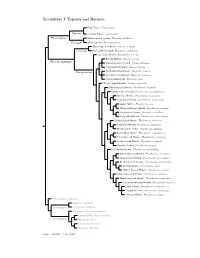
Trochilidae I: Topazes and Hermits Fiery Topaz, Topaza pyra Topazini Crimson Topaz, Topaza pella Florisuginae White-necked Jacobin, Florisuga mellivora Florisugini Black Jacobin, Florisuga fusca White-tipped Sicklebill, Eutoxeres aquila Eutoxerini Buff-tailed Sicklebill, Eutoxeres condamini Saw-billed Hermit, Ramphodon naevius Bronzy Hermit, Glaucis aeneus Phaethornithinae Rufous-breasted Hermit, Glaucis hirsutus ?Hook-billed Hermit, Glaucis dohrnii Threnetes ruckeri Phaethornithini Band-tailed Barbthroat, Pale-tailed Barbthroat, Threnetes leucurus ?Sooty Barbthroat, Threnetes niger ?Broad-tipped Hermit, Anopetia gounellei White-bearded Hermit, Phaethornis hispidus Tawny-bellied Hermit, Phaethornis syrmatophorus Mexican Hermit, Phaethornis mexicanus Long-billed Hermit, Phaethornis longirostris Green Hermit, Phaethornis guy White-whiskered Hermit, Phaethornis yaruqui Great-billed Hermit, Phaethornis malaris Long-tailed Hermit, Phaethornis superciliosus Straight-billed Hermit, Phaethornis bourcieri Koepcke’s Hermit, Phaethornis koepckeae Needle-billed Hermit, Phaethornis philippii Buff-bellied Hermit, Phaethornis subochraceus Scale-throated Hermit, Phaethornis eurynome Sooty-capped Hermit, Phaethornis augusti Planalto Hermit, Phaethornis pretrei Pale-bellied Hermit, Phaethornis anthophilus Stripe-throated Hermit, Phaethornis striigularis Gray-chinned Hermit, Phaethornis griseogularis Black-throated Hermit, Phaethornis atrimentalis Reddish Hermit, Phaethornis ruber ?White-browed Hermit, Phaethornis stuarti ?Dusky-throated Hermit, Phaethornis squalidus Streak-throated Hermit, Phaethornis rupurumii Cinnamon-throated Hermit, Phaethornis nattereri Little Hermit, Phaethornis longuemareus ?Tapajos Hermit, Phaethornis aethopygus ?Minute Hermit, Phaethornis idaliae Polytminae: Mangos Lesbiini: Coquettes Lesbiinae Coeligenini: Brilliants Patagonini: Giant Hummingbird Lampornithini: Mountain-Gems Tro chilinae Mellisugini: Bees Cynanthini: Emeralds Trochilini: Amazilias Source: McGuire et al. (2014).. -

Biolphilately Vol-64 No-3
BIOPHILATELY OFFICIAL JOURNAL OF THE BIOLOGY UNIT OF ATA MARCH 2020 VOLUME 69, NUMBER 1 Great fleas have little fleas upon their backs to bite 'em, And little fleas have lesser fleas, and so ad infinitum. —Augustus De Morgan Dr. Indraneil Das Pangolins on Stamps More Inside >> IN THIS ISSUE NEW ISSUES: ARTICLES & ILLUSTRATIONS: From the Editor’s Desk ......................... 1 Botany – Christopher E. Dahle ............ 17 Pangolins on Stamps of the President’s Message .............................. 2 Fungi – Paul A. Mistretta .................... 28 World – Dr. Indraneil Das ..................7 Secretary -Treasurer’s Corner ................ 3 Mammalia – Michael Prince ................ 31 Squeaky Curtain – Frank Jacobs .......... 15 New Members ....................................... 3 Ornithology – Glenn G. Mertz ............. 35 New Plants in the Philatelic News of Note ......................................... 3 Ichthyology – J. Dale Shively .............. 57 Herbarium – Christopher Dahle ....... 23 Women’s Suffrage – Dawn Hamman .... 4 Entomology – Donald Wright, Jr. ........ 59 Rats! ..................................................... 34 Event Calendar ...................................... 6 Paleontology – Michael Kogan ........... 65 New Birds in the Philatelic Wedding Set ........................................ 16 Aviary – Charles E. Braun ............... 51 Glossary ............................................... 72 Biology Reference Websites ................ 69 ii Biophilately March 2020 Vol. 69 (1) BIOPHILATELY BIOLOGY UNIT -

Owls of Northern Peru
PERU: OWLS OF NORTHERN PERU The endemic Koepcke’s Screech Owl is one of our many fantastic owl targets on this trip (photo Alan van Norman). www.birdingecotours.com info@birdingecotours.com 2 | ITINERARY Owls of Northern Peru Owls are our favorite bird family, and we love to show owls to our clients and friends. We have designed this 14-day itinerary to take you to Northern Peru and show you some of the best birds of this part of the planet, like Marvelous Spatuletail, Peruvian Plantcutter, Tumbes Tyrant, Rufous-crested Coquette, Grey-breasted Mountain Toucan, Andean Condor, Torrent Duck, Chestnut and Ochre-fronted Antpittas, Royal Sunangel, Lulu’s Tody-Flycatcher, and of course as many owls as possible. Birding Ecotours has been operating tours in Northern Peru for almost a decade and has been pioneering in developing a tour like this. Our main objective during this trip will be to track down and show you possibly 18 species of owls. All of them have been recorded on previous Birding Ecotours tours, so we have good knowledge of where they are to be found. Ferruginous Pygmy Owl is often active during the day. From Lima we will fly to the tropical city of Tarapoto, where we will have the chance to see typical Amazon lowland species like White-throated Toucan for those who have never been in the lowlands before and to visit some nice hummingbird feeders with species like the endemic Koepcke’s Hermit, Gould’s Jewelfront, Black-throated Mango, and White-necked Jacobin, among others. Other species we might find include Hoatzin, Carmiol’s Tanager, Slaty- capped Shrike-Vireo, Slate-colored Grosbeak, Buff-fronted Foliage-gleaner, Green Honeycreeper, Black-faced Dacnis, Paradise Tanager, and many more. -
Nesting Behavior of Reddish Hermits (Phaethornis Ruber) and Occurrence of Wasp Cells in Nests
NESTING BEHAVIOR OF REDDISH HERMITS (PHAETHORNIS RUBER) AND OCCURRENCE OF WASP CELLS IN NESTS YOSHIKA ONIKI REDraSHHermits (Phaethornisruber) are small hummingbirdsof the forested tropical lowlands east of the Andes and south of the Orinoco (Meyer de Schauensee,1966: 161). Five birds mist-nettedat Belem (1 ø 28' S, 48ø 27' W, altitude 13 m) weighed2.0 to 2.5 g (average2.24 g). I studiedtheir nestingfrom 14 October1966 to October1967 at Belem, Brazil, in the Area de PesquisasEco16gicas do Guam•t (APEG) and MocamboForest reserves,in the Instituto de Pesquisase Experimentaqfio Agropecu•triasdo Norte (IPEAN). Names of forest types used and the Portugueseequivalents are: tidal swamp forest (vdrze'a), mature upland forest (terra-/irme) and secondgrowth (capoeira). In all casescapo.eira has been in mature upland situations. At Belem Phaethornisruber is commonall year in the lower levels of secondgrowth (capoeira) where thin branchesare plentiful. Isolated males call frequently from thin horizontal branches,never higher than 2.5-3.0 m. The male sits erect and wags his tail forward and backward as he squeaksa seriesof insectlike"pi-pi-pipipipipipi" notes, 18-20 times per minute; the first two or three notesare short and separated,the rest are run togetherrapidly. The bird sometimesstops calling for someseconds and flasheshis tongue in and out several times during the interval. I foundno singingassemblies of malehermits such as Davis (1934) describes for both the Reddishand Long-tailedHermits (Phaethornissuperciliosus). and Snow (1968) for the Little Hermit (P. longuemareus). Breeding season.--The monthly rainfall at Belem in the year of the study was 350 to 550 mm from January to May and 25 to 200 mm from June to December,with lows in October and November and highs in March and April. -
Northern Peru’S Cloud Forest Endemics Mythical Owlet and the Stupendous Spatuletail! August 12-23, 2021 ©2020
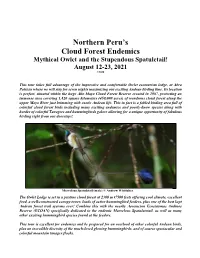
Northern Peru’s Cloud Forest Endemics Mythical Owlet and the Stupendous Spatuletail! August 12-23, 2021 ©2020 This tour takes full advantage of the impressive and comfortable Owlet ecotourism lodge, at Abra Patricia where we will stay for seven nights maximizing our exciting Andean birding time. Its location is perfect, situated within the huge Alto Mayo Cloud Forest Reserve created in 1987, protecting an immense area covering 1,820 square kilometers (450,000 acres) of wondrous cloud forest along the upper Mayo River just brimming with exotic Andean life. This in fact is a fabled birding area full of colorful cloud forest birds including many exciting endemics and poorly-know species along with hordes of colorful Tanagers and hummingbirds galore allowing for a unique opportunity of fabulous birding right from our doorsteps! Marvelous Spatuletail (male) © Andrew Whittaker The Owlet Lodge is set in a pristine cloud forest at 2300 m (7500 feet) offering cool climate, excellent food, a well-constructed canopy tower, loads of active hummingbird feeders, plus one of the best kept Andean forest trail systems ever! Combine this with the nearby Asociacion Ecosistemas Andinos Reserve (ECOAN) specifically dedicated to the endemic Marvelous Spatulatetail, as well as many other exciting hummingbird species found at the feeders. This tour is excellent for endemics and be prepared for an overload of other colorful Andean birds, plus an incredible diversity of the much-loved glowing hummingbirds, and of course spectacular and colorful mountain tanager flocks. Northern Peru’s Cloud Forest: Page 2 At Waquanki Lodge, we will have an exciting couple of nights in this lovely, fairly new, family run lodge, located in forested grounds of the foothills, at about 900 m (3000 feet), near the village of Moyobamba. -

REGUA Bird List July 2020.Xlsx
Birds of REGUA/Aves da REGUA Updated July 2020. The taxonomy and nomenclature follows the Comitê Brasileiro de Registros Ornitológicos (CBRO), Annotated checklist of the birds of Brazil by the Brazilian Ornithological Records Committee, updated June 2015 - based on the checklist of the South American Classification Committee (SACC). Atualizado julho de 2020. A taxonomia e nomenclatura seguem o Comitê Brasileiro de Registros Ornitológicos (CBRO), Lista anotada das aves do Brasil pelo Comitê Brasileiro de Registros Ornitológicos, atualizada em junho de 2015 - fundamentada na lista do Comitê de Classificação da América do Sul (SACC). -

Provisional List of Birds of the Rio Tahuauyo Areas, Loreto, Peru
Provisional List of Birds of the Rio Tahuauyo areas, Loreto, Peru Compiled by Carol R. Foss, Ph.D. and Josias Tello Huanaquiri, Guide Status based on expeditions from Tahuayo Logde and Amazonia Research Center TINAMIFORMES: Tinamidae 1. Great Tinamou Tinamus major 2. White- throated Tinamou Tinamus guttatus 3. Cinereous Tinamou Crypturellus cinereus 4. Little Tinamou Crypturellus soui 5. Undulated Tinamou Crypturellus undulates 6. Variegated Tinamou Crypturellus variegatus 7. Bartlett’s Tinamou Crypturellus bartletti ANSERIFORMES: Anhimidae 8. Horned Screamer Anhima cornuta ANSERIFORMES: Anatidae 9. Muscovy Duck Cairina moschata 10. Blue-winged Teal Anas discors 11. Masked Duck Nomonyx dominicus GALLIFORMES: Cracidae 12. Spix’s Guan Penelope jacquacu 13. Blue-throated Piping-Guan Pipile cumanensis 14. Speckled Chachalaca Ortalis guttata 15. Wattled Curassow Crax globulosa 16. Razor-billed Curassow Mitu tuberosum GALLIFORMES: Odontophoridae 17. Marbled Wood-Quall Odontophorus gujanensis 18. Starred Wood-Quall Odontophorus stellatus PELECANIFORMES: Phalacrocoracidae 19. Neotropic Cormorant Phalacrocorax brasilianus PELECANIFORMES: Anhingidae 20. Anhinga Anhinga anhinga CICONIIFORMES: Ardeidae 21. Rufescent Tiger-Heron Tigrisoma lineatum 22. Agami Heron Agamia agami 23. Boat-billed Heron Cochlearius cochlearius 24. Zigzag Heron Zebrilus undulatus 25. Black-crowned Night-Heron Nycticorax nycticorax 26. Striated Heron Butorides striata 27. Cattle Egret Bubulcus ibis 28. Cocoi Heron Ardea cocoi 29. Great Egret Ardea alba 30. Cappet Heron Pilherodius pileatus 31. Snowy Egret Egretta thula 32. Little Blue Heron Egretta caerulea CICONIIFORMES: Threskiornithidae 33. Green Ibis Mesembrinibis cayennensis 34. Roseate Spoonbill Platalea ajaja CICONIIFORMES: Ciconiidae 35. Jabiru Jabiru mycteria 36. Wood Stork Mycteria Americana CICONIIFORMES: Cathartidae 37. Turkey Vulture Cathartes aura 38. Lesser Yellow-headed Vulture Cathartes burrovianus 39. -

Birds of Brazil
BIRDS OF BRAZIL - MP3 SOUND COLLECTION version 2.0 List of recordings 0001 1 Greater Rhea 1 Song 0:17 Rhea americana (20/7/2005, Chapada dos Guimaraes, Mato Grosso, Brazil, 15.20S,55.50W) © Peter Boesman 0006 1 Gray Tinamou 1 Song 0:43 Tinamus tao (15/8/2007 18:30h, Nirgua area, San Felipe, Venezuela, 10.15N,68.30W) © Peter Boesman 0006 2 Gray Tinamou 2 Song 0:24 Tinamus tao (2/1/2008 17:15h, Tarapoto tunnel road, San Martín, Peru, 06.25S,76.15W) © Peter Boesman 0006 3 Gray Tinamou 3 Whistle 0:09 Tinamus tao (15/8/2007 18:30h, Nirgua area, San Felipe, Venezuela, 10.15N,68.30W) © Peter Boesman 0007 1 Solitary Tinamou 1 Song () 0:05 Tinamus solitarius (11/8/2004 08:00h, Serra da Graciosa, Paraná, Brazil, 25.20S,48.55W) © Peter Boesman. 0009 1 Great Tinamou 1 Song 1:31 Tinamus major (3/1/2008 18:45h, Morro de Calzada, San Martín, Peru, 06.00S,77.05W) © Peter Boesman 0009 2 Great Tinamou 2 Song 0:31 Tinamus major (28/7/2009 18:00h, Pantiacolla Lodge, Madre de Dios, Peru, 12.39S,71.14W) © Peter Boesman 0009 3 Great Tinamou 3 Song 0:27 Tinamus major (26/7/2009 17:00h, Pantiacolla Lodge, Madre de Dios, Peru, 12.39S,71.14W) © Peter Boesman 0009 4 Great Tinamou 4 Song 0:46 Tinamus major (22nd July 2010 17h00, ACTS Explornapo, Loreto, Peru, 120 m. 3°10' S, 72°55' W). (Background: Thrush-like Antpitta, Elegant Woodcreeper). © Peter Boesman. 0009 5 Great Tinamou 5 Call 0:11 Tinamus major (17/7/2006 17:30h, Iracema falls, Presidente Figueiredo, Amazonas, Brazil, 02.00S,60.00W) © Peter Boesman. -

Birds of Reserva Natural Laguna Blanca, Departamento San Pedro, Paraguay and the Imminent Threats to Their Conservation
Rev. Biodivers. Neotrop. ISSN 2027-8918 e-ISSN 2256-5426 Enero-Julio 2016; 6 (1): 55-67 55 DOI: 10.18636/bioneotropical.v6i1.173 Birds of Reserva Natural Laguna Blanca, departamento San Pedro, Paraguay and the imminent threats to their conservation Las aves de la Reserva Natural Laguna Blanca, departamento San Pedro, Paraguay y las amenazas inminentes para su conservación Paul Smith1,2, Hugo del Castillo1,3, Kevin Guest2 Abstract Objective: The results of several years of inventory work at Reserva Natural Laguna Blanca, departamento San Pedro, Paraguay are presented. Results: A total of 301 species are recorded from the reserve, with an additional 18 species known to occur in the catchment area, already declared an Important Bird Area. Thirty four species are reported for the first time in the reserve.Conclusions: The presence of breeding populations of a number of threatened Cerrado birds makes the long term conservation of this site a priority for conservation in Paraguay. However the protected status of the reserve officially ended in January 2015 and the imminent threats that this vitally important bird area faces are detailed. Keywords: Cerrado, Eleothreptus candicans, IBA, Inventory, Grasslands. Resumen Objetivo: Se presentan los resultados de varios años de trabajos de inventario en la Reserva Natural Laguna Blanca, departamento San Pedro, Paraguay. Resultados: Un total de 301 especies de aves han sido registradas en la reserva, han sido comprobadas 18 más en la zona de amortiguamiento (oficialmente declarado un AICA). Treinta y cuatro especies se reportan por primera vez en la zona. Conclusiones: La presencia de poblaciones reproductivas de aves amenazadas del Cerrado indica que la conservación a largo plazo de esta reserva debe ser una prioridad para la conservación en Paraguay. -
Spatuletails, Owlet Lodge & More 2018
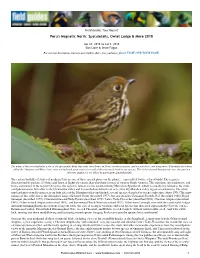
Field Guides Tour Report Peru's Magnetic North: Spatuletails, Owlet Lodge & More 2018 Jun 23, 2018 to Jul 5, 2018 Dan Lane & Jesse Fagan For our tour description, itinerary, past triplists, dates, fees, and more, please VISIT OUR TOUR PAGE. The name of this tour highlights a few of the spectacular birds that make their homes in Peru's northern regions, and we saw these, and many more! This might have been called the "Antpittas and More" tour, since we had such great views of several of these formerly hard-to-see species. This Ochre-fronted Antpitta was one; she put on a fantastic display for us! Photo by participant Linda Rudolph. The eastern foothills of Andes of northern Peru are one of those special places on the planet… especially if you’re a fan of birds! The region is characterized by pockets of white sand forest at higher elevations than elsewhere in most of western South America. This translates into endemism, and hence our interest in the region! Of course, the region is famous for the award-winning Marvelous Spatuletail, which is actually not related to the white sand phenomenon, but rather to the Utcubamba valley and its rainshadow habitats (an arm of the dry Marañon valley region of endemism). The white sand endemics actually span areas on both sides of the Marañon valley and include several species described to science only since about 1976! The most famous of this collection is the diminutive Long-whiskered Owlet (described 1977), but also includes Cinnamon Screech-Owl (described 1986), Royal Sunangel (described 1979), Cinnamon-breasted Tody-Tyrant (described 1979), Lulu’s Tody-Flycatcher (described 2001), Chestnut Antpitta (described 1987), Ochre-fronted Antpitta (described 1983), and Bar-winged Wood-Wren (described 1977). -

Distribution, Ecology, and Life History of the Pearly-Eyed Thrasher (Margarops Fuscatus)
Adaptations of An Avian Supertramp: Distribution, Ecology, and Life History of the Pearly-Eyed Thrasher (Margarops fuscatus) Chapter 6: Survival and Dispersal The pearly-eyed thrasher has a wide geographical distribution, obtains regional and local abundance, and undergoes morphological plasticity on islands, especially at different elevations. It readily adapts to diverse habitats in noncompetitive situations. Its status as an avian supertramp becomes even more evident when one considers its proficiency in dispersing to and colonizing small, often sparsely The pearly-eye is a inhabited islands and disturbed habitats. long-lived species, Although rare in nature, an additional attribute of a supertramp would be a even for a tropical protracted lifetime once colonists become established. The pearly-eye possesses passerine. such an attribute. It is a long-lived species, even for a tropical passerine. This chapter treats adult thrasher survival, longevity, short- and long-range natal dispersal of the young, including the intrinsic and extrinsic characteristics of natal dispersers, and a comparison of the field techniques used in monitoring the spatiotemporal aspects of dispersal, e.g., observations, biotelemetry, and banding. Rounding out the chapter are some of the inherent and ecological factors influencing immature thrashers’ survival and dispersal, e.g., preferred habitat, diet, season, ectoparasites, and the effects of two major hurricanes, which resulted in food shortages following both disturbances. Annual Survival Rates (Rain-Forest Population) In the early 1990s, the tenet that tropical birds survive much longer than their north temperate counterparts, many of which are migratory, came into question (Karr et al. 1990). Whether or not the dogma can survive, however, awaits further empirical evidence from additional studies. -

Lista Das Aves Do Brasil
90 Annotated checklist of the birds of Brazil by the Brazilian Ornithological Records Committee / Lista comentada das aves do Brasil pelo Comitê Brasileiro de Registros Ornitológicos content / conteÚDO Abstract ............................. 91 Charadriiformes ......................121 Scleruridae .............187 Charadriidae .........121 Dendrocolaptidae ...188 Introduction ........................ 92 Haematopodidae ...121 Xenopidae .............. 195 Methods ................................ 92 Recurvirostridae ....122 Furnariidae ............. 195 Burhinidae ............122 Tyrannides .......................203 Results ................................... 94 Chionidae .............122 Pipridae ..................203 Scolopacidae .........122 Oxyruncidae ..........206 Discussion ............................. 94 Thinocoridae .........124 Onychorhynchidae 206 Checklist of birds of Brazil 96 Jacanidae ...............124 Tityridae ................207 Rheiformes .............................. 96 Rostratulidae .........124 Cotingidae .............209 Tinamiformes .......................... 96 Glareolidae ............124 Pipritidae ............... 211 Anseriformes ........................... 98 Stercorariidae ........125 Platyrinchidae......... 211 Anhimidae ............ 98 Laridae ..................125 Tachurisidae ...........212 Anatidae ................ 98 Sternidae ...............126 Rhynchocyclidae ....212 Galliformes ..............................100 Rynchopidae .........127 Tyrannidae ............. 218 Cracidae ................100 Columbiformes