Ancient Greek and Roman Galleries, September 22, 2010
Total Page:16
File Type:pdf, Size:1020Kb
Load more
Recommended publications
-
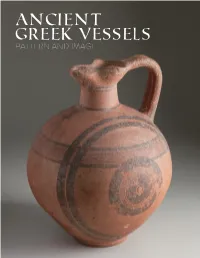
Ancient Greek Vessels Pattern and Image
ANCIENT GREEK VESSELS PATTERN AND IMAGE 1 ACKNOWLEDGMENTS It is my pleasure to acknowledge the many individuals who helped make this exhibition possible. As the first collaboration between The Trout Gallery at Dickinson College and Bryn Mawr and Wilson Colleges, we hope that this exhibition sets a precedent of excellence and substance for future collaborations of this sort. At Wilson College, Robert K. Dickson, Associate Professor of Fine Art and Leigh Rupinski, College Archivist, enthusiasti- cally supported loaning the ancient Cypriot vessels seen here from the Barron Blewett Hunnicutt Classics ANCIENT Gallery/Collection. Emily Stanton, an Art History Major, Wilson ’15, prepared all of the vessels for our initial selection and compiled all existing documentation on them. At Bryn Mawr, Brian Wallace, Curator and Academic Liaison for Art and Artifacts, went out of his way to accommodate our request to borrow several ancient Greek GREEK VESSELS vessels at the same time that they were organizing their own exhibition of works from the same collection. Marianne Weldon, Collections Manager for Special Collections, deserves special thanks for not only preparing PATTERN AND IMAGE the objects for us to study and select, but also for providing images, procuring new images, seeing to the docu- mentation and transport of the works from Bryn Mawr to Carlisle, and for assisting with the installation. She has been meticulous in overseeing all issues related to the loan and exhibition, for which we are grateful. At The Trout Gallery, Phil Earenfight, Director and Associate Professor of Art History, has supported every idea and With works from the initiative that we have proposed with enthusiasm and financial assistance, without which this exhibition would not have materialized. -

Urban Planning in the Greek Colonies in Sicily and Magna Graecia
Urban Planning in the Greek Colonies in Sicily and Magna Graecia (8th – 6th centuries BCE) An honors thesis for the Department of Classics Olivia E. Hayden Tufts University, 2013 Abstract: Although ancient Greeks were traversing the western Mediterranean as early as the Mycenaean Period, the end of the “Dark Age” saw a surge of Greek colonial activity throughout the Mediterranean. Contemporary cities of the Greek homeland were in the process of growing from small, irregularly planned settlements into organized urban spaces. By contrast, the colonies founded overseas in the 8th and 6th centuries BCE lacked any pre-existing structures or spatial organization, allowing the inhabitants to closely approximate their conceptual ideals. For this reason the Greek colonies in Sicily and Magna Graecia, known for their extensive use of gridded urban planning, exemplified the overarching trajectory of urban planning in this period. Over the course of the 8th to 6th centuries BCE the Greek cities in Sicily and Magna Graecia developed many common features, including the zoning of domestic, religious, and political space and the implementation of a gridded street plan in the domestic sector. Each city, however, had its own peculiarities and experimental design elements. I will argue that the interplay between standardization and idiosyncrasy in each city developed as a result of vying for recognition within this tight-knit network of affluent Sicilian and South Italian cities. This competition both stimulated the widespread adoption of popular ideas and encouraged the continuous initiation of new trends. ii Table of Contents: Abstract. …………………….………………………………………………………………….... ii Table of Contents …………………………………….………………………………….…….... iii 1. Introduction …………………………………………………………………………..……….. 1 2. -

STASIS in the POPULATION of METAPONTO: ANAYLSIS of ENVIRONMENT, HEALTH, and POLITICAL UNREST by Brittany Jean Viviani Submitted
STASIS IN THE POPULATION OF METAPONTO: ANAYLSIS OF ENVIRONMENT, HEALTH, AND POLITICAL UNREST By Brittany Jean Viviani Submitted to the Faculty of The Archaeological Studies Program Department of Sociology and Archaeology In partial fulfillment of the requirements for the degree of Bachelor of Science University of Wisconsin-La Crosse Copyright © 2013 by Brittany Jean Viviani All rights reserved ii STASIS IN THE POPULATION OF METAPONTO: ANAYLSIS OF ENVIRONMENT, HEALTH, AND POLITICAL UNREST Brittany Jean Viviani, B.S. University of Wisconsin-La Crosse, 2013 The Greek colony of Metaponto offers an invaluable insight to the study of both rural and urban populations. Analysis of population is an important study to be able to examine social, political, and economic impacts of the time and how a group of people dealt with these stressors. Starting around 500 B.C. Metaponto experienced a period of great prosperity followed by a period of stasis starting around 425 B.C. Analysis was completed to understand whether stasis was the result of 1) epidemic disease, 2) environmental degradation, 3) political unrest, and 4) a combination of factors. Data used included archaeological data and historical accounts of Metaponto from Greek historians. Stress and possible warfare from different groups of people in the Mediterranean against Metaponto would have created increased tension within a colony already ravaged by disease. This could have caused the perfect storm to create stasis temporarily ending the period of prosperity. iii ACKNOWLEDGMENTS I would first like to thank my advisor Dr. David Anderson and committee members Dr. Mark Chavalas, and Dr. Timothy McAndrews for all of their support and guidance during the writing process of my thesis. -
Classical and Hellenistic Glass Workshops from Rhodes
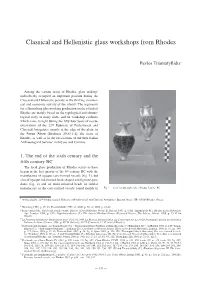
Classical and Hellenistic glass workshops from Rhodes Pavlos Triantafyllidis* Among the various crafts of Rhodes, glass making1 undoubtedly occupied an important position during the Classical and Hellenistic periods in the thriving commer- cial and economic activity of the island2. The arguments for a flourishing glassworking production on the island of Rhodes are mainly based on the typological and chrono- logical study of many finds, and on workshop evidence which came to light during the fifty-four years of rescue excavations of the 22nd Ephorate of Prehistorical and Classical Antiquities, mainly at the edge of the plain, in the Pano;ı “Akran (Diodoros 20.83.1-4), the town of Rhodes, as well as in the excavations of the then Italian Archaeological Service3 in Ialysos and Camiros. 1. The end of the sixth century and the fifth century BC The local glass production of Rhodes seems to have begun in the last quarter of the 6th century BC with the manufacture of opaque core-formed vessels (fig. 1), but also of opaque rod-formed head-shaped and figurine-pen- dants (fig. 2) and of multi-coloured beads of similar manufacture to the core-formed vessels found mainly in Fig. 1 — Core-formed amphoriskoi. Rhodes. Late 6c. BC. * Archaeologist, 22nd Archaeological Ephorate of Prehistorical and Classical Antiquities, Ippoton Street, GR- 85100 Rhodes, Greece. 1 Weinberg 1992, p. 19, 23; Triantafyllidis 1997; id. 2000, p. 30; id. 2002, p. 21-22. 2 Rostovtzeff (M.), The Social and Economic History of the Hellenistic World, II, Oxford, 1941, p. 676ff.; Berthold (R.M.), Rhodes in the Hellenistic Age, London, 1984, p. -

Contemporary Art Magazine Issue # Sixteen December | January Twothousandnine Spedizione in A.P
contemporary art magazine issue # sixteen december | january twothousandnine Spedizione in a.p. -70% _ DCB Milano NOVEMBER TO JANUARY, 2009 KAREN KILIMNIK NOVEMBER TO JANUARY, 2009 WadeGUYTON BLURRY CatherineSULLIVAN in collaboration with Sean Griffin, Dylan Skybrook and Kunle Afolayan Triangle of Need VibekeTANDBERG The hamburger turns in my stomach and I throw up on you. RENOIR Liquid hamburger. Then I hit you. After that we are both out of words. January - February 2009 DEBUSSY URS FISCHER GALERIE EVA PRESENHUBER WWW.PRESENHUBER.COM TEL: +41 (0) 43 444 70 50 / FAX: +41 (0) 43 444 70 60 LIMMATSTRASSE 270, P.O.BOX 1517, CH–8031 ZURICH GALLERY HOURS: TUE-FR 12-6, SA 11-5 DOUG AITKEN, EMMANUELLE ANTILLE, MONIKA BAER, MARTIN BOYCE, ANGELA BULLOCH, VALENTIN CARRON, VERNE DAWSON, TRISHA DONNELLY, MARIA EICHHORN, URS FISCHER, PETER FISCHLI/DAVID WEISS, SYLVIE FLEURY, LIAM GILLICK, DOUGLAS GORDON, MARK HANDFORTH, CANDIDA HÖFER, KAREN KILIMNIK, ANDREW LORD, HUGO MARKL, RICHARD PRINCE, GERWALD ROCKENSCHAUB, TIM ROLLINS AND K.O.S., UGO RONDINONE, DIETER ROTH, EVA ROTHSCHILD, JEAN-FRÉDÉRIC SCHNYDER, STEVEN SHEARER, JOSH SMITH, BEAT STREULI, FRANZ WEST, SUE WILLIAMS DOUBLESTANDARDS.NET 1012_MOUSSE_AD_Dec2008.indd 1 28.11.2008 16:55:12 Uhr Galleria Emi Fontana MICHAEL SMITH Viale Bligny 42 20136 Milano Opening 17 January 2009 T. +39 0258322237 18 January - 28 February F. +39 0258306855 emif@micronet.it www.galleriaemifontana.com Photo General Idea, 1981 David Lamelas, The Violent Tapes of 1975, 1975 - courtesy: Galerie Kienzie & GmpH, Berlin L’allarme è generale. Iper e sovraproduzione, scialo e vacche grasse si sono tra- sformati di colpo in inflazione, deflazione e stagflazione. -

Chapter One Pottery Other Than Transport Amphorae Philip M. Kenrick
. chapter one . Pottery Other Than Transport Amphorae Philip M. Kenrick INTRODUCTION THE potterY fabrics The rescue excavations of 2000 took place alongside par- The pottery is arranged primarily by fabric, in order to dis- allel investigations at Zeugma by French and Turkish tinguish where possible the various sources from which teams. When I was first invited to participate there was Zeugma was supplied. Since there is also a high degree of also understood to be a possibility of a further long-term correlation between fabrics and the functions for which the research excavation on the site to study the pottery.1 At the vessels were intended, the following conceptual structure time, it seemed premature to embark upon a comprehen- was found useful. sive description of the pottery of Zeugma: It was there fore . Table wares. Vessels for serving and consuming food: agreed that I should concentrate on a few contexts that plates, dishes, small bowls, drinking cups, together with could be reasonably well dated and that might be used to lids intended for use with such forms; also some small characterize the major chronological phases identified in flagons and jugs intended for use at the table. These are the trenches for which Oxford Archaeology was respon- generally made in fine fabrics with smooth surfaces, sible: these were Trenches 1, 2, 4, 5, 7, 9, 10, 11, 12, 13, 15, 18, mostly with a distinctive surface finish such as a slip or and 19. glaze. The briefest of notes were made upon the entire pottery collection, and these were then used in conjunction with . -

Kynomartyrion)
DOG SACRIFICE IN ANCIENT AND MODERN GREECE: FROM THE SACRIFICE RITUAL TO DOG TORTURE (KYNOMARTYRION) Manolis G. Sergis Abstract: The article presents and discusses the custom of kynomartyrion (dog torture) which took place in the Greek lands until the 1980s. In many areas it stopped in the 1930s because of its cruelty. The author begins his discussion with the presentation of some elements that are related to the dog. More spe- cifically, the dog is an animal that entered the humanized environment long ago and belongs to the creatures whose nature is twofold because it is part of the human and the non-human worlds and it has been treated as twofold by at least the Indo-Europeans. It is also maintained that the liminal Hellenistic period was decisive for the formation of folk worship because of the religious syncre- tism and the invasion of demons that dominated in the Eastern Mediterranean. The author points out its remarkable similarities to ancient Greek and Roman (and Indo-European) fertile, cathartic and other sacrificial practices. Due to industrialization of agriculture and rationalization of the magical way of thought of the “traditional” peasant, performance of the custom was transformed into a folkloric, spectacular one with intensely violent and sadistic behaviour on the part of humans in the places where it still took place after 1960. The writer argues that violence was always an inherent characteristic of the custom. None- theless, the archaic, and later folk thinking ritualized the performance and attributed to it a different facet, devoid of any sacred elements, during the 20th century where its inherent violence was manifested in its raw essence. -

Clifton Chronicle
SUMMER 2012 Volume Twenty-Two Number One CA Publicationlifton of Clifton Town Meeting C You Dohronicle It You Write It We Print It Cincinnati, Ohio 45220 Box 20067 P.O. Clifton Chronicle Clifton Home Composite—You will not be touring this home any time soon, made up of the homes on Evanswood Place by Bruce Ryan, former resident and producer of yearly Evanswood block party invitation where this illustration first appeared. Clifton House Tour this Mother’s Day By Eric Clark Every third year on Mother’s are like stepping back in time to the sored them throughout the ‘70s and Day, a group of Clifton homeowners period in which they were built. ‘80s, taking a hiatus between 1988 open their doors to greater Cincinnati Although we do not disclose and 1997. Since the resumption and say, “Come on in and have a look pictures or the addresses of the of the tours, the event has drawn around!” So, mark your calendars for homes until the day of the tour. We people from all over Cincinnati and Mother’s Day, May 13, 2012. are confident that if you have an ap- has been a great way to spend part Clifton Town Meeting has lined preciation for architecture or interior of Mother’s Day. up some great houses for the 2012 design, or if you just enjoy touring Tickets are $17.50 in advance tour and it includes something for beautiful Clifton homes, you will and $22.50 the day of the tour. Tick- everyone with a wide and eclectic NOT be disappointed. -

Greek Pottery Gallery Activity
SMART KIDS Greek Pottery The ancient Greeks were Greek pottery comes in many excellent pot-makers. Clay different shapes and sizes. was easy to find, and when This is because the vessels it was fired in a kiln, or hot were used for different oven, it became very strong. purposes; some were used for They decorated pottery with transportation and storage, scenes from stories as well some were for mixing, eating, as everyday life. Historians or drinking. Below are some have been able to learn a of the most common shapes. great deal about what life See if you can find examples was like in ancient Greece by of each of them in the gallery. studying the scenes painted on these vessels. Greek, Attic, in the manner of the Berlin Painter. Panathenaic amphora, ca. 500–490 B.C. Ceramic. Bequest of Mrs. Allan Marquand (y1950-10). Photo: Bruce M. White Amphora Hydria The name of this three-handled The amphora was a large, two- vase comes from the Greek word handled, oval-shaped vase with for water. Hydriai were used for a narrow neck. It was used for drawing water and also as urns storage and transport. to hold the ashes of the dead. Krater Oinochoe The word krater means “mixing The Oinochoe was a small pitcher bowl.” This large, two-handled used for pouring wine from a krater vase with a broad body and wide into a drinking cup. The word mouth was used for mixing wine oinochoe means “wine-pourer.” with water. Kylix Lekythos This narrow-necked vase with The kylix was a drinking cup with one handle usually held olive a broad, relatively shallow body. -

Epilykos Kalos
EPILYKOS KALOS (PLATES 63 and 64) N TWO EARLIERPAPERS, the writerattempted to identifymembers of prominent Athenian families in the late 6th century using a combinationof kalos names and os- traka.1 In the second of these studies, it was observed that members of the same family occurredin the work of a single vase painter,2whether praised as kalos or named as partici- pant in a scene of athletics or revelry.3The converse,i.e. that the same individual may be namedon vases by painterswho, on the basis of stylistic affinities,should belong to the same workshop,seems also to be true.4The presentpaper tries to demonstrateboth these proposi- tions by linking membersof another importantfamily, the Philaidai, to a circle of painters on whose vases they appear. The starting point is Epilykos, who is named as kalos 19 times in the years ca. 515- 505, 14 of them on vases by a single painter, Skythes.5Of the other 5, 2 are cups by the Pedieus Painter, whom Beazley considered might in fact be Skythes late in the latter's career;61 is a cup linked to Skythes by Bloesch,7 through the potter work, and through details of draughtsmanship,by Beazley;8 1 is a cup placed by Beazley near the Carpenter Painter;9and the last is a plastic aryballos with janiform women's heads, which gives its name to Beazley's Epilykos Class.10 The close relationshipof Epilykos and Skythesis especiallystriking in view of Skythes' small oeuvre, so that the 14 vases praising Epilykos accountfor fully half his total output. -
Minerva Facility Operations (Commonwealth) Environment Plan Summary
MINERVA FACILITY OPERATIONS (COMMONWEALTH) ENVIRONMENT PLAN SUMMARY Document No: APU-000338 © 2012 BHP Billiton Petroleum Pty Ltd: This document and information is the sole property of BHP Billiton Petroleum Pty Ltd and may not be exploited, used, copied, duplicated or reproduced in any form or medium without the prior permission of BHP Billiton Petroleum Pty Ltd. Revision History MINERVA OFFSHORE FACILITIES OPERATIONS ENVIRONMENT PLAN SUMMARY Contents 1 INTRODUCTION 3 2 LOCATION OF THE FACILITY 4 3 DESCRIPTION OF THE ACTIVITY 6 3.1 Timing ........................................................................................................................................ 6 4 DESCRIPTION OF RECEIVING ENVIRONMENT 7 4.1 Natural Environment .................................................................................................................. 7 4.2 Biological Environment .............................................................................................................. 8 4.3 Socio-Economic Environment.................................................................................................... 9 5 ENVIRONMENTAL IMPACTS, RISKS AND CONTROLS 10 6 MANAGEMENT APPROACH AND PERFORMANCE MONITORING 14 7 OIL SPILL CONTINGENCY PLAN 14 8 CONSULTATION 14 9 CONTACT DETAILS 15 10 REFERENCES 15 This document may contain proprietary and/or confidential information. This document is a controlled document. BHP Billiton Petroleum | 2 MINERVA OFFSHORE FACILITIES OPERATIONS ENVIRONMENT PLAN SUMMARY 1 INTRODUCTION BHP Billiton Petroleum -

Routes4u Project Feasibility Study on the Roman Heritage Route in the Adriatic and Ionian Region
Routes4U Project Feasibility Study on the Roman Heritage Route in the Adriatic and Ionian Region Routes4U Feasibility Study on an Iron Age cultural route in the Danube Region Routes4U Project Routes4U Feasibility study on an Iron Age cultural route in the Danube Region ROUTES4U FEASIBILITY STUDY ON AN IRON AGE CULTURAL ROUTE IN THE DANUBE REGION August 2019 The present study has been developed in the framework of Routes4U, the Joint Programme between the Council of Europe and the European Commission (DG REGIO). Routes4U aims to foster regional development through the Cultural Routes of the Council of Europe programme in the four EU macro-regions: the Adriatic and Ionian, Alpine, Baltic Sea and Danube Regions. A special thank you goes to the author Martin Fera, and to the numerous partners and stakeholders who supported the study. The opinions expressed in this work are the responsibility of the author and do not necessarily reflect the official policy of the Council of Europe. www.coe.int/routes4u 2 / 57 Routes4U Feasibility study on an Iron Age cultural route in the Danube Region CONTENTS Contents ................................................................................................................................................................... 3 I. EXECUTIVE SUMMARY ........................................................................................................... 5 II. ANALYSIS OF THE “STATE OF THE ART” OF IRON AGE HERITAGE IN THE DANUBE REGION...............................................................................................................................