Early Peoples of Indiana
Total Page:16
File Type:pdf, Size:1020Kb
Load more
Recommended publications
-

Fall 2003 Online Supplement
Electronic Archaeology News Volume 21 Number 3, Online Supplement Fall 2003 From the Editor: MVAC is excited to offer a new way for our members to receive current news about ongoing projects, new finds and upcoming events. We will continue to mail out a newsletter with announcements three times a year, and will provide more information in the online supplement. Please let me know what you think of this change and any suggestions you have for new MVAC at the University material to include. Members who would like a hard copy of the supplement of Wisconsin - La Crosse mailed to their homes can contact me at (608) 785-8454 or 1725 State Street dowiasch.jean@uwlax.edu. Enjoy the newsletter! La Crosse, WI 54601 Jean Dowiasch, Editor www.uwlax.edu/mvac ○○○○○○○○○○○○○○○○○○○○○○○○○○○○○○○○○○○○○○○○○○○○○○○○○○○○○○○○○○○○○○○○ State Highway 33 Projects Yields Upland Sites Vicki Twinde, Research Archaeologist In June of 2003, MVAC personnel conducted a MVAC has recommended more Phase I survey of approximately 7 miles of STH 33, archaeological work be done on from the intersection of County Highway F and STH these sites. Therefore, this fall, 33 at the top of Irish Hill to approximately 1/2 mile pending landowner permis- east of the town of St. Joseph. This is part of a sions, MVAC will undertake Wisconsin Department of Transportation project in additional archaeological work which approximately 21 miles of STH 33 will be re- on eight of these sites. done from CTH F all the way into the town of Cashton. The highway project will be completed in three different sections, as will the archaeology. -
General Vertical Files Anderson Reading Room Center for Southwest Research Zimmerman Library
“A” – biographical Abiquiu, NM GUIDE TO THE GENERAL VERTICAL FILES ANDERSON READING ROOM CENTER FOR SOUTHWEST RESEARCH ZIMMERMAN LIBRARY (See UNM Archives Vertical Files http://rmoa.unm.edu/docviewer.php?docId=nmuunmverticalfiles.xml) FOLDER HEADINGS “A” – biographical Alpha folders contain clippings about various misc. individuals, artists, writers, etc, whose names begin with “A.” Alpha folders exist for most letters of the alphabet. Abbey, Edward – author Abeita, Jim – artist – Navajo Abell, Bertha M. – first Anglo born near Albuquerque Abeyta / Abeita – biographical information of people with this surname Abeyta, Tony – painter - Navajo Abiquiu, NM – General – Catholic – Christ in the Desert Monastery – Dam and Reservoir Abo Pass - history. See also Salinas National Monument Abousleman – biographical information of people with this surname Afghanistan War – NM – See also Iraq War Abousleman – biographical information of people with this surname Abrams, Jonathan – art collector Abreu, Margaret Silva – author: Hispanic, folklore, foods Abruzzo, Ben – balloonist. See also Ballooning, Albuquerque Balloon Fiesta Acequias – ditches (canoas, ground wáter, surface wáter, puming, water rights (See also Land Grants; Rio Grande Valley; Water; and Santa Fe - Acequia Madre) Acequias – Albuquerque, map 2005-2006 – ditch system in city Acequias – Colorado (San Luis) Ackerman, Mae N. – Masonic leader Acoma Pueblo - Sky City. See also Indian gaming. See also Pueblos – General; and Onate, Juan de Acuff, Mark – newspaper editor – NM Independent and -

Factbook 2019-2020
IUPUI UNIVERSITY LIBRARY FACT BOOK 2019–2020 A progressive leader among academic libraries, the IUPUI University Library offers the campus and community technologically advanced services such as rich media technology, 3D printing, PC/MAC specialized software, librarian chat, live tech IUPUI assistance, as well as specialized instructional space. The library focuses on leveraging technology to support student success with 28 full-time faculty librarians, plus programs in information literacy and digital scholarship. With University millions of library database downloads each year, the library’s resources are always available to students. The library is the primary informal learning space on campus, Library and continues to update technology, offer public and private individual and communal learning spaces, and create innovative goods and services for our patrons. Kristi L. Palmer University Library serves thousands of undergraduates, graduate, and Herbert Simon Family Dean professional students. In 2019-20, library staff answered over 7,000 reference questions, in-person and online. Last fiscal year, librarians provided 349 instructional sessions and 887 research consultations. IUPUI ranked #11 in the United States for Free Open Access by the Centre for Science and Technology Studies at Leiden University. In the last six years, IUPUI ScholarWorks has multiplied by more than eight times – from 2,609 items at the beginning of 2013 to 21,632 items today. The University Library currently supports 24 open access journals, from fields of science, religion, teaching, law, and more. OA journals have had 413,062 views this year. The National Service Archives was launched in 2019 to collect the records of individuals and organizations involved in AmeriCorps, Peace Corps, and the promotion of national service and volunteerism. -
Guidelines for the Field Collection of Archaeological Materials and Standard Operating Procedures for Curating Department of Defense Archaeological Collections
Guidelines for the Field Collection of Archaeological Materials and Standard Operating Procedures for Curating Department of Defense Archaeological Collections Prepared for the Legacy Resource Management Program Office Legacy Project No. 98-1714 Mandatory Center of Expertise for the Curation and Management of Archaeological Collections Form Approved REPORT DOCUMENTATION PAGE OMB No. 0704-0188 Public reporting burden for this collection of information is estimated to average 1 hour per response, including the time for reviewing instructions, searching existing data sources, gathering and maintaining the data needed, and completing and reviewing the collection of information. Send comments regarding this burden estimate or any other aspect of this collection of information, including suggestions for reducing this burden, to Washington Headquarters Services, Directorate for Information Operations and Reports, 1215 Jefferson Davis Highway, Suite 1204, Arlington, VA 22202-4302, and to the Office of Management and Budget, Paperwork Reduction Project (0704-0188), Washington, DC 20503. 1. AGENCY USE ONLY (Leave blank) 2. REPORT DATE 1999 3. REPORT TYPE AND DATES COVERED 4. TITLE AND SUBTITLE 5. FUNDING NUMBERS Guidelines for the Field Collection of Archaeological Materials and Standard Operating Procedures for Curation Department of Defense Archaeological Collections 6. AUTHORS Suzanne Griset and Marc Kodack 7. PERFORMING ORGANIZATION NAME(S) AND ADDRESS(ES) PERFORMING ORGANIZATION REPORT NUMBER U.S. Army Corps of Engineers, St. Louis District 1222 Spruce Street (CEMVS-ED-Z) St. Louis, Missouri 63103-2833 9. SPONSORING/MONITORING AGENCY NAME(S) AND ADDRESS(ES) 10. SPONSORING/MONITORING AGENCY Legacy Resource Management Program Office REPORT NUMBER Office of Deputy Under Secretary of Defense (Environmental Security) Legacy Project No. -
2004 Midwest Archaeological Conference Program
Southeastern Archaeological Conference Bulletin 47 2004 Program and Abstracts of the Fiftieth Midwest Archaeological Conference and the Sixty-First Southeastern Archaeological Conference October 20 – 23, 2004 St. Louis Marriott Pavilion Downtown St. Louis, Missouri Edited by Timothy E. Baumann, Lucretia S. Kelly, and John E. Kelly Hosted by Department of Anthropology, Washington University Department of Anthropology, University of Missouri-St. Louis Timothy E. Baumann, Program Chair John E. Kelly and Timothy E. Baumann, Co-Organizers ISSN-0584-410X Floor Plan of the Marriott Hotel First Floor Second Floor ii Preface WELCOME TO ST. LOUIS! This joint conference of the Midwest Archaeological Conference and the Southeastern Archaeological Conference marks the second time that these two prestigious organizations have joined together. The first was ten years ago in Lexington, Kentucky and from all accounts a tremendous success. Having the two groups meet in St. Louis is a first for both groups in the 50 years that the Midwest Conference has been in existence and the 61 years that the Southeastern Archaeological Conference has met since its inaugural meeting in 1938. St. Louis hosted the first Midwestern Conference on Archaeology sponsored by the National Research Council’s Committee on State Archaeological Survey 75 years ago. Parts of the conference were broadcast across the airwaves of KMOX radio, thus reaching a larger audience. Since then St. Louis has been host to two Society for American Archaeology conferences in 1976 and 1993 as well as the Society for Historical Archaeology’s conference in 2004. When we proposed this joint conference three years ago we felt it would serve to again bring people together throughout most of the mid-continent. -
University of Michigan Radiocarbon Dates Xii H
[Ru)Ioc!RBo1, Vol.. 10, 1968, P. 61-114] UNIVERSITY OF MICHIGAN RADIOCARBON DATES XII H. R. CRANE and JAMES B. GRIFFIN The University of Michigan, Ann Arbor, Michigan The following is a list of dates obtained since the compilation of List XI in December 1965. The method is essentially the same as de- scribed in that list. Two C02-CS2 Geiger counter systems were used. Equipment and counting techniques have been described elsewhere (Crane, 1961). Dates and estimates of error in this list follow the practice recommended by the International Radiocarbon Dating Conferences of 1962 and 1965, in that (a) dates are computed on the basis of the Libby half-life, 5570 yr, (b) A.D. 1950 is used as the zero of the age scale, and (c) the errors quoted are the standard deviations obtained from the numbers of counts only. In previous Michigan date lists up to and in- cluding VII, we have quoted errors at least twice as great as the statisti- cal errors of counting, to take account of other errors in the over-all process. If the reader wishes to obtain a standard deviation figure which will allow ample room for the many sources of error in the dating process, we suggest doubling the figures that are given in this list. We wish to acknowledge the help of Patricia Dahlstrom in pre- paring chemical samples and David M. Griffin and Linda B. Halsey in preparing the descriptions. I. GEOLOGIC SAMPLES 9240 ± 1000 M-1291. Hosterman's Pit, Pennsylvania 7290 B.C. Charcoal from Hosterman's Pit (40° 53' 34" N Lat, 77° 26' 22" W Long), Centre Co., Pennsylvania. -

State Parks and Early Woodland Cultures
State Parks and Early Woodland Cultures Key Objectives State Parks Featured Students will understand some basic information related to the ■ Mounds State Park www.in.gov/dnr/parklake/2977.htm Adena, Hopewell and early Woodland Indians, and their connec- ■ Falls of the Ohio State Park www.in.gov/dnr/parklake/2984.htm tions to Mounds and Falls of the Ohio state parks. The students will gain insight into the connection between the Adena culture and the Hopewell tradition, and learn how archaeologists have studied artifacts and mounds to understand these cultures. Activity: Standards: Benchmarks: Assessment Tasks: Key Concepts: Mounds Students will research what was import- Artifacts Identify and compare the major early cultures ant to the Adena Indians. The students Tribes Researching SS.4.1.1 that existed in the region that became Indiana will then compile a list of items found in Adena the Past before contact with Europeans. the Adena mounds and compare them to Hopewell items that we use today. Mississippians Identify and describe historic Native American Use computers in a cooperative group groups that lived in Indiana before the time of to create timelines of major events from SS.4.1.2 early European exploration, including ways that the era of the Adena to the rise of the the groups adapted to and interacted with the Hopewell Indians. physical environment. Use computers in a cooperative group Create and interpret timelines that show rela- to create timelines of major events from SS.4.1.15 tionships among people, events and movements the era of the Adena to the rise of the in the history of Indiana. -

Indiana Archaeology
INDIANA ARCHAEOLOGY Volume 5 Number 2 2010/2011 Indiana Department of Natural Resources Division of Historic Preservation and Archaeology (DHPA) ACKNOWLEDGMENTS Indiana Department of Natural Resources Robert E. Carter, Jr., Director and State Historic Preservation Officer Division of Historic Preservation and Archaeology (DHPA) James A. Glass, Ph.D., Director and Deputy State Historic Preservation Officer DHPA Archaeology Staff James R. Jones III, Ph.D., State Archaeologist Amy L. Johnson Cathy L. Draeger-Williams Cathy A. Carson Wade T. Tharp Editors James R. Jones III, Ph.D., State Archaeologist Amy L. Johnson, Senior Archaeologist and Archaeology Outreach Coordinator Cathy A. Carson, Records Check Coordinator Publication Layout: Amy L. Johnson Additional acknowledgments: The editors wish to thank the authors of the submitted articles, as well as all of those who participated in, and contributed to, the archaeological projects which are highlighted. Cover design: The images which are featured on the cover are from several of the individual articles included in this journal. Mission Statement: The Division of Historic Preservation and Archaeology promotes the conservation of Indiana’s cultural resources through public education efforts, financial incentives including several grant and tax credit programs, and the administration of state and federally mandated legislation. 2 For further information contact: Division of Historic Preservation and Archaeology 402 W. Washington Street, Room W274 Indianapolis, Indiana 46204-2739 Phone: 317/232-1646 Email: dhpa@dnr.IN.gov www.IN.gov/dnr/historic 2010/2011 3 Indiana Archaeology Volume 5 Number 2 TABLE OF CONTENTS Authors of articles were responsible for ensuring that proper permission for the use of any images in their articles was obtained. -

Indiana Archaeology
INDIANA ARCHAEOLOGY Volume 6 Number 1 2011 Indiana Department of Natural Resources Division of Historic Preservation and Archaeology (DHPA) ACKNOWLEDGMENTS Indiana Department of Natural Resources Robert E. Carter, Jr., Director and State Historic Preservation Officer Division of Historic Preservation and Archaeology (DHPA) James A. Glass, Ph.D., Director and Deputy State Historic Preservation Officer DHPA Archaeology Staff James R. Jones III, Ph.D., State Archaeologist Amy L. Johnson, Senior Archaeologist and Archaeology Outreach Coordinator Cathy L. Draeger-Williams, Archaeologist Wade T. Tharp, Archaeologist Rachel A. Sharkey, Records Check Coordinator Editors James R. Jones III, Ph.D. Amy L. Johnson Cathy A. Carson Editorial Assistance: Cathy Draeger-Williams Publication Layout: Amy L. Johnson Additional acknowledgments: The editors wish to thank the authors of the submitted articles, as well as all of those who participated in, and contributed to, the archaeological projects which are highlighted. The U.S. Department of the Interior, National Park Service is gratefully acknow- ledged for their support of Indiana archaeological research as well as this volume. Cover design: The images which are featured on the cover are from several of the individual articles included in this journal. This publication has been funded in part by a grant from the U.S. Department of the Interior, National Park Service‘s Historic Preservation Fund administered by the Indiana Department of Natural Resources, Division of Historic Preservation and Archaeology. In addition, the projects discussed in several of the articles received federal financial assistance from the Historic Preservation Fund Program for the identification, protection, and/or rehabilitation of historic properties and cultural resources in the State of Indiana. -

Hopewell Archeology: the Newsletter of Hopewell Archeology in the Ohio River Valley Volume 2, Number 2, October 1997
Hopewell Archeology: The Newsletter of Hopewell Archeology in the Ohio River Valley Volume 2, Number 2, October 1997 1. Current Research at Hopewell Culture National Historical Park By Bret J. Ruby, Hopewell Culture National Historical Park, Ohio Archeological research is an essential activity at Hopewell Culture National Historical Park. An active program of field research provides the information necessary to protect and preserve Hopewellian archeological resources. The program also addresses a series of long-standing questions regarding the cultural history and adaptive strategies of Hopewellian populations in the central Scioto region. Presented below are preliminary notices of recent field projects conducted by park personnel with the assistance of the National Park Service's Midwest Archeological Center, Lincoln, Nebraska. These recent efforts are focused on three Hopewellian centers in Ross County. Two of these centers, the Mound City Group and the Hopeton Earthworks, are administered by the National Park Service as units of Hopewell Culture National Historical Park. The third center, the Spruce Hill Works, is privately owned and is being considered for possible inclusion in the park. Research at the Mound City Group Work at the Mound City Group was prompted by plans to install a set of eight new interpretive signs along a trail encircling the mounds and earthworks at the site. Although the Mound City Group has been the focus of archeological investigations for almost 150 years, previous research has focused almost exclusively on the mounds and earthworks themselves (Figure 1), with little attention paid to identifying archeological resources that may lie just outside the earthwork walls. Figure 1. -

62Nd Annual Midwest Archaeological Conference October 4–6, 2018 No T R E Dame Conference Center Mc Kenna Hall
62nd Annual Midwest Archaeological Conference October 4–6, 2018 No t r e Dame Conference Center Mc Kenna Hall Parking ndsp.nd.edu/ parking- and- trafǢc/visitor-guest-parking Visitor parking is available at the following locations: • Morris Inn (valet parking for $10 per day for guests of the hotel, rest aurants, and conference participants. Conference attendees should tell t he valet they are here for t he conference.) • Visitor Lot (paid parking) • Joyce & Compt on Lot s (paid parking) During regular business hours (Monday–Friday, 7a.m.–4p.m.), visitors using paid parking must purchase a permit at a pay st at ion (red arrows on map, credit cards only). The permit must be displayed face up on the driver’s side of the vehicle’s dashboard, so it is visible to parking enforcement staff. Parking is free after working hours and on weekends. Rates range from free (less than 1 hour) to $8 (4 hours or more). Campus Shut t les 2 3 Mc Kenna Hal l Fl oor Pl an Registration Open House Mai n Level Mc Kenna Hall Lobby and Recept ion Thursday, 12 a.m.–5 p.m. Department of Anthropology Friday, 8 a.m.–5 p.m. Saturday, 8 a.m.–1 p.m. 2nd Floor of Corbett Family Hall Informat ion about the campus and its Thursday, 6–8 p.m. amenities is available from any of t he Corbett Family Hall is on the east side of personnel at the desk. Notre Dame Stadium. The second floor houses t he Department of Anthropology, including facilities for archaeology, Book and Vendor Room archaeometry, human osteology, and Mc Kenna Hall 112–114 bioanthropology. -
Research Design and Reports Bibliography & Glossary
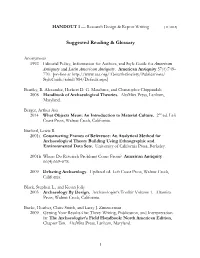
HANDOUT 1 — Research Design & Report Writing [11/2015] Suggested Reading & Glossary Anonymous 1992 Editorial Policy, Information for Authors, and Style Guide for American Antiquity and Latin American Antiquity. American Antiquity 57(4):749– 770. [on-line at http://www.saa.org/AbouttheSociety/Publications/ StyleGuide/tabid/984/Default.aspx] Bentley, R. Alexander, Herbert D. G. Maschner, and Christopher Chippindale 2008 Handbook of Archaeological Theories. AltaMira Press, Lanham, Maryland. Berger, Arthur Asa 2014 What Objects Mean: An Introduction to Material Culture. 2nd ed. Left Coast Press, Walnut Creek, California. Binford, Lewis R. 2001a Constructing Frames of Reference: An Analytical Method for Archaeological Theory Building Using Ethnographic and Environmental Data Sets. University of California Press, Berkeley. 2001b Where Do Research Problems Come From? American Antiquity 66(4):669–678. 2009 Debating Archaeology. Updated ed. Left Coast Press, Walnut Creek, California. Black, Stephen L., and Kevin Jolly 2003 Archaeology By Design. Archaeologist’s Toolkit Volume 1. Altamira Press, Walnut Creek, California. Burke, Heather, Claire Smith, and Larry J. Zimmerman 2009 Getting Your Results Out There: Writing, Publication, and Interpretation. In: The Archaeologist’s Field Handbook: North American Edition, Chapter Ten. AltaMira Press, Lanham, Maryland. 1 Chamberlin, Thomas C. 1890 The Method of Multiple Working Hypotheses. Science (old series) 15:92– 96; reprinted 1965, Science 148:754–759. Clarke, David L. 1978 Analytical Archaeology. 2nd ed. Edited by Robert Chapman. Columbia University Press, New York. 1979 editor. Analytical Archaeologist: Collected Papers of David L. Clarke. Academic Press, New York. Cochrane, Ethan, and Andrew Gardner (editors) 2011 Evolutionary and Interpretive Archaeologies. Left Coast Press, Walnut Creek, California.