Constitution of Kenya Review Commission (Ckrc)
Total Page:16
File Type:pdf, Size:1020Kb
Load more
Recommended publications
-

Memo to Kenya's Youth: Protect Your Motherland Or Perish,Doing
Memo to Kenya’s Youth: Protect Your Motherland or Perish By Willy Mutunga Kenya’s mixed election history Sometimes it is said, with some validity, that the only peaceful, non-violent, free, fair, credible, verifiable, and acceptable elections took place during the “sunset” years of British colonialism in Kenya (1957-1963). During these six years we elected our African representatives to the now multi-racial Legislative Council (LEGCO). It is during this period that decolonization talks took place in Kenya and later at Lancaster House, London. In 1961 Jomo Kenyatta was released from his detention at Maralal in the Samburu County. He soon joined his fellow Africans in the LEGCO, participated in the independence talks at Lancaster, London, as the leader of Kenya African National Union (KANU). His party KANU won the 1963 Elections, forming the internal self- government (Madaraka) from 01 June 1963. He became our first Prime minister on 12 December 1963 and the first President of our Republic on 12 December 1964. Although it was widely accepted that the colonial government and the British settlers would have loved a government of Kenya African Democratic Union (KADU) and the liberal British settlers, KANU was the more popular party. Rigging an election against KANU was out of the question. Gone were the days the colonial government would select their colonial chiefs from the outcomes of rigged queue voting (if for some reason they thought this voting was necessary). The post-colonial times are peppered with stories of the rigging of elections, particularly during the few years the Kenya People’s Union (KPU) existed before it was banned and its leaders detained in 1969. -

Education in 11Th and 12Th Parliaments: Assessing Kenya’S Parliamentary 10-Year Legacy on the Actualization of the Right to Education
EDUCATION IN 11TH AND 12TH PARLIAMENTS: ASSESSING KENYA’S PARLIAMENTARY 10-YEAR LEGACY ON THE ACTUALIZATION OF THE RIGHT TO EDUCATION RESEARCH DONE BY MZALENDO TRUST FOR THE RELI EAST AFRICA PARTNERS WITH THE SUPPORT FROM THE REGIONAL LEARNING INITIATIVE (RELI AFRICA) Table of Contents LIST OF ABBREVIATIONS ........................................................................................................................ 4 CHAPTER ONE ............................................................................................................................................. 6 BACKGROUND INFORMATION ........................................................................................................................... 6 EXECUTIVE SUMMARY ....................................................................................................................................... 6 SCOPE OF STUDY ............................................................................................................................................... 6 METHODOLOGY .................................................................................................................................................. 6 PURPOSE OF STUDY ........................................................................................................................................... 7 CHAPTER TWO ............................................................................................................................................ 7 SENATE LEGACY ON EDUCATION ......................................................................................................... -

Kenya Election History 1963-2013
KENYA ELECTION HISTORY 1963-2013 1963 Kenya Election History 1963 1963: THE PRE-INDEPENDENCE ELECTIONS These were the last elections in pre-independent Kenya and the key players were two political parties, KANU and KADU. KADU drew its support from smaller, less urbanized communities hence advocated majimboism (regionalism) as a means of protecting them. KANU had been forced to accept KADU’s proposal to incorporate a majimbo system of government after being pressured by the British government. Though KANU agreed to majimbo, it vowed to undo it after gaining political power. The majimbo constitution that was introduced in 1962 provided for a two-chamber national legislature consisting of an upper (Senate) and lower (House of Representative). The Campaign KADU allied with the African People’s Party (APP) in the campaign. KANU and APP agreed not to field candidates in seats where the other stood a better chance. The Voting Elections were marked by high voter turnout and were held in three phases. They were widely boycotted in the North Eastern Province. Violence was reported in various parts of the country; four were killed in Isiolo, teargas used in Nyanza and Nakuru, clashes between supporters in Machakos, Mombasa, Nairobi and Kitale. In the House of Representative KANU won 66 seats out of 112 and gained working majority from 4 independents and 3 from NPUA, KADU took 47 seats and APP won 8. In the Senate KANU won 19 out 38 seats while KADU won 16 seats, APP won 2 and NPUA only 1. REFERENCE: NATIONAL ELECTIONS DATA BOOK By Institute for Education in Democracy (published in 1997). -

Parliament of Kenya the Senate
September 19, 2013 SENATE DEBATES 1 PARLIAMENT OF KENYA THE SENATE THE HANSARD Thursday, 19th September, 2013 The Senate met at the Kenyatta International Conference Centre at 2.30 p.m. [The Temporary Speaker (Sen. Murkomen) in the Chair] PRAYERS QUORUM CALL AT COMMENCEMENT OF SITTING The Temporary Speaker (Sen. Murkomen): Hon. Senators, we have a quorum. Let us proceed with today’s business. PAPERS LAID REPORTS OF THE FINANCE COMMITTEE ON COUNTY ESTIMATES/CASH DISBURSEMENT SCHEDULE Sen. Billow: Mr. Temporary Speaker, Sir, I beg to lay the following Papers on the Table of the House, today, Thursday, 19th September, 2013:- Report of the Finance Committee on the Investigations on Irregular Alteration to the Budget Estimates for Turkana County for the Fiscal Year 2013/2014. Report of the Finance Committee on the Cash Disbursement Schedule for County Governments for the Fiscal Year 2013/2014. NOTICES OF MOTIONS Sen. Billow: Mr. Temporary Speaker, Sir, I beg to give notice of the following Motions:- ADOPTION OF REPORT ON COUNTY GOVERNMENT CASH DISBURSEMENT SCHEDULE FOR FINANCIAL YEAR 2013/2014 THAT, pursuant to the provisions of sections 17(7) of the Public Finance Management Act, the Senate adopts the Report of the Standing Disclaimer: The electronic version of the Senate Hansard Report is for information purposes only. A certified version of this Report can be obtained from the Hansard Editor, Senate. September 19, 2013 SENATE DEBATES 2 Committee on Finance, Commerce and Economic Affairs on the County Government Cash Disbursement Schedule for the year 2013/2014 ADOPTION OF REPORT ON IRREGULAR ALTERATION OF ESTIMATES FOR TURKANA COUNTY THAT, the Senate adopts the Report of the Standing Committee on Finance, Commerce and Economic Affairs on the Investigations carried out by the Controller of Budget on the Irregular Alteration of the Budget Estimates for Turkana County for the Fiscal Year 2013/2014. -

Newspaper Visibility of Members of Parliament in Kenya*
Journalism and Mass Communication, ISSN 2160-6579 D July 2012, Vol. 2, No. 7, 717-734 DAVID PUBLISHING Newspaper Visibility of Members of Parliament in Kenya* Kioko Ireri Indiana University, Bloomington, USA This research investigates variables that predicted news coverage of 212 members of parliament (MPs) in Kenya by four national newspapers in 2009. The 10 variables examined are: ordinary MP, cabinet minister, powerful ministry, parliamentary committee chairmanship, seniority, big tribe identity, major party affiliation, presidential ambition, commenting on contentious issues, and criticizing government. Findings indicate that commenting on contentious issues, criticizing government, cabinet minister, ordinary MP, powerful ministry, and seniority significantly predicted visibility of the parliamentarians in newspaper news. However, a multiple regression analysis shows that the strongest predictors are commenting on contentious issues, cabinet minister, criticizing government, and big tribe identity. While commenting on controversial issues was the strongest predictor, major party identification and committee leadership were found not to predict MPs’ visibility. Keywords: Kenya, members of parliament (MPs), newspapers, newspaper visibility, politicians, visibility, visibility predictor Introduction Today, the mass media have become important platforms for the interaction of elected representatives and constituents. Through the mass media, citizens learn what their leaders are doing for them and the nation. Similarly, politicians use the media to make their agendas known to people. It is, thus, rare to come across elected leaders ignorant about the importance of registering their views, thoughts, or activities in the news media. In Kenya, members of parliament have not hesitated to exploit the power of the mass media to its fullest in their re-election bids and in other agendas beneficial to them. -

National Constitutional Conference Documents
NATIONAL CONSTITUTIONAL CONFERENCE DOCUMENTS THE REPORT OF THE RAPPORTEUR GENERAL TO THE NATIONAL CONSTITUTIONAL CONFERENCE ON ITS DELIBERATIONS BETWEEN AUGUST 18 – SEPTEMBER 26, 2003 AT THE BOMAS OF KENYA 17TH NOVEMBER, 2003 OUTLINE OF CONTENTS 1. Interruptions in Mortis Causae 2. The Scope of the Report 3. Issues Outstanding at the end of Bomas I 3.1 On devolution of powers 3.2 On Cultural Heritage 3.3 On affirmative action 4. Deliberations of Technical Working Committees 4.1 The Constitution of Technical Working Committees 4.2 The Operation of Technical Working Committees 5. The Roadmap to Bomas III Appendices A. National Constitutional Conference Process B. Membership of Technical Working Committees of the National Constitutional Conference C. Cross-cutting issues with transitional and consequential implications D. List of Individuals or Institutions providing input to Technical Working Committees during Bomas II E. Detailed process in Technical Working Committees F. Template for Interim and final Reports of Committees G. Template for Committee Reports to Steering Committee and Plenary of the Conference 1 THE REPORT OF THE RAPPORTEUR-GENERAL TO THE NATIONAL CONSTITUTIONAL CONFERENCE ON ITS DELIBERATIONS BETWEEN AUGUST 18 – SEPTEMBER 26, 2003 AT THE BOMAS OF KENYA 1. Interruptions in mortis causae 1. Twice during Bomas II, thel Conference was stunned by the sudden and untimely demise of two distinguished delegates, namely: - ° Delegate No.002, the late Hon. Kijana Michael Christopher Wamalwa, MP, Vice-President and Minister for Regional Development, and ° Delegate No. 412,the late Hon. Dr. Chrispine Odhiambo Mbai, Convenor of the Technical Working Committee G on Devolution. 2. Following the demise of the Vice-President in a London Hospital on August 25, 2003, H. -

Uhuru's War Against His Deputy,Cain And
Why BBI Will Not Promote Peace or Prevent Violence By Patrick K. Mbugua President Uhuru Kenyatta has touted the Building Bridges Initiative (BBI) report as the panacea for peace that will end political and/or election-related violence in Kenya. Mr. Kenyatta has not given Kenyans his definition or understanding of peace, but his lines of argument affirm his minimalist understanding of peace or what peace studies (PS) call negative peace. Students of peace studies caricature this concept of peace as akin to peace between the proverbial happy slave and the slave master. Overall, Mr. Kenyatta’s arguments on peace and political violence in Kenya are based on flawed premises, among them a very naïve essentialist view of ethnicity, and a tunnel vision of Kenya’s social divides. But that is a topic for another day. Rather, this commentary aims to assess whether BBI is a panacea for peace and whether it can prevent political and/or election-related violence in the future. I will comment on the BBI process and analyse who perpetrated the past political violence and why, and then evaluate BBI’s response to that political violence. The article will end with a comment on an observed and horrifying pattern of current events that negates BBI’s proclaimed intentions. Exclusive process A core dictum in peace studies, which originates from Mahatma Gandhi’s moral philosophy, is the unity of processes and ends. The dictum posits that the process that is used to engender social change should be consistent with the goal. This means that if the end goal is inclusion, then the process for attaining this goal should be inclusive because an exclusive process cannot attain inclusion. -

Devolution Conference 23Rd - 27Th April 2018 Kakamega High School Kakamega County
THE FIFTH ANNUAL DEVOLUTION CONFERENCE 23RD - 27TH APRIL 2018 KAKAMEGA HIGH SCHOOL KAKAMEGA COUNTY “Sustainable, Productive, Effective and Efficient Governments for Results Delivery” Our Vision Prosperous and democratic Counties delivering services to every Kenyan. Our Mission To be a global benchmark of excellence in devolution that is non-partisan; providing a supporting pillar for County Government as a platform for consultation, information sharing, capacity building, performance management and dispute resolution. Our Values Our core values are: professionalism, independence, equality and equity, cooperation and being visionary. Our Motto 48 Governments, 1 Nation. THE FIFTH ANNUAL DEVOLUTION CONFERENCE 2018 | i A publication by: The Council of County Governors (COG) Delta Corner, 2nd Floor, Opp PWC Chiromo Road, Off Waiyaki Way P.O Box 40401 - 00100 Nairobi, Kenya Email: info@cog.go.ke Phone: +254 (020) 2403313/4 Mobile: +254729777281 http://www.cog.go.ke ©November 2018 The production of this report was supported by the United States Agency for International Development (USAID) through the Agile and Harmonized Assistance for Devolved Institutions (AHADI) Program. The contents are the responsibility of the authors and do not necessarily reflect the views of USAID or the United States Government. Contents Abbreviations v Foreword vii Statement By The Chairperson, Devolution Conference Steering Committee viii Acknowledgement ix Executive Summary xi 1.0 Introduction 1 1.1 Background 1 1.2 Conference Objectives 1 1.3 Opening Ceremony 2 -
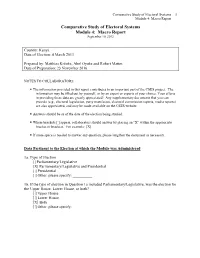
Macro Report Comparative Study of Electoral Systems Module 4: Macro Report September 10, 2012
Comparative Study of Electoral Systems 1 Module 4: Macro Report Comparative Study of Electoral Systems Module 4: Macro Report September 10, 2012 Country: Kenya Date of Election: 4 March 2013 Prepared by: Matthias Krönke, Abel Oyuke and Robert Mattes Date of Preparation: 23 November 2016 NOTES TO COLLABORATORS: . The information provided in this report contributes to an important part of the CSES project. The information may be filled out by yourself, or by an expert or experts of your choice. Your efforts in providing these data are greatly appreciated! Any supplementary documents that you can provide (e.g., electoral legislation, party manifestos, electoral commission reports, media reports) are also appreciated, and may be made available on the CSES website. Answers should be as of the date of the election being studied. Where brackets [ ] appear, collaborators should answer by placing an “X” within the appropriate bracket or brackets. For example: [X] . If more space is needed to answer any question, please lengthen the document as necessary. Data Pertinent to the Election at which the Module was Administered 1a. Type of Election [] Parliamentary/Legislative [X] Parliamentary/Legislative and Presidential [ ] Presidential [ ] Other; please specify: __________ 1b. If the type of election in Question 1a included Parliamentary/Legislative, was the election for the Upper House, Lower House, or both? [ ] Upper House [ ] Lower House [X] Both [ ] Other; please specify: __________ Comparative Study of Electoral Systems 2 Module 4: Macro Report 2a. What was the party of the president prior to the most recent election, regardless of whether the election was presidential? Party of National Unity and Allies (National Rainbow Coalition) 2b. -

Parliament of Kenya the Senate
November 3, 2015 SENATEDEBATES 1 PARLIAMENT OF KENYA THE SENATE THE HANSARD Tuesday, 3rd November, 2015 The Senate met at the Senate Chamber, Parliament Buildings, at 2.30 p.m. [The Deputy Speaker (Sen. Kembi-Gitura) in the Chair] PAPERS LAID Sen. Billow: Mr. Deputy Speaker, Sir, I beg to lay the following Papers on the Table of the Senate today, Tuesday, 3rd November, 2015:- THE REPORT ON THE PETITION ON ALLEGED FLAWS IN THE BUSIA COUNTY BUDGET MAKING PROCESS The Report of the Standing Committee on Finance, Commerce and Budget on the examination of the Petition by Hon. Vincent Wanyama Opisa, MCA, on alleged flaws in the Busia County budget making process. REPORT ON CRA CIRCULAR ON FINANCING OF NON-CORE CAPITAL PROJECTS Report on the Standing Committee on Finance, Commerce and Budget on the Message from the County Assembly of Kilifi on Commission of Revenue Allocation Circular No.5/2015 dated 19th May, 2015 on financing of non-core capital projects. REPORT ON THE PETITION BY MAJOR (RTD.) JOEL KIPRONO ROP ON THE STATE OF KENYA’S ECONOMY Report of the Standing Committee on Finance, Commerce and Budget on the examination of the Petition by Major (Rtd.) Joel Kiprono Rop, a resident of Bomet County on the state of Kenya’s economy. (Sen. Billow laid the documents on the Table) Disclaimer: The electronic version of the Senate Hansard Report is for information purposes only. A certified version of this Report can be obtained from the Hansard Editor, Senate. November 3, 2015 SENATEDEBATES 2 STATEMENTS The Deputy Speaker (Sen. -

Transparency in Kenya's Upstream Oil and Gas Sector
Beating the Resource Curse: Transparency in Kenya’s Upstream Oil and Gas Sector by Sally Lesley Brunton Thesis presented in fulfilment of the requirements for the degree Master of Political Science in the Faculty of Arts and Social Sciences at Stellenbosch University Supervisor: Professor Ian Taylor March 2018 Stellenbosch University https://scholar.sun.ac.za Declaration By submitting this thesis electronically, I declare that the entirety of the work contained therein is my own, original work, that I am the sole author thereof (save to the extent explicitly otherwise stated), that reproduction and publication thereof by Stellenbosch University will not infringe any third party rights and that I have not previously in its entirety or in part submitted it for obtaining any qualification. Date: March 2018 Copyright © 2018 Stellenbosch University. All rights reserved. i Stellenbosch University https://scholar.sun.ac.za Abstract In 2012 Tullow Oil plc discovered commercial quantities of crude oil onshore Kenya. Additional commercial discoveries have subsequently been made and estimates suggest that Kenya’s oil reserves are substantial. Steps towards the development and production of these reserves are progressing and Kenya is thus preparing to become another of sub-Saharan Africa’s oil-exporting states. Nevertheless, experience has shown that the majority of these resource-rich states have succumbed to symptoms of the ‘resource curse’: economic and human development and growth has been hindered rather than helped and many of these states find themselves struggling to escape from the clutches of rent-seeking, bribery and corruption. In an attempt to determine how best Kenya might avoid the negative impacts of the curse this study examines various strands of resource curse theory. -

National Constitutional Conference Documents
NATIONAL CONSTITUTIONAL CONFERENCE DOCUMENTS THE FINAL REPORT OF TECHNICAL WORKING GROUP “E” ON THE JUDICIARY APPROVED FOR ISSUE AT THE 110 TH PLENARY MEETING OF THE CONSTITUTION OF KENYA REVIEW COMMISSION HELD ON 30 NOVEMBER, 2005 TABLE OF CONTENTS Page: 1. Introduction……………………………………………………………………… 3 2. The Mandate of the Committee…………………………………………….……..… 3 3. General Comments on the Main Report………………………………………….… 6 3.1 Judicial Power…………………………………………………………… 6 3.2 Hierarchy of Courts………………………………………………………….. 6 3.3 The Supreme Court……………………………………………………….... 6 3.4 The Court of Appeal………………………………………………………... 7 3.5 The High Court……………………………………………………………... 7 3.6 The Industrial Court…………………………………………………….…... 8 3.7 Kadhis’ Court……………………………………………………………….. 8 3.8 Tribunals……………………………………………………………………. 9 3.9 Independence of the Judiciary……………………………………………… 10 3.10 Appointment of Judges……………………………………………………... 10 3.11 Qualifications for appointment of Judges…………………………………... 10 3.12 Tenure of office of Judges………………………………………………….. 11 3.13 Removal from office………………………………………………………... 11 3.14 The Judicial Service Commission………………………………………….. 12 3.15 The Attorney General.…………………………………………………….... 12 3.16 The Director of Public Prosecutions……………………..….……………… 13 3.17 The Public Defender………………………………………………………... 13 3.18 Prerogative of Mercy………………………………………………….……. 13 4 Specific Recommendations on the Amendments to the Draft Bill……………… 14 5. Conclusion…………………………………………………………………………. 24 6. Appendices………………………………………………………………………… 77 Appendix A– List of Committee Members……………………………………………...