Sermon 30A 2005
Total Page:16
File Type:pdf, Size:1020Kb
Load more
Recommended publications
-
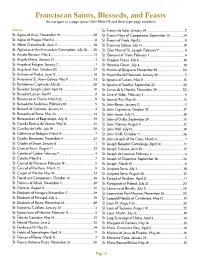
Franciscan Saints, Blesseds, and Feasts (To Navigate to a Page, Press Ctrl+Shift+N and Then Type Page Number)
Franciscan Saints, Blesseds, and Feasts (to navigate to a page, press Ctrl+Shift+N and then type page number) Saints St. Francis de Sales, January 29 ................................................ 3 St. Agnes of Assisi, November 19 ..........................................29 St. Francis Mary of Camporosso, September 20 ................24 St. Agnes of Prague, March 2 ...................................................6 St. Francis of Paola, April 2 ........................................................9 St. Albert Chmielowski, June 17 ............................................. 16 St. Francisco Solano, July 14 .....................................................19 St. Alphonsa of the Immaculate Conception, July 28........20 St. Giles Mary of St. Joseph, February 7 ................................4 St. Amato Ronconi, May 8 .......................................................12 St. Giovanni of Triora, February 7 ............................................4 St. Angela Merici, January 27 ................................................... 3 St. Gregory Grassi, July 8 ........................................................ 18 St. Angela of Foligno, January 7 ................................................1 St. Hermine Grivot, July 8 ....................................................... 18 St. Angelo of Acri, October 30 .............................................. 27 St. Humilis of Bisignano, November 25 .................................30 St. Anthony of Padua, June 13 ................................................ 16 St. -

The Northern Clergy and the Pilgrimage of Grace Keith Altazin Louisiana State University and Agricultural and Mechanical College, Daltazin@Lsu.Edu
Louisiana State University LSU Digital Commons LSU Doctoral Dissertations Graduate School 2011 The northern clergy and the Pilgrimage of Grace Keith Altazin Louisiana State University and Agricultural and Mechanical College, daltazin@lsu.edu Follow this and additional works at: https://digitalcommons.lsu.edu/gradschool_dissertations Part of the History Commons Recommended Citation Altazin, Keith, "The northern clergy and the Pilgrimage of Grace" (2011). LSU Doctoral Dissertations. 543. https://digitalcommons.lsu.edu/gradschool_dissertations/543 This Dissertation is brought to you for free and open access by the Graduate School at LSU Digital Commons. It has been accepted for inclusion in LSU Doctoral Dissertations by an authorized graduate school editor of LSU Digital Commons. For more information, please contactgradetd@lsu.edu. THE NORTHERN CLERGY AND THE PILGRIMAGE OF GRACE A Dissertation Submitted to the Graduate Faculty of the Louisiana State University and Agricultural and Mechanical College in partial fulfillment of the requirements for the degree of Doctor of Philosophy in The Department of History by Keith Altazin B.S., Louisiana State University, 1978 M.A., Southeastern Louisiana University, 2003 August 2011 Acknowledgments The completion of this dissertation would have not been possible without the support, assistance, and encouragement of a number of people. First, I would like to thank the members of my doctoral committee who offered me great encouragement and support throughout the six years I spent in the graduate program. I would especially like thank Dr. Victor Stater for his support throughout my journey in the PhD program at LSU. From the moment I approached him with my ideas on the Pilgrimage of Grace, he has offered extremely helpful advice and constructive criticism. -

College Martyrs
TUTOR GROUP MARTYRS Class A – Ashley Blessed Ralph Ashley Ralph Ashley served as a cook at Douai College France. He went to Spain in 1590 and became a Jesuit Lay Brother. He returned to England in 1598 and served with Father Edward Oldcorne. He was captured in 1604 and was terribly tortured and executed. Class C – Clitherow Saint Margaret Clitherow Margaret Clitherow was a butcher’s wife in York. In 1574 Margaret became a Catholic and an active helper of the Douai priests. She also ran a Catholic school for her children and neighbours. Officers found vestments worn by priests in her house and so on 25th March 1586 she was crushed to death. She took a quarter of an hour to die. Her two sons became priests. Class J – Jones Saint John Jones John Jones was a Welshman. He appears in 1587 as a priest working among the Catholics in a Prison. This work was cut short when his disguise was discovered, and he was arrested and imprisoned at Wisbech Castle. However he did escape and made his way to the continent. He returned to England in 1592, and two years later was a prisoner once more at Wisbech. He was martyred on 12th July 1598. There was an hour’s delay in his execution because the hangman had forgotten his rope. Father Jones made use of time in prayer and addressing the crowd. Class L – Line Saint Anne Line Anne Line and her husband were both converts and though both were disinherited because of their faith they managed to live quite comfortably until 1586 when a priest was arrested whilst saying Mass in their house. -

Shrewsbury: the Great West Window
SHREWSBURY: THE GREAT WEST WINDOW Margaret Rope’s first major commission, which she designed and painted at The Priory, her home in Shrewsbury (reputedly on the kitchen table!), was the Cathedral’s Great West Window. It commemorates Bishop Samuel Webster Allen, 4th Bishop of Shrewsbury, who died in 1908 aged 64, and was unveiled at High Mass on Sunday 27th February 1910 by his successor Bishop Hugh Singleton. According to the detailed account of the occasion in the Catholic journal The Tablet the Bishop ‘drew the cords of the veil and revealed the window through which the sunlight was streaming’1. Margaret was very self-effacing: according to her brother Father Henry Rope at the unveiling she ‘contrived to find a place hidden from view behind the organ’2. First a note about the window’s name. Because of the restricted size and shape of its site the Cathedral was built on a north-south axis instead of having the usual east-west orientation. For liturgical purposes, however, we regard the main altar as being at the east end of the building and this convention was adopted in naming this window, which is at the opposite end to the altar. Geographically speaking it should be the Great South Window! The unusual orientation has the advantage of allowing it to be appreciated in all its glory for much more of the day than it could be if it was really facing west and only catching the evening sun. The six main lights are a picture gallery of British martyrs from the Romans to the Reformation. -

Liturgical Calendar for the Ordinariate of Our Lady of Walsingham
Liturgical Calendar for the Ordinariate of Our Lady of Walsingham Temporale The date of Easter being moveable, Sundays marked * are not needed in every annual cycle. Advent First Sunday of Advent Second Sunday of Advent Third Sunday of Advent From 17 December (O Sapientia) begin the eight days of prayer before Christmas Day Fourth Sunday of Advent Christmas Eve Christmas THE NATIVITY OF THE LORD (Christmas) Sunday within the Octave of the Nativity: The Holy Family of Jesus, Mary and Joseph (if there is no Sunday, 30 December) THE OCTAVE DAY OF CHRISTMAS: SOLEMNITY OF MARY, THE HOLY MOTHER OF GOD *Second Sunday after Christmas Epiphany THE EPIPHANY OF THE LORD (The Manifestation of Christ to the Gentiles) – (6 January or, as permitted or required by authority, the Sunday between 2 and 8 January) The Baptism of the Lord - Sunday after Epiphany (or, if the Epiphany is celebrated on Sunday 7 or 8 January, on Monday 8 or 9 January) Time after Epiphany Time after Epiphany begins usually with Monday of Week 1 on the day following the Baptism of the Lord. For the weekdays following the Baptism of the Lord, the propers for the Week after Epiphany (Week 1) are used. Even when the Baptism of the Lord is transferred to the Monday, the Sunday after the Baptism of the Lord is observed as the Second Sunday after Epiphany. For the purposes of the lectionary, this is Sunday 2 in Ordinary Time and the Sundays thereafter Sundays 3, 4, 5 &c. until Lent begins. Second Sunday after Epiphany * Third Sunday after Epiphany * Fourth Sunday after Epiphany * Fifth -

Franciscan Sacramentary Supplement
1 FRANCISCAN PROPER OF THE SAINTS July 4 1. The rank of the celebration (solemnity, feast or memorial) is indicated for each day. If there is no indication, it is an optional memorial. 2. For each solemnity and feast a proper Mass is provided in its entirety. This is therefore used as given. 3. For memorials: a) Proper texts, given on some days, must always be used; b) When there is a reference to a particular common, the most appropriate texts should be chosen according to the principles at the beginning of the commons. The page reference in each case indicates only the beginning of the common to which reference is made. c) If the rederence is to more than one common, one or the other may be used, according to pastoral need. It is always permissible to interchange texts from several Masses within the same common. For example, if a saint is both a martyr and a bishop, either the common of martyrs or the common of pastor (bishops) may be used. d) In addition to the commons which express a special characteristic holiness (e.g., of martyrs, virgins, or pastors), the texts from the common of saints, referring to holiness in general may always be used. For example, in the case of a saint who is both a virgin and a martyr, texts from the common of saints in general may be used, in addition to texts from the common of martyrs or the common of virgins. e) The prayers over the gifts and after communion, unless there are proper prayers, may be taken either from the common or from the current liturgical season. -

Keeping the Martyrs Alive
Keeping the Martyrs Alive John O’Connor OP St Edmund Campion, St Robert Southwell and Companions are remembered by the Society of Jesus on 1 December, but how does their martyrdom inform our lives as followers of Christ today? ‘Perhaps when questions are resolved and peace is restored the impact of martyrdom becomes weaker’, suggests Fr John O’Connor OP. A couple of years ago I read an who had died for their faith. Of article by Nicholas Lash, entit- course, I knew about St Oliver led ‘What Might Martyrdom Plunkett and those who suffer- Mean?’ ed under the penal laws, but at school, even in politically relax- A good question, that. There is ed Galway, it was Robert Em- a fairly obvious way of answer- met and Wolfe Tone, Connolly ing it, in high-minded, abstract and Pearse who were spoken terms. But perhaps the import- about more – mainly in history ant question is: what might lessons, admittedly – and who martyrdom mean to us , what were put forward as the key role does it actually play in our markers in the common story. lives, in our personal and coll- ective understandings of what it Photo by Lawrence OP at flickr.com I suppose it was because relig- is to be a follower of Christ? ious persecution had long gone Reflecting on the Feast of St Edmund Campion and that Oliver Plunkett did not grip the collective the English Jesuit Reformation Martyrs, I found imagination as the political martyrs did, for the myself asking these questions of myself. political questions were still ongoing and not resolved. -

Download the Walk
Like a Deer Yearning for Running Streams Following in the footsteps of the Lancaster Martyrs Edited by Fr Philip Conner Table of Contents PART 1 Cloud of Witnesses Biographies of the Lancaster Martyrs PART 2 The Martyrs Walk The Icon of the Lancaster Martyrs Introduction to the Pilgrims Walk Prayers at the shrine of the Lancaster Martyrs The Rosary Walk PART 3 Prayers from the Time of the Martyrs Prayers to Sanctify the Day Prayers before Meals Prayers before Receiving Holy Communion Prayers to the Guardian Angels Prayers for a Happy Death Prayers to Our Lady APPENDIX Places to visit relating to the Lancashire Martyrs From front cover: *Inscription on the ancient cross at Lee House Mission, Thornley-cum-Wheatley. he name of this book is taken from graffiti etched into the 3 Twalls of the Tower of London by George Beesley, a martyr hailing from the country parish of Hill Chapel in Goosnargh. There were few villages and towns in Lancashire that were left untouched by the ‘iniury of the tymes’ when Catholicism was driven underground and her adherents were persecuted mercilessly, some condemned to death. At that time Lancaster was the seat of the assizes in North West England and in recent years the Church has recognised the heroic virtue of 14 priests and laymen from the sixteenth and seventeenth centuries, sentenced to be hanged, drawn and quartered on account of their faith on the outskirts of the city. The prayers within this book have been collected from devotional tracts and books of that time, all of which would have been considered contraband. -

Prayers and Art at St. Thomas More 1 Our Father, Who Art in Heaven, Hallowed Be Thy Name; Thy Kingdom Come; Thy Will Be Done on Earth As It Is in Heaven
prayers and art at st. thomas more 1 Our Father, Who art in heaven, hallowed be Thy name; Thy kingdom come; Thy will be done on earth as it is in heaven. Give us this day our daily bread; M and forgive us our trespasses as we forgive those who trespass against us; and lead us not into temptation, but deliver us from evil. Amen. 2 st. thomas more university parish and student center prayers and art at st. thomas more 3 M 4 st. thomas more university parish and student center prayers and art at st. thomas more 5 Contents 8 Map 9 Locations 11 Prologue 15 Introduction 17 Stations of the Cross 19 Altar and Sanctuary 26 Altar Murals 36 Sculptures 55 Music 59 Stained Glass 61 Prayer Gardens and Shrines 73 Architecture 77 Architectural Details 81 Design and Identity 85 Legacy 92 Book Notes 6 st. thomas more university parish and student center prayers and art at st. thomas more 7 1 Ransom’s Garden is South of the Chapel 4 1 2 3 4 5 6 7 Locations 5 6 7 4 1 7 8 The Altar Santuary 1 Crucifix 1 Altars 2 St. Simon Stock and 2 Sacred Heart of Mary 3 St. Hilda of Whitby. 3 Jesus in the Tomb 3 St. Thomas Becket and 4 St. Scholastica St. Aelred of Rievaulx 5 St. Thomas Aquinas 2 6 9 8 4 St. Winifred and 6 St. John Vianney Cardinal St. John Henry Newman 7 St. Agnes 5 10 5 St. Margaret Clitherow Cardinal and 8 St. -

Hugh Taylor, a Carthusian Lay Brother
Watch" at dead of night, he saw a procession of angels Hugh Taylor, a in white raiment, each bearing a lighted candle in his hand. Entering the sacristy, they went straight to the carthusian Lay place in which the Sacristan had concealed the sacred particle. They bowed down in deepest adoration, brother opened the pyx, and after remaining some moments in contemplation of their Lord hidden in the Sacrament of Source: The Tablet – The International Catholic News weekly - Page His love to men, they vanished away. When morning 22, 16th March 1895 came, Brother Hugh asked the Sacristan if he had not placed the sacred particle he spoke of in that place. The The Catholic Truth Society has just published a short life answer being in the affirmative, Hugh told the story of of Dom Maurice Chauncy and Brother Hugh Taylor, his vision, and the Sacristan, fully assured by this grace, from the pen of Dom Lawrence Hendriks, of the same consumed the particle during his Mass; "neither," says order. Hugh Taylor was a Conversus, or professed lay Chauncy, "did he fear death, for he received the Author brother, distinguished by his virtues and by the evident of life, not sickness, for he received Him Who healeth all efficacy of his prayers; He entered the London our infirmities; nor did he any longer feel repugnance, Charterhouse in 1518. for he tasted in spirit that the Lord is sweet." Seculars Under the able direction of Prior Tynbygh, the holy were also in the habit of confiding their doubts and Irishman who formed the Carthusian Martyrs to difficulties to Brother Hugh. -

The Left Panel Files/John Houghton.Pdf
Saint John Houghton Born 1487: Essex. Graduate of Cambridge; Degrees in Canon and Civil Law John Houghton was ordained in 1501 and served as a parish priest for four years. A Carthusian monk, he joined the London Charterhouse in 1515 and made his final vows in 1516. He was elected Prior of the Beauvale (Carthusian Charterhouse) at Eastwood in Nottinghamshire in 1531, becoming Prior of the London Charterhouse later in the same year. In 1534 he was the first person to oppose King Henry VIII's Act of Supremacy and was imprisoned with Humphrey Middlemore. When the Oath of Supremacy was modified to include the phrase ‘in so far as the law of God permits’, John felt he could be loyal to Church and Crown; he and several of his monks signed the oath, despite misgivings. Father John was released. A few days later, troops arrived at the Chapter house to force the remaining monks to sign the oath. On 1 February 1535, Parliament required that the original, unmodified oath be signed by all. Following three days of prayer, Father John, with Robert Lawrence* and Augustine Webster*, contacted Thomas Cromwell to seek an exemption for themselves and their monks. The group was immediately arrested and were committed to the Tower of London. He did not defend himself in court, but refused to cooperate or sign the Oath. The jury could find no malice to the King, but when threatened by Cromwell with prosecution themselves, they found John and his co-defendants guilty of treason. John Houghton was hanged, drawn and quartered on 4th May 1535 at Tyburn, London. -

Issue 27: January 2021 Registered Charity No
Romeronews Issue 27: January 2021 Registered Charity no. 1110069 IN THIS ISSUE Romero Week 2021 Roses in December Once more our hopes to organise a full calendar of events for the Romero Week I in March have been disappointed. We Celebration in London Gemma Simmonds CJ had expected to be able to re-schedule many of the events planned for the 40th II Anniversary in 2020, which were Commemoration in Rome Cardinal Michael Czerny SJ cancelled by last year’s lockdown. But coronavirus continues to have an III enormous impact on our lives both in the The Case for Sainthood? UK and across the world. IV The events that are currently planned, To what do they call us today? either live or streamed are as follows: Justice for the UCA Martyrs Saturday March 13th 11.00am Book Review – Martyrdom National Ecumenical Service St. Martin in the Fields, London News in Brief Wednesday March 24th 6.00pm i) El Mozote Ecumenical Service ii) Winds of Change Metropolitan Cathedral, Liverpool iii) 29 Years of Peace? with Archbishop Malcom McMahon St. Oscar Romero Parish Liverpool Saturday March 27th 12.30pm Romero Anniversary Mass Books and Resources St. George’s Cathedral, Southwark with Archbishop John Wilson 2 www.romerotrust.org.uk The 40th anniversary of the martyrdom of Roses in December the women was commemorated across the world, In Rome, Pope Francis praised them at In dedicating this edition of Romero the end his General Audience on the News to Maryknoll Sisters Ita Ford and anniversary of their death, saying: Maura Clarke, Ursuline Sister Dorothy "Today is the 40th anniversary of Kazel and laywoman Jean Donovan, we the death of four missionaries killed recall the title of the 1982 documentary in El Salvador..