Afrique Du Sud Sélection De Documents Disponibles Dans Nos Rayons
Total Page:16
File Type:pdf, Size:1020Kb
Load more
Recommended publications
-

África · Rutas Literarias
ÁFRICA ‐ AFRIKA Rutas literarias. Destinos internacionales Ibilbide literarioak. Nazioarteko norakoak Se acerca el verano y la biblioteca pone a disposición de sus lectores más viajeros una selección de rutas literarias, cinematográficas y musicales por los cinco continentes. Mil sugerencias culturales para completar la información más práctica de las guías de viaje. Uda iristen ari da eta liburutegiak bere irakurle ibiltarienei bost kontinenteetan zehar ibilbide literario, zinematografiko eta musikalen aukeraketa bat eskeintzen die. Hamaika iradokizun kulturalak bidai‐giden informazio praktikoena osatzeko. BURKINA FASO ∙ BURKINA FASO música ∙ musika KIENOU, Amadou. Taabali. Felmay, 2006 libros ∙ liburuak ARRETXE, Jon. Griot. Elkar, 2004 CABO VERDE ∙ CABO VERDE música ∙ musika BAU. Ilha azul. Harmonia, 2005 CHANTRE, Teofilo. Rodatempo. Tropical Music, 2000 EVORA, Cesaria. Mar azul. Lusafrica, 1992 LURA. Di korpu ku alma. Lusafrica, 2005 TAVARES, Sara. Xinti. World Connection, 2009 libros ∙ liburuak CASO, Ángeles. Contra el viento. Planeta, 2009 LOPES, Baltasar. Chiquinho. El Cobre, 2003 PORTELL, Raimon. Una canción de Cabo Verde. La Galera, 2006 CAMERÚN ∙ KAMERUN música ∙ musika BASS, Apolo. Another world without racism. 2006 BONA, Richard. Munia. The tale. Universal Music, 2003 DIBANGO, Manu. The very best of Manu. Africadelic. Wrasse Records, 2003 MBASSI, Coco. Sisea. Tropical Music, 2003 NYOLO, Sally. Béti. Lusafrica, 2000 www.bibliotecaspublicas.es/civican/ CivicanLib.blogspot.com/ * material disponible en otras bibliotecas de Navarra / Nafarroako beste liburutegietako material librea libros ∙ liburuak BARLEY, Nigel. El antropólogo inocente. Anagrama, 1991 EBENÉZER, Bassi. Pequeñas cosas. Esas maravillas. Bassi Ebenezer, 2006 EGIPTO ∙ EGIPTO música ∙ musika ATLAS, Natasha. Halim. Beggars Banquet, 1997 FADL, Mahmoud. Love letter from King Tut‐ank‐amen. Piranha, 1998 RAMZY, Hossam. -

Mirror, Mediator, and Prophet: the Music Indaba of Late-Apartheid South Africa
VOL. 42, NO. 1 ETHNOMUSICOLOGY WINTER 1998 Mirror, Mediator, and Prophet: The Music Indaba of Late-Apartheid South Africa INGRID BIANCA BYERLY DUKE UNIVERSITY his article explores a movement of creative initiative, from 1960 to T 1990, that greatly influenced the course of history in South Africa.1 It is a movement which holds a deep affiliation for me, not merely through an extended submersion and profound interest in it, but also because of the co-incidence of its timing with my life in South Africa. On the fateful day of the bloody Sharpeville march on 21 March 1960, I was celebrating my first birthday in a peaceful coastal town in the Cape Province. Three decades later, on the weekend of Nelson Mandela’s release from prison in February 1990, I was preparing to leave for the United States to further my studies in the social theories that lay at the base of the remarkable musical movement that had long engaged me. This musical phenomenon therefore spans exactly the three decades of my early life in South Africa. I feel privi- leged to have experienced its development—not only through growing up in the center of this musical moment, but particularly through a deepen- ing interest, and consequently, an active participation in its peak during the mid-1980s. I call this movement the Music Indaba, for it involved all sec- tors of the complex South African society, and provided a leading site within which the dilemmas of the late-apartheid era could be explored and re- solved, particularly issues concerning identity, communication and social change. -
Mannenberg": Notes on the Making of an Icon and Anthem1
African Studies Quarterly | Volume 9, Issue 4 | Fall 2007 "Mannenberg": Notes on the Making of an Icon and Anthem1 JOHN EDWIN MASON Abstract: Abdullah Ibrahim's [Dollar Brand] composition "Mannenberg" was an instant hit, when it was released on the 1974 album, Mannenberg is Where It's Happening. This paper shows that the song is a product of Ibrahim's efforts to find an authentically South African mode of expression within the jazz tradition, blending South African musical forms -- marabi, mbaqanga, and langarm--with American jazz-rock fusion. It quickly became an icon of South African jazz, defining the genre both within the country and overseas. At the same time, the South African coloured community invested the song with their own meaning, transforming it into an an icon of their culture and of themselves. In the 1980s, "Mannenberg" had a second life as an anthem of the struggle against apartheid. Some called it South Africa's "unofficial national anthem." Once again, the song acquired a new meaning, this time through the efforts of musicians, especially Basil Coetzee and Robbie Jansen, who made it the musical centerpiece of countless anti- apartheid rallies and concerts. As the paper traces this narrative, it is constantly aware of the profound influence of African-American culture and political thought on Ibrahim and the coloured community as a whole. Introduction On a winter's day in 1974, a group of musicians led by Abdullah Ibrahim (or Dollar Brand, as most still knew him) entered a recording studio on Bloem Street, in the heart of Cape Town, and emerged, hours later, having changed South African music, forever. -

Play and Irony in the Kwaito Music of Post-Apartheid South Africa
Play and Irony in the Kwaito Music of Post-Apartheid South Africa Tuulikki Pietilä “Kwaito” is a form of South African youth music that emerged at the time when the oppressive apartheid regime was coming to an end in the early 1990s. While both popular press and academic critics, as well as older generations, were morally concerned by the apparent hedonism and lack of socio-political awareness inherent in kwaito, township youth embraced it as an expressive mode of popular music that reflected their life and aspirations. This chapter investigates the humorous, comedic, and ironic aspects of early kwaito, arguing that they were central factors in young people’s passionate attachment to it. The subsequent evolution of kwaito and changes in society led some fans to lose their interest in kwaito; for them, contemporary kwaito is not a source of enjoyment anymore, but rather a source of parody. “Kwaito” is a popular music genre that emerged in South Africa in the early 1990s. It combined foreign musical elements from hip hop, house, and ragamuffin with earlier South African music styles, such as kwela, mbaqanga, marabi, and bubblegum music (Boloka 98-99; Coplan 12; Steingo, “South African” 336). Even though a musical hybrid, kwaito fast became accepted as a distinctive expressive mode of youth in the black townships of South Africa. It is foremost a dance music with an ambience of fun and enjoyment. Its uninhibited indulgence in sparsely clad beautiful bodies, flamboyant fashions, and sensual and skillful dancing was suddenly and widely visible, as controls over media were loosened in the post-apartheid era. -

South African Music in Global Context
South African Music in Global Perspective Gavin Steingo Assistant Professor of Music University of Pittsburgh South African Music * South African music is a music of interaction, encounter, and circulation * South African music is constituted or formed through its relations to other parts of the world * South African music is a global music (although not evenly global – it has connected to different parts of the world at different times and in different ways) Pre-Colonial South African Music * Mainly vocal * Very little drumming * Antiphonal (call-and-response) with parts overlapping * Few obvious cadential points * Partially improvisatory * “Highly organized unaccompanied dance song” (Coplan) * Instruments: single-string bowed or struck instruments, reed pipes * Usually tied to social function, such as wedding or conflict resolution Example 1: Zulu Vocal Music Listen for: * Call-and-Response texture * Staggered entrance of voices * Ending of phrases (they never seem very “complete”) * Subtle improvisatory variations Example 2: Musical Bow (ugubhu) South African History * 1652 – Dutch settle in Cape Town * 1806 – British annex Cape Colony * 1830s – Great Trek * 1867 – Discovery of diamonds * 1886 –Discovery of gold * 1910 – Union of South Africa * 1913 – Natives’ Land Act (“natives” could only own certain parts of the country) * 1948 – Apartheid formed * Grand apartheid (political) * Petty apartheid (social) * 1990 – Mandela released * 1994 – Democratic elections Early Colonial History: The Cape of Good Hope Cape Town * Dutch East India Company -
Ladysmith Black Mambazo Study Guide 0809.Indd
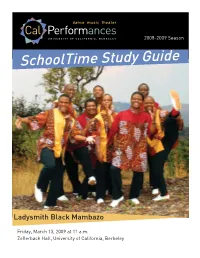
2008-2009 Season SchoolTime Study Guide Ladysmith Black Mambazo Friday, March 13, 2009 at 11 a.m. Zellerbach Hall, University of California, Berkeley Welcome to SchoolTime! On Friday, March 13, 2009, at 11 am, your class will attend a performance of South Africa’s most renowned vocal group, Ladysmith Black Mambazo. Founded in the early 1960s by South African visionary singer and activist Joseph Shabalala, Ladysmith Black Mambazo is considered a national treasure in their native country. The group has revolutionized traditional South African choral-group singing with their distinctive version of isicathamiya (Is-cot-a-MEE-ya), which comes from the powerfully uplifting songs of Zulu mine workers popularized during the apartheid era. Using This Study Guide This study guide will help engage your students with the performance and enrich their fi eld trip to Zellerbach Hall. Before coming to the performance, we encourage you to: • Copy the student resource sheet on page 2 & 3 and hand it out to your students several days before the show. • Discuss the information on pages 4- 5 about the performance and the artists with your students. • Read to your students from the About the Art Form on page 6 and About South Africa sections on page 8. • Engage your students in two or more of the activities on pages 11-12. • Refl ect with your students by asking them guiding questions, which you can fi nd on pages 2, 4, 6 & 8. • Immerse students further into the art form by using the glossary and resource sections on pages 12-13. At the performance: Your students -

Mahlathini and the Mahotella Queens" to Perform at UCSD's Price Center Ballroom on February 10 in Celebration of Black History Month
"Mahlathini and the Mahotella Queens" to perform at UCSD's Price Center Ballroom on February 10 in celebration of Black History Month January 21, 1992 Contact: Ruth Baily, University Events Office, 534-4090 or Alixandra Williams, 534-3120 "MAHLATHINI AND THE MAHOTELLA QUEENS" TO PERFORM AT UCSD FEB. 10 "Mahlathini and the Mahotella Queens," a musical group from South Africa, will perform at 8 p.m. Feb. 10 in the Price Center Ballroom at the University of California, San Diego, as a part of UCSD's celebration of Black History Month. Tickets are $12 for general admission and $9 for students, and may be purchased at the UCSD Price Center Box Office or from TicketMaster outlets. "Mahlathini" performs a popular mixture of African rhythms and sounds, referred to by South Africans as "mbacianga," or "poor man's stew." The melodies and rhythms are taken from so-called street music, wedding music, traditional sounds and international pop. "Mahlathini" spun out of the South African group "Makgona Tsohle Band," in the mid-sixties. Mahlathini was discovered by the Makgona Tsohle Band while performing at a wedding. He was added to the group, and then three female singers, Hilda Tloubatla, Mildred Mangxola and Nobesuthu Shawe joined the group, performing under their present name. From the mid-sixties on, "Mahlathini" and "Makgona" are credited for revolutionizing the South African pop scene. For 25 years, the group sold an average of one to two million copies of each album they produced. When Paul Simon opened the frontier for African music to reach North American shores, the group became known. -

Assessing the Aftermath Area Retailers, Venues, Labels Feel Impact
$4.95 (U.S.), $5.95 (CAN.), £3.75 (U.K.) á IN THIS ISSUE DK 63.50, DM22, 12,000 Lire Qa o) w Z PRflikJ dHF *** *** ************** 3-DIGIT 908 BI GEE4E M740M099 90 OdF 0331 MAR26941 03 MONTY GREENLYGRE APT A 3740 ELM 4°i? LONG BEAC H, CA 90807 ® flUE S TRO .%iwv FOLLOWS PAGE 24 THE INTERNATIONAL NEWSWEEKLY OF MUSIC, VIDEO AND HOME ENTERTAINMENT MAY 16, 1992 ADVERTISEMENTS L.A. Riots: Assessing The Aftermath Video Buying Area Retailers, Venues, Labels Feel Impact Groups, Distribs This story was prepared by Craig shaw district of the city. well as five mom -and-pop stores: De- Rosen, Chris Morris, Deborah Rus- Record stores that were complete- licious Records on Vermont Avenue, Butting Heads sell, Jim McCullaugh, and Earl ly destroyed included at least two Discoteca Bernal on Vermont, a Mid - Paige. chain outlets, Wherehouse Entertain- City Records outlet on Manchester BY EARL PAIGE ment's store at La Brea Avenue and Boulevard, Ruby's Records on Cren- and PAUL SWEETING LOS ANGELES-The rioting and ar- Rodeo Road and Tempo Records and shaw, and Just for the Records on son that destroyed portions of Los Tapes' Crenshaw Boulevard store, as (Continued on page 25) LOS ANGELES -The uneasy Angeles after the April 29 acquittal partnerships between video retail- of four L.A. police officers in the vid- er buying groups and distributors LIDELL TOWNSELL & M.T.F. eotaped beating of motorist Rodney have become more strained as HARMONY King rocked the music and home vid- Dion's Language Is Universal competition between the buying Lidell Townsell and M.T.F. -
University of Zululand Master of Music
UNIVERSITY OF ZULULAND INDIGENOUS FEATURES INHERENT IN AFRICAN POPULAR MUSIC OF SOUTH AFRICA A thesis submitted in partial fulfillment of the requirements for the degree of MASTER OF MUSIC in the department of Music at the University of Zululand by THULASIZWE NKABINDE DECEMBER 1997 INDIGENOUS FEATURES INHERENT IN POPULAR MUSIC OF SOUTH AFRICA SUPERVISOR: PROF MK XULU DECLARATION The whole of this work is a product of my original thought and research. Where the contrary is found that willl always be acknowledged in full. THULASIZWE NKABINDE ACKNOWLEDGMENTS I would like to express my gratitude to Professor Musa ~IU for his patience, advice and guidance, without which this project would have been all the more difficult. My deepest appreciate goes to my father, Mr. Gibson Siyabonga Nkabinde, my wife Beauty and all my children, Khayelihle, Phelelani and Banele for all their support and encouragement, and to Ms Brenda Trimmel for her endless hours of typing and perfectionist care in the format of this project. I would also like to thank all those people who, in one way or another, made this project reach completion. They are: Professor Joseph Bhekizizwe Shabalala of the Ladysmith Black Mambazo, Marks Mankwane of the Makgona Tsohle Band, Mahlathini and the Mahotella Queens, Yvonne Chaka Chaka, Simon Buthelezi, Bongani Hlatshwayo, Print and Electronic Media, the entire SABC staff and the SABC Choristers, not forgetting the enormous support from the audience, the music lovers. DEDICATION This thesis is dedicated to my late mother Mrs Thembakuye Nkabinde who gave me all the support to pursue my career. ABSTRACT The central aim of this study is to identify those features in the music of Ladysmith Black Mambazo, Yvonne Chaka Chaka, Mahlathini and the Mahotella Queens that derive from Indigenous African music and show how they have been transformed to become part of popular idioms. -

A Design of a South African Popular Music Degree Curriculum
A Design of a South African Popular Music Degree Curriculum by Kirsten Nicole Adams Thesis presented in fulfilment of the requirements for the degree of Master of Music (Composition) in the Faculty of Arts and Social Sciences at Stellenbosch University Supervisor: Dr. Barry Ross April 2019 Stellenbosch University https://scholar.sun.ac.za Declaration By submitting this thesis electronically, I declare that the entirety of the work contained therein is my own, original work, that I am the sole author thereof (save to the extent explicitly otherwise stated), that reproduction and publication thereof by Stellenbosch University will not infringe any third party rights and that I have not previously in its entirety or in part submitted it for obtaining any qualification. Kirsten Nicole Adams April 2019 Copyright © 2019 Stellenbosch University All rights reserved i Stellenbosch University https://scholar.sun.ac.za Abstract The study is a qualitative literature review that aims to propose a design of an ideal Bachelor of Music in South African Popular Music curriculum for South African universities. The purpose of this study is to design a degree curriculum that responds to the demands of the South African music industry, and that will hopefully advance the output of the South African music industry. Although not central investigation in the study, cognisance is taken of the financial limitations higher education in South Africa. The possibility of a Bachelor of Music in South African Popular Music degree curriculum is explored in research material focused on Western popular music literature, the demands of the South African music industry, how popular musicians learn, a comparison between existing Bachelor of Music in Popular Music degrees abroad (Berklee College of Music (US), Leeds Arts University (UK) and Griffith University (Australia)) as well as what is available in South Africa. -

State Budget Ax Cuts Most Summer Classes
thre indilegwm*ent flinIa Henrietta's Lovers in N'awlins ifatc 0---- - Not ol+!,iaIly afloc aled w~i'h, Um var.yV MFlor's. .APPLAUSE VOLUME 84, NUMBER 13 THURSDAY, SEPTEMBER 13, 1990 State budget ax cuts most summer classes By DEBBIE CENZIPER said Provost Andrew Sorensen, UT's top Alligator Staff Writer academic officer "We're doing what we have to do As the state budget tightened again Santa Fe Community College Presi- this week, UF administrators decided dent Larry Tyree said so far the school that canceling most summer classes is has not planned any semester cuts, but the least painful way to chop about $8.4 SFCC has frozen all travel expenses, million from the school's budget. vacant faculty positions and purchases UF President John Lombardi scram- of any equipment not needed immedi- bled to meet with campus ately officials Wednesday after If that's not enough, the governor instructed all SFCC may dip into its re- state agencies to cut their serve accounts and trim its budgets 5 percent spring class schedule, At UF, that budget ax Tyree said will fall on the Summer A If UF's proposal is ap- and Summer C semesters, proved in Tallahassee, administrators decided Sorensen said the next step Wednesday. will be finding classes "There is no solution taught only during summer that is painless" Lombardi and trying to offer them in said. "This is a really bone the spring marrow kind of debt, and Srsn UF won't completely it isn't going to be abl shut down during the sum- sorbed easily or happily. -

Name: Ayong Ameck Gillian Student Number: 0215594H
NAME: AYONG AMECK GILLIAN STUDENT NUMBER: 0215594H RESEARCH TOPIC: MUSIC AS A VEHICLE IN CONFLICT TRANSFORMATION AND SOCIAL INTEGRATION IN SOUTH AFRICA DEPARTMENT: SOCIAL ANTHROPOLOGY FACULTY: SOCIAL SCIENCE SCHOOL: HUMANITIES SUPERVISOR: PROF. DAVID COPLAN DATE OF SUBMISSION: 07 FEBUARY 2005 1 ACKNOWLEDGMENT My sincere appreciation and gratitude are expressed to the following people for their assistance during the period of this study: Prof David Coplan, my supervisor, for all his advice, support, encouragement and above all, his patience. I am really grateful The teachers and students of various high schools in Soweto, Braamfontein and Fuba school of arts, which I was opportune to do my focus group, interview there, are well appreciated for their time and effort in answering my questions. To Patrick Mathebe, an arts teacher in Fuba School of Arts who did help me in identifying the songs used in this research as well as translating them. I really appreciate it. To ACTION for Conflict Transformation, my workplace which without, I would never have been inspired with the research topic and also wouldn’t have had materials to work from. To my colleagues, especially Colin and Joan who help me edit some of the work and Spencer and Elizabeth for their constant encouragement. To my family (Kenneth, Dora, Judith, Kitty, Carol, Adel) who have been constantly encouraging To all my friends especially to Millan Atam who also helped in editing this research and did provide a lot of contacts and support for the research. Mah your encouragement did not pass me by. Thanks. I will want to dedicate special thanks to God who has given me the grace and power to take this studies through.