Classics Sergey Sergeyevich Prokofiev (1891 –1953) Eugene Onegin, Op
Total Page:16
File Type:pdf, Size:1020Kb
Load more
Recommended publications
-

Tchaikovsky's Romeo and Juliet
Tchaikovsky’s Romeo and Juliet: A Schleiermacherian Interpretation Emer Nestor This article will discuss the application of Friedrich Daniel Ernst Schleiermacher’s (1768-1834) hermeneutical methods to a general reading of Tchaikovsky’s fantasy-overture, Romeo and Juliet. The German philosopher gave a lecture series on hermeneutics at the University of Berlin in 1819, and from his research on the subject he invariably redefined this field of philosophical thinking. The central elements of his ‘whole and parts’ theory will be discussed as an alternative mode of investigative music analysis. Richard E. Palmer presents six modern definitions of hermeneutics as follows: 1) The theory of biblical exegesis 2) General philological methodology 3) The science of all linguistic understanding 4) The methodological foundation of Geisteswissenschaften 5) Phenomenology of existence and of existential understanding 6) The systems of interpretation, both recollective and iconoclastic used by man to reach the meaning behind myths and symbols.1 The term ‘hermeneutics’ is a word which is prominent in theological, philosophical and literary circles but relatively new to the discipline of musicology.2 Ian Bent asserts that it ‘came to prominence in writing about music implicitly in the nineteenth century and explicitly in the early twentieth century’.3 He remarks that no author in the nineteenth century 1 Richard E. Palmer.: Hermeneutics: Interpretation Theory in Schleiermacher, Dilthey, Heidegger and Gadamer (Evanstown: Northwestern University Press, 1969), 3 3 - Hereafter referred to as Palmer: Hermeneutics. 2 For a more in-depth discussion of hermeneutics see Kurt Mueller-Vollmer: The Hermeneutics Reader: Texts of the German Tradition from the Enlightenment to the Present (Oxford: Basil Blackwell, 1986). -

Eifman Ballet of St. Petersburg
Cal Performances Presents Program Friday, May 1, 2009, 8pm Eifman Ballet of St. Petersburg Saturday, May 2, 2009, 8pm Artistic Director Sunday, May 3, 2009, 3pm Boris Eifman, Zellerbach Hall Soloists Maria Abashova, Elena Kuzmina, Natalia Povorozniuk, Eifman Ballet of St. Petersburg Anastassia Sitnikova, Nina Zmievets Boris Eifman, Artistic Director Yuri Ananyan, Dmitry Fisher, Oleg Gabyshev, Andrey Kasyanenko, Ivan Kozlov, Oleg Markov, Yuri Smekalov Company Marina Burtseva, Valentina Vasilieva, Polina Gorbunova, Svetlana Golovkina, Alina Gornaya, Diana Danchenko, Ekaterina Zhigalova, Evgenia Zodbaeva, Sofia Elistratova, Elena Kotik, Yulia Kobzar, Alexandra Kuzmich, Marianna Krivenko, Marianna Marina, Alina Petrova, Natalia Pozdniakova, Victoria Silantyeva, Natalia Smirnova, Agata Smorodina, Alina Solonskaya, Oksana Tverdokhlebova, Lina Choe Sergey Barabanov, Sergey Biserov, Maxim Gerasimov, Pavel Gorbachev, Anatoly Grudzinsky, Vasil Dautov, Kirill Efremov, Sergey Zimin, Mikhail Ivankov, Alexander Ivanov, Andrey Ivanov, Aleksandr Ivlev, Stanislav Kultin, Anton Labunskas, Dmitry Lunev, Alexander Melkaev, Batyr Niyazov, Ilya Osipov, Artur Petrov, Igor Polyakov, Roman Solovyov Ardani Artists Management, Inc., is the exclusive North American management for Eifman Ballet of St. Petersburg. Valentin Baranovsky Valentin Onegin (West Coast Premiere) Choreography by Boris Eifman Ballet in Two Acts Inspired by Alexander Pushkin’s novel, Eugene Onegin Music by Pyotr Il’yich Tchaikovsky and Alexander Sitkovetsky Cal Performances’ 2008–2009 season is sponsored by Wells Fargo Bank. 6 CAL PERFORMANCES CAL PERFORMANCES 7 Program Cast Friday, May 1, 2009, 8pm Onegin Saturday, May 2, 2009, 8pm Sunday, May 3, 2009, 3pm Zellerbach Hall Onegin music Pyotr Il’yich Tchaikovsky (1840–1893) Variations on a Rococo Theme in A major, Op. 33 (1876) Suite No. 3 in G major, Op. -

Teacher Notes on Russian Music and Composers Prokofiev Gave up His Popularity and Wrote Music to Please Stalin. He Wrote Music
Teacher Notes on Russian Music and Composers x Prokofiev gave up his popularity and wrote music to please Stalin. He wrote music to please the government. x Stravinsky is known as the great inventor of Russian music. x The 19th century was a time of great musical achievement in Russia. This was the time period in which “The Five” became known. They were: Rimsky-Korsakov (most influential, 1844-1908) Borodin Mussorgsky Cui Balakirev x Tchaikovsky (1840-’93) was not know as one of “The Five”. x Near the end of the Stalinist Period Prokofiev and Shostakovich produced music so peasants could listen to it as they worked. x During the 17th century, Russian music consisted of sacred vocal music or folk type songs. x Peter the Great liked military music (such as the drums). He liked trumpet music, church bells and simple Polish music. He did not like French or Italian music. Nor did Peter the Great like opera. Notes Compiled by Carol Mohrlock 90 Igor Fyodorovich Stravinsky (1882-1971) I gor Stravinsky was born on June 17, 1882, in Oranienbaum, near St. Petersburg, Russia, he died on April 6, 1971, in New York City H e was Russian-born composer particularly renowned for such ballet scores as The Firebird (performed 1910), Petrushka (1911), The Rite of Spring (1913), and Orpheus (1947). The Russian period S travinsky's father, Fyodor Ignatyevich Stravinsky, was a bass singer of great distinction, who had made a successful operatic career for himself, first at Kiev and later in St. Petersburg. Igor was the third of a family of four boys. -

2018–19 Full Season Listing
New Jersey Symphony Orchestra: 2018–19 Full Season Listing ZHANG CONDUCTS BEETHOVEN 9 Fri, Oct 5 at 7:30 pm NJPAC in Newark Sat, Oct 6 at 8 pm State Theatre New Jersey in New Brunswick Sun, Oct 7 at 3 pm NJPAC in Newark XIAN ZHANG conductor MARY ELIZABETH WILLIAMS soprano ELIZABETH BISHOP mezzo-soprano LORENZO DECARO tenor REGINALD D. SMITH JR. bass MONTCLAIR STATE UNIVERSITY SINGERS MONTCLAIR STATE UNIVERSITY CHORALE NEWARK VOICES Heather J. Buchanan, conductor NEW JERSEY YOUTH CHORUSES Trish Joyce, artistic director NEW JERSEY SYMPHONY ORCHESTRA Beethoven’s glorious Ninth, led by Xian Zhang, is a fitting start to a spectacular season. The NJSO is joined by singers from Montclair State University and a choir composed in part of Newark residents. WHITLEY Speak Out (US Premiere) Stirring and poignant; rising British composer Kate Whitley’s work is based on Malala Yousafzai’s legendary speech to the UN advocating the right of every girl to have an education. BEETHOVEN Symphony No. 9, “Choral” An unmistakable masterpiece; the hymn’s text extolling the human bond is sung by a joyful assembly, a massed choir including singers from MSU and Newark. * * * SEONG-JIN CHO PLAYS CHOPIN Thu, Oct 11 at 7:30 pm bergenPAC in Englewood Sat, Oct 13 at 8 pm NJPAC in Newark Sun, Oct 14 at 3 pm Mayo Performing Arts Center in Morristown OTTO TAUSK conductor SEONG-JIN CHO piano NEW JERSEY SYMPHONY ORCHESTRA In his 20s, Korean pianist Seong-Jin Cho is on a fast track to stardom. The 2016 Chopin Competition winner’s performance of the composer’s spellbinding Second Piano Concerto is unmissable. -

Download Booklet
554844 bk Grishko2 EC 5|12|02 3:29 PM Page 20 Nikolay Andreyevich Rimsky-Korsakov Mikhail Ivanovich Glinka DDD (1844-1908) (1804-1857) Sadko Ruslan and Lyudmila Russian Opera Arias 8.554844 1 Introduction 2:24 9 Bayan’s song 4:22 2 Sadko’s Melismatic Song 3:47 There is a deserted land Ah, you dark oak grove! A Life for the Tsar Sadko • Prince Igor • Rusalka • A Life for the Tsar 0 Krakowiak 7:02 Pyotr Il’yich Tchaikovsky ! Sobinin’s aria 6:03 Vladimir Grishko, Tenor (1840-1893) Brothers. Into the snow storm! The Slippers 3 Danse des cosaques 3:20 Nikolay Andreyevich Rimsky-Korsakov 4 Vakula’s aria 2:51 (1844-1908) Does your heart not hear my terrible grief? The Tsar’s Bride @ Lïkov’s Arioso (Act I) 2:54 Sergey Rachmaninov It is all different (1873-1943) # Lïkov’s Arioso (Act III) 2:47 Aleko The thundercloud has scurried past 5 Men’s dance 4:31 6 The young gypsy’s romance 1:25 Pyotr Il’yich Tchaikovsky See, beneath yon firmament (1840-1893) The Maid of Orleans Alexander Sergeyevich Dargomïzhsky $ Entr’acte (Act II) 3:16 (1813-1869) Iolanta Rusalka % Vaudémont’s Romance 3:41 7 Prince’s cavatina (Act III) 5:44 No! The charm of a feisty beauty’s embraces Involuntarily I am drawn 8 Gypsy dance 2:58 Alexander Porfir’yevich Borodin (1833-1887) Prince Igor ^ Polovtsian March 5:04 & Vladimir’s Aria 5:34 Slowly the day was fading 8.554844 20 554844 bk Grishko2 EC 5|12|02 3:29 PM Page 2 Vladimir Grishko Zhdyosh’ li? wafting dreams of love, Russian Opera Arias, Vol. -

RUSSIAN & UKRAINIAN Russian & Ukrainian Symphonies and Orchestral Works
RUSSIAN & UKRAINIAN Russian & Ukrainian Symphonies and Orchestral Works Occupying a vast land mass that has long been a melting pot of home-spun traditions and external influences, Russia’s history is deeply encrypted in the orchestral music to be found in this catalogue. Journeying from the Russian Empire through the Soviet era to the contemporary scene, the music of the Russian masters covers a huge canvas of richly coloured and immediately accessible works. Influences of folklore, orthodox liturgy, political brutality and human passion are all to be found in the listings. These range from 19th-century masterpieces penned by ‘The Mighty Five’ (Balakirev, Rimsky-Korsakov, Mussorgsky, Borodin, and Cui) to the edgy works of Prokofiev and Shostakovich that rubbed against the watchful eye of the Soviet authorities, culminating in the symphonic output of one of today’s most noted Russian composers, Alla Pavlova. Tchaikovsky wrote his orchestral works in a largely cosmopolitan style, leaving it to the band of brothers in The Mighty Five to fully shake off the Germanic influence that had long dominated their homeland’s musical scene. As part of this process, they imparted a thoroughly ethnic identity to their compositions. The titles of the works alone are enough to get the imaginative juices running, witness Borodin’s In the Steppes of Central Asia, Rimsky-Korsakov’s The Legend of the Invisible City of Kitezh, and Mussorgsky’s St John’s Night on the Bare Mountain. Supplementing the purely symphonic works, instrumental music from operas and ballets is also to be found in, for example, Prokofiev’sThe Love for Three Oranges Suite, Shostakovich’s four Ballet Suites, and Stravinsky’s Firebird Suite. -

Chicago Symphony Orchestra Riccardo Muti Zell Music Director
PROGRAM ONE HUNDRED TWENTY-FOURTH SEASON Chicago Symphony Orchestra Riccardo Muti Zell Music Director Pierre Boulez Helen Regenstein Conductor Emeritus Yo-Yo Ma Judson and Joyce Green Creative Consultant Global Sponsor of the CSO Thursday, January 15, 2015, at 8:00 Friday, January 16, 2015, at 1:30 Saturday, January 17, 2015, at 8:00 Riccardo Muti Conductor Yefim Bronfman Piano Brahms Piano Concerto No. 2 in B-flat Major, Op. 83 Allegro non troppo Allegro appassionato Andante John Sharp, cello Allegretto grazioso YEFIM BRONFMAN INTERMISSION Tchaikovsky Symphony No. 1 in G Minor, Op. 13 (Winter Daydreams) Daydreams of a Winter Journey: Allegro tranquillo Land of Desolation, Land of Mists: Adagio cantabile ma non tanto Scherzo: Allegro scherzando giocoso Finale: Andante lugubre—Allegro maestoso These concerts are generously sponsored by the Zell Family Foundation. This program is partially supported by grants from the Illinois Arts Council, a state agency, and the National Endowment for the Arts. COMMENTS by Phillip Huscher Johannes Brahms Born May 7, 1833, Hamburg, Germany. Died April 3, 1897, Vienna, Austria. Piano Concerto No. 2 in B-flat Major, Op. 83 Like Dürer, Goethe, and of the ideas for the piano concerto, and, at the a number of German same time, gave birth to new ones that he would composers before him, use when he returned to it. Back in Italy several Brahms found inspiration months later, Brahms was filled with feelings he in Italy. His first trip was could hardly name; he returned to Vienna noting in the spring of 1878, that it seemed “wrong” to call it home after days and, as he wrote home to of such unexpected contentment elsewhere. -

Samson Et Dalila
CAMILLE SAINT-SAËNS samson et dalila conductor Opera in three acts Sir Mark Elder Libretto by Ferdinand Lemaire production Darko Tresnjak DEBUT Monday, September 24, 2018 PM set designer 6:00–9:05 Alexander Dodge DEBUT New Production Premiere costume designer OPENING NIGHT OF THE 2018–19 SEASON Linda Cho DEBUT lighting designer Donald Holder The production of Samson et Dalila was choreographer Austin McCormick made possible by a generous gift from the Gramma Fisher Foundation, Marshalltown, Iowa, and H.M. Agnes Hsu-Tang, PhD. and Oscar Tang Additional funding for this production was received from The Walter and Leonore Annenberg Endowment Fund and William R. Miller general manager Peter Gelb jeanette lerman-neubauer music director Yannick Nézet-Séguin 2018–19 SEASON The 227th Metropolitan Opera performance of CAMILLE SAINT-SAËNS’S samson et dalila conductor Sir Mark Elder in order of vocal appearance samson Roberto Alagna abimélech Elchin Azizov the high priest of dagon Laurent Naouri first philistine Tony Stevenson* second philistine Bradley Garvin a philistine messenger Mark Schowalter This performance is being broadcast an old hebrew live on Metropolitan Dmitry Belosselskiy Opera Radio on SiriusXM channel 75 dalila and streamed at Elīna Garanča metopera.org. Monday, September 24, 2018, 6:00–9:05PM KEN HOWARD / MET OPERA Roberto Alagna Chorus Master Donald Palumbo and Elı¯na Garanˇca Musical Preparation Donna Racik, Gareth Morrell, in the title roles Jonathan C. Kelly, and Bénédicte Jourdois* of Saint-Saëns’s Assistant Stage Directors -

Prokofiev, Sergey (Sergeyevich)
Prokofiev, Sergey (Sergeyevich) (b Sontsovka, Bakhmutsk region, Yekaterinoslav district, Ukraine, 11/23 April 1891; d Moscow, 5 March 1953). Russian composer and pianist. He began his career as a composer while still a student, and so had a deep investment in Russian Romantic traditions – even if he was pushing those traditions to a point of exacerbation and caricature – before he began to encounter, and contribute to, various kinds of modernism in the second decade of the new century. Like many artists, he left his country directly after the October Revolution; he was the only composer to return, nearly 20 years later. His inner traditionalism, coupled with the neo-classicism he had helped invent, now made it possible for him to play a leading role in Soviet culture, to whose demands for political engagement, utility and simplicity he responded with prodigious creative energy. In his last years, however, official encouragement turned into persecution, and his musical voice understandably faltered. 1. Russia, 1891–1918. 2. USA, 1918–22. 3. Europe, 1922–36. 4. The USSR, 1936–53. WORKS BIBLIOGRAPHY DOROTHEA REDEPENNING © Oxford University Press 2005 How to cite Grove Music Online 1. Russia, 1891–1918. (i) Childhood and early works. (ii) Conservatory studies and first public appearances. (iii) The path to emigration. © Oxford University Press 2005 How to cite Grove Music Online Prokofiev, Sergey, §1: Russia: 1891–1918 (i) Childhood and early works. Prokofiev grew up in comfortable circumstances. His father Sergey Alekseyevich Prokofiev was an agronomist and managed the estate of Sontsovka, where he had gone to live in 1878 with his wife Mariya Zitkova, a well-educated woman with a feeling for the arts. -
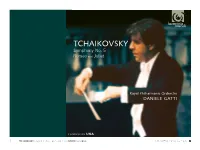
Tchaikovsky Symphony No
TCHAIKOVSKY Symphony No. 5 Romeo and Juliet Royal Philharmonic Orchestra DANIELE GATTI 1 TCHAIKOVSKY / Symphony No.5, Romeo & Juliet / RPO Daniele Gatti HMU 807381 © harmonia mundi PIOTR ILYICH TCHAIKOVSKY (1840–1893) Symphony No. 5 in E minor, Op. 64 45:09 1 I Andante – Allegro con anima 12:46 2 II Andante cantabile, con alcuna licenza – Moderato con anima 13:54 MArtIN OWEN horn solo 3 III Valse: Allegro moderato 5:56 4 IV Finale: Andante maestoso – Allegro vivace – Molto vivace 12:33 5 Romeo & Juliet 20:39 Fantasy Overture, after Shakespeare Acknowledgements Royal Philharmonic Orchestra Front Cover: Photo of Daniele Gatti by Primo Gnani. DANIELE GATTI Cover design: Scarlett Freund All texts and translations © harmonia mundi usa Track 5: Romeo & Juliet, Rondor Music (Ldn) Ltd. Recorded on May 6–7, 1998, at Watford Colosseum Produced by Stephen Johns 1998 BMG UK & Ireland Ltd./Classic FM plc Issued under license from BMG UK & Ireland Ltd. 2003 harmonia mundi usa 1117 Chestnut Street, Burbank, CA 91506 Symphony No. 5: Recorded July 31–August 1, 2003 at Abbey Road Studios, London Producer: Robina G. Young DSD Recording Engineer & Editor: Brad Michel Recorded, edited & mastered in DSD 2 TCHAIKOVSKY / Symphony No.5, Romeo & Juliet / RPO Daniele Gatti HMU 807381 © harmonia mundi TCHAIKOVSKY Symphony No. 5 • Romeo & Juliet ime has tamed Tchaikovsky. Works that once most often cited as having led to both his ill-conceived end. Scarcely do we hear an enjoyable melody than it is must surely have seemed radical–‘bold’ is a word marriage and his alleged suicide. engulfed in a whirlpool of unimportant harmonic T that won’t do–are conventional to contemporary Before beginning his final three symphonies (which progressions and modulations, as though the special aim ears, and the sensibility that inspired Tchaikovsky at his were composed in 1878, 1888, and 1893 respectively), of the composer was to be unintelligible. -

Unit V - a Survey of European Musical Styles
137 UNIT V - A SURVEY OF EUROPEAN MUSICAL STYLES: ROMANTICISM AND IMPRESSIONISM A. AUDIO-VISUAL MATERIALS: RECORDINGS AND FILMSTRIPS USED IN UNIT V B. LESSONS: 1. Romanticism in Music and Art; Part II (Filmstrip) 2. The Romantic Style: Berlioz - Symphonie Fantastique 3. Romantic Piano Virtuoso: Chopin and Liszt 4. Symphonic Poem: Tschaikowsky - Romeo and Juliet 5. Nationalism: Smetana and Tschaikovsky 6. Exoticism: Rimsky-Korsakov - Scheherazade 7. Stravinsky - The Rite of Spring 8. Impressionism in Art and Music, Part I (Filmstr ip) 9. Im?ressionism in Art and Music, Part II (Filmstr ip) 10. Flamenco and Its Influence on French Composers 11. Review of Romanticism 12. Review of Impressionism 13. Exam Doc. 0173b - Page 1 138 RECORDINGS" AND FILMSTRIPS USED IN UNIT V EAV filmstrip Lesson 1 Romanticism in Music and Art Lesson 2 Berlioz - Symphonie Fantastique Liszt - Hungarian Rhapsody f8 Lesson 3 Movie Liszt and His Music Chopin - Mazurka B Flat Major Etude in E Major prelude in E Minoc Nor ton ScOt:es Enjoyment of Music Tschaikowsky - Romeo and Juliet Lesson 4 Columbia 34330 Hubert Laws - Romeo and Juliet LeSson 5 smetana - The Moldau Tschaikowsky - 1812 Overture . Lesson 6 Rimsky-Korsakov - Scheherezade ~ Lesson 7 Stravinsky - Rite of spring EAV filmstr ips Impressionism in Art and Music - Part I, II Lesson 8 & 9 Nonesuch 7s 72002 Lesson 10 The Soul of Flamenco Ravel - Bolero Debussy - Iberia *~ny recordings of the works cited in unit V are available. Doc. 0173b - page 2 \ I· I 139 I UNIT V - LESSON 1 AIM "how did romantic music reflect the individual character of its composers? " PERFORMANCE OBJECTIVES Students will be able to: name seven important romantic composers and their individual accomplishments. -

Bolshoi Ballet La Bayadère
CAL PERFORMANCES PRESENTS SYNOPSIS Thursday, June 4, 2009, 8pm Friday, June 5, 2009, 8pm Saturday, June 6, 2009, 2pm & 8pm Sunday, June 7, 2009, 3pm Zellerbach Hall Bolshoi Ballet Anatoly Iksanov, General Director of the Bolshoi Theatre Yury Burlaka, Artistic Director of the Bolshoi Ballet in La Bayadère Music by Ludwig Minkus Libretto by Marius Petipa & Sergei Khudekov Choreography by Marius Petipa New scenic version by Yuri Grigorovich Berkeley Symphony Orchestra Pavel Klinichev, conductor Scenes from productions by Vakhtang Chabukiani, Nikolai Zubkovsky and Konstantin Sergeyev Sets and costumes after sketches by designers of the first production (1877), Elena Fetisova © Bolshoi revived by Valery Firsov, Nikolai Sharonov (sets) and Nikolai Sviridchikov (costumes) Svetlana Zakharova and Nikolay Tsiskaridze Valery Levental, Supervisor, Set & Costume Revival La Bayadère Alexander Kopylov, Music Director Premiered November 25, 1991. ACT I Running time: three hours 30 minutes with two intervals. Young warriors led by Solor are hunting a tiger. Nikiya and other bayadères give the fakirs water Before entering the forest, Solor asks a fakir named from the sacred pool. Imperceptibly, Magedaveya Magedaveya to tell Nikiya, a bayadère, that he will tells Nikiya that Solor will come to see her. The Children in this production appear courtesy of San Francisco Ballet School, wait for her near the temple. bayadère is happy. Helgi Tomasson, Director, and Lola de Avila, Associate Director. The High Brahmin and priests are solemnly As darkness falls, Nikiya goes to meet her be- leaving the temple. The feast of worshipping fire loved. Their secret rendezvous is guarded by the begins. Fakirs and votaries of the temple, bay- fakir.