Skład Polish Revolutionary Formations
Total Page:16
File Type:pdf, Size:1020Kb
Load more
Recommended publications
-

Eastern Partnership Regional Transport Study
Eastern Partnership regional transport study TRACECA IDEAJune II 2015 Annex II – Thematic maps P a g e | 1 Transport Dialogue and THIS PROJECT IS FUNDED BY THE EU Networks Interoperability II Eastern Partnership regional transport study Final report Annex II – Thematic maps June 2015 This document is prepared by the IDEA II Project. The IDEA II Project is implemented by TRT Trasporti e Territorio in association with: Panteia Group, Dornier Consulting GmbH and Lutsk University Eastern Partnership regional transport study June 2015 Annex II – Thematic maps P a g e | 2 TABLE OF CONTENT 1 ANNEX II – THEMATIC MAPS ................................................................................................ 3 1.1 Rail maps................................................................................................................... 4 1.2 Road maps ................................................................................................................ 4 1.1 Maps for Belarus, Ukraine, Moldova ........................................................................ 6 1.2 Maps for Armenia, Georgia, Azerbaijan ................................................................... 7 Eastern Partnership regional transport study June 2015 Annex II – Thematic maps P a g e | 3 1 ANNEX II – THEMATIC MAPS In the context of this assignment, a GIS database to display the collected indicators of the EaP transport network has been completed. The GIS database is based on the shapefiles (GIS files) of the EaP road and rail transport networks received -

ZRBG – Ghetto-Liste (Stand: 01.08.2014) Sofern Eine Beschäftigung I
ZRBG – Ghetto-Liste (Stand: 01.08.2014) Sofern eine Beschäftigung i. S. d. ZRBG schon vor dem angegebenen Eröffnungszeitpunkt glaubhaft gemacht ist, kann für die folgenden Gebiete auf den Beginn der Ghettoisierung nach Verordnungslage abgestellt werden: - Generalgouvernement (ohne Galizien): 01.01.1940 - Galizien: 06.09.1941 - Bialystok: 02.08.1941 - Reichskommissariat Ostland (Weißrussland/Weißruthenien): 02.08.1941 - Reichskommissariat Ukraine (Wolhynien/Shitomir): 05.09.1941 Eine Vorlage an die Untergruppe ZRBG ist in diesen Fällen nicht erforderlich. Datum der Nr. Ort: Gebiet: Eröffnung: Liquidierung: Deportationen: Bemerkungen: Quelle: Ergänzung Abaujszanto, 5613 Ungarn, Encyclopedia of Jewish Life, Braham: Abaújszántó [Hun] 16.04.1944 13.07.1944 Kassa, Auschwitz 27.04.2010 (5010) Operationszone I Enciklopédiája (Szántó) Reichskommissariat Aboltsy [Bel] Ostland (1941-1944), (Oboltsy [Rus], 5614 Generalbezirk 14.08.1941 04.06.1942 Encyclopedia of Jewish Life, 2001 24.03.2009 Oboltzi [Yid], Weißruthenien, heute Obolce [Pol]) Gebiet Vitebsk Abony [Hun] (Abon, Ungarn, 5443 Nagyabony, 16.04.1944 13.07.1944 Encyclopedia of Jewish Life 2001 11.11.2009 Operationszone IV Szolnokabony) Ungarn, Szeged, 3500 Ada 16.04.1944 13.07.1944 Braham: Enciklopédiája 09.11.2009 Operationszone IV Auschwitz Generalgouvernement, 3501 Adamow Distrikt Lublin (1939- 01.01.1940 20.12.1942 Kossoy, Encyclopedia of Jewish Life 09.11.2009 1944) Reichskommissariat Aizpute 3502 Ostland (1941-1944), 02.08.1941 27.10.1941 USHMM 02.2008 09.11.2009 (Hosenpoth) Generalbezirk -
Sacred Architecture in the Area of Historical Volhynia
E3S Web of Conferences 217, 01007 (2020) https://doi.org/10.1051/e3sconf/202021701007 ERSME-2020 Sacred architecture in the area of historical Volhynia Liliia Gnatiuk1,* 1National Aviation University, Interior Design Department, Faculty of architecture, construction and design, Kyiv, Ukraine Abstract. This article discusses the genesis and historical development of the sacred complexes of historic Volhyn. Based on historical and architectural analysis, it is presented that sacred complexes of historic Volhynia were built according to the canons of temple architecture, and at the same time they have their own characteristics, related to national traditions and regional features which appeared as a result of the process of forming Christianity as a religion associated with national development in the specific study territory. The results of a comprehensive analysis of historical and archival documents found in the archives of Ukraine, Poland and Russia, as well as field research are presented. Results of system and theoretical research of significant retrospective analysis of canonical, historical and political prerequisites of sacral complexes were generalized. The concept of sacred complex structures throughout ХІ-ХІХ th centuries is suggested in correlation with the change of religious identity formation and differentiation according to religious requirements. Existence of autochthonous traditions and genuine vector of the Volhynia’s sacred complex development, considering the specific geopolitical location between East and West in the area where two different cultures collide with each other has been proved. The work is shifting statements concerning direct borrowing of architectural and stylistic components of architectural and planning structure and certain decorative elements. 1 Introduction Architecture more than other forms of art reflects the state of society, its political level, the degree of economic development, aesthetic tastes and preferences. -

Sport in Volyn in the Years 1921–1939. Outline History
View metadata, citation and similar papers at core.ac.uk brought to you by CORE Історичні, філософські, правові й кадрові проблеми фізичної культури та спорту УДК 796(477.82+438)"1921/1939" SPORT IN VOLYN IN THE YEARS 1921–1939. OUTLINE HISTORY Eligiusz Małolepszy1, Teresa Drozdek-Małolepsza1 Daniel Bakota1, Anatolii Tsos2 1 Jan Długosz University in Częstochowa, Institute of Physical Education, Tourism and Physiotherapy, Częstochowa, Poland, e.malolepszy@ajd.czest.pl 2 Lesya Ukrainka Eastern European National University, Lutsk, Ukraine, Tsos.Anatoliy@eenu.edu.ua https://doi.org/10.29038/2220-7481-2017-03-73-81 Abstract Introduction. The aim of this paper is to outline the history of sport in Volyn (the area of the Volhynian province in the period of the Second Polish Republic) in the years 1921–1939. The Volhynian province was established on 19 February 1921. As of April 1, 1939 its area covered 35,754 km2 and had a population of 2,085,600 people (as of 9 December 1931). The population of Polish nationality was 16,6 %, of Ukrainian nationality – 68,4 %, of Jewish nationality – 9,9 %, of German nationality – 2,3 %, of Czech nationality – 1,5 %, of Russian nationality – 1,1 %, the remaining nationalities – 0,2 %. Townspeople of the province represented only 13,3 % of the population. The province consisted of the following counties: Dubno, Horochów, Kostopil, Kovel, Kremenets, Liuboml, Lutsk, Rivne, Sarny, Volodymyr and Zdolbuniv. The county of Sarny (formerly included in Polesia province) became a part of the Volhynian province in December 1930. Methods and Research Problems. As part of preparation of this study the following research methods have been used: analysis of historical sources, the method of synthesis and comparison. -

National Threat Assessment 2021
DEFENCE INTELLIGENCE STATE SECURITY AND SECURITY DEPARTMENT OF SERVICE UNDER THE REPUBLIC OF THE MINISTRY OF LITHUANIA NATIONAL DEFENCE NATIONAL THREAT ASSESSMENT 2021 DEFENCE INTELLIGENCE STATE SECURITY AND SECURITY DEPARTMENT OF SERVICE UNDER THE REPUBLIC OF THE MINISTRY OF LITHUANIA NATIONAL DEFENCE NATIONAL THREAT ASSESSMENT 2021 VILNIUS, 2021 CONTENTS INTRODUCTION 3 FOREWORD 5 SUMMARY 8 NEW SECURITY CHALLENGES 12 REGIONAL SECURITY 17 MILITARY SECURITY 27 ACTIVITIES OF HOSTILE INTELLIGENCE AND SECURITY SERVICES 41 PROTECTION OF CONSTITUTIONAL ORDER 50 INFORMATION SECURITY 54 ECONOMIC AND ENERGY SECURITY 61 TERRORISM AND GLOBAL SECURITY 67 3 INTRODUCTION The National Threat Assessment by the State Security Department of the Republic of Lithuania (VSD) and the Defence Intelligence and Security Service under the Ministry of National Defence of the Republic of Lithuania (AOTD) is presented to the public in accordance with Articles 8 and 26 of the Law on Intelligence of the Republic of Lithuania. The document provides consolidated, unclassified assessment of threats and risks to national security of the Repub- lic of Lithuania prepared by both intelligence services. The document assesses events, processes and trends that correspond to the intelligence requirements approved by the State Defence Council. Based on them and considering the long-term trends affecting national security, the document provides the assessment of major challenges that the Lithuanian national security is to face in the near term (2021–2022). The assessments of long-term -

Geographic Structure of Road Transportation and Logistics Infrastructure in the Republic of Belarus
ISSN 1426-5915 e-ISSN 2543-859X 20(2)/2017 Prace Komisji Geografii Komunikacji PTG 2017, 20(2), 8-18 DOI 10.4467/2543859XPKG.17.007.7389 GeoGraPhic sTrucTure of road TransPorTaTion and loGisTics infrasTrucTure in The rePublic of belarus Struktura geograficzna infrastruktury transportu drogowego i logistyki w Republice Białorusi andrei bezruchonak Department of Economic Geography of Foreign Countries, Faculty of Geography, Belarusian State University, Leningradskaya st. 16, 220030, Minsk, Belarus e-mail: bezruchonak@bsu.by citation: Bezruchonak A., 2017, Geographic structure of road transportation and logistics infrastructure in the Republic of Belarus, Prace Komisji Geografii Komunikacji PTG, 20(2), 8-18. abstract: Transportation, representing 6% of GDP, plays vital role in social and economic development of the Republic of Belarus. The purpose of this article is to present the geographic analysis of current spatial structure of the road transportation in Belarus in 2000-2014. The choice of transport mode for the article was influenced by several factors, such as historic devel- opment, network coverage, transformational changes in productivity, rapid increase in car ownership numbers, emergence of logistic centers and intelligent transportation systems. The article reviews the range of topics, including morphology of the major roads network, logistic centers spatial distribution and regional features of passenger and cargo productivity, discusses current transformational changes within the road transportation sector in Belarus. The key findings indicate that current changes in spatial structure of the road transportation in Belarus have uneven nature, shaped by social, economic, political and geopolitical external and internal factors and are a subject of interest for both transportation researchers and practitioners. -

Situation of Human Rights in Belarus in 2012
Human Rights Center «Viasna» Situation of Human Rights in Belarus in 2012 REVIEW-CHRONICLE Мinsk, 2013 SITUATION OF HUMAN RIGHTS IN BELARUS IN 2012 REVIEW-CHRONICLE Compiled by Tatsiana Reviaka Editing and introduction by Valiantsin Stefanovich The book was prepared on the basis of the monthly reviews of the situation of human rights in Belarus in 2012. Each of the monthly reviews includes the analysis of the most important events which influenced the observation of human rights for the given period, as well as the most evident and characteristic features of the abuses registered at that time. The review was prepared on the basis of personal applications of victims of human rights violations, the facts that were registered by human rigths defenders or voiced in open information sources. The book makes use of photos by Yuliya Darashkevich Dzmitry Bushko, Siarhei Hudzilin, Nastassia Loika, the web-sites http://photo.bymedia. net, http://nn.by, http://euroradio.fm, http://www.svaboda.org, http://volkovysk.by, http://gazetaby.com, http://mfront.net, http://www.reuters.com, http://belsat.eu/be, belhouse.org and the archive of the Human Rights Center «Viasna». TABLE OF CONTENTS Introduction 9 Review-Chronicle of Human Rights Violations in Belarus in January 2012 19 Politically motivated criminal prosecution 19 Harassment and pressurization of human rights activists and organizations 21 Torture and cruel treatment, poor conditions of detention 23 Death penalty 25 Administrative prosecution of social and political activists 25 Restrictions on freedom of speech 27 Restrictions on freedom of assembly 28 Situation of freedom of association 30 Review-Chronicle of Human Rights Violations in Belarus in February 2012 31 Political prisoners. -
The “Belarus Factor” from Balancing to Bridging Geopolitical Dividing Lines in Europe?
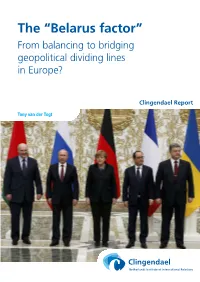
The “Belarus factor” From balancing to bridging geopolitical dividing lines in Europe? Clingendael Report Tony van der Togt The “Belarus factor” From balancing to bridging geopolitical dividing lines in Europe? Tony van der Togt Clingendael Report January 2017 January 2017 © Netherlands Institute of International Relations ‘Clingendael’. Cover photo: The leaders of Belarus, Russia, Germany, France and Ukraine after signing the Minsk II agreement, February 2015. © In Terris Online Newspaper Unauthorized use of any materials violates copyright, trademark and / or other laws. Should a user download material from the website or any other source related to the Netherlands Institute of International Relations ‘Clingendael’, or the Clingendael Institute, for personal or non-commercial use, the user must retain all copyright, trademark or other similar notices contained in the original material or on any copies of this material. Material on the website of the Clingendael Institute may be reproduced or publicly displayed, distributed or used for any public and non-commercial purposes, but only by mentioning the Clingendael Institute as its source. Permission is required to use the logo of the Clingendael Institute. This can be obtained by contacting the Communication desk of the Clingendael Institute (press@clingendael.nl). The following web link activities are prohibited by the Clingendael Institute and may present trademark and copyright infringement issues: links that involve unauthorized use of our logo, framing, inline links, or metatags, as well as hyperlinks or a form of link disguising the URL. About the author Tony van der Togt is Senior Research Fellow at the Netherlands Institute of International Relations ‘Clingendael’ in The Hague. -

59. Yevgeniy Mikhailovich Subbotkin 1. Евгений Михайлович Субботкин 2
226 RUSSIAN GOVERNORS IN THE KINGDOM OF POLAND (1867-1918) 59. Yevgeniy Mikhailovich Subbotkin 1. Евгений Михайлович Субботкин 2. B. 29 August 1840 in Pskov Governorate. 3. Orthodox. 4. Hereditary nobleman of Pskov Governorate. 5. Cadet Corps in Polotsk; Mikhailovsky Artillery Academy 27 November 1861-4 August 1863, 2nd category diploma with the right to wear aiguillettes. 6. No reported estate. 7. Wife: since 1868 Alexandra Ivanovna Vladimirtseva, Orthodox, daughter of collegiate councillor. 8. Children: Anna, b. 26 September 1869; Mikhail, b. 28 November 1871, d. 1926, state councillor, special tasks clerk with the Minister of Trade and Industry, agent of the Ministry of Trade and Industry in Rome; Alexandra, b. 10 October 1875, d. after 1915, married to Aleksey Nikolayevich Malayev, vice-governor of Lublin and Siedlce. 9. Father: Mikhail Pyotrovich Subbotkin (Subotkin), b. 1800 in Pskov Gover- norate, d. after 1854, Orthodox, hereditary nobleman of Pskov Governorate since 21 March 1819, collegiate assessor, clerk of state administration occupying, among others, the following positions: chancellery clerk of Opochetsky Poviat Treasury Chamber, clerk of Vitebsk Governorate government, land ispravnik in Horodko, Dyneburg, Pskov, Vilna and Dzisna, horodnichi in Nevel and Ludza, police-master in Polotsk, owner of hereditary estate of 200 d. in the poviat of Opochka in Pskov Governorate and an estate of 100 d. purchased in the same poviat, married before 1832. Mother: Roza (Róża) Ignatyevna Viskont, b. before 1815, d. after 1853, Roman Catholic, daughter of hereditary nobleman (her brother Fortunat was in 1844 an is- pravnik in Novo-Alexandrovsk). Siblings: Alexandr, b. 1832, d. after 1853; Ippolit, b. -

132 March 2019
Romanov News Новости Романовых By Ludmila & Paul Kulikovsky №132 March 2019 The monument to the Royal Martyrs at the St. Seraphim Cathedral in Vyatka "For the first time in 100 years, a descendant of the Romanovs appeared in Vyatka" From 17 to 20 of March the great-great-grandson of Alexander III, the great-grandson of Grand Duchess Olga Alexandrovna - the sister of Emperor Nicholas II - Paul E. Kulikovsky and his wife Ludmila visited Vyatka. They were invited by the regional public organization "Revival of Vyatka". Paul E. Kulikovsky - "Kirov, or Vyatka as we prefer to call the city, was one of the places on our "to-visit-list", as we want to visit all the places in Russia directly related to the Romanovs, and especially those in which the Romanovs were in exile after the revolution. That is why first of all were visited Romanov related locations and city landmarks. But for the local citizens the main event was a presentation of the book of memoirs of Grand Duchess Olga Alexandrovna “25 Chapters of my life”, followed by a press- conference. City history The city is actually called Kirov - in honour of one of the Stalin co- workers – Sergei Kirov killed in 1934 – but many citizens still use the historical name Vyatka. It was established in 1174. From 1457 to 1780 it was called Khlynov, from 1780 to 1934 Vyatka, and now Kirov. It is the administrative centre of the Kirov region and located on the Vyatka River, 896 km northeast of Moscow. Population is about 507,155 (2018). -

SITUATION of HUMAN RIGHTS in BELARUS in 2014
Human Rights Centre “Viasna” SITUATION OF HUMAN RIGHTS in BELARUS in 2014 REVIEW-CHRONICLE Minsk, 2015 SITUATION OF HUMAN RIGHTS IN BELARUS in 2014 REVIEW-CHRONICLE Author and compiler: Tatsiana Reviaka Editor and author of the foreword: Valiantsin Stefanovich The edition was prepared on the basis of reviews of human rights violations in Belarus published every month in 2014. Each of the monthly reviews includes an analysis of the most important events infl uencing the observance of human rights and outlines the most eloquent and characteristic facts of human rights abuses registered over the described period. The review was prepared on the basis of personal appeals of victims of human rights abuses and the facts which were either registered by human rights activists or reported by open informational sources. The book features photos from the archive of the Human Rights Center “Viasna”, as well as from publications on the websites of Radio Free Europe/ Radio Liberty Belarus service, the Nasha Niva newspaper, tv.lrytas.lt, baj.by, gazetaby.com, and taken by Franak Viachorka and Siarhei Hudzilin. Human Rights Situation in 2014: Trends and Evaluation The situation of human rights during 2014 remained consistently poor with a tendency to deterioration at the end of the year. Human rights violations were of both systemic and systematic nature: basic civil and political rights were extremely restricted, there were no systemic changes in the fi eld of human rights (at the legislative level and (or) at the level of practices). The only positive development during the year was the early release of Ales Bialiatski, Chairman of the Human Rights Centre “Viasna” and Vice-President of the International Federation for Human Rights. -

Intelligence Infiltration of the Polish Ministry of Foreign Affairs by Soviet Intelligence
258 INTERNAL SECURITY REVIEW 20/19 Marek Świerczek Intelligence infiltration of the Polish Ministry of Foreign Affairs by Soviet intelligence Introduction In 2009 a set of documents by L.F. Sockow1, entitled Секреты польской политики. Сборник документов was issued in Moscow. It contained selected materials from the SVR archive (Служба Внешней Разведки Российской Федерации, СВР2) that come from the INO GUGB NKVD (Иностранный отдел Главного управления государственной безопасности Народного комиссариата внутренних дел СССР, INO GUGB NKVD3) and that referred to the foreign politics of the Second Republic of Poland 1935‒1945. Both the editor of the work, i.e. the Foreign Intelligence Service (SVR) and the set of documents with a clear-cut introduction by gen. Lev Filipovich Sockow leave no room for doubt about the propaganda nature of the work. And it was received exactly so by the Polish side. Polish historians and journalists tried to discredit the paper by proving that the thesis suggested there about the alleged politics of rapprochement between the Second Republic of Poland and Nazi Germans to establish that probable alliance against the USSR is in reality a manipulation. Probably it was only Władysław Bułhak who admitted that gen. Sockow’s work proves the thesis that the Soviets had an agent in the Polish MoFA. He developed a hypothesis that the documents of the Polish MoFA published in the set could have been the result of a disinformation operation carried out by the II Department of the Polish General Staff (further: II Department) against INO GUGB NKVD.4 Apart from the short discussion storm the work did not seriously change the way the intelligence infiltration of the state institutions of the II Republic of Poland by the Soviet intelligence.