Monday Scientific Session Listings 273–471
Total Page:16
File Type:pdf, Size:1020Kb
Load more
Recommended publications
-
Forest Farming
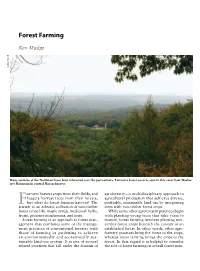
Forest Farming Ken Mudge CY ROSE N NA Many sections of the Northeast have been reforested over the past century. Extensive forest cover is seen in this view from Wachu- sett Mountain in central Massachusetts. armers harvest crops from their fields, and agroforestry—a multidisciplinary approach to loggers harvest trees from their forests, agricultural production that achieves diverse, Fbut what do forest farmers harvest? The profitable, sustainable land use by integrating answer is an eclectic collection of non-timber trees with non-timber forest crops. forest crops like maple syrup, medicinal herbs, While some other agroforestry practices begin fruits, gourmet mushrooms, and nuts. with planting young trees that take years to Forest farming is an approach to forest man- mature, forest farming involves planting non- agement that combines some of the manage- timber forest crops beneath the canopy of an ment practices of conventional forestry with established forest. In other words, other agro- those of farming or gardening to achieve forestry practices bring the forest to the crops, an environmentally and economically sus- whereas forest farming brings the crops to the tainable land-use system. It is one of several forest. In this regard it is helpful to consider related practices that fall under the domain of the role of forest farming in overall forest man- Forest Farming 27 agement. A forest farm should be designed to bearing trees including walnuts and peaches, emulate as much as possible a natural forest. but there is no evidence of deliberate culti- This includes characteristics of a healthy forest vation of useful crops beneath the canopy of ecosystem such as species diversity, resilience established forest. -

Estudos De Egiptologia Vi
ESTUDOS DE EGIPTOLOGIA VI 2ª edição SESHAT - Laboratório de Egiptologia do Museu Nacional Rio de Janeiro – Brasil 2019 SEMNA – Estudos de Egiptologia VI 2ª edição Antonio Brancaglion Junior Cintia Gama-Rolland Gisela Chapot Organizadores Seshat – Laboratório de Egiptologia do Museu Nacional/Editora Klínē Rio de Janeiro/Brasil 2019 Este trabalho está licenciado com uma Licença Creative Commons - Atribuição-Não Comercial- Compartilha Igual 4.0 Internacional. Capa: Antonio Brancaglion Jr. Diagramação e revisão: Gisela Chapot Catalogação na Publicação (CIP) Ficha Catalográfica B816s BRANCAGLION Jr., Antonio. Semna – Estudos de Egiptologia VI/ Antonio Brancaglion Jr., Cintia Gama-Rolland, Gisela Chapot., (orgs.). 2ª ed. – Rio de Janeiro: Editora Klínē,2019. 179 f. Bibliografia. ISBN 978-85-66714-12-8 1. Egito antigo 2. Arqueologia 3. História 4. Coleção I. Título CDD 932 CDU 94(32) I. Título. Universidade Federal do Rio de Janeiro Museu Nacional Programa de Pós-graduação em Arqueologia CDD 932 Seshat – Laboratório de Egiptologia CDU 94(32) Quinta da Boa Vista, s/n, São Cristóvão Rio de Janeiro, RJ – CEP 20940-040 Editora Klínē 2 Sumário APRESENTAÇÃO ..................................................................................................................... 4 OLHARES SOBRE O EGITO ANTIGO: O CASO DA DANÇA DO VENTRE E SUA PROFISSIONALIZAÇÃO ........................................................................................................... 5 LUTAS DE CLASSIFICAÇÕES NO EGITO ROMANO (30 AEC - 284 EC): UMA CONTRIBUIÇÃO A PARTIR DA -

Priscila-IAEA
1 SM/EB-13 E-beam Irradiation of “in nature” Palm: Texture and Color Evaluation Silva, P.V a; Nunes, T.C.F a; Furgeri a, C.; Pitombo b, R.N.M; Hojeije c, K.Y. and Villavicencio, A.L.C.H a a Instituto de Pesquisas Energéticas e Nucleares (IPEN/CNEN-SP), Centro de Tecnologia das Radiações, Laboratório de Detecção de alimentos Irradiados, Cidade Universitária, Av. Professor Lineu Prestes 2242, Butantã CEP 05508-000 São Paulo - SP, Brazil. b Faculdade Ciências Farmacêuticas, Departamento de Tecnologia Farmacêutica e Bioquímica, Universidade de São Paulo, Av. Professor Lineu Prestes 580, Bloco 16 CEP 05508-900 São Paulo – SP, Brazil. c Floresta Indústria e Comércio Ltda. Rodovia Régis Bittencourt BR116, Km 416 Bairro Piúva CEP 118000- 000. Juquiá , São Paulo-SP, Brazil. Email contact of main author: villavic@ipen.br priscilavsilva@gmail.com Abstract The palm tree ( Bactris gasipaes Kunth) is a potential raised species with economic, for the nutritional value of its fruits that can in such way be used in the feeding human being as in the animal, and mainly, for the extraction of the palm that currently has a bigger interest in this culture. Food irradiation is a worldwide technology that aims to improve the product quality, in order to eliminate diverse microorganisms that can spoil the food. Irradiation processing, in the recommended doses, causes very few chemical alterations in foods, nutritional losses are considered insignificant and some of the alterations known found in irradiated foods is not harmful or dangerous. The objective of this work was to evaluate physical characteristics of in nature peach palm, such as color and texture, after combination of e-beam processing and refrigeration. -

Download Product Insert (PDF)
Product Information CNQX Item No. 14618 CAS Registry No.: 115066-14-3 Formal Name: 1,2,3,4-tetrahydro-7-nitro-2,3-dioxo-6- quinoxalinecarbonitrile H Synonyms: 6-cyano-7-Nitroquinoxaline-2,3-dione, NC N O FG 9065 MF: C9H4N4O4 FW: 232.2 O O N N Purity: ≥98% 2 Stability: ≥2 years at -20°C H Supplied as: A crystalline solid λ UV/Vis.: max: 217, 275, 315 nm Laboratory Procedures For long term storage, we suggest that CNQX be stored as supplied at -20°C. It should be stable for at least two years. CNQX is supplied as a crystalline solid. A stock solution may be made by dissolving the CNQX in the solvent of choice. CNQX is soluble in organic solvents such as DMSO and dimethyl formamide (DMF), which should be purged with an inert gas. The solubility of CNQX in these solvents is approximately 5 and 12 mg/ml, respectively. CNQX is sparingly soluble in aqueous buffers. For maximum solubility in aqueous buffers, CNQX should first be dissolved in DMF and then diluted with the aqueous buffer of choice. CNQX has a solubility of approximately 0.5 mg/ml in a 1:1 solution of DMF:PBS (pH 7.2) using this method. We do not recommend storing the aqueous solution for more than one day. CNQX is a competitive, non-NMDA glutamate receptor antagonist (IC50s = 0.3 and 1.5 μM for AMPA and kainate 1,2 receptors, respectively, versus IC50 = 25 μM for NMDA receptors). This compound has been used to specifically target AMPA and kainate receptor responses and thus differentiate from that of NMDA receptors. -

In Ancient Egypt
THE ROLE OF THE CHANTRESS ($MW IN ANCIENT EGYPT SUZANNE LYNN ONSTINE A thesis submined in confonnity with the requirements for the degm of Ph.D. Graduate Department of Near and Middle Eastern Civiliations University of Toronto %) Copyright by Suzanne Lynn Onstine (200 1) . ~bsPdhorbasgmadr~ exclusive liceacc aiiowhg the ' Nationai hiof hada to reproduce, loan, distnia sdl copies of this thesis in miaof#m, pspa or elccmnic f-. L'atm criucrve la propri&C du droit d'autear qui protcge cette thtse. Ni la thèse Y des extraits substrrntiets deceMne&iveatetreimprimCs ouraitnmcrtrepoduitssanssoai aut&ntiom The Role of the Chmaes (fm~in Ancient Emt A doctorai dissertacion by Suzanne Lynn On*, submitted to the Department of Near and Middle Eastern Civilizations, University of Toronto, 200 1. The specitic nanire of the tiUe Wytor "cimûes", which occurrPd fcom the Middle Kingdom onwatd is imsiigated thrwgh the use of a dalabase cataloging 861 woinen whheld the title. Sorting the &ta based on a variety of delails has yielded pattern regatding their cbnological and demographical distribution. The changes in rhe social status and numbers of wbmen wbo bore the Weindicale that the Egyptians perceivecl the role and ams of the titk âiffefcntiy thugh tirne. Infomiation an the tities of ihe chantressw' family memkrs bas ailowed the author to make iderences cawming llse social status of the mmen who heu the title "chanms". MiMid Kingdom tifle-holders wverc of modest backgrounds and were quite rare. Eighteenth DMasty women were of the highest ranking families. The number of wamen who held the titk was also comparatively smaii, Nimeenth Dynasty women came [rom more modesi backgrounds and were more nwnennis. -
An Investigation Into Pro-Apoptotic Targets in Experimental Glaucoma and the Neuroprotective Effects of Ginkgo Biloba in Retinal Ganglion Cells
An investigation into pro-apoptotic targets in experimental glaucoma and the neuroprotective effects of Ginkgo biloba in retinal ganglion cells Abeir Baltmr MB ChB, FRCS (Glasg) A thesis submitted to University College London for the degree of Doctor of Medicine (Research) 2012 Glaucoma and Retinal Neurodegeneration Research Group Visual Neuroscience Institute of Ophthalmology 1 Declaration I, Abeir Baltmr, confirm that the work presented in this thesis is my own. Where information has been derived from other sources, I confirm that this has been indicated in the thesis. Abeir Baltmr 2 Abstract Ginkgo biloba has been advocated as a neuroprotective agent for several years in glaucoma. In this study, immunohistochemistry was used to identify known potential molecular targets of Ginkgo biloba related to retinal ganglion cell (RGC) apoptosis in experimental glaucoma, including amyloid precursor protein (APP), Aß, cytochrome c, caspase-3 and tumor necrosis factor receptor-1 (TNF-R1). Furthermore, using apoptotic inducers related to mechanisms implicated in glaucoma, namely Dimethyl sulphoxide (DMSO), ultraviolet C (UVC) and Sodium Azide (NaN3), the effects of the terpenoid fraction of Ginkgo biloba (Ginkgolide A, Ginkgolide B and Bilobalide) were investigated separately in cultured retinal ganglion cells (RGC-5). Cell viability was determined by 3-(4,5-dimethylthiazol-2-yl)-2,5- diphenyltetrazolium bromide (MTT) assay and morphological analysis of DMSO treated RGC-5 was performed using Hoechst 33342 stain. Immunohistochemistry showed a strong inverse correlation between Aß and APP in ocular hypertension (OHT) animals, with APP and Aß accumulation peaking at 1 and 12 weeks after intraocular pressure (IOP) elevation respectively. Cytochrome c and TNF-R1 expression peaked at 3 weeks, and active caspase 3 activity at 12 weeks after IOP elevation. -
Synthesis and Biological Evaluation
Margarida Leonor Florindo Espadinha Licenciatura em Química Aplicada Enantiopure bicyclic lactams: synthesis and biological evaluation Dissertação para obtenção do Grau de Mestre em Química Bioorgânica Orientador: Prof. Doutora Maria M. M. Santos, FF-UL Elemento de Ligação: Prof. Doutora Paula Sério Branco, FCT-UNL Presidente: Prof. Doutora Paula Sério Branco, FCT-UNL Arguente: Prof. Doutor Vasco Bonifácio, IST-CQFM Vogal: Prof. Doutora Maria M. M. Santos, FF-UL Outubro 2015 i LOMBADA biological evaluation biological dinha synthesis and and synthesis : Margarida Espa Margarida lactams bicyclic Enantiopure ii 2015 Margarida Leonor Florindo Espadinha Licenciatura em Química Aplicada Enantiopure bicyclic lactams: synthesis and biological evaluation Dissertação para obtenção do Grau de Mestre em Química Bioorgânica Orientador: Prof. Doutora Maria M. M. Santos, FF-UL Elemento de Ligação: Prof. Doutora Paula Sério Branco, FCT Presidente: Prof. Doutora Paula Sério Branco, FCT-UNL Arguente: Doutor Vasco Bonifácio, IST-CQFM Vogal: Prof. Doutora Maria M. M. Santos, FF-UL Outubro 2015 iii Enantiopure bicyclic lactams: synthesis and biological evaluation Margarida Leonor Florindo Espadinha, Copyright A Faculdade de Ciências e Tecnologia e a Universidade Nova de Lisboa têm o direito, perpétuo e sem limites geográficos, de arquivar e publicar esta dissertação através de exemplares impressos reproduzidos em papel ou de forma digital, ou por outro qualquer meio conhecido ou que venha a ser inventado e de divulgar através de repositórios científicos e de admitir a sua cópia e distribuição com objectivos educacionais ou de investigação, não comerciais, desde que seja dado crédito ao autor e editor. iv Acknowledgements I would like to thank Professor Dr. Maria M. -
589 Thesis in the Date of Tomb TT 254 Verification Through Analysis Of
Thesis in The Date Of Tomb TT 254 Verification Through Analysis of its Scenes Thesis in The Date of Tomb TT 254 Verification through Analysis of its Scenes Sahar Mohamed Abd el-Rahman Ibrahim Faculty of Archeology, Cairo University, Egypt Abstract: This paper extrapolates and reaches an approximate date of the TOMB of TT 254, the tomb of Mosi (Amenmose) (TT254), has not been known to Egyptologists until year 1914, when it was taken up from modern occupants by the Antiquities Service, The tomb owner is Mosi , the Scribe of the treasury and custodian of the estate of queen Tiye in the domain of Amun This tomb forms with two other tombs (TT294-TT253) a common courtyard within Al-Khokha necropolis. Because the Titles/Posts of the owner of this tomb indicated he was in charge of the estate of Queen Tiye, no wonder a cartouche of this Queen were written among wall paintings. Evidently, this tomb’s stylistic features of wall decorations are clearly influenced by the style of Amarna; such as the male figures with prominent stomachs, and elongated heads, these features refer that tomb TT254 has been finished just after the reign of Amenhotep IV (Akhenatun). Table stands between the deceased and Osiris which is divided into two parts: the first part (as a tray) is loading with offerings, then the other is a bearer which consisted of two stands shaped as pointed pyramids… based on the connotations: 1- Offerings tables. 2- Offerings Bearers. 3- Anubis. 4- Mourners. 5- Reclamation of land for cultivation. 6- Banquet in some noble men tombs at Thebes through New Kingdom era. -
Effect of Ganoderma Lucidum (Reishi) on Hematological Parameters
Available online at www.ijmrhs.com cal R edi ese M ar of c l h a & n r H u e o a J l l t h International Journal of Medical Research & a S n ISSN No: 2319-5886 o c i t i Health Sciences, 2018, 7(3): 151-157 e a n n c r e e t s n I • • IJ M R H S Effect of Ganoderma lucidum (Reishi) on Hematological Parameters in Wistar Rats Hammad Ahmed and Muhammad Aslam* Department of Pharmacology, Faculty of Pharmacy, Ziauddin University, Karachi, Pakistan *Corresponding e-mail: pharmacologist1@yahoo.com ABSTRACT Ganoderma lucidum (Reishi), has been used in Traditional Chinese Medicine (TCM) for 5000 years or more. In China and Japan Ganoderma lucidum has been used in folk medicine, commonly in the treatment of neurasthenia, insomnia, hepatopathy, nephritis, gastric ulcers, asthma, and hypertension. In this study we have evaluated the effect of Ganoderma lucidum on hematological parameters in Wistar rats. The extract was given orally by gavage at the dose of 150 mg/kg and 300 mg/kg body weight. The result of our study shows extremely significant increase in the hemoglobin level, platelet count and leukocyte count more specifically at a dose of 150 mg/kg of Ganoderma lucidum extract when compare with normal control group. However, at a dose of 300 mg/kg of GLE, significant increase in hemoglobin level and extremely significant increase in leukocyte count were observed. Whereas, insignificant result was observed at both the doses of GLE in case of hematocrit level, MCV, MCHC, MCH and RBC count. -

Oxidative Stress and Parkinson's Disease: New Hopes in Treatment with Herbal Antioxidants
See discussions, stats, and author profiles for this publication at: https://www.researchgate.net/publication/283728452 Oxidative stress and Parkinson's disease: New hopes in treatment with herbal antioxidants Article in Current pharmaceutical design · November 2015 CITATIONS READS 43 1,053 4 authors, including: Mahmoud Bahmani Hedayatollah Shirzad 219 PUBLICATIONS 2,021 CITATIONS Shahrekord University of Medical Sciences 106 PUBLICATIONS 1,357 CITATIONS SEE PROFILE SEE PROFILE Mahmoud Rafieian-kopaei Shahrekord University of Medical Sciences 337 PUBLICATIONS 5,110 CITATIONS SEE PROFILE Some of the authors of this publication are also working on these related projects: Genetic mapping of deafness in Iran View project expression of anti-oxidative stress genes in ulcerative colitis View project All content following this page was uploaded by Mahmoud Bahmani on 28 November 2015. provided by shahrekord university of medical scinces The user has requested enhancement of the downloaded file. View metadata, citation and similar papers at core.ac.uk CORE brought to you by Send Orders for Reprints to reprints@benthamscience.ae Current Pharmaceutical Design, 2016, 22, 000-000 1 Oxidative Stress and Parkinson’s Disease: New Hopes in Treatment with Herbal Antioxidants Amir Sarrafchi1, Mahmoud Bahmani2, Hedayatollah Shirzad1 and Mahmoud Rafieian-Kopaei1* 1Medical Plants Research Center, Shahrekord University of Medical Sciences, Shahrekord, Iran; 2Food and Bev- erages Safety Research Center, Urmia University of Medical Sciences, Urmia, Iran Abstract: Parkinson's disease (PD) is a neurodegenerative disorder due to dopamine deficit in substatia nigra. PD is mainly a sporadic disease with unestablished etiology. However, exposure to environmental toxins, head trauma, Please provide corresponding author(s) inflammation, and free radicals are potential reasons. -

Role of Oxidative Stress and Neuroinflammation in Attention
antioxidants Review Role of Oxidative Stress and Neuroinflammation in Attention-Deficit/Hyperactivity Disorder Juan Carlos Corona Laboratory of Neurosciences, Hospital Infantil de México Federico Gómez, Mexico City 06720, Mexico; jcorona@himfg.edu.mx; Tel.: +52-55-5228-9917 Received: 27 July 2020; Accepted: 8 September 2020; Published: 23 October 2020 Abstract: Attention-deficit/hyperactivity disorder (ADHD) is a neurodevelopmental disorder of childhood. Although abnormalities in several brain regions and disturbances of the catecholaminergic pathway have been demonstrated, the pathophysiology of ADHD is not completely understood, but as a multifactorial disorder, has been associated with an increase in oxidative stress and neuroinflammation. This review presents an overview of factors that increase oxidative stress and neuroinflammation. The imbalance between oxidants and antioxidants and also the treatment with medications are two factors that can increase oxidative damage, whereas the comorbidity between ADHD and inflammatory disorders, altered immune response, genetic and environmental associations, and polymorphisms in inflammatory-related genes can increase neuroinflammation. Evidence of an association with these factors has become valuable for research on ADHD. Such evidence opens up new intervention routes for the use of natural products as antioxidants that could have potential as a treatment against oxidative stress and neuroinflammation in ADHD. Keywords: oxidative stress; neuroinflammation; attention-deficit/hyperactivity disorder -
1750.Full.Pdf
1750 • The Journal of Neuroscience, February 3, 2010 • 30(5):1750–1759 Development/Plasticity/Repair In the Developing Rat Hippocampus, Endogenous Activation of Presynaptic Kainate Receptors Reduces GABA Release from Mossy Fiber Terminals Maddalena D. Caiati,* Sudhir Sivakumaran,* and Enrico Cherubini Neuroscience Programme, International School for Advanced Studies, 34014 Trieste, Italy Presynaptic kainate receptors regulate synaptic transmission in several brain areas but are not known to have this action at immature mossy fiber (MF) terminals, which during the first week of postnatal life release GABA, which exerts into targeted cells a depolarizing and excitatory action. Here, we report that, during the first week of postnatal life, endogenous activation of GluK1 receptors by glutamate present in the extracellular space severely depresses MF-mediated GABAergic currents [GABAA-mediated postsynaptic currents (GPSCs)]. Activation of GluK1 receptors was prevented by treating the slices with enzymatic glutamate scavengers that enhanced the clearance of glutamate from the extracellular space. The depressant effect of GluK1 on MF-GPSCs was mediated by a metabotropic process sensitive to pertussis toxin. In the presence of U73122 (1-[6-[[(17b)-3-methoxyestra-1,3,5(10)-trien-17-yl]amino]hexyl]-1H- pyrrole-2,5-dione), a selective inhibitor of phospholipase C, along the transduction pathway downstream to G-protein, GluK1 activation increased the probability of GABA release, thus unveiling the ionotropic action of this receptor. In line with this type of action, we found that GluK1 enhanced MF excitability by directly depolarizing MF terminals via calcium-permeable cation channels. Furthermore, GluK1 dynamically regulated the direction of spike time-dependent plasticity occurring by pairing MF stimulation with postsynaptic spiking and switched spike time-dependent potentiation into depression.