Slow Documentaries: the Long Take in Contemporary Nonfiction Films
Total Page:16
File Type:pdf, Size:1020Kb
Load more
Recommended publications
-
Kvarterakademisk
kvarter Volume 18. Spring 2019 • on the web akademiskacademic quarter From Wander to Wonder Walking – and “Walking-With” – in Terrence Malick’s Contemplative Cinema Martin P. Rossouw has recently been appointed as Head of the Department Art History and Image Studies – University of the Free State, South Africa – where he lectures in the Programme in Film and Visual Media. His latest publications appear in Short Film Studies, Image & Text, and New Review of Film and Television Studies. Abstract This essay considers the prominent role of acts and gestures of walking – a persistent, though critically neglected motif – in Terrence Malick’s cinema. In recognition of many intimate connections between walking and contemplation, I argue that Malick’s particular staging of walking characters, always in harmony with the camera’s own “walks”, comprises a key source for the “contemplative” effects that especially philo- sophical commentators like to attribute to his style. Achieving such effects, however, requires that viewers be sufficiently- en gaged by the walking presented on-screen. Accordingly, Mal- ick’s films do not fixate on single, extended episodes of walk- ing, as one would find in Slow Cinema. They instead strive to enact an experience of walking that induces in viewers a par- ticular sense of “walking-with”. In this regard, I examine Mal- ick’s continual reliance on two strategies: (a) Steadicam fol- lowing-shots of wandering figures, which involve viewers in their motion of walking; and (b) a strict avoidance of long takes in favor of cadenced montage, which invites viewers into a reflective rhythm of walking. Volume 18 41 From Wander to Wonder kvarter Martin P. -

Kenji Mizoguchi Cinematographic Style (Long Take) in 'The Life of Oharu' (1952)
KENJI MIZOGUCHI CINEMATOGRAPHIC STYLE (LONG TAKE) IN 'THE LIFE OF OHARU' (1952). Rickmarthel Julian Kayug Bachelor ofApplied Arts with Honours (Cinematography) 2013 UNIVERSITI MALAYSIA SARAW AK BORANG PENGESAHAN STATUS TESIS/LAPORAN JUDUL: Kenji Mizoguchi Cinematographic Style (Long Take) In The 'Life OfOharu' (1952). SESI PENGAJIAN: 200912013 Saya RICKMARTHEL JULIAN KA YUG Kad Pengenalan bemombor 890316126011 mengaku membenarkan tesisl Laporan * ini disimpan di Pusat Khidmat Maklumat Akademik, Universiti Malaysia Sarawak dengan syarat-syarat kegunaan seperti berikut: 1. Tesisl Laporan adalah hakmilik Universiti Malaysia Sarawak 2. Pusat Khidmat Maklumat Akademik, Universiti Malaysia Sarawak dibenarkan membuat salinan untuk tujuan pengajian sahaja 3. Pusat Khidmat Maklumat Akademik, Universiti Malaysia Sarawak dibenarkan membuat pengdigitan untuk membangunkan Pangkalan Data Kandungan Tempatan 4. Pusat Khidmat Maklumat Akademik, Universiti Malaysia Sarawak dibenarkan membuat salinan tesisl laporan ini sebagai bahan pertukaran antara institusi pengajian tinggi 5. *sila tandakan rn (mengandungi maklumat yang berdarjah keselamatan SULIT 6·D atau kepentingan seperti termaktub di dalam AKTA RAHSIA 1972) TERHAD D (mengandungi maklumat Terhad yang telah ditentukan oleh Organisasilbadan di mana penyelidikan dijalankan) V ~IDAK TERHAD Disahkan Disahkan Oleh: c:dt~f • Tandatangan Penulis Tandatangan Penyelia Tarikh t:L~ 1"""~ ~ l3 Tarikh: '~I O-=l""/?4l ~ Alamat Tetap: Kg. Pamilaan, Peti Surat 129,89908 Tenom, Sabah. Mobil Jefri ~ samareoa Lect\Il'U . faculty ofApplie4 aM CrcallVe Catatan: *Tesis/ Laporan dimaksudkan sebagai tesis bagi Ijazah Doktor Falsafah,~a Muda • lika Tesis/ Laporan SULIT atau TERHAD, sila lampirkan surat daripada pihak berkuasal organisasi berkenaan dengan menyatakan sekali sebab dan tempoh tesis/ laporan ini perlu dikelaskan $ebagai SULIT atau TERHAD This project report attached hereto, entitled "KENJI MIZOGUCHI CINEMATOGRAPHIC STYLE (LONG TAKE) IN THE LIFE OF OHARU (1952)". -

Download English-US Transcript (PDF)
MITOCW | watch?v=ftrKlCmELm4 The following content is provided under a Creative Commons license. Your support will help MIT OpenCourseWare continue to offer high quality educational resources for free. To make a donation or to view additional materials from hundreds of MIT courses, visit MIT OpenCourseWare at ocw.mit.edu. PROFESSOR: I want to talk a little bit about producing and realizing your visions, and give an example of some of the things that Chris was talking about. So we shot a video on how engines worked, and there is a part of the video where the two creators were talking about how a turbine engine works. And I think I might have told this story before, about how we ended up finding like an actual Boeing engine. But there are a lot of ways that we could have filmed this scene. We could have animated it, we could have done a wide frame shot with animation overlay, like I showed you with George's [INAUDIBLE] videos. We could have done B-roll, so we could have just done like close up shots of the engine while you heard Luke explaining how it worked, with his voiceover. Or we could have done a live explanation, which is what we went with. So this is how George shot Luke. We went with the traditional thirds framing. Again, this isn't necessarily a rule that you have to go by, it just worked really well for this scene. And we went with this because it also gave us the ability to do sort of an interesting point of view shot. -
Techniques of Cinematography: 2 (SUPROMIT MAITI)
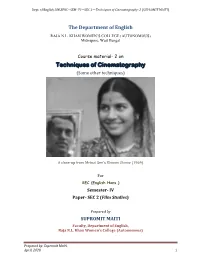
Dept. of English, RNLKWC--SEM- IV—SEC 2—Techniques of Cinematography: 2 (SUPROMIT MAITI) The Department of English RAJA N.L. KHAN WOMEN’S COLLEGE (AUTONOMOUS) Midnapore, West Bengal Course material- 2 on Techniques of Cinematography (Some other techniques) A close-up from Mrinal Sen’s Bhuvan Shome (1969) For SEC (English Hons.) Semester- IV Paper- SEC 2 (Film Studies) Prepared by SUPROMIT MAITI Faculty, Department of English, Raja N.L. Khan Women’s College (Autonomous) Prepared by: Supromit Maiti. April, 2020. 1 Dept. of English, RNLKWC--SEM- IV—SEC 2—Techniques of Cinematography: 2 (SUPROMIT MAITI) Techniques of Cinematography (Film Studies- Unit II: Part 2) Dolly shot Dolly shot uses a camera dolly, which is a small cart with wheels attached to it. The camera and the operator can mount the dolly and access a smooth horizontal or vertical movement while filming a scene, minimizing any possibility of visual shaking. During the execution of dolly shots, the camera is either moved towards the subject while the film is rolling, or away from the subject while filming. This process is usually referred to as ‘dollying in’ or ‘dollying out’. Establishing shot An establishing shot from Death in Venice (1971) by Luchino Visconti Establishing shots are generally shots that are used to relate the characters or individuals in the narrative to the situation, while contextualizing his presence in the scene. It is generally the shot that begins a scene, which shoulders the responsibility of conveying to the audience crucial impressions about the scene. Generally a very long and wide angle shot, establishing shot clearly displays the surroundings where the actions in the Prepared by: Supromit Maiti. -
The General Idea Behind Editing in Narrative Film Is the Coordination of One Shot with Another in Order to Create a Coherent, Artistically Pleasing, Meaningful Whole
Chapter 4: Editing Film 125: The Textbook © Lynne Lerych The general idea behind editing in narrative film is the coordination of one shot with another in order to create a coherent, artistically pleasing, meaningful whole. The system of editing employed in narrative film is called continuity editing – its purpose is to create and provide efficient, functional transitions. Sounds simple enough, right?1 Yeah, no. It’s not really that simple. These three desired qualities of narrative film editing – coherence, artistry, and meaning – are not easy to achieve, especially when you consider what the film editor begins with. The typical shooting phase of a typical two-hour narrative feature film lasts about eight weeks. During that time, the cinematography team may record anywhere from 20 or 30 hours of film on the relatively low end – up to the 240 hours of film that James Cameron and his cinematographer, Russell Carpenter, shot for Titanic – which eventually weighed in at 3 hours and 14 minutes by the time it reached theatres. Most filmmakers will shoot somewhere in between these extremes. No matter how you look at it, though, the editor knows from the outset that in all likelihood less than ten percent of the film shot will make its way into the final product. As if the sheer weight of the available footage weren’t enough, there is the reality that most scenes in feature films are shot out of sequence – in other words, they are typically shot in neither the chronological order of the story nor the temporal order of the film. -

Animation! [Page 8–9] 772535 293004 the TOWER 9> Playing in the Online Dark
9 euro | SPRING 2020 MODERN TIMES REVIEW THE EUROPEAN DOCUMENTARY MAGAZINE CPH:DOX THESSALONIKI DF ONE WORLD CINÉMA DU RÉEL Copenhagen, Denmark Thessaloniki, Greece Prague, Czech Paris, France Intellectually stimulating and emotionally engaging? [page 10–11] THE PAINTER AND THE THIEF THE PAINTER HUMAN IDFF MAJORDOCS BOOKS PHOTOGRAPHY Oslo, Norway Palma, Mallorca New Big Tech, New Left Cinema The Self Portrait; Dear Mr. Picasso Animation! [page 8–9] 772535 293004 THE TOWER 9> Playing in the online dark In its more halcyon early days, nature of these interactions. ABUSE: In a radical the internet was welcomed Still, the messages and shared psychosocial experiment, into households for its utopi- (albeit blurred for us) images an possibilities. A constantly are highly disturbing, the bra- the scope of online updating trove of searchable zenness and sheer volume of child abuse in the Czech information made bound en- the approaches enough to sha- Republic is uncovered. cyclopaedia sets all but obso- ke anyone’s trust in basic hu- lete; email and social media manity to the core («potential- BY CARMEN GRAY promised to connect citizens ly triggering» is a word applied of the world, no longer seg- to films liberally these days, Caught in the Net mented into tribes by physical but if any film warrants it, it is distance, in greater cultural un- surely this one). Director Vit Klusák, Barbora derstanding. The make-up artist recog- Chalupová In the rush of enthusiasm, nises one of the men and is Czech Republic, Slovakia the old truth was suspended, chilled to witness this behav- that tools are only as enlight- iour from someone she knows, ened as their users. -
The Speed of the VCR
Edinburgh Research Explorer The speed of the VCR Citation for published version: Davis, G 2018, 'The speed of the VCR: Ti West's slow horror', Screen, vol. 59, no. 1, pp. 41-58. https://doi.org/10.1093/screen/hjy003 Digital Object Identifier (DOI): 10.1093/screen/hjy003 Link: Link to publication record in Edinburgh Research Explorer Document Version: Peer reviewed version Published In: Screen Publisher Rights Statement: This is a pre-copyedited, author-produced PDF of an article accepted for publication in Screen following peer review. The version of record Glyn Davis; The speed of the VCR: Ti West’s slow horror, Screen, Volume 59, Issue 1, 1 March 2018, Pages 41–58 is available online at: https://doi.org/10.1093/screen/hjy003. General rights Copyright for the publications made accessible via the Edinburgh Research Explorer is retained by the author(s) and / or other copyright owners and it is a condition of accessing these publications that users recognise and abide by the legal requirements associated with these rights. Take down policy The University of Edinburgh has made every reasonable effort to ensure that Edinburgh Research Explorer content complies with UK legislation. If you believe that the public display of this file breaches copyright please contact openaccess@ed.ac.uk providing details, and we will remove access to the work immediately and investigate your claim. Download date: 28. Sep. 2021 The speed of the VCR: Ti West’s slow horror GLYN DAVIS In Ti West’s horror film The House of the Devil (2009), Samantha (Jocelin Donahue), a college student short of cash, takes on a babysitting job. -

AN UNEASY CONTRADICTION Surveying the Career of Edward Burtynsky by CAROL M CCUSKER
PANORAMIC AN UNEASY CONTRADICTION Surveying the career of Edward Burtynsky BY CAROL M CCUSKER OIL FIELDS #19 (DIPTYCH), BELRIDGE, CALIFORNIA, USA—2003 Our dependence on nature to provide the materials for our con - quarries, and uranium tailings. More recently, he has pho - This photographic trajectory, from the subtle to the shocking, says the photographer. “We are drawn by desire, a chance at sumption, and our concern for the health of our planet sets us into tographed landscapes we couldn’t imagine without his camera: is in sync with growing public awareness of critical land-use issues. good living, yet…the world is suffering for our success.” an uneasy contradiction. — Edward Burtynsky China’s relocation of millions of citizens to make way for the You could say that Ed Burtynsky and his audience have grown up Three Gorges Dam, E-waste recycling, tire dumps, and ship- together in mutual ecological consciousness, with the photogra - sing color film, a large format camera, positioning himself rom the mid-1980s to the present, photographer Edward breaking. For two decades, Burtynsky’s environmentally con - pher acting like Dickens’s “Ghost of Christmas Future,” revealing above his subject, often printing to a painterly size of 50x60 Burtynsky has made beautiful images of landscapes we’d scious photographs have grown from picturing quiet, seemingly the malevolent fruits of our collective consumption. “Between Uinches, with an eye for compositional beauty amid the Frather not see. He photographs sites that are essential to benign hillsides with houses and dogs to the flagrantly poi - attraction and repulsion, seduction and fear…these images are ruins, his photographs form a detailed archive of the present that our worldwide energy consumption: open-pit mines, refineries, sonous, in the red river tailings of Sudbury, Ontario. -
SCMS 2011 MEDIA CITIZENSHIP • Conference Program and Screening Synopses
SCMS 2011 MEDIA CITIZENSHIP • Conference Program and Screening Synopses The Ritz-Carlton, New Orleans • March 10–13, 2011 • SCMS 2011 Letter from the President Welcome to New Orleans and the fabulous Ritz-Carlton Hotel! On behalf of the Board of Directors, I would like to extend my sincere thanks to our members, professional staff, and volunteers who have put enormous time and energy into making this conference a reality. This is my final conference as SCMS President, a position I have held for the past four years. Prior to my presidency, I served two years as President-Elect, and before that, three years as Treasurer. As I look forward to my new role as Past-President, I have begun to reflect on my near decade-long involvement with the administration of the Society. Needless to say, these years have been challenging, inspiring, and expansive. We have traveled to and met in numerous cities, including Atlanta, London, Minneapolis, Vancouver, Chicago, Philadelphia, and Los Angeles. We celebrated our 50th anniversary as a scholarly association. We planned but unfortunately were unable to hold our 2009 conference at Josai University in Tokyo. We mourned the untimely death of our colleague and President-Elect Anne Friedberg while honoring her distinguished contributions to our field. We planned, developed, and launched our new website and have undertaken an ambitious and wide-ranging strategic planning process so as to better position SCMS to serve its members and our discipline today and in the future. At one of our first strategic planning sessions, Justin Wyatt, our gifted and hardworking consultant, asked me to explain to the Board why I had become involved with the work of the Society in the first place. -

1997 Sundance Film Festival Awards Jurors
1997 SUNDANCE FILM FESTIVAL The 1997 Sundance Film Festival continued to attract crowds, international attention and an appreciative group of alumni fi lmmakers. Many of the Premiere fi lmmakers were returning directors (Errol Morris, Tom DiCillo, Victor Nunez, Gregg Araki, Kevin Smith), whose earlier, sometimes unknown, work had received a warm reception at Sundance. The Piper-Heidsieck tribute to independent vision went to actor/director Tim Robbins, and a major retrospective of the works of German New-Wave giant Rainer Werner Fassbinder was staged, with many of his original actors fl own in for forums. It was a fi tting tribute to both Fassbinder and the Festival and the ways that American independent cinema was indeed becoming international. AWARDS GRAND JURY PRIZE JURY PRIZE IN LATIN AMERICAN CINEMA Documentary—GIRLS LIKE US, directed by Jane C. Wagner and LANDSCAPES OF MEMORY (O SERTÃO DAS MEMÓRIAS), directed by José Araújo Tina DiFeliciantonio SPECIAL JURY AWARD IN LATIN AMERICAN CINEMA Dramatic—SUNDAY, directed by Jonathan Nossiter DEEP CRIMSON, directed by Arturo Ripstein AUDIENCE AWARD JURY PRIZE IN SHORT FILMMAKING Documentary—Paul Monette: THE BRINK OF SUMMER’S END, directed by MAN ABOUT TOWN, directed by Kris Isacsson Monte Bramer Dramatic—HURRICANE, directed by Morgan J. Freeman; and LOVE JONES, HONORABLE MENTIONS IN SHORT FILMMAKING directed by Theodore Witcher (shared) BIRDHOUSE, directed by Richard C. Zimmerman; and SYPHON-GUN, directed by KC Amos FILMMAKERS TROPHY Documentary—LICENSED TO KILL, directed by Arthur Dong Dramatic—IN THE COMPANY OF MEN, directed by Neil LaBute DIRECTING AWARD Documentary—ARTHUR DONG, director of Licensed To Kill Dramatic—MORGAN J. -

Die Erfinderin Der Formen. Das Kino Von Chantal Akerman Hier/Da: Chantel Akermans Là-Bas Filmvorführung: Jeanne Dielman, 23 Quai Du Commerce, Antwerpen (2004–2011)
Donnerstag, 23. Mai 2019 Tel Aviv. Sie ist außerdem Kuratorin und Programmgestalterin für sität Frankfurt/M. und Mitglied des Exzellenclusters „Die Heraus- Mit Godard wird das Kino historisch, mit Chantal Akerman fängt es Alisa Lebow Docaviv, das Tel Aviv Documentary Film Festival. bildung normativer Ordnungen“. Jüngere Veröffentlichungen:Die neu an: Das Werk der belgischen Regisseurin, Installationskünstlerin und Distanz rahmen: News from Home Filmvorführung: Là-bas, B/F 2006, 78 min. Künste des Kinos, Frankfurt/M. 2013; Aktive Passivität. Über den Schriftstellerin Chantal Akerman ist eine ausführliche und vielgestaltige Vortrag in englischer Sprache Spielraum des Denkens, Handelns und anderer Künste, Frankfurt/M. Antwort auf die Frage, was im Kino jenseits der fast durchwegs männ- Chantal Akermans News from Home wird mitunter als Liebeserklä- 2014; Hollywood ignorieren. Vom Kino, Frankfurt/M. 2017; Nicht- lichen Helden-Geschichte von Griffith bis Hitchcock noch möglich ist, rung an ihre Mutter beschrieben, kann aber auch als Darstellung einer Donnerstag, 13. Juni 2019 rechthabenwollen. Gedankenspiele, Frankfurt/M. 2018. als deren Erben die Nouvelle Vague sich verstand. Akermans Filme wie Distanzerfahrung verstanden werden. Während die damals 27 Jahre Eva Kuhn Filmvorführung: De l’autre côté, F/B 2002, 103 min. Jeanne Dielman, 23 Quai du Commerce, 1080 Bruxelles, Je Tu Il alte Akerman die täglichen Briefe ihrer Mutter laut vorliest, sehen wir Vor und nach Jeanne Dielman Elle, D’est oder La captive sind im Kino ohne Vorbild und prägen mit Szenen aus einer gänzlich anderen Welt. Der Zwiespalt könnte kaum Donnerstag, 11. Juli 2019 ihren bahnbrechenden feministischen Sichtweisen seit ihrem Erscheinen offensichtlicher sein. Der Film ist zugleich ein Dokument einer sehr “It felt as though there was a before and after Jeanne Dielman Dieter Roelstraete die Ausdrucksmöglichkeiten des Films. -
Bibliography
BIBLIOGRAPHY An Jingfu (1994) The Pain of a Half Taoist: Taoist Principles, Chinese Landscape Painting, and King of the Children . In Linda C. Ehrlich and David Desser (eds.). Cinematic Landscapes: Observations on the Visual Arts and Cinema of China and Japan . Austin: University of Texas Press, 117–25. Anderson, Marston (1990) The Limits of Realism: Chinese Fiction in the Revolutionary Period . Berkeley: University of California Press. Anon (1937) “Yueyu pian zhengming yundong” [“Jyutpin zingming wandung” or Cantonese fi lm rectifi cation movement]. Lingxing [ Ling Sing ] 7, no. 15 (June 27, 1937): no page. Appelo, Tim (2014) ‘Wong Kar Wai Says His 108-Minute “The Grandmaster” Is Not “A Watered-Down Version”’, The Hollywood Reporter (6 January), http:// www.hollywoodreporter.com/news/wong-kar-wai-says-his-668633 . Aristotle (1996) Poetics , trans. Malcolm Heath (London: Penguin Books). Arroyo, José (2000) Introduction by José Arroyo (ed.) Action/Spectacle: A Sight and Sound Reader (London: BFI Publishing), vii-xv. Astruc, Alexandre (2009) ‘The Birth of a New Avant-Garde: La Caméra-Stylo ’ in Peter Graham with Ginette Vincendeau (eds.) The French New Wave: Critical Landmarks (London: BFI and Palgrave Macmillan), 31–7. Bao, Weihong (2015) Fiery Cinema: The Emergence of an Affective Medium in China, 1915–1945 (Minneapolis: University of Minnesota Press). Barthes, Roland (1968a) Elements of Semiology (trans. Annette Lavers and Colin Smith). New York: Hill and Wang. Barthes, Roland (1968b) Writing Degree Zero (trans. Annette Lavers and Colin Smith). New York: Hill and Wang. Barthes, Roland (1972) Mythologies (trans. Annette Lavers), New York: Hill and Wang. © The Editor(s) (if applicable) and The Author(s) 2016 203 G.