Howard Inaugural Formatted 140109
Total Page:16
File Type:pdf, Size:1020Kb
Load more
Recommended publications
-
TIDE Salon — Transcript PDF Accessible Text Descriptions and Transcription Produced by Harriet Smith Hughes
1 TIDE Salon — Transcript PDF Accessible text descriptions and transcription produced by Harriet Smith Hughes. Table of Contents Funder’s Introduction Landing Page Introduction to TIDE: by Nandini Das TIDE Salon Introduction Icons and Journey Map Website Footer TIDE Salon Credits Embarkation ‘Alien’ Keyword Alien — Final composition Alien — Keyword essay Alien — Project Archive First project Zoom — all participants Alien — Mid-composition Project WhatsApp Alien — Pre-composition Artist Research Alien — Artist’s experimentation, Zia Ahmed Alien — Post-composition Project Zoom Alien — Steven Savale reflects Alien — Artist Profiles Alien — Fragment by Preti Taneja Alien — Biography of Preti Taneja ‘Traveller’ Keyword Traveller — Final Composition Traveller — Keyword essay Traveller — Project Archive Traveller — Freeplay experiments Traveller — Acoustic live play Traveller — Collaboration WhatsApp 1 Traveller — Collaboration WhatsApp 2 Traveller — Artists’ Project Zoom Part 1 2 Traveller — Artists’ Project Zoom Part 2 Traveller — Post-composition Project Zoom Traveller — Shama Rahman reflects on the project Traveller — Artist Profiles Traveller — Fragment by Preti Taneja ‘Savage’ Keyword Savage — Final composition Savage — Keyword essay Savage — Project archive Savage — Artists’ Project Zoom Part 1 Savage — Ms Mohammed’s Experimentation and Live Takes Savage — Sarathy Korwar’s experimentation Savage — Artists’ Project Zoom Part 2 Savage — WhatsApp / Email Collaborations Savage — Post-composition Project Zoom Savage — Ms. Mohammed reflects on the process Savage — Artist Profiles Savage — Fragment by Preti Taneja Funder’s Introduction [Black background with text, headed by three logos: the TIDE logo; the Oxford University logo; and the ERC, European Research Council logo.] The TIDE project is funded by the European Research Council (ERC) under the European Union’s Horizon 2020 research and innovation programme (grant agreement no. -

ARIA Charts, 1993-01-10 to 1993-04-18
4 i Enjoy iian /21.'oril industty %s °clai!? m 1'3 A U S T R A L I A N SINGLES CHART ALBUMS CHART TW LW TI TITLE / ARTIST TW LW TI TITLE / ARTIST 1 1 6 I WILL ALWAYS LOVE YOU Whitney Houston A BMG 4321120654 *1 3 4 STILL THE 12TH MAN The Twelfth Man A2 EMI 8141392 *2 12 7 YOU DON'T TREAT ME NO GOOD Sonia Dada • FES C 12078 *2 10 11 TIMELESS (THE CLASSICS) Michael Bolton A COL/SONY 472302.2 3 2 14 END OF THE ROAD Boyz II Men A PDR/POL 8600644 3 1 10 ABBA GOLD • GREATEST HITS ABBA A2 PDR/POL 5172752 4 4 10 ACCIDENTLY KELLY STREET Frente A VVHUFES C 12063 *4 14 17 UNPLUGGED Eric Clapton A WARNER 9362450242 5 3 10 WOULD I LIE TO YOU? Charles & Eddie • EMI 8802284 *5 23 4 THE BODYGUARD Soundtrack BMG 7822186992 6 7 25 NOVEMBER RAIN Guns n' Roses A GEF/BMG GEFCS19067 6 7 6 MARVIN THE ALBUM Frente A WHI/FES D 93367 *7 18 7 DECEMBER 1963 (OH WHAT A NIGHT) The Four Seasons SONY 658441.8 7 5 9 THE ESSENTIAL COLLECTION Joe Cocker A EMI 7807572 8 5 20 ACHY BREAKY HEART Billy Ray Cyrus A2 PHON/POL 8640554 *8 16 10 COOLEYHIGHHARMONY Boyz II Men A PDR/POL 530 089-2 9 6 18 THE DAY YOU WENT AWAY Wendy Matthews • WARNER 4509905224 9 2 9 GLITTERING PRIZE 81.92 Simple Minds A VIR/EMI 7865082 10 10 9 TEQUILA A.L.T. -

Crossing Over: from Black Rhythm Blues to White Rock 'N' Roll
PART2 RHYTHM& BUSINESS:THE POLITICAL ECONOMY OF BLACKMUSIC Crossing Over: From Black Rhythm Blues . Publishers (ASCAP), a “performance rights” organization that recovers royalty pay- to WhiteRock ‘n’ Roll ments for the performance of copyrighted music. Until 1939,ASCAP was a closed BY REEBEEGAROFALO society with a virtual monopoly on all copyrighted music. As proprietor of the com- positions of its members, ASCAP could regulate the use of any selection in its cata- logue. The organization exercised considerable power in the shaping of public taste. Membership in the society was generally skewed toward writers of show tunes and The history of popular music in this country-at least, in the twentieth century-can semi-serious works such as Richard Rodgers and Lorenz Hart, Cole Porter, George be described in terms of a pattern of black innovation and white popularization, Gershwin, Irving Berlin, and George M. Cohan. Of the society’s 170 charter mem- which 1 have referred to elsewhere as “black roots, white fruits.’” The pattern is built bers, six were black: Harry Burleigh, Will Marion Cook, J. Rosamond and James not only on the wellspring of creativity that black artists bring to popular music but Weldon Johnson, Cecil Mack, and Will Tyers.’ While other “literate” black writers also on the systematic exclusion of black personnel from positions of power within and composers (W. C. Handy, Duke Ellington) would be able to gain entrance to the industry and on the artificial separation of black and white audiences. Because of ASCAP, the vast majority of “untutored” black artists were routinely excluded from industry and audience racism, black music has been relegated to a separate and the society and thereby systematically denied the full benefits of copyright protection. -
2007 Esol Project
2007 ESOL PROJECT http://www.bbc.co.uk/radio3/worldmusic/a4wm2007 1 www.myspace.com/bbcawardsforworldmusic Contents Introduction 3 Evaluation Form 4 Entry 3 Material 7 Entry 3 Answer Sheet 18 Entry 3 Lesson Plan 20 Level 1 Material 25 Level 1 Answer Sheet 38 Level 1 Lesson Plan 39 Level 2 Material 43 Level 2 Answer Sheet 50 Level 2 Lesson Plan 51 Extension Activities 56 http://www.bbc.co.uk/radio3/worldmusic/a4wm2007 2 www.myspace.com/bbcawardsforworldmusic Introduction Britain - a diverse society It is no accident that the term ‘world music’ was coined in a nation whose favourite dish is Chicken Tikka Masala; ever since Sir Francis Drake returned from the Americas with the now humble potato the UK has looked to the rest of the world to expand its culture, tastes and creativity. These days the ‘Golden Hind’ bobs in the swell of a well-earned retirement, a tourist attraction whose ‘golden’ years are spent as a memorial to world culture and exploration. Her voyage, which took three years, is now an anachronism, replaced by the modern galleons of the Internet, TV and more importantly the multiculturalism of British society. Reaching a diverse new audience Britain has a uniquely diverse nation. There is now an estimated minority ethnic population of more than 4 million, 7.1% of the population. Modern Britain is a home to communities from every corner of the globe; their plethoras of cultures, cuisines and skills have been an important force in Britain’s development socially, culturally and economically. Historically, the British world music audience has, in its ethnic make-up, been somewhat less diverse than the background picture of the UK. -
California State University, Northridge
CALIFORNIA STATE UNIVERSITY, NORTHRIDGE THE SPATIAL PRACTICES OF SOUL REBEL RADIO IN LOS ANGELES’ THIRD WORLD LEFT A thesis submitted in partial fulfillment of the requirements For the degree of Master of Arts Chicano and Chicana Studies By Miguel Paredes August 2012 The thesis of Miguel Paredes is approved: _________________________ ______________________ Professor Yreina D. Cervántez Date _________________________ ______________________ Dr. Gabriel Gutierrez Date _________________________ _______________________ Dr. David Rodriguez, Chair Date ii Dedication To the young people in Los Angeles, to the working class communities in the Third World Left throughout Southern California especially Elysian Valley aka “Frogtown” in Northeast LA, to the over 50 members of the Soul Rebel Radio collective especially the founding members Eduardo, Laura, Javier, Jose, Tito, Teresa, Hasmik, Jorge, XL, Travis, Oriel, and Lex, to the KPFK staff and audience, to the staff of the CSUN Chican@ Studies Department especially Dr. Rudy Acuña, Dr. Alberto Garcia, Harry Gamboa, Fermin Herrera, Dr. Mary Pardo, Dr. Gabriel Gutierrez, Yreina D. Cervántez, Dr. Jorge Garcia, Ruben Mendoza, and posthumously dedicated to Roberto Sifuentes , Dr. Shirlene Soto, and “Toppy” Flores. To my family especially my mother Lucila Paredes, my father Miguel Paredes Sr., my brother Adrian Paredes, my sister Gabriela Paredes and her daughter Dahlila and son Ivan, my brother Daniel Paredes, and his son Diego, to my best friends Mike and Guzman, to my godchildren Juliette, Justin, Isaac, Elia, and Ehecatl, and to the Fe@s including Pascual, Mixpe, and Chris, but particularly to Ixya Herrera for giving me the motivation and support to complete my Master’s Degree in Chican@ Studies. -

Bay Guardian | August 26 - September 1, 2009 ■
I Newsom screwed the city to promote his campaign for governor^ How hackers outwitted SF’s smart parking meters Pi2 fHB _ _ \i, . EDITORIALS 5 NEWS + CULTURE 8 PICKS 14 MUSIC 22 STAGE 40 FOOD + DRINK 45 LETTERS 5 GREEN CITY 13 FALL ARTS PREVIEW 16 VISUAL ART 38 LIT 44 FILM 48 1 I ‘ VOflj On wireless INTRODUCING THE BLACKBERRY TOUR BLACKBERRY RUNS BETTER ON AMERICA'S LARGEST, MOST RELIABLE 3G NETWORK. More reliable 3G coverage at home and on the go More dependable downloads on hundreds of apps More access to email and full HTML Web around the globe New from Verizon Wireless BlackBerryTour • Brilliant hi-res screen $ " • Ultra fast processor 199 $299.99 2-yr. price - $100 mail-in rebate • Global voice and data capabilities debit card. Requires new 2-yr. activation on a voice plan with email feature, or email plan. • Best camera on a full keyboard BlackBerry—3.2 megapixels DOUBLE YOUR BLACKBERRY: BlackBerry Storm™ Now just BUY ANY, GET ONE FREE! $99.99 Free phone 2-yr. price must be of equal or lesser value. All 2-yr. prices: Storm: $199.99 - $100 mail-in rebate debit card. Curve: $149.99 - $100 mail-in rebate debit card. Pearl Flip: $179.99 - $100 mail-in rebate debit card. Add'l phone $100 - $100 mail-in rebate debit card. All smartphones require new 2-yr. activation on a voice plan with email feature, or email plan. While supplies last. SWITCH TO AMERICA S LARGEST, MOST RELIABLE 3G NETWORK. Call 1.800.2JOIN.IN Click verizonwireless.com Visit any Communications Store to shop or find a store near you Activation fee/line: $35 ($25 for secondary Family SharePlan’ lines w/ 2-yr. -

Diasporic Music in a Time of War”: Pantomime Terrors
“Diasporic Music in a Time of War”: Pantomime Terrors John Hutnyk1 Centre for Cultural Studies at Goldsmiths, University of London I increasingly find it problematic to write analytically about “diaspora and music” at a time of war. It seems inconsequential; the culture industry is not much more than a distraction; a fairy tale diversion to make us forget a more sinister amnesia behind the stories we tell. This paper nonetheless takes up debates about cultural expression in the field of diasporic musics in Britain. It examines instances of creative engagement with, and destabilisation of, music genres by Fun^da^mental and Asian Dub Foundation, and it takes a broadly culture critique perspective on diasporic creativity as a guide to thinking about the politics of hip- hop in a time of war. Examples from music industry and media reportage of the work of these two bands pose both political provocation and a challenge to the seemingly unruffled facade of British civil society, particularly insofar as musical work might still be relevant to struggles around race and war. Here, at a time of what conservative critics call a ‘clash of civilizations’, I examine how music and authenticity become the core parameters for a limited and largely one-sided argument that seems to side-step political context in favour of sensationalised – entrenched – identities and a mythic, perhaps unworkable, ideal of cultural harmony that praises the most asinine versions of multiculturalism while demonizing those most able to bring it about. Here the idea that musical cultures are variously authentic, possessive or coherent must be questioned when issues of death and destruction are central, but ignored. -
A New Generation of Jazz from Japan Featuring Takuya Kuroda and Ensemble
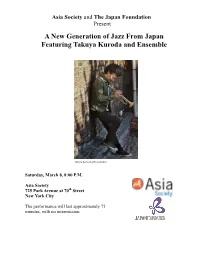
Asia Society and The Japan Foundation Present A New Generation of Jazz From Japan Featuring Takuya Kuroda and Ensemble Takuya Kuroda (Hiroyuki Seo) Saturday, March 8, 8:00 P.M. Asia Society 725 Park Avenue at 70th Street New York City The performance will last approximately 75 minutes, with no intermission. Asia Society and The Japan Foundation Present A New Generation of Jazz From Japan Featuring Takuya Kuroda and Ensemble THE ENSEMBLE: Takuya Kuroda, trumpet Rashaan Carter, bass Adam Jackson, drums Corey King, trombone Keita Ogawa, percussion Takeshi Ohbayashi, piano/keyboards ABOUT THE ARTISTS TAKUYA KURODA (TRUMPET) Japanese trumpeter Takuya Kuroda is a veteran and mainstay of the New York Jazz scene. A 2006 graduate of The New School’s Jazz and Contemporary Music Program, Takuya has performed alongside some of the best musicians (Junior Mance, Jose James, Greg Tardy, Andy Ezrin, Jiro Yoshida, Akoya Afrobeat, Valery Ponomarev Big Band) at some of the city’s most renowned live music venues including Radio City Music Hall, The Blue Note, The Village Underground, Sweet Rhythm, 55 Bar, and SOBs. RASHAAN CARTER (BASS) Rashaan Carter is entrenched in the New York jazz scene and has worked with Benny Golson, Curtis Fuller and Louis Hayes, Wallace Roney, Marc Cary, Cindy Blackman, Doug and Jean Carn, Antoine Roney, Sonny Simmons, and many more. ADAM JACKSON (DRUMS) Adam Jackson has had the pleasure of working with platinum recording group Destiny’s Child, Ciara, Grammy-nominated Emily King, Frank McComb and on the Tony Award winning musical Memphis. COREY KING (TROMBONE) Since his arrival in New York, Corey King has performed and/or recorded with notable artists such as Dave Binney, Dr. -

The A-Z of Brent's Black Music History
THE A-Z OF BRENT’S BLACK MUSIC HISTORY BASED ON KWAKU’S ‘BRENT BLACK MUSIC HISTORY PROJECT’ 2007 (BTWSC) CONTENTS 4 # is for... 6 A is for... 10 B is for... 14 C is for... 22 D is for... 29 E is for... 31 F is for... 34 G is for... 37 H is for... 39 I is for... 41 J is for... 45 K is for... 48 L is for... 53 M is for... 59 N is for... 61 O is for... 64 P is for... 68 R is for... 72 S is for... 78 T is for... 83 U is for... 85 V is for... 87 W is for... 89 Z is for... BRENT2020.CO.UK 2 THE A-Z OF BRENT’S BLACK MUSIC HISTORY This A-Z is largely a republishing of Kwaku’s research for the ‘Brent Black Music History Project’ published by BTWSC in 2007. Kwaku’s work is a testament to Brent’s contribution to the evolution of British black music and the commercial infrastructure to support it. His research contained separate sections on labels, shops, artists, radio stations and sound systems. In this version we have amalgamated these into a single ‘encyclopedia’ and added entries that cover the period between 2007-2020. The process of gathering Brent’s musical heritage is an ongoing task - there are many incomplete entries and gaps. If you would like to add to, or alter, an entry please send an email to hello@metrolandcultures.com 3 4 4 HERO An influential group made up of Dego and Mark Mac, who act as the creative force; Gus Lawrence and Ian Bardouille take care of business. -
Clyde Mcphatter 1987.Pdf
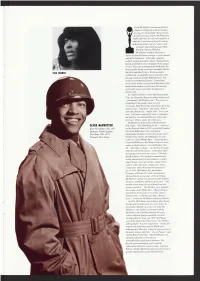
Clyde McPhatter was among thefirst | singers to rhapsodize about romance in gospel’s emotionally charged style. It wasn’t an easy stepfor McP hatter to make; after all, he was only eighteen, a 2m inister’s son born in North Carolina and raised in New Jersey, when vocal arranger and talent manager Billy | Ward decided in 1950 that I McPhatter would be the perfect choice to front his latest concept, a vocal quartet called the Dominoes. At the time, quartets (which, despite the name, often contained more than four members) were popular on the gospel circuit. They also dominated the R&B field, the most popular being decorous ensembles like the Ink Spots and the Orioles. Ward wanted to combine the vocal flamboyance of gospel with the pop orientation o f the R&B quartets. The result was rhythm and gospel, a sound that never really made it across the R &B chart to the mainstream audience o f the time but reached everybody’s ears years later in the form of Sixties soul. As Charlie Gillett wrote in The Sound of the City, the Dominoes began working instinctively - and timidly. McPhatter said, ' ‘We were very frightened in the studio when we were recording. Billy Ward was teaching us the song, and he’d say, ‘Sing it up,’ and I said, 'Well, I don’t feel it that way, ’ and he said, ‘Try it your way. ’ I felt more relaxed if I wasn’t confined to the melody. I would take liberties with it and he’d say, ‘That’s great. -
Reflections on the Mercury Music Prize in 2016, Simon Frith
View metadata, citation and similar papers at core.ac.uk brought to you by CORE provided by University of East Anglia digital repository Popular Music Interview with Simon Frith – Reflections on the Mercury Music Prize In 2016, Simon Frith stepped down as chair of the Mercury Music Prize (MMP), a post he had held for the 25 years since the Prize was founded in 1992. During this time, the MMP – awarded to the British and Irish album of the year - became an established part of the UK music industry’s annual cycle, helping to shape musical taste and business practice. Its credibility as a prize also made it the one that musicians wanted to win. While he was chair, Simon Frith wrote Performing Rites (1996), a book that analysed, among other things, the value attributed to music and the processes by which that value is determined. The MMP could be seen as a practical example of the ideas and arguments of the book. The Editorial Group of Popular Music invited Simon Frith to reflect on his time as chair of the MMP and on the link between this role and his academic interests. The interview was conducted by John Street. The conversation began with a question about the interests behind the MMP over its 25-year history. Simon Frith: The Mercury Prize was a marketing initiative of the music industry, through the British Phonographic Industry (BPI); it was a way of selling records. The BPI understood that if such a prize was going to work, it had to be seen as independent of the industry itself. -
Where to Next? a Dynamic Model of User Preferences
Where To Next? A Dynamic Model of User Preferences Francesco Sanna Passino∗ Lucas Maystre Dmitrii Moor Imperial College London Spotify Spotify fs4515@ic.ac.uk lucasm@spotify.com dmitriim@spotify.com Ashton Anderson† Mounia Lalmas University of Toronto Spotify ashton@cs.toronto.edu mounia@acm.org ABSTRACT 1 INTRODUCTION We consider the problem of predicting users’ preferences on on- Online platforms have transformed the way users access informa- line platforms. We build on recent findings suggesting that users’ tion, audio and video content, knowledge repositories, and much preferences change over time, and that helping users expand their more. Over three decades of research and practice have demon- horizons is important in ensuring that they stay engaged. Most strated that a) learning users’ preferences, and b) personalizing existing models of user preferences attempt to capture simulta- users’ experience to match these preferences is immensely valuable neous preferences: “Users who like 퐴 tend to like 퐵 as well”. In to increase engagement and satisfaction. To this end, recommender this paper, we argue that these models fail to anticipate changing systems have emerged as essential building blocks [3]. They help preferences. To overcome this issue, we seek to understand the users find their way through large collections of items and assist structure that underlies the evolution of user preferences. To this them in discovering new content. They typically build on user pref- end, we propose the Preference Transition Model (PTM), a dynamic erence models that exploit correlations across users’ preferences. model for user preferences towards classes of items. The model As an example within the music domain, if a user likes The Beatles, enables the estimation of transition probabilities between classes of that user might also like Simon & Garfunkel, because other users items over time, which can be used to estimate how users’ tastes are who listen to the former also listen to the latter.