Norfolk Street Wesleyan Chapel, Sheffield
Total Page:16
File Type:pdf, Size:1020Kb
Load more
Recommended publications
-

Unique Opportunity for Sale Springvale Chapel 400 Springvale Road Sheffield
UNIQUE OPPORTUNITY FOR SALE SPRINGVALE CHAPEL 400 SPRINGVALE ROAD SHEFFIELD S10 1LP Former Congregational Church, 400 Springvale Road, Crookes, S10 1LP Combined size of 9,645 sq ft Description The subject property comprises the former Crookes Congregational Church, dating from 1906 and designed by the well renowned architect of the time, William John Hale. The property was converted to offices use in the early 1990’s and has been updated and refurbished over time to provide a stunning working environment, benefitting from large, open plan areas as well as excellent natural light. The refurbishment preserved many of the original features of this Grade II Listed property, including stained glass windows, original domed ceiling and mezzanine gallery area. The offices also benefit from: ▪ Fully glazed meeting room ▪ Male, female and disabled WC’s ▪ Lower ground archive/storage ▪ Fitted kitchen area ▪ Reception area ▪ Break out areas ▪ Private car park Former Congregational Church, 400 Springvale Road, Crookes, S10 1LP Combined size of 9,645 sq ft Location The property is located on Springavle Road, which links Crookes and Commonside within the popular western suburbs of Sheffield. Crookes is a well established suburban retail pitch, providing an abundance of close by local amenities. Sheffield City Centre is also within close proximity, being under 1 mile to the east. Broomhill is located 0.5miles to the south, also providing a wealth of amenities such as coffee shops, restaurants and bars. The University of Sheffield’s campus and the Teaching Hospital’s campus, including The Royal Hallamshire Hospital, Sheffield Children’s Hospital and the Charles Clifford Hospital, are situated close by. -

Durham E-Theses
Durham E-Theses Watching Over one another in Love: Methodist Superintendents and Oversight in the Church COCKLING, IAN,NEIL How to cite: COCKLING, IAN,NEIL (2015) Watching Over one another in Love: Methodist Superintendents and Oversight in the Church , Durham theses, Durham University. Available at Durham E-Theses Online: http://etheses.dur.ac.uk/11372/ Use policy The full-text may be used and/or reproduced, and given to third parties in any format or medium, without prior permission or charge, for personal research or study, educational, or not-for-prot purposes provided that: • a full bibliographic reference is made to the original source • a link is made to the metadata record in Durham E-Theses • the full-text is not changed in any way The full-text must not be sold in any format or medium without the formal permission of the copyright holders. Please consult the full Durham E-Theses policy for further details. Academic Support Oce, Durham University, University Oce, Old Elvet, Durham DH1 3HP e-mail: e-theses.admin@dur.ac.uk Tel: +44 0191 334 6107 http://etheses.dur.ac.uk 2 Abstract Ian Neil Cockling Watching Over one another in Love: Methodist Superintendents and Oversight in the Church The thesis tests the claim that superintendent ministers in the Methodist Church of Great Britain exercise an effective ministry of personal oversight which is pivotal in the church’s life, and which makes a distinctive contribution to the Christian understanding of episkopé. The thesis describes empirical, exploratory research into the nature, operant practice and understanding of superintendency which was focused on the Newcastle upon Tyne District of the Methodist Church during 2011-2012. -

Proceedings W Esley Historical Society
Proceedings OF THE W esley Historical Society Editor: REv. JOHN C. BOWMER, M.A., B.D., Ph.D. Volume XXXIX October 1973 CAPTAIN THOMAS WEBB RETURNS To John Street Church, New York N Sunday, 3rd June 1973, Captain Thomas Webb returned to John Street United Methodist church, New York, in the 0 form of two physical trophies closely tied in to the concluding years of his life. The first was the memorial tablet which had been mounted in Portland Chapel, Bristol, soon after his death. The other was the original pastel portrait executed by Lewis Vasiet a few years before the Captain's decease.1 During his last years Thomas \V ebb lived in Bristol. He and his wife were very active in Methodist affairs-members of the society at John Wesley's chapel in the heart of the city-" The New Room in the Horsefair ".2 They appear to have resided in or near Portland Avenue, in the south·western sector of the city. The Captain be came convinced that a strong new society should be organized in the vicinity, and that a chapel could be provided for their worship. He gave himself sedulously to the project, securing an excellent site and erecting a chapel in Portland Place, although he himself could no longer make the financial contribution that his heart could have wished.8 Captain Webb died on 2oth December 1796, and was buried in Portland Chapel-in a vault below the recess in the sanctuary where stood the communion table. Mrs. Webb died early in January 182o, and she too was buried in the selfsame vault.4 1 For data on Lewis Vaslet, see footnote 9 on page 59· ~Archives of the New Room, Bristol. -

Gender and Family Networks in Victorian Sheffield
Graduate Theses, Dissertations, and Problem Reports 2020 Respectable Women, Ambitious Men: Gender and Family Networks in Victorian Sheffield Autumn Mayle aumayle@mix.wvu.edu Follow this and additional works at: https://researchrepository.wvu.edu/etd Part of the European History Commons, History of Gender Commons, History of Religion Commons, and the Women's History Commons Recommended Citation Mayle, Autumn, "Respectable Women, Ambitious Men: Gender and Family Networks in Victorian Sheffield" (2020). Graduate Theses, Dissertations, and Problem Reports. 7530. https://researchrepository.wvu.edu/etd/7530 This Dissertation is protected by copyright and/or related rights. It has been brought to you by the The Research Repository @ WVU with permission from the rights-holder(s). You are free to use this Dissertation in any way that is permitted by the copyright and related rights legislation that applies to your use. For other uses you must obtain permission from the rights-holder(s) directly, unless additional rights are indicated by a Creative Commons license in the record and/ or on the work itself. This Dissertation has been accepted for inclusion in WVU Graduate Theses, Dissertations, and Problem Reports collection by an authorized administrator of The Research Repository @ WVU. For more information, please contact researchrepository@mail.wvu.edu. Respectable Women, Ambitious Men: Gender and Family Networks in Victorian Sheffield Autumn Mayle Dissertation submitted to the Eberly College of Arts and Sciences at West Virginia University In partial fulfillment for the requirement for the degree of Doctorate in History Katherine Aaslestad, Ph. D., Chair Joseph Hodge, Ph. D. Matthew Vester, Ph. D. Marilyn Francus, Ph. -

The Separation of the Methodists from the Church of England a Historical Fact
mm J (f^atnell UninetBttg 9Itbtacg THE GIFT OF MS^^*^**-^ ""'""^"^ '""'^^^ BX8276 .T89 " ^^''^iMiiiffliiSliiiftifiiWiS"'"'''*'* f™"! 'He Ch Cornell University Library The original of this book is in the Cornell University Library. There are no known copyright restrictions in the United States on the use of the text. http://www.archive.org/details/cu31924029470683 iiilliliiiliiilimililii The Separation of the Methodists from the ^ ^ Church of England 1^ ^ BY ROBERT LEONARD TUCKER, M.A. ^1 ^ ^ ^ NEW YORK 1918 ^iiiiiiilillMPiliiiliiiiilililliliililBliii^ The Separation of the Methodists from the Church of England BY ROBERT LEONARD TUCKER, M.A. SUBMITTED IN PARTIAL FULFILLMENT OF THE REQUIREMENTS FOR THE DEGREE OF DOCTOR OF PHILOSOPHY COLUMBIA UNIVERSITY Printed for the Author by THE METHODIST BOOK CONCERN New York City igi8 A^io^^is Copyright, 1918, by R. L. TUCKER All Rights Reserved TO MY WIFE GRACE GREEN TUCKER MY MOTHER FANNIE ALLUM TUCKER MY FATHER JOHN TUCKER THREE METHODISTS WHOSE LIVES SHOW THAT NOBLEST SPIRIT OF TRUE RELIGION FAR MORE CLEARLY THAN ALL MY WORDS, THIS TASK IS DEDICATED CONTENTS PAGE Preface 7 Introduction 9 Chapter I. The Methodist View of Eighteenth Century Life 11 I. Methodist Dissatisfaction with the Customs and Religion of the Times 11 II. Methodist View of the Church and the Clergy 12 Chapter II. The Churchman's View of Eighteenth Century Life. 17 I. Enthusiasm 17 II. The Church View of Enthusiasm 23 III. Methodist Attempts to Check Extreme Enthusiasm 30 IV. Methodism and Mysticism 34 Chapter III. Methodist Doctrine 37 I. Original Sin 37 II. Justification by Faith 39 in. The New Birth 42 IV. -

Wesley Historical Society Editor: Rev
Proceedings OF THE Wesley Historical Society Editor: REv. JOHN C. BOWMER, M.A., B.D. Volume XXXIV March 1963 EDITORIAL HE commencement of another volume provides us with an opportunity to greet our readers, for our Society is essentially T a confraternity of unseen friends, with the Proceedings as the only tangible link between us all. This year of Grace, 1963, has dawned with the People called Methodists very much in the news. One could not write this Edit orial without some reference to the Report, just published, of the Conversations between the Methodists and the Church of England. As we are a society whose interests are primarily in history, it could be said that the Report is not our direct concern, and (what is prob ably more to the point) that even less is it our duty to comment upon it at this stage. At the same time, one has to acknowledge that it was our own particular history-viz. the relationship of Wesley and the early Methodists to the Church of England-that led to these Conversations taking place in the first instance. Certainly we be lieve that no true judgement can be passed upon them without some knowledge of that history, and we would like to think that some of the articles which have appeared in these pages-e.g. those on ordin ation-were more widely read in our Church. History surely has a word for the present. * * Two hundred years ago there passed from the Methodist scene that turbulent priest-one of the most colourful figures of the Revival -William Grimshaw. -
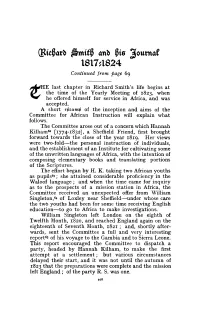
1817*1824 Continued from Page 69
(RtcfWb ^mtf$ anb 0te jjournaf 1817*1824 Continued from page 69 last chapter in Richard Smith's life begins at the time of the Yearly Meeting of 1823, when he offered himself for service in Africa, and was accepted. A short resume of the inception and aims of the Committee for African Instruction will explain what follows. The Committee arose out of a concern which Hannah Kilham6* [1774-1832], a Sheffield Friend, first brought forward towards the close of the year 1819. Her views were two-fold—the personal instruction of individuals, and the establishment of an Institute for cultivating some of the unwritten languages of Africa, with the intention of composing elementary books and translating portions of the Scriptures. The effort began by H. K. taking two African youths as pupils63; she attained considerable proficiency in the Waloof language ; and when the time came for inquiry as to the prospects of a mission station in Africa, the Committee received an unexpected offer from William Singleton,6* of Loxley near Sheffield—under whose care the two youths had been for some time receiving English education—to go to Africa to make investigations. William Singleton left London on the eighth of Twelfth Month, 1820, and reached England again on the eighteenth of Seventh Month, 1821 ; and, shortly after wards, sent the Committee a full and very interesting report6* of his voyage to the Gambia and to Sierra Leone. This report encouraged the Committee to dispatch a party, headed by Hannah Kilham, to make the first attempt at a settlement; but various circumstances delayed their start, and it was not until the autumn of 1823 that the preparations were complete and the mission left England ; of the party R. -

South Yorkshire
INDUSTRIAL HISTORY of SOUTH RKSHI E Association for Industrial Archaeology CONTENTS 1 INTRODUCTION 6 STEEL 26 10 TEXTILE 2 FARMING, FOOD AND The cementation process 26 Wool 53 DRINK, WOODLANDS Crucible steel 27 Cotton 54 Land drainage 4 Wire 29 Linen weaving 54 Farm Engine houses 4 The 19thC steel revolution 31 Artificial fibres 55 Corn milling 5 Alloy steels 32 Clothing 55 Water Corn Mills 5 Forging and rolling 33 11 OTHER MANUFACTUR- Windmills 6 Magnets 34 ING INDUSTRIES Steam corn mills 6 Don Valley & Sheffield maps 35 Chemicals 56 Other foods 6 South Yorkshire map 36-7 Upholstery 57 Maltings 7 7 ENGINEERING AND Tanning 57 Breweries 7 VEHICLES 38 Paper 57 Snuff 8 Engineering 38 Printing 58 Woodlands and timber 8 Ships and boats 40 12 GAS, ELECTRICITY, 3 COAL 9 Railway vehicles 40 SEWERAGE Coal settlements 14 Road vehicles 41 Gas 59 4 OTHER MINERALS AND 8 CUTLERY AND Electricity 59 MINERAL PRODUCTS 15 SILVERWARE 42 Water 60 Lime 15 Cutlery 42 Sewerage 61 Ruddle 16 Hand forges 42 13 TRANSPORT Bricks 16 Water power 43 Roads 62 Fireclay 16 Workshops 44 Canals 64 Pottery 17 Silverware 45 Tramroads 65 Glass 17 Other products 48 Railways 66 5 IRON 19 Handles and scales 48 Town Trams 68 Iron mining 19 9 EDGE TOOLS Other road transport 68 Foundries 22 Agricultural tools 49 14 MUSEUMS 69 Wrought iron and water power 23 Other Edge Tools and Files 50 Index 70 Further reading 71 USING THIS BOOK South Yorkshire has a long history of industry including water power, iron, steel, engineering, coal, textiles, and glass. -

Word & Deed — 06.2 — May 2004
A Publication of The Salvation Army Word & Deed Mission Statement: The purpose of the journal is to encourage and disseminate the thinking of Salvationists and other Christian colleagues on matters broadly related to the theology and ministry of The Salvation Army. The journal provides a means to understand topics central to the mission of The Salvation Army, inte grating the Army's theology and ministry in response to Christ's command to love God and our neighbor. Salvation Army Mission Statement: The Salvation Army, an international movement, is an evangelical part of the universal Christian Church. Its message is based on the Bible. Its ministry is motivated by the love of God. Its mission is to preach the gospel of Jesus Christ and to meet human needs in His name without discrimination. Editorial Address: Manuscripts, requests for style sheets, and other correspondence should be addressed to Lt. Colonel Marlene Chase at The Salvation Army, National Headquarters, 615 Slaters Lane, Alexandria, VA 22314. Phone: (703) 684-5500. Fax: (703) 684-5539. Email: marlene_chase@usn.salvationarmy.org. Editorial Policy: Contributions related to the mission of the journal will be encouraged, and at times there will be a general call for papers related to specific subjects. The Salvation Army is not responsible for every view which may be expressed in this journal. Manuscripts should be approximately 12-15 pages, including endnotes. Please submit the following: 1) three hard copies of the manuscript with the author's name (with rank and appointment if an officer) on the cover page only. This ensures objec tivity during the evaluation process. -
Early Methodism in Aberdeen
The Story Of Early Methodism in Aberdeen by ERNEST WILKINSON, M.A. Early Methodism in Aberdeen Foreword to this edition This copy of the original 1973 booklet was typed to a computer file in 2002. I have tried to keep as far as possible to the original formatting and layout. There are a few editorial additions, but these are signified by being written in italics. The original booklet was written by Ernest Wilkinson, who was one of the stewards at the Aberdeen Methodist Church. I think he was an accountant by profession, and the booklet was written to celebrate the centenary of the Crown Terrace building in 1973. Another addition on the back page of this electronic document to the original booklet is a table listing all the ministers appointed to the Aberdeen church from its beginnings. This is a copy of the hand-written document kept in the vestry, and updated every time there is a new minister appointed. A copy of this booklet was handed to me recently from someone unconnected with the present Methodist Church; I don’t know from where she got it. Howard Marshall knew Ernest Wilkinson, though I didn’t. He was apparently a Tax Inspector. I thought it sufficiently interesting to type it out so that others could read it, and let Mr. Wilkinson’s account survive a few more years. This booklet was produced to mark the centenary of Crown Terrace Methodist Church in 1973. This reprint is done at a time when the sanctuary area is being remodelled, the pews and pipe organ removed, and the floor levelled. -
Revised Thesis March 2014
This electronic thesis or dissertation has been downloaded from the King’s Research Portal at https://kclpure.kcl.ac.uk/portal/ Leadership and Oversight in British Methodism - whither episcope? Maunder, Stephen John Awarding institution: King's College London The copyright of this thesis rests with the author and no quotation from it or information derived from it may be published without proper acknowledgement. END USER LICENCE AGREEMENT Unless another licence is stated on the immediately following page this work is licensed under a Creative Commons Attribution-NonCommercial-NoDerivatives 4.0 International licence. https://creativecommons.org/licenses/by-nc-nd/4.0/ You are free to copy, distribute and transmit the work Under the following conditions: Attribution: You must attribute the work in the manner specified by the author (but not in any way that suggests that they endorse you or your use of the work). Non Commercial: You may not use this work for commercial purposes. No Derivative Works - You may not alter, transform, or build upon this work. Any of these conditions can be waived if you receive permission from the author. Your fair dealings and other rights are in no way affected by the above. Take down policy If you believe that this document breaches copyright please contact librarypure@kcl.ac.uk providing details, and we will remove access to the work immediately and investigate your claim. Download date: 27. Sep. 2021 Leadership and Oversight in British Methodism - whither episcope? Stephen J Maunder Thesis submitted for the Doctorate in Theology and Ministry King’s College, London 1 Acknowledgements and Thanks Throughout the six year DThMin process I have received financial support from the Methodist Church both centrally and from the South-East District and London District. -

SCARGILL, Thomas the Younger, of Sheffield
Updated 31 May 2003 1553 PARKYNE, Robert, of Sheffelde, written 1 May 1553, wife Alice PARKYNE*, daughter Alice PARKYNE “to have Closes the which I have by indenture of Richard HARTLEY during my yeares & my manor at my house”, Thomas CRISE? “my servant & his mother”. Supervisors/recorders; Thomas HOWSLAY, Edward COLLYE, H... HARTLAY, Edward PA...., & Richard WYGFALL. [Proved 5 Oct 1553, York]. 1556 PARKYNE, William, Wadsley, parish of Ecclesfield, written 17 Jul 1556. Beneficiaries: John WOODHEAD, £4 & his children Nicholas & Anne, 3s 4d each; sister Agnes, 4 marks; brother Nicholas PARKYN, £10; George, Anne & Margaret the children of brother Thomas PARKYN*, 3s 4d each; William HOBSONE, 6s 8d; godson Thomas HOBSONE, 3s 4d; Rauff HINGILL, a pair of hose. Supervisors; Richard PARKYN & John WOODHEAD. Witnesses: William HOBSONE, Richard PARKYNE, Rauff HINGILL, John WOODHEAD & Richard CONOP, priest. 1615 PARKIN, Robert, of Wadsley, Ecclesfield, written 10 May 1615. Beneficiaries: wife Anne & youngest son William, £11 in goods & money; which is owed by John WEBSTER of Owlerton, also the lease made by Francis BARBER, son William also to have the vice, glazer, axletrees, files & tongs; second son Robert PARKIN & son William to share the bellows, iron & also lease near Malin brigge; son-in-law Francis WARTER, £3; eldest son John PARKIN, 12d; children William, Elizabeth & Margaret, 12d each; wife Anne* to have rest. Supervisors; Thomas PARKIN of Owlerton & Henry TURNER. Witnesses: John CRESWICK & William DAWSON. 1632 PARKIN, John, Ecclesfield, written 1 Mar 1632. Beneficiaries: wife Emmott*; William SMITH, Robert SMITH, John SMITH, Thomas SMITH, Charles SMITH, Mary SMITH, Margaret SMITH, Emmott SMITH children of Charles SMITH; John PARKIN & William PARKIN; Thomas STONES, Robert STONES, Elizabeth STONES, Ellin STONES & Anne STONES children of Rauph STONES of High greene & his wife; Henry SMITH; poor of Ecclesfield.