Eastern Yiddish Toponyms of German Origin
Total Page:16
File Type:pdf, Size:1020Kb
Load more
Recommended publications
-
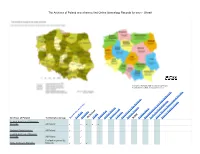
The Archives of Poland and Where to Find Online Genealogy Records for Each - Sheet1
The Archives of Poland and where to find Online Genealogy Records for each - Sheet1 This work is licensed under a Creative Commons Attribution-ShareAlike 3.0 Unported License Archives of Poland Territorial coverage Search theGenBaza ArchivesGenetekaJRI-PolandAGAD Przodek.plGesher Archeion.netGalicia LubgensGenealogyPoznan in the BaSIAProject ArchivesPomGenBaseSzpejankowskisPodlaskaUpper and Digital Szpejenkowski SilesianSilesian Library Genealogical Digital Library Society Central Archives of Historical Records All Poland ✓ ✓ ✓ ✓ ✓ National Digital Archive All Poland ✓ ✓ Central Archives of Modern Records All Poland ✓ ✓ Podlaskie (primarily), State Archive in Bialystok Masovia ✓ ✓ ✓ The Archives of Poland and where to find Online Genealogy Records for each - Sheet1 Branch in Lomza Podlaskie ✓ ✓ Kuyavian-Pomerania (primarily), Pomerania State Archive in Bydgoszcz and Greater Poland ✓ ✓ ✓ ✓ Kuyavian-Pomerania (primarily), Greater Branch in Inowrocław Poland ✓ ✓ ✓ ✓ Silesia (primarily), Świetokrzyskie, Łódz, National Archives in Częstochowa and Opole ✓ ✓ ✓ ✓ Pomerania (primarily), State Archive in Elbląg with the Warmia-Masuria, Seat in Malbork Kuyavian-Pomerania ✓ ✓ ✓ ✓ State Archive in Gdansk Pomerania ✓ ✓ ✓ ✓ Gdynia Branch Pomerania ✓ ✓ ✓ State Archive in Gorzow Lubusz (primarily), Wielkopolski Greater Poland ✓ ✓ ✓ Greater Poland (primarily), Łódz, State Archive in Kalisz Lower Silesia ✓ ✓ ✓ ✓ ✓ Silesia (primarily), State Archive in Katowice Lesser Poland ✓ ✓ ✓ ✓ Branch in Bielsko-Biala Silesia ✓ ✓ ✓ Branch in Cieszyn Silesia ✓ ✓ ✓ Branch -
The Consensus of Sandomierz: an Early Attempt to Create a Unified Protestant Church in 16Th Century Poland and Lithuania
CTQ 73 (2009): 317–346 The Consensus of Sandomierz : An Early Attempt to Create a Unified Protestant Church in 16 th Century Poland and Lithuania Darius Petkunas In early April 1570, representatives of the Reformed, Lutheran, and Bohemian Brethren Churches in Poland and Lithuania met in the city of Sandomierz for an extraordinary general synod. The purpose was to formulate a common confession which would symbolize the united faith and practice of the three churches to the crown and the parliament. The result was the formulation and acceptance of the Consensus of Sandomierz (Latin: Consensus Sendomiriensis) .1 The signing of the Consensus of Sandomierz has been regarded as a watershed event, unique not only in the history of the Polish and Lithuanian Churches, but in the Reformation era. It was here that, for the first time, representatives of three separate Protestant confessions with diverse theological and liturgical traditions stated that the chief obstacles in the way of church union had been overcome. They were now essentially united in faith, making intercommunion possible. Future efforts would make the realization of this unity evident to all. Never before had Lutherans been willing to concede so much in order to enter a consensus, even though there was no agreement on the essential sacramental issues. In the 1520s, Lutherans had even refused to enter into a military alliance with Zwinglian and other Reformed princes and territories to create a common defense in the face of what seemed to be an inevitable attack from Roman Catholic military forces. At Marburg in 1529, Luther and Ulrich Zwingli were unable to come to an agreement concerning the nature of Christ’s presence in the Sacrament of the Altar thereby dooming any possibility of a common Protestant front against the Roman Catholic Church. -

Translated by Stan Hanna
AUSTRIA-HUNGARY’S LAST WAR, 1914-1918 (ÖSTERREICH-UNGARNS LETZTER KRIEG, 1914-1918) EDITED BY THE AUSTRIAN FEDERAL MINISTRY OF THE ARMY AND WAR ARCHIVE Under the Direction of Edmund Glaise-Horstenau Edited by Josef Brauner, Eduard Czegka, Jaromir Diakow, Friedrich Franek, Rudolf Kiszling, Eduard Steinitz, and Ernst Wisshaupt Translated by Stan Hanna Vol 2 (1915) FROM THE BATTLE OF LIMANOWA-LAPANOW FINALE TO THE TAKE OF BREST-LITOWSK With 40 leaflets and 36 sketches 1931 Publisher of Military Science Releases Vienna © 2005 Stan Hanna. All Rights Reserved. Austria-Hungary’s Last War, 1914-1918 Vol 2 TABLE OF CONTENTS TO THE SECOND VOLUME (1915) I. The Situation at the End of 1914 and Start of 1915.............1 A. Summary of the Situation on the Various Fronts..........................1 B. Condition of Austria-Hungary's Land Forces..............................6 1. The soldiers and their equipment......................................6 2. The military leadership..............................................22 3. Morale...............................................................29 4. The national make-up of the Army.....................................32 II. THE CARPATHIAN WINTER, 1914-1915.............................53 A. The Pursuit of the Russians after Limanowa-Lapanow.....................53 1. The pursuit on 13 December is unsatisfactory; decisions of theleaders on both sides...........................................................53 2. Operations of 3rd and 4th Aus-Hung. Armies through 17 December.......56 3. The Russian retreat north of the Vistula (15-18 December)............63 B. The Last Actions of 1914...............................................67 1. Events south of the Vistula..........................................67 a. The Russians build a new front; Austro-Hungarian measures on 17 December..............................................................67 b. Actions at Tarnow and the Dunajec (18-20 December).................69 c. 3rd Army's offensive falters (18-20 December)......................72 d. -
The Role of Bohdan Khmelnytskyi and the Kozaks in the Rusin Struggle for Independence from the Polish-Lithuanian Commonwealth: 1648--1649
University of Windsor Scholarship at UWindsor Electronic Theses and Dissertations Theses, Dissertations, and Major Papers 1-1-1967 The role of Bohdan Khmelnytskyi and the Kozaks in the Rusin struggle for independence from the Polish-Lithuanian Commonwealth: 1648--1649. Andrew B. Pernal University of Windsor Follow this and additional works at: https://scholar.uwindsor.ca/etd Recommended Citation Pernal, Andrew B., "The role of Bohdan Khmelnytskyi and the Kozaks in the Rusin struggle for independence from the Polish-Lithuanian Commonwealth: 1648--1649." (1967). Electronic Theses and Dissertations. 6490. https://scholar.uwindsor.ca/etd/6490 This online database contains the full-text of PhD dissertations and Masters’ theses of University of Windsor students from 1954 forward. These documents are made available for personal study and research purposes only, in accordance with the Canadian Copyright Act and the Creative Commons license—CC BY-NC-ND (Attribution, Non-Commercial, No Derivative Works). Under this license, works must always be attributed to the copyright holder (original author), cannot be used for any commercial purposes, and may not be altered. Any other use would require the permission of the copyright holder. Students may inquire about withdrawing their dissertation and/or thesis from this database. For additional inquiries, please contact the repository administrator via email (scholarship@uwindsor.ca) or by telephone at 519-253-3000ext. 3208. THE ROLE OF BOHDAN KHMELNYTSKYI AND OF THE KOZAKS IN THE RUSIN STRUGGLE FOR INDEPENDENCE FROM THE POLISH-LI'THUANIAN COMMONWEALTH: 1648-1649 by A ‘n d r e w B. Pernal, B. A. A Thesis Submitted to the Department of History of the University of Windsor in Partial Fulfillment of the Requirements for the Degree of Master of Arts Faculty of Graduate Studies 1967 Reproduced with permission of the copyright owner. -

Family Planning Advice in State-Socialist Poland, 1950S–80S: Local and Transnational Exchanges
Med. Hist. (2020), vol. 64(2), pp. 240–266. c The Author(s), 2020. Published by Cambridge University Press doi:10.1017/mdh.2020.5 Family Planning Advice in State-Socialist Poland, 1950s–80s: Local and Transnational Exchanges SYLWIA KUZMA-MARKOWSKA´ 1 and AGATA IGNACIUK 2* 1American Studies Center, Institute of the Americas and Europe, Al. Niepodleglosci 22, 02-653 Warsaw, Poland 2Institute of Ethnology and Cultural Anthropology, Faculty of History, University of Warsaw, Zurawia˙ 4, 00-503 Warsaw, Poland Abstract: This paper scrutinises the relations between different models of family planning advice and their evolution in Poland between the mid-1950s and the late 1980s, focusing on their similarities and dissimilarities, conflicts and concordances. From 1956 onwards, the delivery of family planning advice became a priority for both the Polish Catholic Church and the party-state, especially its health authorities, which supported the foundation of the Society of Conscious Motherhood and aspired to mainstream birth control advice through the network of public well-woman clinics. As a consequence, two systems of family planning counselling emerged: the professional, secular family planning movement and Catholic pre-marital and marital counselling. We argue that reciprocal influence and emulation existed between state-sponsored and Catholic family planning in state-socialist Poland, and that both models used transnational organisations and debates relating to contraception for their construction and legitimisation. By evaluating the extent to which the strategies and practices for the delivery of birth control advice utilised by transnational birth control movements were employed in a ‘second world’ context such as Poland, we reveal unexpected supranational links that complicate and problematise historiographical and popular understandings of the Iron Curtain and Cold War Europe. -

S Y L a B U S
S Y L A B U S Course: CODE: Informatization of Civil Procedure Faculty: Wydział Prawa i Administracji (Faculty of Law and Administration) Form of Ye Semester Form of Course Hours the Exam ECTS ar 2021/2022 2 lecture 1 test 3 5 Teacher dr Karolina Ziemianin The Aims of the The aim of the course is to familiarize the student with the IT aspects of civil procedure. They cover in Course particular the issues of using IT tools during the trial and in the administration of justice. Prerequisites The student should have basic knowledge of substantive and procedural civil law. TEACHING EFFECT’S Category The effect’s descritpion KNOWLEDGE The student knows and distinguishes computer tools that are being used in the judicial and extrajudicial proceedings. The students knows the types of judicial and extrajudicial proceedings in the computer tools are used. The student typifies tasks of the judicial authorities in the field of creating and using computer tools in the jurisdiction. SKILLS The student solves problems described in simple cases. The student is able to properly use the available computers tools used in the judicial and extrajudicial proceedings. The student is able to prepare applications and pleadings in the proceedings that use computers tools. COMPETENCES The student is ready to undertake individual and team activities related to the administration of justice. The student is ready to identify with the tasks carried out in the practice of law with the use of tools to inform the administration of justice. STUDY CONTENT 1. Introduction to civil procedure – basic issues. 1 2. -

Chassidic Route. Ropczyce
Ropczyce THE CHASSIDIC ROUTE 02 | Ropczyce | introduction | 03 Foundation for the Preservation of Jewish Heritage in Poland was established in March ���� by the Dear Sirs, Union of Jewish Communities in Poland and the World Jewish Restitution Organization (WJRO). �is publication is dedicated to the history of the Jewish community of Ropczyce, and is a part Our mission is to protect and commemorate the surviving monuments of Jewish cultural of a series of pamphlets presenting history of Jews in the localities participating in the Chassidic heritage in Poland. �e priority of our Foundation is the protection of the Jewish cemeteries: in Route project, run by the Foundation for the Preservation of Jewish Heritage in Poland since ����. cooperation with other organizations and private donors we saved from destruction, fenced and �e Chassidic Route is a tourist route which follows the traces of Jews from southeastern Poland commemorated several of them (e.g. in Zakopane, Kozienice, Mszczonów, Kłodzko, Iwaniska, and, soon, from western Ukraine. �� localities, which have already joined the project and where Strzegowo, Dubienka, Kolno, Iłża, Wysokie Mazowieckie). �e actions of our Foundation cover the priceless traces of the centuries-old Jewish presence have survived, are: Baligród, Biłgoraj, also the revitalization of particularly important and valuable landmarks of Jewish heritage, e.g. the Chełm, Cieszanów, Dębica, Dynów, Jarosław, Kraśnik, Lesko, Leżajsk (Lizhensk), Lublin, Przemyśl, synagogues in Zamość, Rymanów and Kraśnik. Ropczyce, Rymanów, Sanok, Tarnobrzeg, Ustrzyki Dolne, Wielkie Oczy, Włodawa and Zamość. We do not limit our heritage preservation activities only to the protection of objects. It is equally �e Chassidic Route runs through picturesque areas of southeastern Poland, like the Roztocze important for us to broaden the public’s knowledge about the history of Jews who for centuries Hills and the Bieszczady Mountains, and joins localities, where one can find imposing synagogues contributed to cultural heritage of Poland. -

Gazeta Winter 2016
Chaim Goldberg, Purim Parade, 1993, oil painting on canvas Volume 23, No. 1 Gazeta Winter 2016 A quarterly publication of the American Association for Polish-Jewish Studies and Taube Foundation for Jewish Life & Culture Editorial & Design: Fay Bussgang, Julian Bussgang, Shana Penn, Vera Hannush, Alice Lawrence, Maayan Stanton, LaserCom Design. Front Cover Photo: Chaim Goldberg; Back Cover Photo: Esther Nisenthal Krinitz J.D. Kirszenbaum, Self-portrait, c. 1925, oil on canvas TABLE OF CONTENTS Message from Irene Pipes ............................................................................................... 1 Message from Tad Taube and Shana Penn ................................................................... 2 RESEARCH PROJECT The Holocaust in the Eyes of Polish Youth By Dr. Jolanta Ambrosewicz-Jacobs .................................................................................. 3 ART AS FAMILY LEGACY A Daughter Returns with Memories in Art By Bernice Steinhardt .......................................................................................................... 7 Resurrection of a Painter: “From Staszów to Paris, via Weimar, Berlin and Rio de Janeiro” By Nathan Diament ........................................................................................................... 12 Creating a New Museum in Kazimierz By Shalom Goldberg ......................................................................................................... 16 CONFERENCES, SPRING/SUMMER PROGRAMS, AND FESTIVALS Conference on Launch of Volume -

The Political Activity of Mazovian Dukes Between the 13Th and 15Th Century
The Person and the Challenges Volume 5 (2015) Number 1, p. 219–230 DOI: http://dx.doi.org/10.15633/pch.936 Waldemar Graczyk Cardinal StefanWyszynski University in Warsaw, Poland The Political Activity of Mazovian Dukes between the 13th and 15th Century Abstract According to some historians, Mazovia once had a separate political existence, with a different form of economy, a social structure and customs that differedfrom those of the Crown, a separate dialect, and its own laws. One of theoutward expressions of its separate existence was its own dynasty. To defend its independence, Mazovia entered into feudal contracts with Bohemia and Kazimierz III the Great. Mazovian dukes also paid homage to Władysław Jagiełło, not only as an acknowledgment of dependence, but also of certain obligations the dukes took upon themselves. After the death of Władysław Jagiełło, a group of Lesser Poland lords proposed the candidature of Siemowit V as king of Poland, and Mazovia had a chance to play a more significant role in Polish politics. It should be stressed that while Siemowit IV still enjoyed popularity on the political scene, his sons, particularly after they divided their patrimony among themselves in 1434, very soon lost significance. The period of the greatest regional disintegration of Mazovia began and the province soon lost any political significance. Keywords Mazovia; politics; dukes; alliances; law. Mazovia, situated in the middle Vistula region, was one of the provinces forming part of the early Piast state. In the beginning of the 11th century, Płock became the centre of a vast province and the state run by Miecław. -

Raport O Stanie Gminy Biecz Za 2018 Rok
RAPORT O STANIE GMINY BIECZ ZA 2018 ROK maj 2019 Spis treści I. Wprowadzenie II. Informacje ogólne III. Informacje finansowe A. Stan finansów B. Wykonanie wydatków inwestycyjnych/majątkowych C. Realizacja Funduszu Sołeckiego IV. Informacja o stanie mienia komunalnego V. Informacja o realizacji polityk, programów i strategii A. Strategia Rozwoju Lokalnego Gminy Biecz w perspektywie do 2025 roku B. Gminny program rewitalizacji C. Program gospodarowania mieszkaniowym zasobem gminy D. Plan wykorzystania zasobu nieruchomości gminnych E. Program opieki nad zabytkami F. Program Ochrony Powietrza z Planem Gospodarki Niskoemisyjnej dla Gminy Biecz G. Program ochrony środowiska H. Strategia Rozwiązywania Problemów Społecznych Gminy Biecz na lata 2016-2021 I. Gminny Program Wspierania Rodziny na lata 2016-2018 J. Gminny Program Przeciwdziałania Przemocy w Rodzinie oraz Ochrony Ofiar Przemocy w Rodzinie na lata 2017-2021 K. Świadczenie wychowawcze „Program 500+” L. Świadczenie „Dobry start” (Program 300+) Ł. Świadczenia rodzinne M. Projekty Regionalnego Programu Operacyjnego Województwa Małopolskiego N. Program „Pomoc państwa w zakresie dożywiania” O. Karta Dużej Rodziny i Biecka Karta Dużej Rodziny P. Program „Opieka 75 +” - usługi opiekuńcze R. Gminny Program Profilaktyki i Rozwiązywania Problemów Alkoholowych S. Gminny Program Przeciwdziałania Narkomanii na 2018 rok T. Program współpracy Gminy Biecz z organizacjami pozarządowymi U. Projekt Założeń do Planu Zaopatrzenia w Ciepło, Energię Elektryczną i Paliwa Gazowe V. Program usuwania wyrobów zawierających azbest z terenu gminy Biecz na lata 2013-2032 VI. Realizacja uchwał Rady Miejskiej VII. Współpraca z innymi społecznościami samorządowymi VIII. Część analityczna A. Ład przestrzenny B. Infrastruktura C. Oświata i edukacja D. Pomoc społeczna E. Kultura F. Funkcjonowanie administracji w liczbach IX. Podsumowanie X. -

Oto Opoka, a Na Niej Zbudowano - Kazimierz Dolny
GÓRNICTWO ODKRYWKOWE nr 1/2020 OTO OPOKA, A NA NIEJ ZBUDOWANO - KAZIMIERZ DOLNY HERE IS THE OPOKA ROCK - AND KAZIMIERZ DOLNY WAS BUILT ON IT Bogusław Bąk, Barbara Radwanek-Bąk - Państwowy Instytut Geologiczny-PIB Opoki i gezy są jednymi z charakterystycznych kopalin skalnych regionu lubelskiego. Skały te od dawna użytkowano tu, a także w regionie świętokrzyskim i łódzkim, w lokalnym budownictwie. Obecnie są one zapomniane, a ich znaczenie jest mar- ginalne. Liczne badania i praktyka, potwierdzają również przydatność obu kopalin jako surowca do produkcji cementu, w tym gatunków specjalnych. Po wojnie wykorzystywano opoki na znaczną skalę do regulacji Wisły, ale ich znaczenie jako kamieni budowlanych niemal zanikło. Niektóre opuszczone kamieniołomy opok i gez przekształcono w cenne geostanowiska. Takie obiekty dawnego, historycznego już dziś górnictwa skalnego można podziwiać zwłaszcza w Kazimierzu Dolnym i jego okoli- cach. Przypominają one o wielowiekowych tradycjach wykorzystania tych specyficznych kopalin oraz stanowią istotny element dokumentujący georóżnorodność regionu. W okolicach Kazimierza Dolnego, który leży w obrębie tzw. Małopolskiego przełomu Wisły znajdują się jeszcze inne interesujące obiekty geoturystyczne (zwłaszcza geomorfologiczne), a wśród nich wysokie skarpy doliny Wisły, piaszczyste łachy tworzące malownicze wyspy na rzece oraz dobrze wykształcone i zachowane wąwozy lessowe. Innym przejawem bogatej georóżnorodności tych okolic jest obecność wód mineralnych i zmineralizowanych, które wydobywa się w Nałęczowie zarówno dla celów leczniczych uzdrowiska, jak i do produkcji znanej wody „Nałęczowianka”. Słowa kluczowe: opoki, gezy, kamienie budowlane, górnictwo skalne, geostanowiska Opoka and gaize are one of the characteristic rocks in the Lublin region. These rocks have long been used here, as well as in the Świętokrzyskie and Łódź regions, in local construction. -

Raport O Stanie Gminy Pilzno Za 2020 Rok
RAPORT O STANIE GMINY PILZNO ZA 2020 ROK Urząd Miejski w Pilźnie ul. Rynek 6 39-220 Pilzno www.pilzno.um.gov.pl Strona | 2 Szanowni Mieszkańcy Gminy Pilzno, Pragnę zaprezentować Państwu Raport o stanie Gminy Pilzno za rok 2020 r., czyli dokument prezentujący kondycję gminy w jej najważniejszych obszarach. Dowiemy się z niego, jak wyglądają sprawy gminy między innymi w takich sferach jak: dochody i wydatki budżetowe, zadłużenie gminy, inwestycje, ochrona środowiska, kultura, funkcjonowanie spółki gminnej czy kształtowanie się liczby mieszkańców. Zachęcam zatem do uważnego zapoznania się z niniejszym opracowaniem, które pozwoli Państwu na wieloaspektowe spojrzenie na złożony organizm, jakim jest nasze miasto i gmina. Jednocześnie mam nadzieję, że poniższa publikacja stanie się punktem wyjścia dla do rozważań nad możliwościami ugruntowania zjawisk pozytywnych oraz sposobem niwelowania zjawisk negatywnych. Dziękuję za zaangażowanie w pracę na rzecz rozwoju gminy, za wszystkie opinie sugestie i uwagi. Ewa Gołębiowska Burmistrz Pilzna Strona | 3 Strona | 4 Spis treści Wstęp ................................................................................................................................................... 7 I. CHARAKTERYSTYKA GMINY PILZNO .............................................................................................. 9 I.1. Położenie i powierzchnia Gminy ...................................................................................................... 9 I.2. Władze lokalne i gminne jednostki organizacyjne ........................................................................