3 List of Free Blacks 6-2-9.Pdf
Total Page:16
File Type:pdf, Size:1020Kb
Load more
Recommended publications
-
Utopian Promise
Unit 3 UTOPIAN PROMISE Puritan and Quaker Utopian Visions 1620–1750 Authors and Works spiritual decline while at the same time reaffirming the community’s identity and promise? Featured in the Video: I How did the Puritans use typology to under- John Winthrop, “A Model of Christian Charity” (ser- stand and justify their experiences in the world? mon) and The Journal of John Winthrop (journal) I How did the image of America as a “vast and Mary Rowlandson, A Narrative of the Captivity and unpeopled country” shape European immigrants’ Restoration of Mrs. Mary Rowlandson (captivity attitudes and ideals? How did they deal with the fact narrative) that millions of Native Americans already inhabited William Penn, “Letter to the Lenni Lenapi Chiefs” the land that they had come over to claim? (letter) I How did the Puritans’ sense that they were liv- ing in the “end time” impact their culture? Why is Discussed in This Unit: apocalyptic imagery so prevalent in Puritan iconog- William Bradford, Of Plymouth Plantation (history) raphy and literature? Thomas Morton, New English Canaan (satire) I What is plain style? What values and beliefs Anne Bradstreet, poems influenced the development of this mode of expres- Edward Taylor, poems sion? Sarah Kemble Knight, The Private Journal of a I Why has the jeremiad remained a central com- Journey from Boston to New York (travel narra- ponent of the rhetoric of American public life? tive) I How do Puritan and Quaker texts work to form John Woolman, The Journal of John Woolman (jour- enduring myths about America’s -

The Original Lists of Persons of Quality, Emigrants, Religious Exiles, Political
Cornell University Library The original of tiiis book is in the Cornell University Library. There are no known copyright restrictions in the United States on the use of the text. http://www.archive.org/details/cu31924096785278 In compliance with current copyright law, Cornell University Library produced this replacement volume on paper that meets the ANSI Standard Z39.48-1992 to replace the irreparably deteriorated original. 2003 H^^r-h- CORNELL UNIVERSITY LIBRARY BOUGHT WITH THE INCOME OF THE SAGE ENDOWMENT FUND GIVEN IN 1891 BY HENRY WILLIAMS SAGE : ; rigmal ^ist0 OF PERSONS OF QUALITY; EMIGRANTS ; RELIGIOUS EXILES ; POLITICAL REBELS SERVING MEN SOLD FOR A TERM OF YEARS ; APPRENTICES CHILDREN STOLEN; MAIDENS PRESSED; AND OTHERS WHO WENT FROM GREAT BRITAIN TO THE AMERICAN PLANTATIONS 1600- I 700. WITH THEIR AGES, THE LOCALITIES WHERE THEY FORMERLY LIVED IN THE MOTHER COUNTRY, THE NAMES OF THE SHIPS IN WHICH THEY EMBARKED, AND OTHER INTERESTING PARTICULARS. FROM MSS. PRESERVED IN THE STATE PAPER DEPARTMENT OF HER MAJESTY'S PUBLIC RECORD OFFICE, ENGLAND. EDITED BY JOHN CAMDEN HOTTEN. L n D n CHATTO AND WINDUS, PUBLISHERS. 1874, THE ORIGINAL LISTS. 1o ihi ^zmhcxs of the GENEALOGICAL AND HISTORICAL SOCIETIES OF THE UNITED STATES OF AMERICA, THIS COLLECTION OF THE NAMES OF THE EMIGRANT ANCESTORS OF MANY THOUSANDS OF AMERICAN FAMILIES, IS RESPECTFULLY DEDICATED PY THE EDITOR, JOHN CAMDEN HOTTEN. CONTENTS. Register of the Names of all the Passengers from London during One Whole Year, ending Christmas, 1635 33, HS 1 the Ship Bonavatture via CONTENTS. In the Ship Defence.. E. Bostocke, Master 89, 91, 98, 99, 100, loi, 105, lo6 Blessing . -

Session 2 Home Ownership=Wealth Accumulation JCC Arts and Culture
12/17/2020 Session 2 Home Ownership=Wealth Accumulation 1 JCC Arts and Culture Program Lev Rothenberg Director of Arts and Education 2 1 12/17/2020 Welcome and More…. Rules of the Road: • So glad you are here! • 2 parts: Presentation + Conversation. • Everyone’s voice is important. • Jot down your questions/comments. • Mute during presentation. • Raise your HAND to be recognized. • Do NOT use Chat. It is disruptive. Thank You! 3 From Last Week Any “Aha” moments to share from last week’s discussion, “History of Racism”? 4 2 12/17/2020 What is Racism? • Racism is commonly defined as “Prejudice + Power. • Prejudice is used against someone based on his/her race. • Racism is a belief that certain racial groups are superior to others and have rights and power over others. Racism can be manifested through beliefs, policies, attitudes and actions by governments, organizations and individuals. 5 What Is Systemic Racism? • It is Prejudice expressed through the Power of governments, institutions, organizations, policies and laws. • Systemic, Structural and Institutional Racism are often used interchangeably. For our purposes. .We will use the term Systemic Racism. 6 3 12/17/2020 The “Other Story” Much of our country’s history is from a White perspective, but . There is Another Story about Free Blacks and their relationship with govt. institutions 7 Wealth Accumulation Reviewing sources of wealth. • Household items Crops • Slaves Livestock • Land Precious metals • Buildings/homes Currency – (later) • Stocks/securities (First in1790’s in Philadelphia) Enslaved Africans in America had NO wealth. They were considered a Source of wealth. 8 4 12/17/2020 Early Colonists We all know . -
Samuel Adams
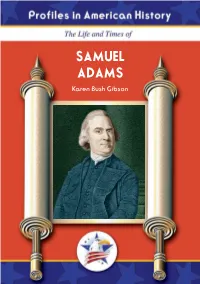
Monumental Milestones Milestones Monumental The Life and of Times samuel adams samuel adams Karen Bush Gibson The Life and Times of samuel Movement Rights Civil The adams Karen Bush Gibson As America’s first politician, Samuel Adams dedicated his life to improving the lives of the colonists. At a young age, he began talking and listening to people to find out what issues mattered the most. Adams proposed new ideas, first in his own newspaper, then in other newspapers throughout the colonies. When Britain began taxing the colonies, Adams encouraged boy- cotting and peaceful protests. He was an organizer of the Boston Tea Party, one of the main events leading up to the American Revolution. The British seemed intent on imprisoning Adams to keep him from speaking out, but he refused to stop. He was one of the first people to publicly declare that the colonies should be independent, and he worked tirelessly to see that they gained that independence. According to Thomas Jefferson, Samuel Adams was the Father of the Revolution. ISBN 1-58415-440-3 90000 9 PUBLISHERS 781584 154402 samueladamscover.indd 1 5/3/06 12:51:01 PM Copyright © 2007 by Mitchell Lane Publishers, Inc. All rights reserved. No part of this book may be reproduced without written permission from the publisher. Printed and bound in the United States of America. Printing 1 2 3 4 5 6 7 8 9 Library of Congress Cataloging-in-Publication Data Gibson, Karen Bush. The life and times of Samuel Adams/Karen Bush Gibson. p. cm. — (Profiles in American history) Includes bibliographical references and index. -

Cato, Roman Stoicism, and the American 'Revolution'
Cato, Roman Stoicism, and the American ‘Revolution’ Katherine Harper A thesis submitted in fulfilment of the requirements for the degree of Doctor of Philosophy. Arts Faculty, University of Sydney. March 27, 2014 For My Parents, To Whom I Owe Everything Contents Acknowledgements ......................................................................................................... i Abstract.......................................................................................................................... iv Introduction ................................................................................................................... 1 Chapter One - ‘Classical Conditioning’: The Classical Tradition in Colonial America ..................... 23 The Usefulness of Knowledge ................................................................................... 24 Grammar Schools and Colleges ................................................................................ 26 General Populace ...................................................................................................... 38 Conclusions ............................................................................................................... 45 Chapter Two - Cato in the Colonies: Joseph Addison’s Cato: A Tragedy .......................................... 47 Joseph Addison’s Cato: A Tragedy .......................................................................... 49 The Universal Appeal of Virtue ........................................................................... -

History of Hardin County, Illinois, 1939
http://stores.ebay.com/Ancestry-Found http://stores.ebay.com/Ancestry-Found UNIV jf\ ILLINOIS \*$Kfi , AI CHAMPAIGN- (JR. ANA ILLINOIS HISTORICAL SURVEY RKWHBHffi http://stores.ebay.com/Ancestry-Found STB* HISTORY OF HARDIN COUNTY, ILLINOIS WRITTEN BY The Historical Committee for the Centennial 19 3 9 PREFACE HARDIN County has contributed Largely to Illinois history' and we cannot fully comprehend the story of our beloved county unless we know someuYng of the trials and triumphs of the people who have given to Hardin County its prominence in the state and national affairs. It is the aim jf the authors to present the important facts in the history of Hardin County in chronological or- der and in a brief and tangible shape without making any attempt at rhetorical display. Grateful acknowledgements are due the Historical committee composed of the following persons: E. N. Hall, R. F. Taylor, A. A. Miles, Robert Gustin and Sidney Hainan for their untiring efforts in assembling and preparing the material and facts here presented. The history of Hardin County has been written as a part of the Centennial celebration which was observed on Thursday, March 2nd, 1939 by the opening of court in regular session with Circuit Judges Roy Pearce, W. Joe Hill and Blaine Huffman sitting in a body with County Judge James G. Gullett. The early history of the county from the date of organization up to July 4, 1876 as had been prepared by L. F. Twitchell, Franklin Dimick, John Vinyard, Elihu Oxford, Edward Shearer and John Mitch- ell was read and ordered to be made a permanent record of the Circuit Court and of the County Court of Hardin County that it might be preserved for succeeding gener- ations. -

Selected Bibliography of American History Through Biography
DOCUMENT RESUME ED 088 763 SO 007 145 AUTHOR Fustukjian, Samuel, Comp. TITLE Selected Bibliography of American History through Biography. PUB DATE Aug 71 NOTE 101p.; Represents holdings in the Penfold Library, State University of New York, College at Oswego EDRS PRICE MF-$0.75 HC-$5.40 DESCRIPTORS *American Culture; *American Studies; Architects; Bibliographies; *Biographies; Business; Education; Lawyers; Literature; Medicine; Military Personnel; Politics; Presidents; Religion; Scientists; Social Work; *United States History ABSTRACT The books included in this bibliography were written by or about notable Americans from the 16th century to the present and were selected from the moldings of the Penfield Library, State University of New York, Oswego, on the basis of the individual's contribution in his field. The division irto subject groups is borrowed from the biographical section of the "Encyclopedia of American History" with the addition of "Presidents" and includes fields in science, social science, arts and humanities, and public life. A person versatile in more than one field is categorized under the field which reflects his greatest achievement. Scientists who were more effective in the diffusion of knowledge than in original and creative work, appear in the tables as "Educators." Each bibliographic entry includes author, title, publisher, place and data of publication, and Library of Congress classification. An index of names and list of selected reference tools containing biographies concludes the bibliography. (JH) U S DEPARTMENT Of NIA1.114, EDUCATIONaWELFARE NATIONAL INSTITUTE OP EDUCATION THIS DOCUMENT HAS BEEN REPRO DUCED ExAC ICY AS RECEIVED FROM THE PERSON OR ORGANIZATIONORIGIN ATING IT POINTS OF VIEW OR OPINIONS STATED DO NOT NECESSARILYREPRE SENT OFFICIAL NATIONAL INSTITUTEOF EDUCATION POSITION OR POLICY PREFACE American History, through biograRhies is a bibliography of books written about 1, notable Americans, found in Penfield Library at S.U.N.Y. -
Annotated Bibliography -- Trailtones
Annotated Bibliography -- Trailtones Part Three: Annotated Bibliography Contents: Abdul, Raoul. Blacks in Classical Music. New York: Dodd, Mead and Company, 1977. [Mentions Tucson-born Ulysses Kay and his 'New Horizons' composition, performed by the Moscow State Radio Orchestra and cited in Pravda in 1958. His most recent opera was Margeret Walker's Jubilee.] Adams, Alice D. The Neglected Period of Anti-Slavery n America 1808-1831. Gloucester, Massachusetts: Peter Smith, 1964. [Charts the locations of Colonization groups in America.] Adams, George W. Doctors in Blue: the Medical History of the Union Army. New York: Henry Schuman, 1952. [Gives general information about the Civil War doctors.] Agee, Victoria. National Inventory of Documentary Sources in the United States. Teanack, New Jersey: Chadwick Healy, 1983. [The Black History collection is cited . Also found are: Mexico City Census counts, Arizona Indians, the Army, Fourth Colored Infantry, New Mexico and Civil War Pension information.] Ainsworth, Fred C. The War of the Rebellion Compilation of the Official Records of the Union and Confederate Armies. General Index. [Volumes I and Volume IV deal with Arizona.] Alwick, Henry. A Geography of Commodities. London: George G. Harrop and Co., 1962. [Tells about distribution of workers with certain crops, like sugar cane.] Amann, William F.,ed. Personnel of the Civil War: The Union Armies. New York: Thomas Yoseloff, 1961. [Gives Civil War genealogy of the Black Regiments that moved into Arizona from the United States Colored troops.] American Folklife Center. Ethnic Recordings in America: a Neglected Heritage. Washington: Library of Congress, 1982. [Talks of the Black Sacred Harping Singing, Blues & Gospel and Blues records of 1943- 66 by Mike Leadbetter.] American Historical Association Annual Report. -

Of the Friends 5 Historical Society
^^m ^^^^^^^m^ The Journal of the Friends 5 Historical Society VOLUME 52 NUMBER 3 1970 FRIENDS' HISTORICAL SOCIETY FRIENDS HOUSE • EUSTON ROAD • LONDON N.W.i also obtainable at Friends Book Store : 302 Arch Street, Philadelphia 6, Pa., U.S.A. Yearly 50? ($1.75) I Contents •AGE Editorial 157 -^m More First Publishers of Truth. Henry J. Cadbury . 159 Tracing the Influence of Sebastian Franck. Henry J. Cadbury 168 William Riley Barker's Milton and Friends. Andrew W. •• 170 The Circulating Yearly Meeting for the Northern Counties, 1699-1798. David M. Butler 192 The Christian Appeal of 1855: Friends' Public Response to the Crimean War. Stephen I : rick 203 Quakers in Early Twentieth-Century Scotland, will', n H. Marwick 211 The Quaker Collection, University of Lancaster Library. John S. Andrews 219 Research in Progress 220 Historical Research 221 Reports on Archives 222 Notes and Queries 225 Friends' Historical Society President: 1969—William H. Marwick 1970—Edwin B. Bronner 1971—Stephen C. Morland Chairman: Elfrida Vipont Foulds Secretary: Edward H. Milligan Joint Alfred W. Braithwaite and Editors: Russell S. Mortimer The Membership Subscription is 50p ($1.75) per annum (£10 Life Membership). Subscriptions should be paid to the Secretary, c/o The Library, Friends House, Euston Road, London N.W.i. Vol. 52 No. 3 1 97° THE JOURNAL OF THE FRIENDS' HISTORICAL SOCIETY Publishing Office: Friends House, Euston Road, London N.W. i. Communications should be addressed to the Editors at Friends House Editorial DWIN BRONNER'S Presidential Address to the Society, delivered at Exeter on Saturday, August 15, E1970, under the title: "The Other Branch: relationships between London Yearly Meeting and the Hicksites in the I9th century", is published separately. -
LIST of STATUES in the NATIONAL STATUARY HALL COLLECTION As of April 2017
history, art & archives | u. s. house of representatives LIST OF STATUES IN THE NATIONAL STATUARY HALL COLLECTION as of April 2017 STATE STATUE SCULPTOR Alabama Helen Keller Edward Hlavka Alabama Joseph Wheeler Berthold Nebel Alaska Edward Lewis “Bob” Bartlett Felix de Weldon Alaska Ernest Gruening George Anthonisen Arizona Barry Goldwater Deborah Copenhaver Fellows Arizona Eusebio F. Kino Suzanne Silvercruys Arkansas James Paul Clarke Pompeo Coppini Arkansas Uriah M. Rose Frederic Ruckstull California Ronald Wilson Reagan Chas Fagan California Junipero Serra Ettore Cadorin Colorado Florence Sabin Joy Buba Colorado John “Jack” Swigert George and Mark Lundeen Connecticut Roger Sherman Chauncey Ives Connecticut Jonathan Trumbull Chauncey Ives Delaware John Clayton Bryant Baker Delaware Caesar Rodney Bryant Baker Florida John Gorrie Charles A. Pillars Florida Edmund Kirby Smith Charles A. Pillars Georgia Crawford Long J. Massey Rhind Georgia Alexander H. Stephens Gutzon Borglum Hawaii Father Damien Marisol Escobar Hawaii Kamehameha I C. P. Curtis and Ortho Fairbanks, after Thomas Gould Idaho William Borah Bryant Baker Idaho George Shoup Frederick Triebel Illinois James Shields Leonard Volk Illinois Frances Willard Helen Mears Indiana Oliver Hazard Morton Charles Niehaus Indiana Lewis Wallace Andrew O’Connor Iowa Norman E. Borlaug Benjamin Victor Iowa Samuel Jordan Kirkwood Vinnie Ream Kansas Dwight D. Eisenhower Jim Brothers Kansas John James Ingalls Charles Niehaus Kentucky Henry Clay Charles Niehaus Kentucky Ephraim McDowell Charles Niehaus -
Barthé, Darryl G. Jr.Pdf
A University of Sussex PhD thesis Available online via Sussex Research Online: http://sro.sussex.ac.uk/ This thesis is protected by copyright which belongs to the author. This thesis cannot be reproduced or quoted extensively from without first obtaining permission in writing from the Author The content must not be changed in any way or sold commercially in any format or medium without the formal permission of the Author When referring to this work, full bibliographic details including the author, title, awarding institution and date of the thesis must be given Please visit Sussex Research Online for more information and further details Becoming American in Creole New Orleans: Family, Community, Labor and Schooling, 1896-1949 Darryl G. Barthé, Jr. Doctorate of Philosophy in History University of Sussex Submitted May 2015 University of Sussex Darryl G. Barthé, Jr. (Doctorate of Philosophy in History) Becoming American in Creole New Orleans: Family, Community, Labor and Schooling, 1896-1949 Summary: The Louisiana Creole community in New Orleans went through profound changes in the first half of the 20th-century. This work examines Creole ethnic identity, focusing particularly on the transition from Creole to American. In "becoming American," Creoles adapted to a binary, racialized caste system prevalent in the Jim Crow American South (and transformed from a primarily Francophone/Creolophone community (where a tripartite although permissive caste system long existed) to a primarily Anglophone community (marked by stricter black-white binaries). These adaptations and transformations were facilitated through Creole participation in fraternal societies, the organized labor movement and public and parochial schools that provided English-only instruction. -
Writing in First Person About the Atlantic Slave Trade Lesson Plan Grade Level: 6-8 Curriculum Focus: Grammar and Composition Lesson Duration: Three Class Periods
Writing in First Person about the Atlantic Slave Trade Lesson Plan Grade Level: 6-8 Curriculum Focus: Grammar and Composition Lesson Duration: Three class periods Student Objectives Discuss general information about the Atlantic slave trade. Review facts about the St. John revolt, and brainstorm a list of people involved in the rebellion. Write a personal account from the point of view of one person involved in the revolt. Materials Discovery School video on unitedstreaming: Slavery, Society, and Apartheid Search for this video by using the video title (or a portion of it) as the keyword. Selected clips that support this lesson plan: Slave Revolt Atlantic Slave Trade Apartheid Takes Hold The End of Apartheid Video on unitedstreaming: Slave Ship -. Search for this video by using the video title (or a portion of it) as the keyword. Selected clips that support this lesson plan: June, 1839: Singbeh Pieh (Joseph Cinqué) Leads a Slave Revolt Aboard the Amistad The Story of Olaudah Equiano Computer with Internet access Paper, pen or pencil Writing in First Person about the Atlantic Slave Trade 2 Lesson Plan Procedures 1. After watching the program, discuss the Atlantic slave trade. Begin by telling students that from 1500 to 1870, about 11 million Africans were captured and taken on ships to the Americas. Have students answer the following questions based on what they learned in the program: What was the triangular trade? (the slave trade connecting Africa, the Americas, and Europe) Why were slaves considered “black gold”? (They provided inexpensive labor for plantations in the Americas, making them valuable like gold.) Were the slaves always captured by Europeans? Explain.