Arch Sup 1 (Kristiansen)
Total Page:16
File Type:pdf, Size:1020Kb
Load more
Recommended publications
-
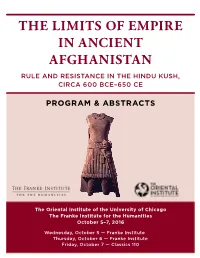
The Limits of Empire in Ancient Afghanistan Rule and Resistance in the Hindu Kush, Circa 600 BCE–650 CE
THE LIMITS OF EMPIRE IN ANCIENT AFGHANIStaN RULE AND RESISTANCE IN THE HINDU KUSH, CIRCA 600 BCE–650 CE PROGRAM & ABSTRACTS The Oriental Institute of the University of Chicago The Franke Institute for the Humanities October 5–7, 2016 Wednesday, October 5 — Franke Institute Thursday, October 6 — Franke Institute Friday, October 7 — Classics 110 THE LIMITS OF EMPIRE IN ANCIENT AFGHANIStaN RULE AND RESISTANCE IN THE HINDU KUSH, CIRCA 600 BCE–650 CE Organized by Gil J. Stein and Richard Payne The Oriental Institute — The University of Chicago Co-sponsored by the Oriental Institute and the Franke Institute for the Humanities — The University of Chicago PROGRAM WEDNESDAY, OCTOBER 5, 2016 — Franke InsTITUTE KEYNOTE LECTURE 5:00 Thomas Barfield “Afghan Political Ecologies: Past and Present” THURSDAY, OCTOBER 6, 2016 — Franke InsTITUTE 8:00–8:30 Coffee 8:30–9:00 Introductory Comments by Gil Stein and Richard Payne SESSION 1: aCHAEMENIDS AND AFTER 9:00–9:45 Matthew W. Stolper “Achaemenid Documents from Arachosia and Bactria: Administration in the East, Seen from Persepolis” 9:45–10:30 Matthew Canepa “Reshaping Eastern Iran’s Topography of Power after the Achaemenids” 10:30–11:00 Coffee Break Cover image. Headless Kushan statue (possibly Kanishka). Uttar Pradesh, India. 2nd–3rd century CE Sandstone 5’3” Government Museum, Mathura. Courtesy Google LIMITS OF EMPIRE 3 SESSION 2: HELLENISTIC AND GRECO-BACTRIAN REGIMES 11:00–11:45 Laurianne Martinez-Sève “Greek Power in Hellenistic Bactria: Control and Resistance” 11:45–12:30 Osmund Bopearachchi “From Royal Greco-Bactrians to Imperial Kushans: The Iconography and Language of Coinage in Relation to Diverse Ethnic and Religious Populations in Central Asia and India” 12:30–2:00 Break SESSIOn 3: KUSHAN IMPERIALISM: HISTORY AND PHILOLOGY 2:00–2:45 Christopher I. -

Germanic Origins from the Perspective of the Y-Chromosome
Germanic Origins from the Perspective of the Y-Chromosome By Michael Robert St. Clair A dissertation submitted in partial satisfaction of the requirements for the degree of Doctor in Philosophy in German in the Graduate Division of the University of California, Berkeley Committee in charge: Irmengard Rauch, Chair Thomas F. Shannon Montgomery Slatkin Spring 2012 Abstract Germanic Origins from the Perspective of the Y-Chromosome by Michael Robert St. Clair Doctor of Philosophy in German University of California, Berkeley Irmengard Rauch, Chair This dissertation holds that genetic data are a useful tool for evaluating contemporary models of Germanic origins. The Germanic languages are a branch of the Indo-European language family and include among their major contemporary representatives English, German, Dutch, Danish, Swedish, Norwegian and Icelandic. Historically, the search for Germanic origins has sought to determine where the Germanic languages evolved, and why the Germanic languages are similar to and different from other European languages. Both archaeological and linguist approaches have been employed in this research direction. The linguistic approach to Germanic origins is split among those who favor the Stammbaum theory and those favoring language contact theory. Stammbaum theory posits that Proto-Germanic separated from an ancestral Indo-European parent language. This theoretical approach accounts for similarities between Germanic and other Indo- European languages by posting a period of mutual development. Germanic innovations, on the other hand, occurred in isolation after separation from the parent language. Language contact theory posits that Proto-Germanic was the product of language convergence and this convergence explains features that Germanic shares with other Indo-European languages. -

Ancient Iranian Nomads in Western Central Asia
ISBN 978-92-3-102846-5 ANCIENT IRANIAN NOMADS IN. 1 ANCIENT IRANIAN NOMADS IN WESTERN CENTRAL ASIA* A. Abetekov and H. Yusupov Contents Literary sources on the ancient Iranian nomads of Central Asia ............ 25 Society and economy of the Iranian nomads of Central Asia .............. 26 Culture of the Iranian nomads of Central Asia ..................... 29 The territory of Central Asia, which consists of vast expanses of steppe-land, desert and semi-desert with fine seasonal pastures, was destined by nature for the development of nomadic cattle-breeding. Between the seventh and third centuries b.c. it was inhabited by a large number of tribes, called Scythians by the Greeks, and Sakas by the Persians. The history of the Central Asian nomads is inseparable from that of the nomadic and semi-nomadic peoples of the Eurasian steppe zone. Their political and economic life was closely linked, and their material culture had much in common. It should also be noted that, despite their distinctive qualities, the nomadic tribes were closely connected with the agricultural population of Central Asia. In fact, the history and movements of these nomadic tribes and the settled population cannot be considered in isolation; each had its impact on the other, and this interdependence must be properly understood. * See Map 1. 24 ISBN 978-92-3-102846-5 Literary sources on the ancient Iranian. Literary sources on the ancient Iranian nomads of Central Asia The term ‘Tura’¯ 1 is the name by which the Central Asian nomadic tribes were in one of the earliest parts of the Avesta. The Turas¯ are portrayed as enemies of the sedentary Iranians and described, in Yašt XVII (prayer to the goddess Aši), 55–6, as possessing fleet-footed horses.2 As early as 641 or 640 b.c. -
Bronze Age Settlement Patterns and the Development of Complex Societies in the Southern Ural Steppes (3500-1400 Bc)
BRONZE AGE SETTLEMENT PATTERNS AND THE DEVELOPMENT OF COMPLEX SOCIETIES IN THE SOUTHERN URAL STEPPES (3500-1400 BC) by Denis V. Sharapov, PhD B.S., University of Colorado at Colorado Springs, 2006 M.A., Georgia State University, 2008 M.A., Georgia State University, 2011 Submitted to the Graduate Faculty of the Kenneth P. Dietrich School of Arts and Sciences in partial fulfillment of the requirements for the degree of Doctor of Philosophy University of Pittsburgh 2017 UNIVERSITY OF PITTSBURGH DIETRICH SCHOOL OF ARTS AND SCIENCES This dissertation was presented by Denis V. Sharapov It was defended on April 14, 2017 and approved by Francis Allard, Associate Professor, Department of Anthropology, Indiana University of Pennsylvania Loukas Barton, Assistant Professor, Department of Anthropology, University of Pittsburgh Marc Bermann, Associate Professor, Department of Anthropology, University of Pittsburgh Dissertation Advisor: Robert D. Drennan, Distinguished Professor, Department of Anthropology, University of Pittsburgh ii Copyright © by Denis V. Sharapov 2017 iii BRONZE AGE SETTLEMENT PATTERNS AND THE DEVELOPMENT OF COMPLEX SOCIETIES IN THE SOUTHERN URAL STEPPES (3500-1400 BC) Denis V. Sharapov, PhD University of Pittsburgh, 2017 The ethnohistorical record of the Eurasian steppes points to the long-term predominance of extensive herding economies, associated with low population densities and high levels of geographic mobility. Consequently, investigations of early forms of complex socio-political organization in this region have thus far been primarily focused on Bronze Age (ca. 3500 - 1000 BC) funerary and ceremonial monuments, which presumably served as aggregation points for dispersed populations. When it comes to settlement pattern evidence, researchers claim that traditional models of regional-scale demographic organization, developed in the context of settled societies, cannot be applied to the early complex communities of the steppes. -
Linguistics Development Team
Development Team Principal Investigator: Prof. Pramod Pandey Centre for Linguistics / SLL&CS Jawaharlal Nehru University, New Delhi Email: pkspandey@yahoo.com Paper Coordinator: Prof. K. S. Nagaraja Department of Linguistics, Deccan College Post-Graduate Research Institute, Pune- 411006, ksnagaraja2006@gmail.com Content Writer: Prof. K. S. Nagaraja Prof H. S. Ananthanarayana Content Reviewer: Retd Prof, Department of Linguistics Osmania University, Hyderabad 500007 Paper : Historical and Comparative Linguistics Linguistics Module : Indo-Aryan Language Family Description of Module Subject Name Linguistics Paper Name Historical and Comparative Linguistics Module Title Indo-Aryan Language Family Module ID Lings_P7_M1 Quadrant 1 E-Text Paper : Historical and Comparative Linguistics Linguistics Module : Indo-Aryan Language Family INDO-ARYAN LANGUAGE FAMILY The Indo-Aryan migration theory proposes that the Indo-Aryans migrated from the Central Asian steppes into South Asia during the early part of the 2nd millennium BCE, bringing with them the Indo-Aryan languages. Migration by an Indo-European people was first hypothesized in the late 18th century, following the discovery of the Indo-European language family, when similarities between Western and Indian languages had been noted. Given these similarities, a single source or origin was proposed, which was diffused by migrations from some original homeland. This linguistic argument is supported by archaeological and anthropological research. Genetic research reveals that those migrations form part of a complex genetical puzzle on the origin and spread of the various components of the Indian population. Literary research reveals similarities between various, geographically distinct, Indo-Aryan historical cultures. The Indo-Aryan migrations started in approximately 1800 BCE, after the invention of the war chariot, and also brought Indo-Aryan languages into the Levant and possibly Inner Asia. -
Babylonian Populations, Servility, and Cuneiform Records
Journal of the Economic and Social History of the Orient 60 (2017) 715-787 brill.com/jesh Babylonian Populations, Servility, and Cuneiform Records Jonathan S. Tenney Cornell University tenney@cornell.edu Abstract To date, servility and servile systems in Babylonia have been explored with the tradi- tional lexical approach of Assyriology. If one examines servility as an aggregate phe- nomenon, these subjects can be investigated on a much larger scale with quantitative approaches. Using servile populations as a point of departure, this paper applies both quantitative and qualitative methods to explore Babylonian population dynamics in general; especially morbidity, mortality, and ages at which Babylonians experienced important life events. As such, it can be added to the handful of publications that have sought basic demographic data in the cuneiform record, and therefore has value to those scholars who are also interested in migration and settlement. It suggests that the origins of servile systems in Babylonia can be explained with the Nieboer-Domar hy- pothesis, which proposes that large-scale systems of bondage will arise in regions with * This was written in honor, thanks, and recognition of McGuire Gibson’s efforts to impart a sense of the influence of aggregate population behavior on Mesopotamian development, notably in his 1973 article “Population Shift and the Rise of Mesopotamian Civilization”. As an Assyriology student who was searching texts for answers to similar questions, I have occasionally found myself in uncharted waters. Mac’s encouragement helped me get past my discomfort, find the data, and put words on the page. The necessity of assembling Mesopotamian “demographic” measures was something made clear to me by the M.A.S.S. -
Test-Booklet
Test No: 2 Date: 12.01.2019 Max. Marks: 250 Max. Time 3 Hours ANTHROPOLOGY- ALL INDIA TEST SERIES ARCHEOLOGY, GENERAL ANTHROPOLOGY PAPER-1, CHAPTERS- 1.1 to 1.8 & PAPER-2, CHAPTERS- 1.1 to 1.3 KEY 1a. Visual Anthropology • Visual anthropologists look at the visual aspects of a culture, such as art and media, and are also interested in how anthropological data can be represented visually, • Visual anthropologists are concerned with both the visual aspects of culture and using media to present data visually. • study a wide range of cultural aspects, including art, dance, ritual, jewelry, body adornments; also intersects with archaeology in the study of prehistoric art, such as cave paintings • Visual anthropology is a subfield of social anthropology that is concerned, in part, with the study and production of ethnographic photography, film and, since the mid-1990s, new media. More recently it has been used by historians of science and visual culture. • study of all visual representations such as dance and other kinds of performance, museums and archiving, all visual arts, and the production and reception of mass media. • research topics include sand paintings, tattoos, sculptures and reliefs, cave paintings, scrimshaw, jewelry, hieroglyphics, paintings and photographs • Displaying data visually presents unique advantages that aren't always found through writing. For example, something as detailed and visually-focused as a dance is easily conveyed through a video, where the viewer can get a sometimes stronger sense of the experience • So-called "collecting clubs" included the British anthropologists Edward Burnett Tylor, Alfred Cort Haddon, and Henry Balfour, who exchanged and shared photographs as part of an attempt to document and classify ethnographic "races." • Bateson and Mead took more than 25,000 photos while conducting research in Bali, and published 759 photographs to support and develop their ethnographic observations. -

Bibliography
Bibliography Many books were read and researched in the compilation of Binford, L. R, 1983, Working at Archaeology. Academic Press, The Encyclopedic Dictionary of Archaeology: New York. Binford, L. R, and Binford, S. R (eds.), 1968, New Perspectives in American Museum of Natural History, 1993, The First Humans. Archaeology. Aldine, Chicago. HarperSanFrancisco, San Francisco. Braidwood, R 1.,1960, Archaeologists and What They Do. Franklin American Museum of Natural History, 1993, People of the Stone Watts, New York. Age. HarperSanFrancisco, San Francisco. Branigan, Keith (ed.), 1982, The Atlas ofArchaeology. St. Martin's, American Museum of Natural History, 1994, New World and Pacific New York. Civilizations. HarperSanFrancisco, San Francisco. Bray, w., and Tump, D., 1972, Penguin Dictionary ofArchaeology. American Museum of Natural History, 1994, Old World Civiliza Penguin, New York. tions. HarperSanFrancisco, San Francisco. Brennan, L., 1973, Beginner's Guide to Archaeology. Stackpole Ashmore, w., and Sharer, R. J., 1988, Discovering Our Past: A Brief Books, Harrisburg, PA. Introduction to Archaeology. Mayfield, Mountain View, CA. Broderick, M., and Morton, A. A., 1924, A Concise Dictionary of Atkinson, R J. C., 1985, Field Archaeology, 2d ed. Hyperion, New Egyptian Archaeology. Ares Publishers, Chicago. York. Brothwell, D., 1963, Digging Up Bones: The Excavation, Treatment Bacon, E. (ed.), 1976, The Great Archaeologists. Bobbs-Merrill, and Study ofHuman Skeletal Remains. British Museum, London. New York. Brothwell, D., and Higgs, E. (eds.), 1969, Science in Archaeology, Bahn, P., 1993, Collins Dictionary of Archaeology. ABC-CLIO, 2d ed. Thames and Hudson, London. Santa Barbara, CA. Budge, E. A. Wallis, 1929, The Rosetta Stone. Dover, New York. Bahn, P. -

The Iranian Reflexes of Proto-Iranian *Ns
The Iranian Reflexes of Proto-Iranian *ns Martin Joachim Kümmel, Friedrich-Schiller-Universität Jena martin-joachim.kuemmel@uni-jena.de Abstract1 The obvious cognates of Avestan tąθra- ‘darkness’ in the other Iranian languages generally show no trace of the consonant θ; they all look like reflexes of *tār°. Instead of assuming a different word formation for the non-Avestan words, I propose a solution uniting the obviously corresponding words under a common preform, starting from Proto-Iranian *taNsra-: Before a sonorant *ns was preserved as ns in Avestan (feed- ing the change of tautosyllabic *sr > *θr) but changed to *nh elsewhere, followed by *anhr > *ã(h)r. A parallel case of apparent variation can be explained similarly, namely Avestan pąsnu- ‘ashes’ and its cog- nates. Finally, the general development of Proto-Indo-Iranian *ns in Iranian and its relative chronology is discussed, including word-final *ns, where it is argued that the Avestan accusative plural of a-stems can be derived from *-āns. Keywords: Proto-Iranian, nasals, sibilant, sound change, variation, chronology 1. Introduction The aim of this paper is to discuss some details of the development of the Proto- Iranian (PIr) cluster *ns in the Iranian languages. Before we proceed to do so, it will be useful to recall the most important facts concerning the history of dental-alveolar sibilants in Iranian. 1) PIr had inherited a sibilant *s identical to Old Indo-Aryan (Sanskrit/Vedic) s from Proto-Indo-Iranian (PIIr) *s. This sibilant changed to Common Iranian (CIr) h in most environments, while its voiced allophone z remained stable all the time. -

NARTAMONGЖ 2013 Vol. Х, N 1, 2 F. R. ALLCHIN ARCHEOLOGICAL and LANGUAGE-HISTORICAL EVIDENCE for the MOVEMENT of INDO
NARTAMONGÆ 2013 Vol. Х, N 1, 2 F. R. ALLCHIN ARCHEOLOGICAL AND LANGUAGE-HISTORICAL EVIDENCE FOR THE MOVEMENT OF INDO-ARYAN SPEAKING PEOPLES INTO SOUTH ASIA The present Symposium serves a useful purpose in focusing our attention upon the difficulties encountered in recognising the movements of peoples from archeological evidence. One of the reassuring aspects of the broad inter- national approach which is experienced in such a gathering is that it serves to show the common nature of the problems that confront us in trying to re- construct the movements of the Indo-Aryans and Iranians, whether in the South-Russian steppes or the steppes of Kazakhstan; the Caucasus or the southern parts of Middle Asia properly speaking; or in Iran, Afghanistan, Pa- kistan or India. Perhaps this is why there were recurrent themes in several pa- pers, and why echoes of what I was trying to express appeared also in the pa- pers of others, notably in those of B. A. Litvinsky and Y. Y. Kuzmina. In particular, there seems to be a need for a general hypothesis or model for these movements. Such a model must be inter-disciplinary, combining the more limited models derivable from archeological, historical, linguistic, anth- ropological and other categories of data. Strictly speaking, the several hypo- theses derived from each of these categories should first be formulated inde- pendently, and then as a second stage they should be systematically compared to one another. Only when there do not appear to be serious contradictions be- tween them should they be regarded as ready for incorporation into the general model. -

Haplogroup R1b (Y-DNA)
Eupedia Home > Genetics > Haplogroups (home) > Haplogroup R1b Haplogroup R1b (Y-DNA) Content 1. Geographic distribution Author: Maciamo. Original article posted on Eupedia. 2. Subclades Last update January 2014 (revised history, added lactase 3. Origins & History persistence, pigmentation and mtDNA correspondence) Paleolithic origins Neolithic cattle herders The Pontic-Caspian Steppe & the Indo-Europeans The Maykop culture, the R1b link to the steppe ? R1b migration map The Siberian & Central Asian branch The European & Middle Eastern branch The conquest of "Old Europe" The conquest of Western Europe IE invasion vs acculturation The Atlantic Celtic branch (L21) The Gascon-Iberian branch (DF27) The Italo-Celtic branch (S28/U152) The Germanic branch (S21/U106) How did R1b become dominant ? The Balkanic & Anatolian branch (L23) The upheavals ca 1200 BCE The Levantine & African branch (V88) Other migrations of R1b 4. Lactase persistence and R1b cattle pastoralists 5. R1 populations & light pigmentation 6. MtDNA correspondence 7. Famous R1b individuals Geographic distribution Distribution of haplogroup R1b in Europe 1/22 R1b is the most common haplogroup in Western Europe, reaching over 80% of the population in Ireland, the Scottish Highlands, western Wales, the Atlantic fringe of France, the Basque country and Catalonia. It is also common in Anatolia and around the Caucasus, in parts of Russia and in Central and South Asia. Besides the Atlantic and North Sea coast of Europe, hotspots include the Po valley in north-central Italy (over 70%), Armenia (35%), the Bashkirs of the Urals region of Russia (50%), Turkmenistan (over 35%), the Hazara people of Afghanistan (35%), the Uyghurs of North-West China (20%) and the Newars of Nepal (11%). -
M. Witzel (2003) Sintashta, BMAC and the Indo-Iranians. a Query. [Excerpt
M. Witzel (2003) Sintashta, BMAC and the Indo-Iranians. A query. [excerpt from: Linguistic Evidence for Cultural Exchange in Prehistoric Western Central Asia] (to appear in : Sino-Platonic Papers 129) Transhumance, Trickling in, Immigration of Steppe Peoples There is no need to underline that the establishment of a BMAC substrate belt has grave implications for the theory of the immigration of speakers of Indo-Iranian languages into Greater Iran and then into the Panjab. By and large, the body of words taken over into the Indo-Iranian languages in the BMAC area, necessarily by bilingualism, closes the linguistic gap between the Urals and the languages of Greater Iran and India. Uralic and Yeneseian were situated, as many IIr. loan words indicate, to the north of the steppe/taiga boundary of the (Proto-)IIr. speaking territories (§2.1.1). The individual IIr. languages are firmly attested in Greater Iran (Avestan, O.Persian, Median) as well as in the northwestern Indian subcontinent (Rgvedic, Middle Vedic). These materials, mentioned above (§2.1.) and some more materials relating to religion (Witzel forthc. b) indicate an early habitat of Proto- IIr. in the steppes south of the Russian/Siberian taiga belt. The most obvious linguistic proofs of this location are the FU words corresponding to IIr. Arya "self-designation of the IIr. tribes": Pre-Saami *orja > oarji "southwest" (Koivulehto 2001: 248), ārjel "Southerner", and Finnish orja, Votyak var, Syry. ver "slave" (Rédei 1986: 54). In other words, the IIr. speaking area may have included the S. Ural "country of towns" (Petrovka, Sintashta, Arkhaim) dated at c.