Behind the Scenes
Total Page:16
File Type:pdf, Size:1020Kb
Load more
Recommended publications
-
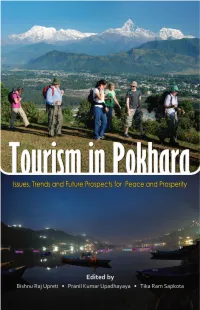
Tourism in Pokhara: Issues, Trends and Future Prospects for Peace and Prosperity
Tourism in Pokhara: Issues, Trends and Future Prospects for Peace and Prosperity 1 Tourism in Pokhara Issues, Trends and Future Prospects for Peace and Prosperity Edited by Bishnu Raj Upreti Pranil Kumar Upadhayaya Tikaram Sapkota Published by Pokhara Tourism Council, Pokhara South Asia Regional Coordination Office of NCCR North-South and Nepal Centre for Contemporary Research, Kathmandu Kathmandu 2013 Citation: Upreti BR, Upadhayaya PK, Sapkota T, editors. 2013. Tourism in Pokhara Issues, Trends and Future Prospects for Peace and Prosperity. Kathmandu: Pokhara Tourism Council (PTC), South Asia Regional Coordination Office of the Swiss National Centre of Competence in Research (NCCR North- South) and Nepal Center for Contemporary Research (NCCR), Kathmandu. Copyright © 2013 PTC, NCCR North-South and NCCR, Kathmandu, Nepal All rights reserved. ISBN: 978-9937-2-6169-2 Subsidised price: NPR 390/- Cover concept: Pranil Upadhayaya Layout design: Jyoti Khatiwada Printed at: Heidel Press Pvt. Ltd., Dillibazar, Kathmandu Cover photo design: Tourists at the outskirts of Pokhara with Mt. Annapurna and Machhapuchhre on back (top) and Fewa Lake (down) by Ashess Shakya Disclaimer: The content and materials presented in this book are of the respective authors and do not necessarily reflect the views and opinions of Pokhara Tourism Council (PTC), the Swiss National Centre of Competence in Research (NCCR North-South) and Nepal Centre for Contemporary Research (NCCR). Dedication To the people who contributed to developing Pokhara as a tourism city and paradise The editors of the book Tourism in Pokhara: Issues, Trends and Future Prospects for Peace and Prosperity acknowledge supports of Pokhara Tourism Council (PTC) and the Swiss National Centre of Competence in Research (NCCR) North-South, co-funded by the Swiss National Science Foundation (SNSF), the Swiss Agency for Development and Cooperation (SDC), and the participating institutions. -

Person and Time Deixis in English and Newari Langauge
PERSON AND TIME DEIXIS IN ENGLISH AND NEWARI LANGAUGE A Thesis Submitted to the Department of English Education In Partial Fulfilment for the Master of Education in English Submitted by Nilu Shova Maharjan Faculty of Education Tribhuvan University Kirtipur, Kathmandu, Nepal 2014 1 PERSON AND TIME DEIXIS IN ENGLISH AND NEWARI LANGUAGE A Thesis Submitted to the Department of English Education In Partial fulfilment for the Master of Education in English Submitted By Nilu Shova Maharjan Faculty of Education Tribhuvan University Kirtipur, Kathmandu, Nepal 2014 T. U. Reg. No.: 9-2-29-1650-2005 Date of Approval of Campus Roll No.: 1199 the Proposal: 21/09/2012 Exam Roll No.: 280630/067 Date of Submission: 2/4/2014 2 DECLARATION I hereby declare to the best of my knowledge that this thesis is original; no part of it was earlier submitted for the candidature of research degree to any university. Date: _______________ _________________________ Nilu Shova Maharjan 3 RECOMMENDATION FOR ACCEPTANCE This is to certify that Ms. Nilu Shova Maharjan has completed the research work of her M. Ed. Thesis entitled Person and Time Deixis in English and Newari Langugaes under my guidance and supervision. I recommend the thesis for acceptance. Date: 2/4/2014 _____________________ Mr. Khem Raj Joshi (Supervisor) Teaching Assistant Department of English Education Faculty of Education University Campus, T.U., Kirtipur 4 RECOMMENDATION FOR EVALUATION This thesis has been recommended by the following Research Guidance Committee: Signature Dr. Anjana Bhattarai ______________ Reader and Head Chairperson Department of English Education University Campus, T.U., Kirtipur Mrs. Hima Rawal ______________ Lecturer Member Department of English Education University Campus, T.U., Kirtipur Mr. -

Nepal, November 2005
Library of Congress – Federal Research Division Country Profile: Nepal, November 2005 COUNTRY PROFILE: NEPAL November 2005 COUNTRY Formal Name: Kingdom of Nepal (“Nepal Adhirajya” in Nepali). Short Form: Nepal. Term for Citizen(s): Nepalese. Click to Enlarge Image Capital: Kathmandu. Major Cities: According to the 2001 census, only Kathmandu had a population of more than 500,000. The only other cities with more than 100,000 inhabitants were Biratnagar, Birgunj, Lalitpur, and Pokhara. Independence: In 1768 Prithvi Narayan Shah unified a number of states in the Kathmandu Valley under the Kingdom of Gorkha. Nepal recognizes National Unity Day (January 11) to commemorate this achievement. Public Holidays: Numerous holidays and religious festivals are observed in particular regions and by particular religions. Holiday dates also may vary by year and locality as a result of the multiple calendars in use—including two solar and three lunar calendars—and different astrological calculations by religious authorities. In fact, holidays may not be observed if religious authorities deem the date to be inauspicious for a specific year. The following holidays are observed nationwide: Sahid Diwash (Martyrs’ Day; movable date in January); National Unity Day and birthday of Prithvi Narayan Shah (January 11); Maha Shiva Ratri (Great Shiva’s Night, movable date in February or March); Rashtriya Prajatantra Diwash (National Democracy Day, movable date in February); Falgu Purnima, or Holi (movable date in February or March); Ram Nawami (Rama’s Birthday, movable date in March or April); Nepali New Year (movable date in April); Buddha’s Birthday (movable date in April or May); King Gyanendra’s Birthday (July 7); Janai Purnima (Sacred Thread Ceremony, movable date in August); Children’s Day (movable date in August); Dashain (Durga Puja Festival, movable set of five days over a 15-day period in September or October); Diwali/Tihar (Festival of Lights and Laxmi Puja, movable set of five days in October); and Sambhidhan Diwash (Constitution Day, movable date in November). -
Nepal Side, We Must Mention Prof
The Journal of Newar Studies Swayambhv, Ifliihichaitya Number - 2 NS 1119 (TheJournal Of Newar Studies) NUmkL2 U19fi99&99 It has ken a great pleasure bringing out the second issue of EdltLlo the journal d Newar Studies lijiiiina'. We would like to thank Daya R Sha a Gauriehankar Marw&~r Ph.D all the members an bers for their encouraging comments and financial support. ivc csp~iilly:-l*-. urank Prof. Uma Shrestha, Western Prof.- Todd ttwria Oregon Univers~ty,who gave life to this journd while it was still in its embryonic stage. From the Nepal side, we must mention Prof. Tej Shta Sudip Sbakya Ratna Kanskar, Mr. Ram Shakya and Mr. Labha Ram Tuladhar who helped us in so many ways. Due to our wish to publish the first issue of the journal on the Sd Fl~ternatioaalNepal Rh&a levi occasion of New Nepal Samht Year day {Mhapujii), we mhed at the (INBSS) Pdand. Orcgon USA last minute and spent less time in careful editing. Our computer Nepfh %P Puch3h Amaica Orcgon Branch software caused us muble in converting the files fm various subrmttd formats into a unified format. We learn while we work. Constructive are welcome we try Daya R Shakya comments and will to incorporate - suggestions as much as we can. Atedew We have received an enormous st mount of comments, Uma Shrcdha P$.D.Gaurisbankar Manandhar PIID .-m -C-.. Lhwakar Mabajan, Jagadish B Mathema suggestions, appreciations and so forth, (pia IcleI to page 94) Puma Babndur Ranjht including some ~riousconcern abut whether or not this journal Rt&ld Rqmmtatieca should include languages other than English. -

Ghorepani Poon Hill Trek - 5 Days
Ghorepani Poon Hill Trek - 5 Days DURATION: 5 DAYS Trip Facts Duration : 5 Days Trip Difficulty : Moderate Group size : 1-30 Pax Accommodation : Hotel/Lodge/Tea House Meals included : Breakfast, Lunch & Dinner Transportation : Bus/Car/Taxi Trip starting point : Nayapul Trip Ending point : Nayapul Best season : March, April and May & September, October and November Trip Overview Ghorepani Poon hill trek – 5 Days is a situated in the Annapurna Region.It is the most popular and easy trek in Nepal.Ghorepani Poon hill trek is a charming trek that offers the most Himalayan views and typical village culture.This is a classical trekking route in Annapurna region. Ghorepani poon hill 5 - Days trek begins from 1 ½ hour’s drive from Pokhara by taxi or van to Nayapul.This trek passes beautiful villages of Birethati, Tikhedunga, Ulleri, Banthati, Ghorepani, Deaurli, Tadapani and Ghandruk Village. There are natural fresh air, forest, waterfall; mountains, etc. which will make your trek more enjoyable. Ghorepani is a village located in Myagdi district in the Dhaulagiri Zone of northern central Nepal. The viewpoint of the trek is Poon Hill (3210m), which offers the best view of sunrise, sunset and mountains. The region consists of natural scenery lie rhododendron, forest full of unique birds and beautiful valley that will make your trip a pleasant one. From Poon Hill if the sky is clear you will be able to see all mountains ranges likes Annapurna south (7230m), Hiuchuli, Nilgiri, fish trail, Gangapurna, Annapurna I (8095m), Annapurna Iv, Tukche peak, Dhaulagiri I (8169m) Dhaulagiri range and Manaslu range etc. Why Choose Himalayan Local Guide? 1st. -

River Culture in Nepal
Nepalese Culture Vol. XIV : 1-12, 2021 Central Department of NeHCA, Tribhuvan University, Kathmandu, Nepal DOI: https://doi.org/10.3126/nc.v14i0.35187 River Culture in Nepal Kamala Dahal- Ph.D Associate Professor, Patan Multipal Campus, T.U. E-mail: kamala.dahal@pmc.tu.edu.np Abstract Most of the world civilizations are developed in the river basins. However, we do not have too big rivers in Nepal, though Nepalese culture is closely related with water and rivers. All the sacraments from birth to the death event in Nepalese society are related with river. Rivers and ponds are the living places of Nepali gods and goddesses. Jalkanya and Jaladevi are known as the goddesses of rivers. In the same way, most of the sacred places are located at the river banks in Nepal. Varahakshetra, Bishnupaduka, Devaghat, Triveni, Muktinath and other big Tirthas lay at the riverside. Most of the people of Nepal despose their death bodies in river banks. Death sacrement is also done in the tirthas of such localities. In this way, rivers of Nepal bear the great cultural value. Most of the sacramental, religious and cultural activities are done in such centers. Religious fairs and festivals are also organized in such a places. Therefore, river is the main centre of Nepalese culture. Key words: sacred, sacraments, purity, specialities, bath. Introduction The geography of any localities play an influencing role for the development of culture of a society. It affects a society directly and indirectly. In the beginning the nomads passed their lives for thousands of year in the jungle. -

Country Technical Note on Indigenous Peoples' Issues
Country Technical Note on Indigenous Peoples’ Issues Republic of India Country Technical Notes on Indigenous Peoples’ Issues REPUBLIC OF INDIA Submitted by: C.R Bijoy and Tiplut Nongbri Last updated: January 2013 Disclaimer The opinions expressed in this publication are those of the authors and do not necessarily represent those of the International Fund for Agricultural Development (IFAD). The designations employed and the presentation of material in this publication do not imply the expression of any opinion whatsoever on the part of IFAD concerning the legal status of any country, territory, city or area or of its authorities, or concerning the delimitation of its frontiers or boundaries. The designations ‗developed‘ and ‗developing‘ countries are intended for statistical convenience and do not necessarily express a judgment about the stage reached by a particular country or area in the development process. All rights reserved Table of Contents Country Technical Note on Indigenous Peoples‘ Issues – Republic of India ......................... 1 1.1 Definition .......................................................................................................... 1 1.2 The Scheduled Tribes ......................................................................................... 4 2. Status of scheduled tribes ...................................................................................... 9 2.1 Occupation ........................................................................................................ 9 2.2 Poverty .......................................................................................................... -

Ghorepani Poon Hill Trek
Ghorepani Poon Hill Trek TRIP FACTS Spectacular mountain scenery, villages inhabited by the Gurungs, dense rhododendron forests full of birds and deep sub-tropical valleys, climb Poon Hill, Himalayan Giants, Dhaulagiri 8,167m and Annapurna 8,091m along with a maze of other peaks, rhododendron flower in March, April and many more.. Trip duration: 5 Days Maximum altitude: 3210m Grade: Classic / Easy to fairly challenging Starts in: Pokhara Ends in: Pokhara Accommodation: Tea House (lodge) Transportation: Car/Van/bus Best Season: Oct- Nov (autumn season) Very good Season Mar- May (spring season) Good season: Dec-Feb (winter season) On luck weather season: June-Sep (summer/rainy Season) ITINERARY: Day 01 Pokhara to Nayapul drive by private car/van and trek to Tirkhedhunga Altitude: 1577m Trek Length: 4 HOURS Meal: Lunch, Dinner After your Energetic Breakfast, at around 8:00am your guide will meet you at the hotel premises. You will be transferred to Nayapul via Office transport. Nayapul is 1.5 hours’ drive from pokhara, the drive covers the distance of 43kms. After Reaching Nayapul you will begin your trek towards Tirkhedhunga. The Trek Begins with 15 mins walk towards the village Of Birethanti Then walking across the Banks of Modi Khola, Then a short Ascending Trek to The village of Tikhedhunga. The guide will take you to your Tea House Accommodation for overnight stay in Tirkhedhunga. Today’s trek is a slight Preparation for the upcomingtrek. Day 02 Trek to Ghorepani Altitude: 2855M Trek Length: 6 HOURS Meal: Breakfast, Lunch, Dinner The trek starts with the uphill climb through the village of Ulleri, the path rises more gently from this point, over the forests of oak and rhododendrons, towards Banthanti as we hike towards Nangethanti. -
Functions of Nachhung (Shaman) in the Chamling Rai in Eastern Nepal
Patan Pragya (Volume: 7 Number: 1 2020) [ ISSN No. 2595-3278 Received Date: July 2020 Revised: Oct. 2020 Accepted: Dec.2020 https://doi.org/10.3126/pragya.v7i1.35247 Functions of Nachhung (Shaman) in the Chamling Rai in Eastern Nepal Rai Puspa Raj Abstract Rai is an indigenous people and decedent of Kirati dynasty, inhabitant of eastern part of Nepal. It is known as Kirat Pradesh before the unification of Nepal. Now, Kirat Pradesh is became political word in Nepal for name of province number 1 but not endorse till present. The Chamling Rai society is comprised different interdependent parts and units as like religion, culture, economy, polity, educational etc. Kirat religion is a part of Rai community constituted by the different units and interdepended among different parts. The Chamling word Nachhung (shaman) is called priest of the Kirat religion. So, this article focuses on the Nachhung who is the Rai priest, shaman and healer as functional unit of the Rai society. The main research questions if how the Nachhung plays function as the being part of Rai society and contribute to existence of Rai society as whole. It explores the interdependence of Nachhung on other parts like rite and ritual, marriage, feast and festival, community, health, social and religious activities. Keywords: Nachhung's function, rite and ritual, Sakela festival, healing illness. Introduction Shamanism is a kind of religion in the primitive society. Tylor argues that animism is the first religion of the world. There was found debate on shamanism among different scholars in 19th centuray. Tylor, Schmidt considered shamanism as primitive religion but Durkhiem, Marcel Mauss considered magic as immoral and private act. -

A Geologic Guide to the Gokyo Ri Trek: Its Hazards, Nepal’S Hindrances Allison Bolger SIT Study Abroad
SIT Graduate Institute/SIT Study Abroad SIT Digital Collections Independent Study Project (ISP) Collection SIT Study Abroad Fall 2011 A Geologic Guide to the Gokyo Ri Trek: Its Hazards, Nepal’s Hindrances Allison Bolger SIT Study Abroad Follow this and additional works at: https://digitalcollections.sit.edu/isp_collection Part of the Nature and Society Relations Commons, and the Tourism Commons Recommended Citation Bolger, Allison, "A Geologic Guide to the Gokyo Ri Trek: Its Hazards, Nepal’s Hindrances" (2011). Independent Study Project (ISP) Collection. 1351. https://digitalcollections.sit.edu/isp_collection/1351 This Unpublished Paper is brought to you for free and open access by the SIT Study Abroad at SIT Digital Collections. It has been accepted for inclusion in Independent Study Project (ISP) Collection by an authorized administrator of SIT Digital Collections. For more information, please contact digitalcollections@sit.edu. Allison Bolger December 8, 2011 A Geologic Guide to the Gokyo Ri Trek: Its Hazards, Nepal’s Hindrances Abstract The purpose of this Independent Research Project is to study the geology of the Gokyo Ri Trek and record it in the form of a publishable, trailside guidebook. This guidebook will not only enhance trekkers’ academic experience with enjoyable, interesting facts about Gokyo’s geology, but will also inform them of the natural hazards all around. From glacial lakes and high mountain peaks to precarious scree slopes and towering ice falls, the geology of Sagarmatha National Park offers more than just rocks and snow. With these natural, yet highly unpredictable wonders and the tourists they attract also comes the power to severely hinder, or possibly even improve, local livelihoods. -

Adaptation and Identity of Yolmo People Contributiolls to Nepalese Studies, Vol
90 Occasional Papers Regmi, Mahesh C. 1976, Lalldowllership in Nepal, Berkeley: University of California Press. Rosser, Colin 1966, "Social Mobility in the Newar Caste System" in C. Von Ftirer-Haimendorf (ed.) Caste and Kill ill Nepal. Illdia and Cye/oll, Bombey: Asia Publishing House. Srinivas, M.N. 1966, Socia/ Challge ill Modern Illdia, Berkeley: ADAPTATION AND University of California Press IDENTITY OF YOLMO Sharma, Balchandra 1978 (2033 v.s.), Nepa/ko Airihasik Ruparekha (An Outline of the History of Nepal), Baranasi: Krishna Kumari Devi. Biood Pokharel Sharma, Prayag Raj 2004, "Introduction" in Andras HOfer, 2004, The Caste Hierarchy alld the State in Nepal: A Study ofthe Mu/ki Aill of1854, Kathmandu: Himal Books. An Overview Sharma, Prayag Raj 1978, "Nepal: Hindu-Tribal Interface" III This article focuses on adaptation and identity of Yolmo people ContributiOlls to Nepalese Studies, Vol. 16, No. I, pp. 1-4. living in the western part of the Sindhupalchok district. The Yolmo are traditionally herders and traders but later they diversified their economy and are now relying on tourism, wage labour and work aboard for income. It is believed that they arrived in the Melamchi area from Tibet from the 18'" century onwards. This article basically concerns on how Yolmo change their adaptive strategy for their survival and how did they become successful in keep their identity even though they have a small population. The economic adaptation in mountain region is very difficult due to marginal land and low productivity. Therefore they diversified their economy in multiple sectors to cope with the environment. Bishop states that "diversification involves exploiting one or more zones and managing several economic activities simultaneously" (1998:22). -

Gokyo Ri - Sagarmatha National Park Trek - 11 Days
Gokyo Ri - Sagarmatha National Park Trek - 11 Days Trip Facts Destination Nepal Duration 11 Days Group Size 2-30 Trip Code DWTKO15 Grade Challenging Activity Everest Treks Region Everest Region Max. Altitude 5,430m Gokyo Ri Nature of Trek Lodge to Lodge Trekking Activity per Day Approximately 4-6 hrs walking Accomodation Hotel/Lodge/ Tea House during the trek Start / End Point Kathmandu / Kathmandu Meals Included All Meals (Breakfast, Lunch & Dinner) during the trek Best Season Feb, Mar, Apri, May, June, Sep, Oct, Nov & Dec Transportation Domestic flight (lukla-Ktm-Lukla) and private vehicle (Transportation) A Leading Himalayan Trekking & Adventure Specialists TRULY YOUR TRUSTED NEPAL’S TRIP OPERATOR. Reaching one of the highest-situated settlements in the world accompanied by beautiful lakes and rivers, majestic mountains (Gokyo Ri in Sagarmatha National park), dense forests, the trail to Gokyo lakes... Discovery World Trekking would like to recommend all our valuable clients to arrive in Kathmandu a day before our '11 Days Gokyo Lake Trek'. Make sure to attend our official briefing a day before the trek. The primary motive for the meeting is to give you proper guidance and vital information about the trek. Secondarily, we recheck all the equipment for your comfortable journey. We ensure that you have all the supplies needed for the trek. This pre-meeting will give a clear idea about the necessary supplies and challenges you may face during the trek. It will be a kind of motivational seminar for you to be outfitted and energized about the trek. Additionally, it is recommended to put a margin of 1 or 2 days extra.