Oral History Interview with Bruce Conner, 1973 April 16
Total Page:16
File Type:pdf, Size:1020Kb
Load more
Recommended publications
-

R0693-05.Pdf
I' i\ FILE NO .._O;:..=5:....:::1..;::..62;;;;..4:..- _ RESOLUTION NO. ----------------~ 1 [Howl Week.] 2 3 Resolution declaring the week of October 2-9 Howl Week in the City and County of San 4 Francisco to commemorate the 50th anniversary of the first reading of Allen Ginsberg's 5 classic American poem about the Beat Generation. 6 7 WHEREAS, Allen Ginsberg wrote Howl in San Francisco, 50 years ago in 1955; and 8 ! WHEREAS, Mr. Ginsberg read Howl for the first time at the Six Gallery on Fillmore 9 I Street in San Francisco on October 7, 1955; and 10 WHEREAS, The Six Gallery reading marked the birth of the Beat Generation and the 11 I start not only of Mr. Ginsberg's career, but also of the poetry careers of Michael McClure, 12 Gary Snyder, Jack Kerouac, Philip Whalen; and 13 14 WHEREAS, Howl was published by Lawrence Ferlinghetti at City Lights and has sold 15 nearly one million copies in the Pocket Poets Series; and 16 WHEREAS, Howl rejuvenated American poetry and marked the start of an American 17 Cultural Revolution; and 18 WHEREAS, The City and County of San Francisco is proud to call Allen Ginsberg one 19 of its most beloved poets and Howl one of its signature poems; and, 20 WHEREAS, October 7,2005 will mark the 50th anniversary of the first reading of 21 HOWL; and 22 WHEREAS, Supervisor Michela Alioto-Pier will dedicate a plaque on October 7,2005 23 at the site of Six Gallery; now, therefore, be it 24 25 SUPERVISOR PESKIN BOARD OF SUPERVISORS Page 1 9/20/2005 \\bdusupu01.svr\data\graups\pElskin\iagislatiarlire.soll.ltrons\2005\!lo\l'lf week 9.20,05.6(J-(; 1 RESOLVED, That the San Francisco Board of Supervisors declares the week of 2 October 2-9 Howl Week to commemorate the 50th anniversary of this classic of 20th century 3 American literature. -

Bohemian Space and Countercultural Place in San Francisco's Haight-Ashbury Neighborhood
University of Central Florida STARS Electronic Theses and Dissertations, 2004-2019 2017 Hippieland: Bohemian Space and Countercultural Place in San Francisco's Haight-Ashbury Neighborhood Kevin Mercer University of Central Florida Part of the History Commons Find similar works at: https://stars.library.ucf.edu/etd University of Central Florida Libraries http://library.ucf.edu This Masters Thesis (Open Access) is brought to you for free and open access by STARS. It has been accepted for inclusion in Electronic Theses and Dissertations, 2004-2019 by an authorized administrator of STARS. For more information, please contact STARS@ucf.edu. STARS Citation Mercer, Kevin, "Hippieland: Bohemian Space and Countercultural Place in San Francisco's Haight-Ashbury Neighborhood" (2017). Electronic Theses and Dissertations, 2004-2019. 5540. https://stars.library.ucf.edu/etd/5540 HIPPIELAND: BOHEMIAN SPACE AND COUNTERCULTURAL PLACE IN SAN FRANCISCO’S HAIGHT-ASHBURY NEIGHBORHOOD by KEVIN MITCHELL MERCER B.A. University of Central Florida, 2012 A thesis submitted in partial fulfillment of the requirements for the degree of Master of Arts in the Department of History in the College of Arts and Humanities at the University of Central Florida Orlando, Florida Summer Term 2017 ABSTRACT This thesis examines the birth of the late 1960s counterculture in San Francisco’s Haight-Ashbury neighborhood. Surveying the area through a lens of geographic place and space, this research will look at the historical factors that led to the rise of a counterculture here. To contextualize this development, it is necessary to examine the development of a cosmopolitan neighborhood after World War II that was multicultural and bohemian into something culturally unique. -

Radio Transmission Electricity and Surrealist Art in 1950S and '60S San
Journal of Surrealism and the Americas 9:1 (2016), 40-61 40 Radio Transmission Electricity and Surrealist Art in 1950s and ‘60s San Francisco R. Bruce Elder Ryerson University Among the most erudite of the San Francisco Renaissance writers was the poet and Zen Buddhist priest Philip Whalen (1923–2002). In “‘Goldberry is Waiting’; Or, P.W., His Magic Education As A Poet,” Whalen remarks, I saw that poetry didn’t belong to me, it wasn’t my province; it was older and larger and more powerful than I, and it would exist beyond my life-span. And it was, in turn, only one of the means of communicating with those worlds of imagination and vision and magical and religious knowledge which all painters and musicians and inventors and saints and shamans and lunatics and yogis and dope fiends and novelists heard and saw and ‘tuned in’ on. Poetry was not a communication from ME to ALL THOSE OTHERS, but from the invisible magical worlds to me . everybody else, ALL THOSE OTHERS.1 The manner of writing is familiar: it is peculiar to the San Francisco Renaissance, but the ideas expounded are common enough: that art mediates between a higher realm of pure spirituality and consensus reality is a hallmark of theopoetics of any stripe. Likewise, Whalen’s claim that art conveys a magical and religious experience that “all painters and musicians and inventors and saints and shamans and lunatics and yogis and dope fiends and novelists . ‘turned in’ on” is characteristic of the San Francisco Renaissance in its rhetorical manner, but in its substance the assertion could have been made by vanguard artists of diverse allegiances (a fact that suggests much about the prevalence of theopoetics in oppositional poetics). -

Lawrence Ferlinghetti, Poet Who Nurtured the Beats, Dies At
Lawrence Ferlinghetti, Poet Who Nurtured the Beats, Dies at 101 An unapologetic proponent of “poetry as insurgent art,” he was also a publisher and the owner of the celebrated San Francisco bookstore City Lights. By Jesse McKinley Feb. 23, 2021 Lawrence Ferlinghetti, a poet, publisher and political iconoclast who inspired and nurtured generations of San Francisco artists and writers from City Lights, his famed bookstore, died on Monday at his home in San Francisco. He was 101. The cause was interstitial lung disease, his daughter, Julie Sasser, said. The spiritual godfather of the Beat movement, Mr. Ferlinghetti made his home base in the modest independent book haven now formally known as City Lights Booksellers & Publishers. A self-described “literary meeting place” founded in 1953 and located on the border of the city’s sometimes swank, sometimes seedy North Beach neighborhood, City Lights, on Columbus Avenue, soon became as much a part of the San Francisco scene as the Golden Gate Bridge or Fisherman’s Wharf. (The city’s board of supervisors designated it a historic landmark in 2001.) While older and not a practitioner of their freewheeling personal style, Mr. Ferlinghetti befriended, published and championed many of the major Beat poets, among them Allen Ginsberg, Gregory Corso and Michael McClure, who died in May. His connection to their work was exemplified — and cemented — in 1956 with his publication of Ginsberg’s most famous poem, the ribald and revolutionary “Howl,” an act that led to Mr. Ferlinghetti’s arrest on charges of “willfully and lewdly” printing “indecent writings.” In a significant First Amendment decision, he was acquitted, and “Howl” became one of the 20th century’s best-known poems. -

Bruce Conner (1933 – 2008)
BRUCE CONNER (1933 – 2008) BORN: McPherson, Kansas EDUCATION: 1956 B.F.A., Nebraska University 1956 Brooklyn Museum Art School 1957 University of Colorado SOLO EXHIBITIONS: 2012 Gallery Paule Anglim, San Francisco, CA Bruce Conner and the Primal Scene of Punk Rock, MCA Denver, Denver, CO 2011 Bruce Conner: An Anonymous Memorial, American University, Katzen Arts Center, Washington D.C. Bruce Conner: Falling Leaves: An Anonymous Memorial, Paula Cooper Gallery, New York, NY 2010 Bruce Conner: 1970’s, Kunstalle Wien, Vienna, Austria (travelled to Kunsthalle Zurich, Switzerland) I am Not Bruce Conner, Ursula Blickle Foundation, Krachtal, Germany Bruce Conner, Inova/Kenilworth Institute, University of Wisonsin, Milwaukee, Peck School of the Arts 4 ½, Creative Time, New York, NY Long Play: Bruce Conner and the Singles Collection, SFMOMA, San Francisco The Late Bruce Conner, Susan Inglett Gallery, New York, NY 2009 Bruce Conner: Discovered, Gallery Paule Anglim, San Francisco, CA Bruce Conner in the 1970s, Michael Kohn Gallery, Los Angeles, CA Intelligent Design: Untitled Lithographs 1970-1971, Milwaukee Art Museum, Milwaukee, WI 2008 Gallery Paule Anglim, San Francisco, CA Applause, Miyake Fine Art, Tokyo, Japan Mabuhay Gardens, UC Berkeley Art Musuem, Berkeley, CA 2007 Bruce Conner, Susan Inglett Gallery, New York, NY Gallery Paule Anglim, San Francisco, CA Michael Kohn Gallery, Los Angeles, CA 2006 Bruce Conner Sheldon Memorial art Gallery, Lincoln, NE 2005 After Conner: Anonymous, Anonymouse and Emily Feather, Katzen Art Center Museum, American -

The Sixties Counterculture and Public Space, 1964--1967
University of New Hampshire University of New Hampshire Scholars' Repository Doctoral Dissertations Student Scholarship Spring 2003 "Everybody get together": The sixties counterculture and public space, 1964--1967 Jill Katherine Silos University of New Hampshire, Durham Follow this and additional works at: https://scholars.unh.edu/dissertation Recommended Citation Silos, Jill Katherine, ""Everybody get together": The sixties counterculture and public space, 1964--1967" (2003). Doctoral Dissertations. 170. https://scholars.unh.edu/dissertation/170 This Dissertation is brought to you for free and open access by the Student Scholarship at University of New Hampshire Scholars' Repository. It has been accepted for inclusion in Doctoral Dissertations by an authorized administrator of University of New Hampshire Scholars' Repository. For more information, please contact Scholarly.Communication@unh.edu. INFORMATION TO USERS This manuscript has been reproduced from the microfilm master. UMI films the text directly from the original or copy submitted. Thus, some thesis and dissertation copies are in typewriter face, while others may be from any type of computer printer. The quality of this reproduction is dependent upon the quality of the copy submitted. Broken or indistinct print, colored or poor quality illustrations and photographs, print bleedthrough, substandard margins, and improper alignment can adversely affect reproduction. In the unlikely event that the author did not send UMI a complete manuscript and there are missing pages, these will be noted. Also, if unauthorized copyright material had to be removed, a note will indicate the deletion. Oversize materials (e.g., maps, drawings, charts) are reproduced by sectioning the original, beginning at the upper left-hand comer and continuing from left to right in equal sections with small overlaps. -

A History of the Communication Company, 1966-1967
San Jose State University SJSU ScholarWorks Master's Theses Master's Theses and Graduate Research Summer 2012 Outrageous Pamphleteers: A History Of The Communication Company, 1966-1967 Evan Edwin Carlson San Jose State University Follow this and additional works at: https://scholarworks.sjsu.edu/etd_theses Recommended Citation Carlson, Evan Edwin, "Outrageous Pamphleteers: A History Of The Communication Company, 1966-1967" (2012). Master's Theses. 4188. DOI: https://doi.org/10.31979/etd.cg2e-dkv9 https://scholarworks.sjsu.edu/etd_theses/4188 This Thesis is brought to you for free and open access by the Master's Theses and Graduate Research at SJSU ScholarWorks. It has been accepted for inclusion in Master's Theses by an authorized administrator of SJSU ScholarWorks. For more information, please contact scholarworks@sjsu.edu. OUTRAGEOUS PAMPHLETEERS: A HISTORY OF THE COMMUNICATION COMPANY, 1966-1967 A Thesis Presented to The Faculty of the School of Library and Information Science San José State University In Partial Fulfillment of the Requirements for the Degree Master of Library and Information Science by Evan E. Carlson August 2012 © 2012 Evan E. Carlson ALL RIGHTS RESERVED The Designated Thesis Committee Approves the Thesis Titled OUTRAGEOUS PAMPHLETEERS: A HISTORY OF THE COMMUNICATION COMPANY, 1966-1967 by Evan E. Carlson APPROVED FOR THE SCHOOL OF LIBRARY AND INFORMATION SCIENCE SAN JOSÉ STATE UNIVERSITY August 2012 Dr. Debra Hansen School of Library and Information Science Dr. Judith Weedman School of Library and Information Science Beth Wrenn-Estes School of Library and Information Science ABSTRACT OUTRAGEOUS PAMPHLETEERS: A HISTORY OF THE COMMUNICATION COMPANY, 1966-1967 by Evan E. -

The Prints of Bruce Conner
Press Release Afterimage: The Prints of Bruce Conner September 20 – November 17, 2012 Senior & Shopmaker Gallery, in collaboration with the Conner Family Trust, is pleased to present Afterimage: The Prints of Bruce Conner, the first exhibition of the artist’s work at the gallery. Conner, who passed away in 2008, was born in McPherson, Kansas in 1933 and moved to San Francisco in the late 1950s where he became a pivotal figure in the Beat scene of poets, writers, artists and performers. Active in all media, including painting, collage and assemblage, sculpture, graphic arts, filmmaking, and photography, Conner brought a radical and iconoclastic approach to art-making, questioning and rejecting ideals of artistic purity, style, and identity, as well as the market-driven dynamic of the art world. The show, accompanied by an on-line catalogue with an essay by Peter Boswell, will include lithographs Conner produced in 1970-71 to preserve the imagery of his ephemeral felt-tip drawings of the period, as well as later prints based on ink blot drawings and collages. Linking the artist’s extensive graphic oeuvre to his work in other media is a command of light and shadow that permeates images hovering between fugitive and eternal, fantasy and reality. The retinal effect of his starkly monochromatic drawings of the 1960s and 1970s is achieved through the use of densely woven lines, creating highly complex shifting patterns. Formally rigorous, these maze- like drawings negate external references and dissolve figure/ground boundaries. Often structured by circular mandala forms, they attest to the artist’s deep knowledge of occult and Eastern philosophies. -
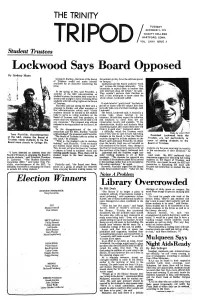
Students Feel Med School Pangs *•• by Lois Kimmelman
0 THE TRINITY TUESDAY AIMS OCTOBER 9, 1973 TRINITY COLLEGE HARTFORD, CONN. VOL. LXXII ISSUE 5 M TRIPOD 0 W! Ml Student Trustees Lockwood Says Board Opposed By Lindsay Mann George B. Starkey, chairman of the Board the problem is they have the ultimate power of Trustees would not make himself on campus." available for an interview concerning the Lockwood said the Board would be "hard issue. put" to know the College intimately. "It is unrealistic to expect them to become that In the spring of 1972, said Piccirillo, a well informed about the school," he said. member of the SEC sub-committee on They wouldn't perform their function as student trustees, the student body voted by a well if they attempted to know about the three to one margin in favor of seating three whole school, Lockwood added. students with full-voting rights on the Board of Trustees. It would also be "pretty hard" for them to Piccirillo said last spring the SEC sent a get off on issues with the volume that they proposal to Starkey and other members of normally take care of at their meetings, said the administration which said "three Lockwood. " students (should) be elected by the student The Board, Lockwood said, is basically a body to serve as voting members on the review body, whose function is not Board of Trustees until they graduate, at initiatory. He said they expect the initiation which time new elections will be held to fill and emphasis to come from the ad- any vacancies." The proposal also offered ministration, faculty and students. -

The Whitney to Present Jay Defeo: a Retrospective
THE WHITNEY TO PRESENT JAY DEFEO: A RETROSPECTIVE DeFeo working on what was then titled Deathrose, 1960. Photograph by Burt Glinn. © Burt Glinn/Magnum Photos NEW YORK, December 12, 2012—Jay DeFeo spent nearly eight years realizing her masterpiece, The Rose (1958-66), an approximately 2,000-pound painting that is now recognized as one of the icons of the Whitney Museum’s collection. This winter, the Whitney will place The Rose within the context of more than four decades of DeFeo’s work in the most comprehensive look at the artist to date. Jay DeFeo: A Retrospective, which opens on February 28, 2013, features nearly 150 of DeFeo’s works, many of which will be exhibited for the first time. The show traces motifs and themes the artist examined throughout her career in drawings, photographs, collages, jewelry, and the monumental paintings for which she is best known. The exhibition is organized by Dana Miller, curator of the permanent collection at the Whitney, and will be on view in the fourth-floor Emily Fisher Landau Galleries through June 2, 2013. “DeFeo remains an artist whose full career has not yet received the careful consideration that it deserves,” Miller states. “In presenting her entire career, this retrospective demonstrates the captivating sweep of DeFeo’s heterogeneous work and illuminates her groundbreaking experimentation and extraordinary vision.” The retrospective comes home to the Whitney after receiving critical acclaim and attracting large audiences at the San Francisco Museum of Modern Art. San Francisco Chronicle art critic Kenneth Baker wrote in his review of the exhibition, “Before and since her death at 60 in 1989, DeFeo's reputation has hinged on one colossal work: ‘The Rose’…This belated career survey corrects that overemphasis but, more important, it introduces DeFeo to a broad public as an artist of wide and diverse accomplishment.” The substantially larger presentation at the Whitney will also feature an expanded selection of DeFeo’s drawings and photographs from the 1970s. -

The Rat Bastard Protective Association Was Founded in 1957 by the Artist Bruce Conner and the Poet Michael Mcclure
The Rat Bastard Protective Association was founded in 1957 by the artist Bruce Conner and the poet Michael McClure. As Conner told it to Peter Boswell, a seasoned curator, the association was “for people who were making things with the detritus of society, who themselves were ostracized or alienated from full involvement with society.” This community of artists and poets lived and worked together in and around 2322 Fillmore Street (San Francisco), which they dubbed “Painterland." The idiosyncratic group included Wallace Berman, Bruce Conner, Jean Conner, George Herms, Wally Hedrick and Jay DeFeo. © 2018 The Jay DeFeo Foundation / Artist Rights Society (ARS), New York. Courtesy of The Jay DeFeo Foundation and Mitchell-Innes & Nash, NY. Jay DeFeo. Untitled. 1973. DeFeo, a New Hampshire native, grew up in the Bay area, and attended the University of California, Berkeley, where she earned both her bachelor’s and master’s degrees in the early 1950’s. After traveling to Europe and North Africa, DeFeo settled permanently in Northern California. It was a propitious moment in American culture. In 1953, Lawrence Ferlinghetti, the poet, and Peter D. Martin, a sociologist, had opened City Lights booksellers. San Francisco became the quasi-West Coast capital of Beat culture, the home of “new bohemian hedonists who celebrated non- conformity and spontaneous creativity.” This was the cultural milieu for DeFeo. DeFeo worked almost exclusively on The Rose from 1958 to 1966. (This painting may have been a true monomaniacal obsession. Monomaniacs are defined as rational people whose rationality is applied to a specific object, branch of knowledge or activity.) The Rose is DeFeo’s Meisterstück bar none, and it always has to be mentioned. -

The 6Os Communes Messianic Communities) Bus at Bellows Falls) Vermont
The 6os Communes Messianic Communities) bus at Bellows Falls) Vermont. Photograph by Timothy Miller. TIMOTHY MILLER The 60s Communes Hippies and Beyond Syracuse UniversityPress Copyright © 1999 by Syracuse UniversityPress, Syracuse, New York 13244-5160 AllRights Reserved First Edition 1999 02 03 04 05 06 6 5 4 3 2 The paper used in this publication meets the minimum requirements of American National Standard forInformation Sciences-Permanence of Paper for Printed Library Materials, ANS I z39.48-1984.@ LIBRARY OF CONGRESS CATALOG ING -IN-PUBLICATI ON DATA Miller, Timothy, 1944- The 6os communes : hippies and beyond/ Timothy Miller. p. cm. Includes bibliographical references and index. ISBN 0-8156-2811-0 (cloth: alk. paper) ISBN 0-8156-0601-x (pbk.: alk. paper) I. Communal living-United States. 2. United States-Social conditions- 1960-1980. I. Title. II. Title: Sixties communes. III. Title: Hippies and beyond. HQ97I.M55 1999 307.77'4'0973-dc21 99-37768 Manufactured in the United States of America For Michael) Gretchen) andJeffre y TIMOTHY MILLER is professor of religious studies at the University of Kansas. Among his previous publica tions is The Quest forUt opia in Twentieth-CenturyAm erica: 1900-1960) the first of three volumes on communal life to be published by Syracuse UniversityPress. Contents Acknowledgments IX Introduction xm I. Set and Setting: The Roots of the 196os-Era Communes I 2. The New Communes Emerge: 1960-1965 17 3. Communes Begin to Spread: 1965-1967 41 4. Out of the Haight and Back to the Land: Countercultural Communes after the Summer of Love 67 5. Searching for a Common Center: Religious and Spiritual Communes 92 6.