To Live Forever: Egyptian Treasures from the Brooklyn Museum
Total Page:16
File Type:pdf, Size:1020Kb
Load more
Recommended publications
-
Egyptian Quiz
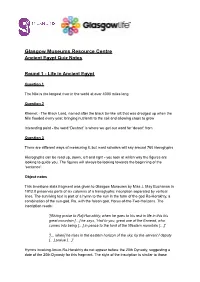
Glasgow Museums Resource Centre Ancient Egypt Quiz Notes Round 1 - Life in Ancient Egypt Question 1 The Nile is the longest river in the world at over 4000 miles long Question 2 Khemet - The Black Land, named after the black tar-like silt that was dredged up when the Nile flooded every year, bringing nutrients to the soil and allowing crops to grow Interesting point - the word ‘Deshret’ is where we get our word for ‘desert’ from Question 3 There are different ways of measuring it, but most scholars will say around 760 hieroglyphs Hieroglyphs can be read up, down, left and right - you look at which way the figures are looking to guide you. The figures will always be looking towards the beginning of the ‘sentence’. Object notes This limestone stela fragment was given to Glasgow Museums by Miss J. May Buchanan in 1912.It preserves parts of six columns of a hieroglyphic inscription separated by vertical lines. The surviving text is part of a hymn to the sun in the form of the god Ra-Horakhty, a combination of the sun-god, Ra, with the falcon god, Horus-of-the-Two-Horizons. The inscription reads: '[Giving praise to Ra]-Hor-akhty, when he goes to his rest in life in this his great mountain […] he says, ‘Hail to you, great one of the Ennead, who comes into being […] in peace to the land of the Western mountain […]' '[… when] he rises in the eastern horizon of the sky, by the servant / deputy […] praise […]' Hymns invoking Amun-Ra-Horakhty do not appear before the 20th Dynasty, suggesting a date of the 20th Dynasty for this fragment. -

13. Palette of King Narmer Predynatic Egypt. C. 3000 – 2920 B. C. E
13. Palette of King Narmer Predynatic Egypt. C. 3000 – 2920 B. C. E. Greywacke (2 images) Video at YouTube Article at Khan Academy Discovered (1898) among a group of sacred implements ritually buried in a deposit within an early temple of the falcon god Horus at the site of Hierakonpolis (the capital of Egypt during the pre-dynastic period), this large ceremonial object is one of the most important artifacts from the dawn of Egyptian civilization o Temple caches of this type are not uncommon. There was a great deal of focus on ritual and votive objects (offerings to the God) in temples. Every ruler, elite individual, and anyone else who could afford it, donated items to the temple to show their piety and increase their connection to the deity. After a period of time, the temple would be full of these objects and space would need to be cleared for new votive donations. However, since they had been dedicated to a temple and sanctified, the old items that needed to be cleared out could not simply be thrown away or sold. Instead, the general practice was to bury them in a pit under the temple floor o The "Main Deposit" at Hierakonpolis, where the Narmer Palette was discovered, contained many hundreds of objects, including a number of large relief-covered ceremonial mace-heads, ivory statuettes, carved knife handles, figurines of scorpions and other animals, stone vessels, and a second elaborately decorated palette 63.5 cm (more than 2 feet) in height and made of smooth greyish-green siltstone, is decorated on both faces with detailed low relief. -

Temples and Tombs Treasures of Egyptian Art from the British Museum
Temples and Tombs Treasures of Egyptian Art from The British Museum Resource for Educators this is max size of image at 200 dpi; the sil is low res and for the comp only. if approved, needs to be redone carefully American Federation of Arts Temples and Tombs Treasures of Egyptian Art from The British Museum Resource for Educators American Federation of Arts © 2006 American Federation of Arts Temples and Tombs: Treasures of Egyptian Art from the British Museum is organized by the American Federation of Arts and The British Museum. All materials included in this resource may be reproduced for educational American Federation of Arts purposes. 212.988.7700 800.232.0270 The AFA is a nonprofit institution that organizes art exhibitions for presen- www.afaweb.org tation in museums around the world, publishes exhibition catalogues, and interim address: develops education programs. 122 East 42nd Street, Suite 1514 New York, NY 10168 after April 1, 2007: 305 East 47th Street New York, NY 10017 Please direct questions about this resource to: Suzanne Elder Burke Director of Education American Federation of Arts 212.988.7700 x26 sburke@afaweb.org Exhibition Itinerary to Date Oklahoma City Museum of Art Oklahoma City, Oklahoma September 7–November 26, 2006 The Cummer Museum of Art and Gardens Jacksonville, Florida December 22, 2006–March 18, 2007 North Carolina Museum of Art Raleigh, North Carolina April 15–July 8, 2007 Albuquerque Museum of Art and History Albuquerque, New Mexico November 16, 2007–February 10, 2008 Fresno Metropolitan Museum of Art, History and Science Fresno, California March 7–June 1, 2008 Design/Production: Susan E. -
The Story of Osiris Osiris Was the King of Egypt
Story The Story of Osiris Osiris was the King of Egypt. During his reign, Osiris’ people were happy and well-fed. However, Osiris’ brother Seth became very jealous of the king’s success. While Osiris was travelling and bringing his blessings to other nations, Seth came up with a devious plan. Secretly, Seth found out Osiris’ exact body measurements and asked for a beautiful chest to be made that he knew would only fit Osiris. Upon Osiris’ return from his travels, Seth invited his brother to a great feast. During the celebrations, Seth revealed the exquisite chest and declared that he would give it to anyone who fitted into it exactly. Many tried and failed to fit into the chest, and eventually, Osiris asked to try. He was delighted that the chest fitted him perfectly, but at that very moment, Seth’s evil plan revealed itself; he slammed the lid, nailed it shut and sealed every crack with molten lead. Osiris died within the chest and his soul (or ‘ka’) moved on into the spirit world. Seth ruthlessly cast the chest that contained Osiris’ body into the River Nile. Isis, who was Osiris’ sister and wife, was devastated and feared for the safety of Horus, their child. She secretly fled into the marshes to look after Horus but was afraid that Seth would find the baby and murder him. So when Isis found shelter on a small, isolated island, which was home to the goddess Buto, she asked Buto to guard Horus. For extra protection, Isis transformed the island into a floating island, so it never stayed in one place permanently. -
Mechanical Engineering in Ancient Egypt, Part 45: Birds Statues (Falcon and Vulture)
International Journal of Emerging Engineering Research and Technology Volume 5, Issue 3, March 2017, PP 39-48 ISSN 2349-4395 (Print) & ISSN 2349-4409 (Online) http://dx.doi.org/10.22259/ijeert.0503004 Mechanical Engineering in Ancient Egypt, Part 45: Birds Statues (Falcon and Vulture) Galal Ali Hassaan (Emeritus Professor), Department of Mechanical Design & Production, Faculty of Engineering, Cairo University, Giza, Egypt ABSTRACT The evolution of mechanical engineering in ancient Egypt is investigated in this research paper through studying the production of statues and figurines of falcons and vultures. Examples from historical eras between Predynastic and Late Periods are presented, analysed and aspects of quality and innovation are outlined in each one. Material, dynasty, main dimension (if known) and present location are also outlined to complete the information about each statue or figurine. Keywords: Mechanical engineering, ancient Egypt, falcon statues, vulture statues INTRODUCTION This is the 45th paper in a scientific research aiming at presenting a deep insight into the history of mechanical engineering during the ancient Egyptian civilization. The paper handles the production of falcon and vulture statues and figurines during the Predynastic and Dynastic Periods of the ancient Egypt history. This work depicts the insight of ancient Egyptians to birds lived among them and how they authorized its existence through statuettes and figurines. Smith (1960) in his book about ancient Egypt as represented in the Museum of Fine Arts at Boston presented a number of bird figurines including ducks from the Middle Kingdom, gold ibis from the New Kingdom and a wooden spoon in the shape of a duck and lady from the New Kingdom [1]. -

Hellenistic and Pharaonic Influences on the Formation of Coptic Identity
Scriptura 85 (2004), pp. 292-301 HELLENISTIC AND PHARAONIC INFLUENCES ON THE FORMATION OF COPTIC IDENTITY Annette Evans Department of Ancient Studies Stellenbosch University Abstract Conflicting descriptions of Coptic identity still exist today. The Copts regard themselves as those descendents of Pharaonic Egyptians who have retained their identity because of their Christian faith, in spite of Egypt having become a predominantly Islamic, Arab country. They claim to have “caught a glimpse of the Light of Christianity” before the birth of Christ. This article offers iconographical evidence to supplement an explanation of how the ancient Egyptian mythopoeic thinking, in combination with the syncretistic cultural environment of Hellenism, mediated this phenomenon. Today the Coptic Orthodox Church of Egypt represents “a return to the apostolic father type leading of the church”. Although pharaonic and gnostic influences appear to have contributed to their remarkable eusebeia, the Copts perceive themselves as having abided by the decisions of the first three Church Councils and have respected and upheld the canon. 1. Introduction The word Copt originated from the ancient Egyptian word for Memphis, Hah-ka-Ptah – the house or temple of the spirit of Ptah. With the suppression of the prefix and the suffix the stem kaPt or gypt remained, which was then corrupted to the Arabic Qibt (Atiya 1968:16). The Hellenes used Aiguptos for both Egypt and the Nile, and Aiguptoi was used by Origen to distinguish Egyptian Christians from Hellenes (Van der Vliet and Zonhoven 1998:117). The Copts have a unique identity: inseparable from their pharaonic past, yet intimately associated with the beginning of Christianity. -

Uncovering Egypt
Pre- and Post-Program Activities Uncovering Egypt Grade Level: 4 - 8 Time: 60 minutes Program objectives: Students will learn basic components and procedures of an archaeological excavation and its lab work. Students will explore the time period and lifestyles of ancient Egypt. Students will identify and classify findings and form a hypothesis from the site evidence. Program description: Archaeology is a science that allows us to unlock the secrets of past civilizations. Participate in a hands-on demonstration of archaeological techniques as students explore a mock excavation site from Egypt and learn to identify a culture based on the artifacts discovered. Major vocabulary and concepts: Amulet Ankh Archaeology Artifact Cartouche Classify Crook and Flail Djed Pillar Egypt Excavate Hieroglyphs Hypothesis Mummification Papyrus Pharaoh Pyramid Sarcophagus Scarab Scribe Symbol Wedjat Suggested pre-visit activities: The ancient Egyptians believed that their Gods and Goddesses were responsible for everything that occurred in their daily lives. Imagine that you were one of the ancient Egyptian Gods or Goddesses. What God or Goddess would you prefer to be and what special abilities would you have? Pretend that you are an archeologist making an exciting new discovery of an artifact that was believed to be lost to history. Write a journal entry describing the artifact and its discovery. Make sure to record a clear description of the artifact itself for your research notes! Make a 3-dimensional model of a pyramid. Introduce the math topics of how to make a triangle and square to construct the pyramid. Draw or cut out pictures to represent examples of your favorite food, sport, TV show, clothing, pet, books, recreational activity, etc. -

Ancient Egyptian Chronology.Pdf
Ancient Egyptian Chronology HANDBOOK OF ORIENTAL STUDIES SECTION ONE THE NEAR AND MIDDLE EAST Ancient Near East Editor-in-Chief W. H. van Soldt Editors G. Beckman • C. Leitz • B. A. Levine P. Michalowski • P. Miglus Middle East R. S. O’Fahey • C. H. M. Versteegh VOLUME EIGHTY-THREE Ancient Egyptian Chronology Edited by Erik Hornung, Rolf Krauss, and David A. Warburton BRILL LEIDEN • BOSTON 2006 This book is printed on acid-free paper. Library of Congress Cataloging-in-Publication Data Ancient Egyptian chronology / edited by Erik Hornung, Rolf Krauss, and David A. Warburton; with the assistance of Marianne Eaton-Krauss. p. cm. — (Handbook of Oriental studies. Section 1, The Near and Middle East ; v. 83) Includes bibliographical references and index. ISBN-13: 978-90-04-11385-5 ISBN-10: 90-04-11385-1 1. Egypt—History—To 332 B.C.—Chronology. 2. Chronology, Egyptian. 3. Egypt—Antiquities. I. Hornung, Erik. II. Krauss, Rolf. III. Warburton, David. IV. Eaton-Krauss, Marianne. DT83.A6564 2006 932.002'02—dc22 2006049915 ISSN 0169-9423 ISBN-10 90 04 11385 1 ISBN-13 978 90 04 11385 5 © Copyright 2006 by Koninklijke Brill NV, Leiden, The Netherlands. Koninklijke Brill NV incorporates the imprints Brill, Hotei Publishing, IDC Publishers, Martinus Nijhoff Publishers, and VSP. All rights reserved. No part of this publication may be reproduced, translated, stored in a retrieval system, or transmitted in any form or by any means, electronic, mechanical, photocopying, recording or otherwise, without prior written permission from the publisher. Authorization to photocopy items for internal or personal use is granted by Brill provided that the appropriate fees are paid directly to The Copyright Clearance Center, 222 Rosewood Drive, Suite 910, Danvers, MA 01923, USA. -
THE DESTINY of the WORLD : a STUDY on the END of the UNIVERSE in the Llght of ANCIENT EGYPTIAN TEXTS
THE DESTINY OF THE WORLD : A STUDY ON THE END OF THE UNIVERSE IN THE LlGHT OF ANCIENT EGYPTIAN TEXTS Sherine M. ElSebaie A thesis submitted in conformity with the requirements for the degree of Master of Arts Graduate Department of Near and Middle Eastern Civilizations University of Toronto O Copyright by Sherine M. ElSebaie (2000) National Library Bibliothèque nationale of Canada du Canada Acquisitions and Acquisitions et Bibliographic Services services bibliographiques 395 Wellington Street 395, rue Wellington Ottawa ON K1A ON4 Ottawa ON KfA ON4 Canada Canada The author has granted a non- L'auteur a accordé une licence non exclusive licence allowing the exclusive permettant à la National Library of Canada to Bibliothèque nationale du Canada de reproduce, loan, distribute or seil reproduire, prêter, distribuer ou copies of this thesis in microform, vendre des copies de cette thèse sous paper or electronic formats. la fome de microfiche/nlm, de reproduction sur papier ou sur format électronique. The author retains ownership of the L'auteur conserve la propriété du copyright in this thesis. Neither the droit d'auteur qui protège cette thèse. thesis nor substantial extracts fiom it Ni la thèse ni des extraits substantiels may be printed or otherwise de celle-ci ne doivent être imprimés reproduced without the author's ou autrement reproduits sans son permission. autorisation. The Destiny of The World: A Study on the End of The Universe in The Light of Ancient Egyptian Texts Sherine M. ElSebaie Master of Arts, 2000 Dept. of Near and Middle Eastern Civilizations University of Toronto ABSTRACT The subject of this thesis is a theme that has not been fully çtudied until today and that has long been thought to be overlooked by the ancient Egyptians in a negative way. -

Ancient Egyptians Believed in an Afterlife
Note To the Teacher This kit is designed to help your students learn more about Ancient Egypt by viewing images from the Walters Art Museum collection. The scope ranges from the Middle Kingdom (Dynasties ca. 2061-1640 BCE) through the Ptolemaic Period (332-30 BCE). You will find ten images of objects from Ancient Egypt. In addition to the images, there is a timeline, essays about the museum objects; lesson plans for elementary, middle grades and high school, and bibliographies with resources to assist you in your class presentation. Resources include: a vocabulary list, books for you and your students, websites, videos and other art tools. TRK Borrowing Policy Please… 1. Return this kit in person or by mail on or by its due date. A valid credit card number is required to borrow Teacher Resource Kits. A $25.00 fee will be charged for kits that are returned up to one month late. Borrowers will be assessed the pur- chase cost of kits borrowed if materials are returned more than one month late. The box the TRK was sent in can be reused for its return. 2. Keep your TRK intact and in working order. You are responsible for the contents of this kit while it is in your possession. If any item is miss- ing or damaged, please contact the Department of School Programs at 410.547.9000, ext. 298, as soon as possible. 3. Fill out the TRK Evaluation so that kits can be improved with your input and student feedback. Please return the Teacher Resource Kit to: Department of School Programs Division of Education and Public Programs The Walters Art Museum 600 North Charles Street Baltimore, MD 21201-5185 Copyright Statement Materials contained in this Education kit are not to be reproduced or transmitted in any format, other than for educational use, without specific advance written permission from the Walters Art Museum. -

Book of the Dead: Becoming God in Ancient Egypt — Which Will Open in Our Special Exhibits Gallery This Fall
News & Notes MEMBERS’ MAGAZINE ISSUE 235 | AUTUMN 2017 FROM THE DIRECTOR’S STUDY defining characteristic of the Oriental Institute has always been the equal em- phasis on archaeological and textual approaches to the study of the ancient A THE ORIENTAL INSTITUTE Near East. This dual focus is aptly exemplified by the two featured articles in this 1155 East 58th Street issue, which, while considering ancient Egypt from different perspectives, demon- Chicago, Illinois, 60637 strate that novel approaches can shed new light on long-considered problems. In the lead article, Foy Scalf introduces us to the exhibition he is curating WEBSITE oi.uchicago.edu — Book of the Dead: Becoming God in Ancient Egypt — which will open in our special exhibits gallery this fall. The Book of the Dead, a seminal text of the ancient FACSIMILE world, has been the source of a vast scholarship since the middle of the nineteenth 773.702.9853 century, yet it remains poorly understood beyond Egyptological circles, and the MEMBERSHIP INFORMATION source of many popular misconceptions about ancient Egyptian culture and reli- 773.702.9513 gion. As Foy explains, our special exhibit seeks to remedy this by bringing the lat- oi-membership@uchicago.edu est research to bear on questions of the purpose, origins, history, and theological MUSEUM INFORMATION context of the Book of the Dead. Contrary to its name, which is a modern coinage, 773.702.9520 the Book of the Dead is about life — the eternal life of the soul after death. Far SUQ GIFT AND BOOK SHOP from being a book in the traditional sense or a single canonical text for that mat- 773.702.9510 ter, the Book of the Dead is a compendium of spells, of diverse origins and uses, which collectively provide the deceased with a handbook for the Netherworld, ADMINISTRATIVE OFFICE 773.702.9514 assuring rejuvenation and, moreover, identifying the human realm with the divine. -

Naukratis, Heracleion-Thonis and Alexandria
Originalveröffentlichung in: Damian Robinson, Andrew Wilson (Hg.), Alexandria and the North-Western Delta. Joint conference proceedings of Alexandria: City and Harbour (Oxford 2004) and The Trade and Topography of Egypt's North-West Delta, 8th century BC to 8th century AD (Berlin 2006), Oxford 2010, S. 15-24 2: Naukratis, Heracleion-Thonis and Alexandria - Remarks on the Presence and Trade Activities of Greeks in the North-West Delta from the Seventh Century BC to the End of the Fourth Century BC Stefan Pfeiffer The present article examines how Greek trade in Egypt 2. Greeks and SaTtic Egypt developed and the consequences that the Greek If we disregard the Minoan and Mycenaean contacts economic presence had on political and economic condi with Egypt, we can establish Greco-Egyptian relations as tions in Egypt. I will focus especially on the Delta region far back as the seventh century BC.2 A Greek presence and, as far as possible, on the city of Heracleion-Thonis on in the Delta can be established directly or indirectly for the Egyptian coast, discovered by Franck Goddio during the following places: Naukratis, Korn Firin, Sais, Athribis, underwater excavations at the end of the twentieth Bubastis, Mendes, Tell el-Mashkuta, Daphnai and century. The period discussed here was an exceedingly Magdolos. 3 In most of the reports, 4 Rhakotis, the settle exciting one for Egypt, as the country, forced by changes ment preceding Alexandria, is mentioned as the location in foreign policy, reversed its isolation from the rest of the of the Greeks, an assumption based on a misinterpreted ancient world.