Jefferson and Cyrus
Total Page:16
File Type:pdf, Size:1020Kb
Load more
Recommended publications
-

The Outbreak of the Rebellion of Cyrus the Younger Jeffrey Rop
The Outbreak of the Rebellion of Cyrus the Younger Jeffrey Rop N THE ANABASIS, Xenophon asserts that the Persian prince Cyrus the Younger was falsely accused of plotting a coup I d’état against King Artaxerxes II shortly after his accession to the throne in 404 BCE. Spared from execution by the Queen Mother Parysatis, Cyrus returned to Lydia determined to seize the throne for himself. He secretly prepared his rebellion by securing access to thousands of Greek hoplites, winning over Persian officials and most of the Greek cities of Ionia, and continuing to send tribute and assurances of his loyalty to the unsuspecting King (1.1).1 In Xenophon’s timeline, the rebellion was not official until sometime between the muster of his army at Sardis in spring 401, which spurred his rival Tissaphernes to warn Artaxerxes (1.2.4–5), and his arrival several months later at Thapsacus on the Euphrates, where Cyrus first openly an- nounced his true intentions (1.4.11). Questioning the “strange blindness” of Artaxerxes in light of Cyrus’ seemingly obvious preparations for revolt, Pierre Briant proposed an alternative timeline placing the outbreak of the rebellion almost immediately after Cyrus’ return to Sardis in late 404 or early 403.2 In his reconstruction, the King allowed Cyrus 1 See also Ctesias FGrHist 688 F 16.59, Diod. 14.19, Plut. Artax. 3–4. 2 Pierre Briant, From Cyrus to Alexander (Winona Lake 2002) 617–620. J. K. Anderson, Xenophon (New York 1974) 80, expresses a similar skepticism. Briant concludes his discussion by stating that the rebellion officially (Briant does not define “official,” but I take it to mean when either the King or Cyrus declared it publicly) began in 401 with the muster of Cyrus’ army at Sardis, but it is nonetheless appropriate to characterize Briant’s position as dating the official outbreak of the revolt to 404/3. -

Marathon 2,500 Years Edited by Christopher Carey & Michael Edwards
MARATHON 2,500 YEARS EDITED BY CHRISTOPHER CAREY & MICHAEL EDWARDS INSTITUTE OF CLASSICAL STUDIES SCHOOL OF ADVANCED STUDY UNIVERSITY OF LONDON MARATHON – 2,500 YEARS BULLETIN OF THE INSTITUTE OF CLASSICAL STUDIES SUPPLEMENT 124 DIRECTOR & GENERAL EDITOR: JOHN NORTH DIRECTOR OF PUBLICATIONS: RICHARD SIMPSON MARATHON – 2,500 YEARS PROCEEDINGS OF THE MARATHON CONFERENCE 2010 EDITED BY CHRISTOPHER CAREY & MICHAEL EDWARDS INSTITUTE OF CLASSICAL STUDIES SCHOOL OF ADVANCED STUDY UNIVERSITY OF LONDON 2013 The cover image shows Persian warriors at Ishtar Gate, from before the fourth century BC. Pergamon Museum/Vorderasiatisches Museum, Berlin. Photo Mohammed Shamma (2003). Used under CC‐BY terms. All rights reserved. This PDF edition published in 2019 First published in print in 2013 This book is published under a Creative Commons Attribution-NonCommercial- NoDerivatives (CC-BY-NC-ND 4.0) license. More information regarding CC licenses is available at http://creativecommons.org/licenses/ Available to download free at http://www.humanities-digital-library.org ISBN: 978-1-905670-81-9 (2019 PDF edition) DOI: 10.14296/1019.9781905670819 ISBN: 978-1-905670-52-9 (2013 paperback edition) ©2013 Institute of Classical Studies, University of London The right of contributors to be identified as the authors of the work published here has been asserted by them in accordance with the Copyright, Designs and Patents Act 1988. Designed and typeset at the Institute of Classical Studies TABLE OF CONTENTS Introductory note 1 P. J. Rhodes The battle of Marathon and modern scholarship 3 Christopher Pelling Herodotus’ Marathon 23 Peter Krentz Marathon and the development of the exclusive hoplite phalanx 35 Andrej Petrovic The battle of Marathon in pre-Herodotean sources: on Marathon verse-inscriptions (IG I3 503/504; Seg Lvi 430) 45 V. -

The Subterfuge of Friendship: an Examination
THE SUBTERFUGE OF FRIENDSHIP: AN EXAMINATION OF FRIENDLY RELATIONS IN XENOPHON’S CYROPAEDIA by Emma Hadzi-Antich, B.A. A thesis submitted to the Graduate Council of Texas State University in partial fulfillment of the requirements for the degree of Master of Arts with a Major in Political Science December 2013 Committee Members: Cecilia Castillo, Chair Kenneth Grasso Kenneth Ward COPYRIGHT by Emma Hadzi-Antich 2013 FAIR USE AND AUTHOR’S PERMISSION STATEMENT Fair Use This work is protected by the Copyright Laws of the United States (Public Law 94-553, section 107). Consistent with fair use as defined in the Copyright Laws, brief quotations from this material are allowed with proper acknowledgement. Use of this material for financial gain without the author’s express written permission is not allowed. Duplication Permission As the copyright holder of this work I, Emma Hadzi-Antich, refuse permission to copy in excess of the “Fair Use” exemption without my written permission. ACKNOWLEDGEMENTS I wish to thank all those who helped me complete this project. I am deeply grateful to the Jack Kent Cooke Foundation for supporting me throughout both my undergraduate and graduate education. Thanks are also due to my advisors and committee members, Professor Cecilia Castillo, Professor Kenneth Grasso, and Professor Kenneth Ward. Any acknowledgement of thanks on my part is empty without expressing gratitude for my biggest supporter, Ted Hadzi-Antich. iv TABLE OF CONTENTS Page ACKNOWLEDGMENTS ................................................................................................iv CHAPTER 1. INTRODUCTION: CYRUS AS THE SOLUTION............................................1 2. THE INCOMPLETE EDUCATION OF CYRUS...............................................5 3. PRINCE OF PERSIA: THE NARRATIVE ......................................................16 4. -

An Introduction to Old Persian Prods Oktor Skjærvø
An Introduction to Old Persian Prods Oktor Skjærvø Copyright © 2016 by Prods Oktor Skjærvø Please do not cite in print without the author’s permission. This Introduction may be distributed freely as a service to teachers and students of Old Iranian. In my experience, it can be taught as a one-term full course at 4 hrs/w. My thanks to all of my students and colleagues, who have actively noted typos, inconsistencies of presentation, etc. TABLE OF CONTENTS Select bibliography ................................................................................................................................... 9 Sigla and Abbreviations ........................................................................................................................... 12 Lesson 1 ..................................................................................................................................................... 13 Old Persian and old Iranian. .................................................................................................................... 13 Script. Origin. .......................................................................................................................................... 14 Script. Writing system. ........................................................................................................................... 14 The syllabary. .......................................................................................................................................... 15 Logograms. ............................................................................................................................................ -

The Greek Sources Proceedings of the Groningen 1984 Achaemenid History Workshop Edited by Heleen Sancisi-Weerdenburg and Amélie Kuhrt
Achaemenid History • II The Greek Sources Proceedings of the Groningen 1984 Achaemenid History Workshop edited by Heleen Sancisi-Weerdenburg and Amélie Kuhrt Nederlands Instituut voor het Nabije Oosten Leiden 1987 ACHAEMENID HISTORY 11 THE GREEK SOURCES PROCEEDINGS OF THE GRONINGEN 1984 ACHAEMENID HISTORY WORKSHOP edited by HELEEN SANCISI-WEERDENBURG and AMELIE KUHRT NEDERLANDS INSTITUUT VOOR HET NABIJE OOSTEN LEIDEN 1987 © Copyright 1987 by Nederlands Instituut voor het Nabije Oosten Witte Singe! 24 Postbus 9515 2300 RA Leiden, Nederland All rights reserved, including the right to translate or to reproduce this book or parts thereof in any form CIP-GEGEVENS KONINKLIJKE BIBLIOTHEEK, DEN HAAG Greek The Greek sources: proceedings of the Groningen 1984 Achaemenid history workshop / ed. by Heleen Sancisi-Weerdenburg and Amelie Kuhrt. - Leiden: Nederlands Instituut voor het Nabije Oosten.- (Achaemenid history; II) ISBN90-6258-402-0 SISO 922.6 UDC 935(063) NUHI 641 Trefw.: AchaemenidenjPerzische Rijk/Griekse oudheid; historiografie. ISBN 90 6258 402 0 Printed in Belgium TABLE OF CONTENTS Abbreviations. VII-VIII Amelie Kuhrt and Heleen Sancisi-Weerdenburg INTRODUCTION. IX-XIII Pierre Briant INSTITUTIONS PERSES ET HISTOIRE COMPARATISTE DANS L'HIS- TORIOGRAPHIE GRECQUE. 1-10 P. Calmeyer GREEK HISTORIOGRAPHY AND ACHAEMENID RELIEFS. 11-26 R.B. Stevenson LIES AND INVENTION IN DEINON'S PERSICA . 27-35 Alan Griffiths DEMOCEDES OF CROTON: A GREEKDOCTORATDARIUS' COURT. 37-51 CL Herrenschmidt NOTES SUR LA PARENTE CHEZ LES PERSES AU DEBUT DE L'EM- PIRE ACHEMENIDE. 53-67 Amelie Kuhrt and Susan Sherwin White XERXES' DESTRUCTION OF BABYLONIAN TEMPLES. 69-78 D.M. Lewis THE KING'S DINNER (Polyaenus IV 3.32). -
The Best of the Achaemenids: Benevolence, Self-Interest and the ‘Ironic’ Reading of Cyropaedia
chapter fifteen THE BEST OF THE ACHAEMENIDS: BENEVOLENCE, SELF-INTEREST AND THE ‘IRONIC’ READING OF CYROPAEDIA Gabriel Danzig The argument of this chapter may be summarized as follows. Critics argue that although he maintains a pretence of benevolence, in reality Cyrus is always relentlessly pursuing his own interest. This, however, is a false dichotomy. For Xenophon, the pursuit of self-interest does not contra- dict either benevolence or bene cence. On the contrary, benevolence and bene cence contribute to obtaining self-interested ends and therefore the pursuit of self-interest requires them (see Memorabilia 3.1.10, Oeconomicus 12.15). This is because the most useful possessions are friends, and these are acquired by acts of benevolence. More di cult is the question of conicts between self-interest and the interests of one’s friends and allies. But con- icts between true interests, as opposed to wishes and desires, need not arise often, since diferent individuals deserve and bene t from diferent things. This compatibility of interest is illustrated especially by Cyrus’ gain- ing the upper hand over his uncle Cyaxares. Rather than harming him, this development advances both his and Cyrus’ interests simultaneously. Introduction Xenophon’s Cyropaedia tells the historical- ctional story of how Cyrus founded the Persian empire. It is easy to assume that in composing this tale Xenophon attributes to Cyrus all the best qualities of his ideal leader. How- ever, a surprisingly large number of scholars has argued that there is irony in the portrait and that in fact Xenophon has serious reservations and objec- tions to the behaviour and modes of governing he attributes to Cyrus.1 This argument was presented rst by Carlier (1978), and has been re- peated and developed by numerous other writers.2 Carlier’s argument was 1 I am glad to see that in her recent book Gray 2011: esp. -

Bibliotheca Sacra
758 <n'ESIA8 01' CRJDUB. Samajes are found at Bombay, at Ahmedabad. at Poooa,. Bangalore, at Madras, at Mangalore, aud possibly at other cities too in the west and south. These all have felt more or less of the influence of Keshab Chandra Sen, though they , are not all, at the present time, directly connected with the Brahma Samaj of India, as his own society is caIIecl. I Since the formation by secession of tbe Sadharan BraIuDa Samaj, after the Kuch Bihar marriage in 1878, 1DUI1 m the country branches have united with it, and others ani independent of either, though holding in the main similar news. ARTICLE VII. I CTESIAS OF CNIDUS. BY PBOI'. B. A. ICBOIlP, BIlOBY COLLBGB, OXWOJlD, osoaou. J PERHAPS no period in history is of more real interest to the historian, antiquarian, or biblical student than the fey centuries immediately preceding 400 B.C., when the Greeks made their first invasion of Upper Asia. Precious must be I all the knowledge of the East which even the fragmenwy records of history and monumental inscriptions have left to us. Most of our knowledge of Upper Asia at thi8 period, at least in so far as profane history is concerned, we owe to Herodotus and Ctesias of Cnidus; both Asiatic Greeks by birth and living almost as contemporaries. The works of Xenophon, it is true, have some value bere; but cbiefty 18 the observations of a judicious traveller, and not as the laborious researches of the industrious historian. In bis Anabasis he holds closely to his theme - the march of the Greeks; and in the Cyropaedia he portrays a character too unreal to be historical. -

The Court of Cyrus the Younger in Anatolia: Some Remarks
STUDIES IN ANCIENT ART AND CIVILIZATION, VOL. 23 (2019) pp. 95-111, https://doi.org/10.12797/SAAC.23.2019.23.05 Michał Podrazik University of Rzeszów THE COURT OF CYRUS THE YOUNGER IN ANATOLIA: SOME REMARKS Abstract: Cyrus the Younger (born in 424/423 BC, died in 401 BC), son of the Great King Darius II (424/423-404 BC) and Queen Parysatis, is well known from his activity in Anatolia. In 408 BC he took power there as a karanos (Old Persian *kārana-, Greek κάρανος), a governor of high rank with extensive military and political competence reporting directly to the Great King. Holding his power in Anatolia, Cyrus had his own court there, in many respects modeled after the Great King’s court. The aim of this article is to show some aspects of functioning and organization of Cyrus the Younger’s court in Anatolia. Keywords: Cyrus the Younger; court; court’s staff and protocol In 4081, Cyrus, commonly known as the Younger (424/423-401), son of the Great King Darius II (424/423-404), was appointed by his father to rule over an important part of the Achaemenid Empire, Anatolia. Cyrus wielded his power there as karanos (Old Persian *kārana-, Greek κάρανος), a high- ranking governor with extensive military and political competence, reporting directly to the Great King (see Podrazik 2018, 69-83; cf. Barkworth 1993, 150-151; Debord 1999, 122-123; Briant 2002, 19, 321, 340, 600, 625-626, 878, 1002; Hyland 2013, 2-5). Cyrus held his own court while in Anatolia. The court was organized along the lines of the King’s court, but was certainly no match for it 1 All dates in the article pertain to the events before the birth of Christ except where otherwise stated. -

Ancient Persian Civilization
Ancient Persian Civilization Dr. Anousha Sedighi Associate Professor of Persian sedighi@pdx.edu Summer Institute: Global Education through film Middle East Studies Center Portland State University Students hear about Iran through media and in the political context → conflict with U.S. How much do we know about Iran? (people, places, events, etc.) How much do we know about Iran’s history? Why is it important to know about Iran’s history? It helps us put today’s conflicts into context: o 1953 CIA coup (overthrow of the first democratically elected Prime Minister: Mossadegh) o Hostage crisis (1979-1981) Today we learn about: Zoroastrianism (early monotheistic religion, roots in Judaism, Christianity, Islam) Cyrus the great (founder of Persian empire, first declaration of human rights) Foreign invasions of Persia (Alexander, Arab invasion, etc.) Prominent historical figures (Ferdowsi, Avicenna, Rumi, Razi, Khayyam, Mossadegh, Artemisia, etc.) Sounds interesting! Do we have educations films about them? Yes, in fact most of them are available online! Zoroaster Zoroaster: religious leader Eastern Iran, exact birth/time not certain Varies between 6000-1000 BC Promotes peace, goodness, love for nature Creator: Ahura-Mazda Three principles: Good thoughts Good words Good deeds Influenced Judaism, Christianity, Islam Ancient Iranian Peoples nd Middle of 2 melluniuem (Nomadic people) Aryan → Indo European tribe → Indo-Iranian Migrated to Iranian Plateau (from Eurasian plains) (Persians, Medes, Scythians, Bactrians, Parthians, Sarmatians, -

An Unprecedented Threat to Civil Liberties: an Essay in Honor Of
Chemerinsky: An Unprecedented Threat to Civil Liberties: An Essay in Honor of AN UNPRECEDENTED THREAT TO CIVIL LIBERTIES: AN ESSAY IN HONOR OF NADINE STROSSEN Erwin Chemerinsky* I. INTRODUCTION I have heard it said that one does not need many heroes if one chooses wisely. Nadine Strossen is one of my heroes. In addition to being a dear friend, she is my role model of a person who combines being a committed teacher, an accomplished scholar, and an activist for social justice. About fifteen years ago, we attended a conference in San Antonio and took a long walk along the River Walk. As we did, she mentioned that she was thi,nking of running to be president of the American Civil Liberties Union ("ACLU") to replace Norman Dorsen, who led the organization so successfully for many years. As a long-time ACLU member, I was thrilled to hear this and said that I could not imagine anyone in the country who would be better. Her accomplishments as ACLU president have been enormous and have exceeded what anyone could possibly have imagined. I am honored to have been included in this symposium in Nadine's honor. As I considered_ a topic, I decided I wanted to focus on the war on terrorism and civil liberties. Without a doubt, the greatest threats to civil liberties during Nadine's presidency of the ACLU have been the events since September 11, 200 I. The unprecedented attack on American soil combined with a presidential administration totally insensitive to considerations of civil liberties have combined to create profound threats to individual liberties. -

Senato Della Repubblica Camera Dei Deputati
SENATO DELLA REPUBBLICA CAMERA DEI DEPUTATI XIII LEGISLATURA Doc. XXIII n. 64 VOLUME PRIMO Tomo II COMMISSIONE PARLAMENTARE D'INCHIESTA SUL TERRORISMO IN ITALIA E SULLE CAUSE DELLA MANCATA INDIVIDUAZIONE DEI RESPONSABILI DELLE STRAGI istituita con legge 23 dicembre 1992, n. 499, che richiama la legge 17 maggio 1988, n. 172 e successive modificazioni (composta dai senatori: Pellegrino, Presidente, Manca, Vice presidente, Palombo, Segretario, Bertoni, Caruso, Cioni, CoÁ, De Luca Athos, Dentamaro, Dolazza, Follieri, Giorgianni, Mantica, Mignone, Nieddu, Pace, Pardini, Piredda, Staniscia, Toniolli, Ventucci e dai deputati: Grimaldi, Vice presidente, Attili, Bielli, Cappella, Carotti, Cola, Delbono, Detomas, Dozzo, FragalaÁ, Gnaga, Lamacchia, Leone, Marotta, Miraglia del Giudice, Nan, Ruzzante, Saraceni, Taradash, Tassone) Decisioni adottate dalla Commissione nella seduta del 22 marzo 2001 in merito alla pubblicazione degli atti e dei documenti prodotti e acquisiti ELABORATI PRESENTATI DAI COMMISSARI Comunicate alle Presidenze il 26 aprile 2001 13 - PAR - INC - 0064 - 0 TIPOGRAFIA DEL SENATO (1200) Senato della Repubblica± III ± Camera dei deputati XIII LEGISLATURA ± DISEGNI DI LEGGE E RELAZIONI - DOCUMENTI INDICE VOLUME I, TOMO II Lettere di trasmissione ai Presidenti delle Camere . Pag. V Decisioni adottate dalla Commissione nella seduta del 22 marzo 2001........................... »IX Elenco degli elaborati prodotti dai Commissari. »XI Legge istituitiva e Regolamento interno. ......... »XV Elenco dei componenti . ..................... » XXXVIII Il Piano Solo e la teoria del golpe negli anni Sessanta (On. FragalaÁ, Sen. Manca, Sen. Mantica) . »1 Stragi e terrorismo in Italia dal dopoguerra al 1974 (On. Bielli, On. Grimaldi, On. Attili, On. Cappella, On. Ruzzante, Sen. Bertoni, Sen. Cioni, Sen. Par- dini, Sen. Staniscia) . ..................... »67 Il parziale ritrovamento dei reperti di Robbiano di Medi- glia e la «controinchiesta» BR su Piazza Fontana (Sen. -
Jefferson and Cyrus
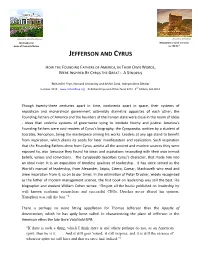
photo source: www.kdhamptons.com photo source: Bruno Barbey Monticello, the Mausoleum of Cyrus the Great Home of Thomas Jefferson ca. 530 BC * JEFFERSON AND CYRUS HOW THE FOUNDING FATHERS OF AMERICA, IN THEIR OWN WORDS, WERE INSPIRED BY CYRUS THE GREAT : A SYNOPSIS Richard N. Frye, Harvard University and Afshin Zand, Independent Scholar Summer 2013. www.richardfrye.org © Richard Frye and Afshin Zand, 2013. 2nd Edition, Feb 2014. Though twenty‐three centuries apart in time, continents apart in space, their systems of republican and monarchical government ostensibly diametric opposites of each other, the Founding Fathers of America and the founders of the Iranian state were close in the realm of ideas ‐ ideas that underlie systems of governance vying to institute liberty and justice. America’s Founding Fathers were avid readers of Cyrus’s biography, the Cyropaedia, written by a student of Socrates, Xenophon, being the masterpiece among his works. Leaders at any age stand to benefit from inspiration, which plants its seeds for later manifestation and realization. Such inspiration that the Founding Fathers drew from Cyrus, amidst all the ancient and modern sources they were exposed to, was because they found his ideas and aspirations resonating with their own inmost beliefs, values and convictions. The Cyropaedia describes Cyrus’s character, that made him into an ideal ruler. It is an exposition of timeless qualities of leadership. It has since served as the World’s manual of leadership, from Alexander, Scipio, Cicero, Caesar, Machiavelli who read and drew inspiration from it, so on to our times. In the estimation of Peter Drucker, widely recognized as the father of modern management science, the first book on leadership was still the best.