Article (Published Version)
Total Page:16
File Type:pdf, Size:1020Kb
Load more
Recommended publications
-

Syagrus Romanzoffiana [Cham.] Glassman
SCIENTIFIC note Doi: https://doi.org/10.17584/rcch.2019v13i3.8363 Pre-depulping and depulping treatments and the emergence of queen palm seeds (Syagrus romanzoffiana [Cham.] Glassman) Tratamiento de pre-despulpado y despulpado sobre la emergencia de semillas de palma reina (Syagrus romanzoffiana [Cham.] Glassman) LUCAS MARQUEZAN NASCIMENTO1 EDUARDO PRADI VENDRUSCOLO2, 4 LUIZ FERNANDES CARDOSO CAMPOS1 LISMAÍRA GONÇALVES CAIXETA GARCIA1 LARISSA LEANDRO PIRES1 ALEXANDER SELEGUINI3 Syagrus romanzoffiana under conditions of Brazilian Cerrado. Photo: L.M. Nascimento ABSTRACT The propagation of the palm Syagrus romanzoffiano is done sexually with seeds, making the process of obtai- ning new plants slow and difficult, especially on large scales. In addition, seed germination is slow, uneven and susceptible to degradation and loss of vigor because of embryo deterioration, even under laboratory conditions. As a result of the lack of information on efficient depulping methods for queen palm fruits, the present study aimed to establish a depulping methodology that is less aggressive to embryos, maintaining emergence quality. This experiment was carried out in Goiânia, Brazil, using fruits from eight stock plants submitted to three pre-depulping treatments (control, fermentation and drying) and two depulping me- thods (industrial depulping and concrete-mixer with the addition of gravel). After the different pre-sowing processes, the fresh and dry pyrenes mass, remaining fibers adhered to the pyrene and seedling emergence were evaluated. The pulper removed an average of 45% more pyrene pulp than the concrete mixer. However, these methodologies did not result in differences in the emergence of plants, which was affected only by the pre-depulping treatment, with superiority in the use of fresh fruits. -

Journal of the International Palm Society Vol. 58(4) Dec. 2014 the INTERNATIONAL PALM SOCIETY, INC
Palms Journal of the International Palm Society Vol. 58(4) Dec. 2014 THE INTERNATIONAL PALM SOCIETY, INC. The International Palm Society Palms (formerly PRINCIPES) Journal of The International Palm Society Founder: Dent Smith The International Palm Society is a nonprofit corporation An illustrated, peer-reviewed quarterly devoted to engaged in the study of palms. The society is inter- information about palms and published in March, national in scope with worldwide membership, and the June, September and December by The International formation of regional or local chapters affiliated with the Palm Society Inc., 9300 Sandstone St., Austin, TX international society is encouraged. Please address all 78737-1135 USA. inquiries regarding membership or information about Editors: John Dransfield, Herbarium, Royal Botanic the society to The International Palm Society Inc., 9300 Gardens, Kew, Richmond, Surrey, TW9 3AE, United Sandstone St., Austin, TX 78737-1135 USA, or by e-mail Kingdom, e-mail j.dransfield@kew.org, tel. 44-20- to info@palms.org, fax 512-607-6468. 8332-5225, Fax 44-20-8332-5278. OFFICERS: Scott Zona, Dept. of Biological Sciences (OE 167), Florida International University, 11200 SW 8 Street, President: Leland Lai, 21480 Colina Drive, Topanga, Miami, Florida 33199 USA, e-mail zonas@fiu.edu, tel. California 90290 USA, e-mail lelandlai@aquafauna.com, 1-305-348-1247, Fax 1-305-348-1986. tel. 1-310-383-2607. Associate Editor: Natalie Uhl, 228 Plant Science, Vice-Presidents: Jeff Brusseau, 1030 Heather Drive, Cornell University, Ithaca, New York 14853 USA, e- Vista, California 92084 USA, e-mail mail nwu1@cornell.edu, tel. 1-607-257-0885. -

09-Plantas Alimentícias.Indd
Iheringia Série Botânica Museu de Ciências Naturais ISSN ON-LINE 2446-8231 Fundação Zoobotânica do Rio Grande do Sul Lista preliminar das plantas alimentícias nativas de Mato Grosso do Sul, Brasil Ieda Maria Bortolotto, Geraldo Alves Damasceno-Junior & Arnildo Pott Fundação Universidade Federal de Mato Grosso do Sul, Instituto de Biociências, Laboratório de Botânica. Bairro Universitário, CEP 79070-900, Campo Grande, Mato Grosso do Sul. iedamaria.bortolotto@gmail.com Recebido em 27.IX.2014 Aceito em 17.V.2016 DOI 10.21826/2446-8231201873s101 RESUMO – Apresentamos o inventário preliminar das plantas alimentícias silvestres do Mato Grosso do Sul usadas na dieta humana ou com potencial para uso. Incluímos espécies que constam em publicações e em trabalhos inéditos dos autores, cujas coletas, realizadas no estado, estão incorporadas nos herbários CGMS, COR e CPAP. Adicionalmente, foram incluídas espécies de Arecaceae, coletadas no estado depositadas em outros Herbários e espécies dos gêneros Arachis, Dioscorea e Passifl ora que constam na Lista de Espécies da Flora do Brasil para o Mato Grosso do Sul. Foram encontradas 294 espécies, distribuídas em 160 gêneros e 67 famílias botânicas. As famílias mais ricas foram Fabaceae (49) e Myrtaceae (38), seguidas por Arecaceae (32) e Passifl oraceae (12). Esta é a primeira listagem de espécies alimentícias do estado. Palavras chaves: frutos comestíveis, Cerrado, Pantanal ABSTRACT – Preliminary list of native food plants of Mato Grosso do Sul, Brazil - We present a preliminary inventory of wild food plants found in Mato Grosso do Sul that are used in human diet or potentially useful. Species were compiled from publications and from data collected by the authors; specimens deposited in CGMS, COR and CPAP herbaria were also included. -
Forest Fragment Size and Microhabitat Effects on Palm Seed Predation
BIOLOGICAL CONSERVATION 131 (2006) 1– 13 available at www.sciencedirect.com journal homepage: www.elsevier.com/locate/biocon Forest fragment size and microhabitat effects on palm seed predation Marina Fleurya,b,c,*, Mauro Galettib,c aLaborato´rio de Ecologia e Restaurac¸a˜ o Florestal (LERF), Escola Superior de Agricultura ‘‘Luiz de Queiroz’’, Universidade de Sa˜ o Paulo (ESALQ/USP), Brazil bLaborato´rio de Biologia da Conservac¸a˜ o, Grupo de Fenologia e Dispersa˜ o de Sementes, Departamento de Ecologia, Universidade Estadual Paulista (UNESP), C.P. 199, 13506-900, Rio Claro, Sa˜ o Paulo, Brazil cInstituto de Biologia da Conservac¸a˜ o (IBC), Av.P-13, 293, Rio Claro, SP, Brazil ARTICLE INFO ABSTRACT Article history: The establishment of plant species depends crucially on where the seeds are deposited. How- Received 11 January 2005 ever, since most studies have been conducted in continuous forests, not much is known about Received in revised form the effects of forest fragmentation on the maintenance of abiotic and biotic characteristics in 19 October 2005 microhabitats and their effects on seed survival. In this study, we evaluated the effects of for- Accepted 24 October 2005 est fragmentation on the predation upon the seeds of the palm Syagrus romanzoffiana in three Available online 3 April 2006 microhabitats (interior forest, forest edge and gaps) in eight fragments of semi-deciduous Atlantic forest ranging in size from 9.5 ha to 33,845 ha in southeastern Brazil. Specifically, Keywords: we examined the influence of the microhabitat structure, fauna and fragment size on the pat- Arecaceae tern of seed predation. -
Floristic Richness in a Transitional Area Between Mixed and Semideciduous Forests in the Middle Tibagi River Region, Southern Brazil
ISSN 0798 1015 HOME Revista ESPACIOS ! ÍNDICES ! A LOS AUTORES ! Vol. 38 (Nº 28) Año 2017. Pág. 18 Floristic richness in a transitional area between Mixed and Semideciduous Forests in the middle Tibagi River region, southern Brazil Riqueza florística em uma área de transição entre Florestas Mistas e Semidecíduas na região média do rio Tibagi, sul do Brasil Eduardo ADENESKY-FILHO 1 ; Franklin GALVÃO 2; Paulo Cesar BOTOSSO 3 Recibido: 31/12/16 • Aprobado: 25/01/2017 Content 1. Introduction 2. Materials and Methods 3. Results 4. Discussion Acknowledgements Bibliographic references ABSTRACT: RESUMO: The vast forest that covered the state of Parana has A vasta floresta que cobria o estado do Paraná foi been reduced to small forest fragments. The Tibagi reduzida a pequenos fragmentos florestais. A bacia do River watershed has some of best fragments, but with rio Tibagi tem alguns dos melhores fragmentos, mas little detailed information about this region is available. com pouca informação detalhada sobre esta região está This study documented the tree and shrub vegetation disponível. Este estudo documentou a vegetação found within the limits of the town of Telêmaco Borba, arbórea e arbórea encontrada dentro dos limites do state of Parana. It recorded 221 species in 51 families município de Telêmaco Borba, estado do Paraná. and 138 genera, among which are one tree species Registou 221 espécies em 51 famílias e 138 gêneros, previously unreported from that state and eight entre os quais uma espécie de árvore anteriormente endangered species. The information obtained shows não declarada desse estado e oito espécies ameaçadas the relevance of forest fragments for the Tibagi River as de extinção. -

MORPHOLOGY of FRUITS, DIASPORES, SEEDS, SEEDLINGS, and SAPLINGS of Syagrus Coronata (Mart.) Becc
652 Original Article MORPHOLOGY OF FRUITS, DIASPORES, SEEDS, SEEDLINGS, AND SAPLINGS OF Syagrus coronata (Mart.) Becc. MORFOLOGIA DE FRUTOS, DIÁSPOROS, SEMENTES, PLÂNTULAS E MUDAS DE Syagrus coronata (Mart.) Becc Sueli da Silva SANTOS-MOURA 1; Edilma Pereira GONÇALVES 2; Luan Danilo Ferreira de Andrade MELO 1; Larissa Guimarães PAIVA 1; Tatiana Maria da SILVA 1 1. Master's in Agricultural Production by the Rural Federal University of Pernambuco, Academic Unit of Garanhuns, Garanhuns, PE, Brazil; 2. Teacher, doctor at the Federal Rural University of Pernambuco, Academic Unit of Garanhuns, Garanhuns, PE, Brazil. ABSTRACT: Licuri ( Syagrus coronata (Mart.) Becc.) is an ornamental palm tree native of Brazil with great economic potential, because it provides raw material for manufacturing a wide range of products. The objective of this study was to assess the morphology of the fruits, diaspores, seeds, seedlings, and saplings of Syagrus coronata . The study was performed at the Laboratory of Seed Analysis (LSA) of the Federal Rural University of Pernambuco/Academic Unit of Garanhuns-PE, by using licuri fruits collected from the rural area of Caetés-PE. It was evaluated fruit morphology, diaspores, seeds, seedlings and saplings. Germination, in the form of cotyledon petiole emergence, began 15 days after sowing, is hypogeal, cryptocotylar, and remote tubular. It is slow and uneven, extending up to 60 days after the first eophyll appears. The saplings have alternate, pinnate, glabrous, entire leaves with parallel venation and sheath invagination. The primary roots persistent, the secondary roots arise from the stem root node in the primary root, and lateral roots only fasciculate was evidenced when the change was 300 days, and must remain in the nursery for at least 360 days after germination before taking it to the field, due to the slow development of this species. -

Breeding Biology of the White-Winged Nightjar (Eleothreptus Candicans) in Eastern Paraguay
Revista Brasileira de Ornitologia, 22(2), 219-233 ARTICLE June 2014 Breeding biology of the White-winged Nightjar (Eleothreptus candicans) in eastern Paraguay Robert G. Pople Department of Zoology, University of Cambridge, Downing Street, Cambridge, CB2 3EJ, UK. Email: rob.pople@cantab.net Current address: BirdLife International, Wellbrook Court, Girton Road, Cambridge, CB3 0NA, UK. Received on 03 September 2013. Accepted on 02 October 2013. ABSTRACT: Breeding biology of the White-winged Nightjar (Eleothreptus candicans) in eastern Paraguay. I present the first detailed description of the breeding biology of the White-winged Nightjar (Eleothreptus candicans), based on data collected over three breeding seasons during 1998-2001 at Aguará Ñu, Canindeyú, eastern Paraguay. Male nightjars defended small territories situated on the upper slopes of ridgelines. Each territory contained one or more “display arenas” at which the male performed nuptial display flights. Aggregation indices confirmed that the primary display arenas of males were significantly clustered within the survey area. Within their territories, males apparently selected display arenas on the basis of their structural characteristics: mounds used as arenas were significantly lower and broader than random mounds. Males engaged in display activity from late August to early January. On average, males performed 0.54 ± 0.04 display flights per minute during nocturnal focal watches, but there was considerable intra-male variation in display rate. Following a burst of activity immediately after their arrival at display arenas at dusk, male display rate was best explained by ambient levels of moonlight. Males produced a previously undescribed insect-like “tik tik” call when inactive on their territories. -

Las Palmeras En El Marco De La Investigacion Para El
REVISTA PERUANA DE BIOLOGÍA Rev. peru: biol. ISSN 1561-0837 Volumen 15 Noviembre, 2008 Suplemento 1 Las palmeras en el marco de la investigación para el desarrollo en América del Sur Contenido Editorial 3 Las comunidades y sus revistas científicas 1he scienrific cornmuniries and their journals Leonardo Romero Presentación 5 Laspalmeras en el marco de la investigación para el desarrollo en América del Sur 1he palrns within the framework ofresearch for development in South America Francis Kahny CésarArana Trabajos originales 7 Laspalmeras de América del Sur: diversidad, distribución e historia evolutiva 1he palms ofSouth America: diversiry, disrriburíon and evolutionary history Jean-Christopbe Pintaud, Gloria Galeano, Henrik Balslev, Rodrigo Bemal, Fmn Borchseníus, Evandro Ferreira, Jean-Jacques de Gran~e, Kember Mejía, BettyMillán, Mónica Moraes, Larry Noblick, FredW; Staufl'er y Francis Kahn . 31 1he genus Astrocaryum (Arecaceae) El género Astrocaryum (Arecaceae) . Francis Kahn 49 1he genus Hexopetion Burret (Arecaceae) El género Hexopetion Burret (Arecaceae) Jean-Cbristopbe Pintand, Betty MiJJány Francls Kahn 55 An overview ofthe raxonomy ofAttalea (Arecaceae) Una visión general de la taxonomía de Attalea (Arecaceae) Jean-Christopbe Pintaud 65 Novelties in the genus Ceroxylon (Arecaceae) from Peru, with description ofa new species Novedades en el género Ceroxylon (Arecaceae) del Perú, con la descripción de una nueva especie Gloria Galeano, MariaJosé Sanín, Kember Mejía, Jean-Cbristopbe Pintaud and Betty MiJJán '73 Estatus taxonómico -

Diferenciação Polínica De Butia, Euterpe, Geonoma, Syagrus E Thritrinax E Implicações Paleoecológicas De Arecaceae Para O Rio Grande Do Sul
Diferenciação polínica de Butia, Euterpe, Genoma, Syagrus e Thritrinax ... 35 Diferenciação polínica de Butia, Euterpe, Geonoma, Syagrus e Thritrinax e implicações paleoecológicas de Arecaceae para o Rio Grande do Sul. Soraia Girardi Bauermann, Andréia Cardoso Pacheco Evaldt, Janaína Rosana Zanchin & Sergio Augusto de Loreto Bordignon Universidade Luterana do Brasil – Laboratório de Palinologia, Av. Farroupilha, 8001. Caixa Postal, 124, CEP. 92425-900, Canoas, RS, Brasil. lab.palinologia@ulbra.br Recebido em 08.VI.2009. Aceito em 03.V.2010 RESUMO – As Arecaceae ou “palmeiras”, como são popularmente conhecidas, compreendem 207 gêneros e 2.675 espécies. Pouco é conhecido sobre sua história paleoecológica no extremo sul do Brasil, principalmente devido à difi culdade de separação das espécies no registro polínico. Para o Estado, é citada a ocorrência de 11 espécies, sendo que 9 são apresentadas neste trabalho contribuindo assim com dados inéditos desta família para o Rio Grande do Sul. A preparação dos grãos de pólen para posterior análise foi realizada através de acetólise. Fez-se descrição polínica dos grãos de pólen de Arecaceae baseado em seus atributos quanti e qualitativos. A análise morfológica das espécies mostrou grãos de pólen estenopolínicos, porém apresentando diferenças em relação ao tamanho e ornamentação, possibilitando o estabelecimento de quatro tipos polínicos. Através dos dados de distribuição e hábitat das espécies foi possível estabelecer correlação entre os tipos polínicos e o ambiente onde as plantas se desenvolvem. Palavras-chave: grãos de pólen, Palmae, morfologia polínica, Arecales. ABSTRACT – Pollen Difference in Butia, Euterpe, Geonoma, Syagrus and Thritrinax and paleoecological implications of Arecaceae for Rio Grande do Sul. The Arecaceae or “palm”, as they are popularly known, comprises 207 genera and 2675 species. -

Journal of the International Palm Society Vol. 57(3) Sep. 2013 the INTERNATIONAL PALM SOCIETY, INC
Palms Journal of the International Palm Society Vol. 57(3) Sep. 2013 THE INTERNATIONAL PALM SOCIETY, INC. The International Palm Society Palms (formerly PRINCIPES) Journal of The International Palm Society Founder: Dent Smith The International Palm Society is a nonprofit corporation An illustrated, peer-reviewed quarterly devoted to engaged in the study of palms. The society is inter- information about palms and published in March, national in scope with worldwide membership, and the June, September and December by The International formation of regional or local chapters affiliated with the Palm Society Inc., 9300 Sandstone St., Austin, TX international society is encouraged. Please address all 78737-1135 USA. inquiries regarding membership or information about Editors: John Dransfield, Herbarium, Royal Botanic the society to The International Palm Society Inc., 9300 Gardens, Kew, Richmond, Surrey, TW9 3AE, United Sandstone St., Austin, TX 78737-1135 USA, or by e-mail Kingdom, e-mail j.dransfield@kew.org, tel. 44-20- to info@palms.org, fax 512-607-6468. 8332-5225, Fax 44-20-8332-5278. OFFICERS: Scott Zona, Dept. of Biological Sciences (OE 167), Florida International University, 11200 SW 8 Street, President: Leland Lai, 21480 Colina Drive, Topanga, Miami, Florida 33199 USA, e-mail zonas@fiu.edu, tel. California 90290 USA, e-mail lelandlai@aquafauna.com, 1-305-348-1247, Fax 1-305-348-1986. tel. 1-310-383-2607. Associate Editor: Natalie Uhl, 228 Plant Science, Vice-Presidents: Jeff Brusseau, 1030 Heather Drive, Cornell University, Ithaca, New York 14853 USA, e- Vista, California 92084 USA, e-mail mail nwu1@cornell.edu, tel. 1-607-257-0885. -
Page 1 T H E M O N T G O M E R Y N E W S T H E M O N T G O M E R Y
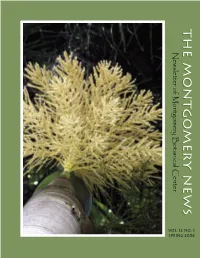
THETHE MONTGOMERYMONTGOMERY NEWSNEWS Newsletter of Montgomery Botanical Center VOL. VOL. 12 NO. 1 SPRING SPRING 2004 WhoWho WeWe AreAre Terrence Walters, Ph.D. Executive Director Lee Anderson Manager, Horticulture & Facilities Mary Andrews Manager, Development & Communications A Botanical Garden Charles Bauduy Assistant Palm Horticulturist Jack Bauer Facilities Supervisor Barbara Bohnsack Built for Science Field Supervisor Mario Borroto Landscaper Terrence Walters, Ph.D. Juan Corona MBC Executive Director Equipment Specialist Orlando Coy Grounds Supervisor Stella Cuestas Assistant Cycad Horticulturist Laurie Danielson Palm Horticulturist Abbie Dasher Landscaper Willy Dye Landscaper Christine Emshousen Cycad Horticulturist Jody Haynes Cycad Biologist Barbara Judd Nursery Horticulturist Judith Kay Seedbank Coordinator Martha Lagos Housekeeper Scott Massey Dicot Horticulturist Vickie Murphy Assistant Palm Horticulturist Larry Noblick, Ph.D. Manager, Collections Development Palm Biologist Willie Payne Landscaper Jessie Pender Landscaper Annamaria Richcreek Administrator Randy Russ Landscaper Arantza Strader Database Assistant Ansel Thomas Irrigation Specialist Hostilio Torres This population of Caryota gigas in the MBC collection not only provides an attractive visual Equipment Operator Marino Valcourt presentation of shapes and textures, but, along with its associated data, is far more valuable Irrigation Technician to researchers than if just one or two representatives of the species were available. Laura Vasquez Field Specialist Evelyn -

Literaturverzeichnis
Literaturverzeichnis Abaimov, A.P., 2010: Geographical Distribution and Ackerly, D.D., 2009: Evolution, origin and age of Genetics of Siberian Larch Species. In Osawa, A., line ages in the Californian and Mediterranean flo- Zyryanova, O.A., Matsuura, Y., Kajimoto, T. & ras. Journal of Biogeography 36, 1221–1233. Wein, R.W. (eds.), Permafrost Ecosystems. Sibe- Acocks, J.P.H., 1988: Veld Types of South Africa. 3rd rian Larch Forests. Ecological Studies 209, 41–58. Edition. Botanical Research Institute, Pretoria, Abbadie, L., Gignoux, J., Le Roux, X. & Lepage, M. 146 pp. (eds.), 2006: Lamto. Structure, Functioning, and Adam, P., 1990: Saltmarsh Ecology. Cambridge Uni- Dynamics of a Savanna Ecosystem. Ecological Stu- versity Press. Cambridge, 461 pp. dies 179, 415 pp. Adam, P., 1994: Australian Rainforests. Oxford Bio- Abbott, R.J. & Brochmann, C., 2003: History and geography Series No. 6 (Oxford University Press), evolution of the arctic flora: in the footsteps of Eric 308 pp. Hultén. Molecular Ecology 12, 299–313. Adam, P., 1994: Saltmarsh and mangrove. In Groves, Abbott, R.J. & Comes, H.P., 2004: Evolution in the R.H. (ed.), Australian Vegetation. 2nd Edition. Arctic: a phylogeographic analysis of the circu- Cambridge University Press, Melbourne, pp. marctic plant Saxifraga oppositifolia (Purple Saxi- 395–435. frage). New Phytologist 161, 211–224. Adame, M.F., Neil, D., Wright, S.F. & Lovelock, C.E., Abbott, R.J., Chapman, H.M., Crawford, R.M.M. & 2010: Sedimentation within and among mangrove Forbes, D.G., 1995: Molecular diversity and deri- forests along a gradient of geomorphological set- vations of populations of Silene acaulis and Saxi- tings.