Grass Pickerel Esox Americanus Vermiculatus
Total Page:16
File Type:pdf, Size:1020Kb
Load more
Recommended publications
-
INDIVIDUAL SANITARY MEASURE Denmark Daniel Oestmann And
DECISION MEMORANDUM— INDIVIDUAL SANITARY MEASURE Denmark Daniel Oestmann and Priya Kadam David Smith and Kevin Gillespie EQUIVALENCE REQUEST: Denmark requested an equivalence determination for an alternative post-mortem inspection i.e. visual inspection instead of palpation and incision of lung and liver and their associated lymph nodes of slaughtered market hogs. For purposes of determining equivalence, Danish market hogs are of the 220-240 pounds /six months of age range; the alternative post-mortem inspection procedure is not applicable to sows, boars, and roaster pigs. BACKGROUND: On December 16, 2008 in an FSIS-Denmark bilateral meeting a team of FSIS experts met and reviewed Denmark’s Supply Chain Inspection system, and presentations by Danish officials. The Supply Chain Inspection system allows inspection of market hogs raised under an integrated quality control program coupled with an on-site verification at slaughter establishments of visually inspected carcasses and organs to ensure that passed carcasses and parts are wholesome and not adulterated. As a part of this inspection system, on December 24, 2008, FSIS approved Denmark’s use of an alternative post- mortem inspection procedure omitting the incision of mandibular lymph nodes for market hogs used to detect granulomatous lymphadenitis which is mitigated through on-farm controls that are assessed and reported through government oversight when hogs come to slaughter. As a part of this Supply Chain Inspection system, in April 2010, Denmark proposed another alternate visual only post mortem inspection procedure, omitting the palpation of mesenteric lymph nodes of slaughtered market hogs used to detect granulomatous lymphadenitis is mitigated through on-farm controls that are assessed and reported through government oversight when hogs come to slaughter. -

Heraldry Examples Booklet.Cdr
Book Heraldry Examples By Khevron No color on color or metal on metal. Try to keep it simple. Make it easy to paint, applique’ or embroider. Blazon in layers from the deepest layer Per pale vert and sable all semy of caltrops e a talbot passant argent. c up to the surface: i v Field (color or division & colors), e Primary charge (charge or ordinary), Basic Book Heraldry d Secondary charges close to the primary, by Khevron a Tertiary charges on the primary or secondary, Device: An heraldic representation of youself. g Peripheral secondary charges (Chief,Canton,Border), Arms: A device of someone with an Award of Arms. n i Tertiary charges on the peropheral. Badge: An heraldic representation of what you own. z a Name field tinctures chief/dexter first. l Only the first word, the metal Or, B and proper nouns are capitalized. 12 2 Tinctures, Furs & Heraldic 11 Field Treatments Cross Examples By Khevron By Khevron Crosses have unique characteristics and specific names. Tinctures: Metals and Colors Chief Rule #1: No color upon another color, or metal on metal! Canton r r e e t t s i x e n - Fess - i D Or Argent Sable Azure Vert Gules Purpure S Furs Base Cross Latin Cross Cross Crosslet Maltese Potent Latin Cross Floury Counter-Vair Vair Vair in PaleVair-en-pointe Vair Ancient Ermine Celtic Cross Cross Gurgity Crosslet Fitchy Cross Moline Cross of Bottony Jerusalem A saltire vair in saltire Vair Ermines or Counter- Counter Potent Potent-en-pointe ermine Cross Quarterly in Saltire Ankh Patonce Voided Cross Barby Cross of Cerdana Erminois Field -
Edna Assay Development
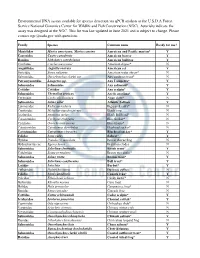
Environmental DNA assays available for species detection via qPCR analysis at the U.S.D.A Forest Service National Genomics Center for Wildlife and Fish Conservation (NGC). Asterisks indicate the assay was designed at the NGC. This list was last updated in June 2021 and is subject to change. Please contact ngc@usda.gov with questions. Family Species Common name Ready for use? Mustelidae Martes americana, Martes caurina American and Pacific marten* Y Castoridae Castor canadensis American beaver Y Ranidae Lithobates catesbeianus American bullfrog Y Cinclidae Cinclus mexicanus American dipper* N Anguillidae Anguilla rostrata American eel Y Soricidae Sorex palustris American water shrew* N Salmonidae Oncorhynchus clarkii ssp Any cutthroat trout* N Petromyzontidae Lampetra spp. Any Lampetra* Y Salmonidae Salmonidae Any salmonid* Y Cottidae Cottidae Any sculpin* Y Salmonidae Thymallus arcticus Arctic grayling* Y Cyrenidae Corbicula fluminea Asian clam* N Salmonidae Salmo salar Atlantic Salmon Y Lymnaeidae Radix auricularia Big-eared radix* N Cyprinidae Mylopharyngodon piceus Black carp N Ictaluridae Ameiurus melas Black Bullhead* N Catostomidae Cycleptus elongatus Blue Sucker* N Cichlidae Oreochromis aureus Blue tilapia* N Catostomidae Catostomus discobolus Bluehead sucker* N Catostomidae Catostomus virescens Bluehead sucker* Y Felidae Lynx rufus Bobcat* Y Hylidae Pseudocris maculata Boreal chorus frog N Hydrocharitaceae Egeria densa Brazilian elodea N Salmonidae Salvelinus fontinalis Brook trout* Y Colubridae Boiga irregularis Brown tree snake* -
Government Data Confirm That Grizzly Bears Have a Negligible Effect on U.S. Cattle and Sheep Industries
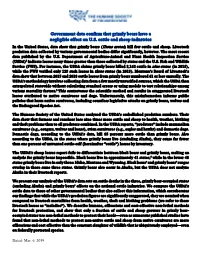
Government data confirm that grizzly bears have a negligible effect on U.S. cattle and sheep industries In the United States, data show that grizzly bears (Ursus arctos) kill few cattle and sheep. Livestock predation data collected by various governmental bodies differ significantly, however. The most recent data published by the U.S. Department of Agriculture-Animal and Plant Health Inspection Service (USDA)1 indicate losses many times greater than those collected by states and the U.S. Fish and Wildlife Service (FWS). For instance, the USDA claims grizzly bears killed 3,162 cattle in nine states (in 2015), while the FWS verified only 123 such losses in three states (in 2013). Montana’s Board of Livestock’s data show that between 2015 and 2018 cattle losses from grizzly bears numbered 61 or less annually. The USDA’s methodology involves collecting data from a few mostly unverified sources, which the USDA then extrapolated statewide without calculating standard errors or using models to test relationships among various mortality factors.2 This contravenes the scientific method and results in exaggerated livestock losses attributed to native carnivores and dogs. Unfortunately, this misinformation informs public policies that harm native carnivores, including countless legislative attacks on grizzly bears, wolves and the Endangered Species Act. The Humane Society of the United States analyzed the USDA’s embellished predation numbers. Their data show that farmers and ranchers lose nine times more cattle and sheep to health, weather, birthing and theft problems than to all predators combined. In the USDA reports, “predators” include mammalian carnivores (e.g., cougars, wolves and bears), avian carnivores (e.g., eagles and hawks) and domestic dogs. -

Livestock Concerns with Feral Hogs
Livestock Concerns with Feral Hogs Aaron Sumrall Newton Co. Extension Agent History of Feral Hogs • Introduce to New World by De Soto in 1539 as a food source. • Made it to Texas in 1680’s. • Population explosion beginning in 1930 thru now……Why? – Great Depression….hardship of the 30’s. – Imported for hunting opportunities. What is the Current Status? • Population estimates of >1 million. • Occupy 244 of 254 counties. • 2007- Caused $52 million in Ag only. • $200/Hog/Year in Damage. • 42 of 50 States. Feral Hog Biology • Life expectancy of 4-5 years. • Reproductively capable of 6 months if nutrition is available. – 1st litter can be weaned before 1st birthday of sow. • Gestation of 115 days. • Average littler size of 4-6 piglets. • What do you call a group of feral hogs? Feral Hog Biology….Continued • Sounders typically of 6-12 individuals can be >30. • Mature hogs from 110-300 lbs. • Come in 3 flavors. – Eurasian Wild Boar – Domesticated hogs released – Combination of the two Areas of Feral Hog Damage • Agricultural:$52 million in 2007. • Disease • Predation • Habitat Destruction • Accidents • Sensitive Areas……example Wetlands. • Residential • Recreational • $800 million animal in Ag/Environmental. Areas of Feral Hog Damage...Continued • Length of tie required for land recovery. • Loss of topsoil. • Destruction of sensitive habitat. • Predation of livestock and wildlife population. • Introduction of other invasive species. – Reduction or loss of native vegetation. • Reduced water quality. – Roadway damage, etc…. What are Legal Options? • Hunting • Trapping • Dogs • Snares • Ariel Gunning What else is Legal? • Are you required to hold a hunting license shoot/hunt hogs? –It Depends!!! Is it Legal to Raise Feral Hogs? • NO! It is not legal to posses or feed feral hogs without a permit. -

Ecology and Conservation of Mudminnow Species Worldwide
FEATURE Ecology and Conservation of Mudminnow Species Worldwide Lauren M. Kuehne Ecología y conservación a nivel mundial School of Aquatic and Fishery Sciences, University of Washington, Seattle, WA 98195 de los lucios RESUMEN: en este trabajo, se revisa y resume la ecología Julian D. Olden y estado de conservación del grupo de peces comúnmente School of Aquatic and Fishery Sciences, University of Washington, Box conocido como “lucios” (anteriormente conocidos como 355020, Seattle, WA 98195, and Australian Rivers Institute, Griffith Uni- la familia Umbridae, pero recientemente reclasificados en versity, QLD, 4111, Australia. E-mail: olden@uw.edu la Esocidae) los cuales se constituyen de sólo cinco espe- cies distribuidas en tres continentes. Estos peces de cuerpo ABSTRACT: We review and summarize the ecology and con- pequeño —que viven en hábitats de agua dulce y presentan servation status of the group of fishes commonly known as movilidad limitada— suelen presentar poblaciones aisla- “mudminnows” (formerly known as the family Umbridae but das a lo largo de distintos paisajes y son sujetos a las típi- recently reclassified as Esocidae), consisting of only five species cas amenazas que enfrentan las especies endémicas que distributed on three continents. These small-bodied fish—resid- se encuentran en contacto directo con los impactos antro- ing in freshwater habitats and exhibiting limited mobility—often pogénicos como la contaminación, alteración de hábitat occur in isolated populations across landscapes and are subject e introducción de especies no nativas. Aquí se resume el to conservation threats common to highly endemic species in conocimiento actual acerca de la distribución, relaciones close contact with anthropogenic impacts, such as pollution, filogenéticas, ecología y estado de conservación de cada habitat alteration, and nonnative species introductions. -

Comparative Food Habits of Deer and Three Classes of Livestock Author(S): Craig A
Comparative Food Habits of Deer and Three Classes of Livestock Author(s): Craig A. McMahan Reviewed work(s): Source: The Journal of Wildlife Management, Vol. 28, No. 4 (Oct., 1964), pp. 798-808 Published by: Allen Press Stable URL: http://www.jstor.org/stable/3798797 . Accessed: 13/07/2012 12:15 Your use of the JSTOR archive indicates your acceptance of the Terms & Conditions of Use, available at . http://www.jstor.org/page/info/about/policies/terms.jsp . JSTOR is a not-for-profit service that helps scholars, researchers, and students discover, use, and build upon a wide range of content in a trusted digital archive. We use information technology and tools to increase productivity and facilitate new forms of scholarship. For more information about JSTOR, please contact support@jstor.org. Allen Press is collaborating with JSTOR to digitize, preserve and extend access to The Journal of Wildlife Management. http://www.jstor.org COMPARATIVEFOOD HABITSOF DEERAND THREECLASSES OF LIVESTOCK CRAIGA. McMAHAN,Texas Parksand Wildlife Department,Hunt Abstract: To observe forage competition between deer and livestock, the forage selections of a tame deer (Odocoileus virginianus), a goat, a sheep, and a cow were observed under four range conditions, using both stocked and unstocked experimental pastures, on the Kerr Wildlife Management Area in the Edwards Plateau region of Texas in 1959. The animals were trained in 2 months of preliminary testing. The technique employed consisted of recording the number of bites taken of each plant species by each animal during a 45-minute grazing period in each pasture each week for 1 year. -

Susquhanna River Fishing Brochure
Fishing the Susquehanna River The Susquehanna Trophy-sized muskellunge (stocked by Pennsylvania) and hybrid tiger muskellunge The Susquehanna River flows through (stocked by New York until 2007) are Chenango, Broome, and Tioga counties for commonly caught in the river between nearly 86 miles, through both rural and urban Binghamton and Waverly. Local hot spots environments. Anglers can find a variety of fish include the Chenango River mouth, Murphy’s throughout the river. Island, Grippen Park, Hiawatha Island, the The Susquehanna River once supported large Smallmouth bass and walleye are the two Owego Creek mouth, and Baileys Eddy (near numbers of migratory fish, like the American gamefish most often pursued by anglers in Barton) shad. These stocks have been severely impacted Fishing the the Susquehanna River, but the river also Many anglers find that the most enjoyable by human activities, especially dam building. Susquehanna River supports thriving populations of northern pike, and productive way to fish the Susquehanna is The Susquehanna River Anadromous Fish Res- muskellunge, tiger muskellunge, channel catfish, by floating in a canoe or small boat. Using this rock bass, crappie, yellow perch, bullheads, and method, anglers drift cautiously towards their toration Cooperative (SRFARC) is an organiza- sunfish. preferred fishing spot, while casting ahead tion comprised of fishery agencies from three of the boat using the lures or bait mentioned basin states, the Susquehanna River Commission Tips and Hot Spots above. In many of the deep pool areas of the (SRBC), and the federal government working Susquehanna, trolling with deep running lures together to restore self-sustaining anadromous Fishing at the head or tail ends of pools is the is also effective. -

Muskellunge: a Michigan Resource
Muskellunge: A Michigan Resource The muskellunge, or musky, is a tremendous game fish native to the lakes and streams of Michigan. The musky also is a fish of many myths regarding its’ appetite, size and elusiveness. The stories about muskies portray a fish feeding on anything that moves and can fit down their tooth-filled jaws…yet believed to be so difficult to catch that the musky is called “the fish of 10,000 casts.” Here, we briefly explore the mythical, legendary and genuine muskellunge. IDENTIFICATION Muskellunge are members of the esocid family of fish, which also includes the northern pike. This particular family of fish, technically called Esocidae, share similar characteristics such as long thin bodies and soft-rayed fins. These fish have large mouths full of sharp teeth. Muskellunge and pike are identified as piscivores, which means their primary diet is fish. Though similar in appearance, muskellunge tend to achieve larger sizes than northern pike. The musky’s coloration is one of dark stripes, or dark spots, on a light background. Northern pike, in contrast, usually have light, bean-shaped spots on a dark background. The shape of the tail fin is a good method of identification as a musky’s is pointed and the tail fin of a pike is rounded. Another key characteristic for identification is the presence or absence of scales on the cheeks and gill covers. Muskies only have scales on the upper half of the cheek and gill cover. Like the muskellunge, the northern pike gill cover has scales on the upper half, but the cheek is fully scaled. -

Fish Species of Saskatchewan
Introduction From the shallow, nutrient -rich potholes of the prairies to the clear, cool rock -lined waters of our province’s north, Saskatchewan can boast over 50,000 fish-bearing bodies of water. Indeed, water accounts for about one-eighth, or 80,000 square kilometers, of this province’s total surface area. As numerous and varied as these waterbodies are, so too are the types of fish that inhabit them. In total, Saskatchewan is home to 67 different fish species from 16 separate taxonomic families. Of these 67, 58 are native to Saskatchewan while the remaining nine represent species that have either been introduced to our waters or have naturally extended their range into the province. Approximately one-third of the fish species found within Saskatchewan can be classed as sportfish. These are the fish commonly sought out by anglers and are the best known. The remaining two-thirds can be grouped as minnow or rough-fish species. The focus of this booklet is primarily on the sportfish of Saskatchewan, but it also includes information about several rough-fish species as well. Descriptions provide information regarding the appearance of particular fish as well as habitat preferences and spawning and feeding behaviours. The individual species range maps are subject to change due to natural range extensions and recessions or because of changes in fisheries management. "...I shall stay him no longer than to wish him a rainy evening to read this following Discourse; and that, if he be an honest Angler, the east wind may never blow when he goes a -fishing." The Compleat Angler Izaak Walton, 1593-1683 This booklet was originally published by the Saskatchewan Watershed Authority with funds generated from the sale of angling licences and made available through the FISH AND WILDLIFE DEVELOPMENT FUND. -

Control Efforts for Invasive Northern Pike Esox Lucius on the Kenai Peninsula, 2007
Fishery Data Series No. 11-10 Control Efforts for Invasive Northern Pike Esox lucius on the Kenai Peninsula, 2007 by Robert L. Massengill May 2011 Alaska Department of Fish and Game Divisions of Sport Fish and Commercial Fisheries Symbols and Abbreviations The following symbols and abbreviations, and others approved for the Système International d'Unités (SI), are used without definition in the following reports by the Divisions of Sport Fish and of Commercial Fisheries: Fishery Manuscripts, Fishery Data Series Reports, Fishery Management Reports, and Special Publications. All others, including deviations from definitions listed below, are noted in the text at first mention, as well as in the titles or footnotes of tables, and in figure or figure captions. Weights and measures (metric) General Measures (fisheries) centimeter cm Alaska Administrative fork length FL deciliter dL Code AAC mid eye to fork MEF gram g all commonly accepted mid eye to tail fork METF hectare ha abbreviations e.g., Mr., Mrs., standard length SL kilogram kg AM, PM, etc. total length TL kilometer km all commonly accepted liter L professional titles e.g., Dr., Ph.D., Mathematics, statistics meter m R.N., etc. all standard mathematical milliliter mL at @ signs, symbols and millimeter mm compass directions: abbreviations east E alternate hypothesis HA Weights and measures (English) north N base of natural logarithm e cubic feet per second ft3/s south S catch per unit effort CPUE foot ft west W coefficient of variation CV gallon gal copyright © common test statistics (F, t, χ2, etc.) inch in corporate suffixes: confidence interval CI mile mi Company Co. -

Heraldic Terms
HERALDIC TERMS The following terms, and their definitions, are used in heraldry. Some terms and practices were used in period real-world heraldry only. Some terms and practices are used in modern real-world heraldry only. Other terms and practices are used in SCA heraldry only. Most are used in both real-world and SCA heraldry. All are presented here as an aid to heraldic research and education. A LA CUISSE, A LA QUISE - at the thigh ABAISED, ABAISSÉ, ABASED - a charge or element depicted lower than its normal position ABATEMENTS - marks of disgrace placed on the shield of an offender of the law. There are extreme few records of such being employed, and then only noted in rolls. (As who would display their device if it had an abatement on it?) ABISME - a minor charge in the center of the shield drawn smaller than usual ABOUTÉ - end to end ABOVE - an ambiguous term which should be avoided in blazon. Generally, two charges one of which is above the other on the field can be blazoned better as "in pale an X and a Y" or "an A and in chief a B". See atop, ensigned. ABYSS - a minor charge in the center of the shield drawn smaller than usual ACCOLLÉ - (1) two shields side-by-side, sometimes united by their bottom tips overlapping or being connected to each other by their sides; (2) an animal with a crown, collar or other item around its neck; (3) keys, weapons or other implements placed saltirewise behind the shield in a heraldic display.