Nomina Insecta Nearctica Scarabaeidae
Total Page:16
File Type:pdf, Size:1020Kb
Load more
Recommended publications
-

ANTC Environmental Assessment
U.S. Department of the Interior Bureau of Land Management Environmental Assessment DOI-BLM-NV-B010-2013-0024-EA Telecommunication Facilities at Kingston, Dyer, and Hickison Summit July 2013 Applicant: Arizona Nevada Tower Corporation 6220 McLeod Drive Ste. 100 Las Vegas, Nevada 89120 Battle Mountain District Bureau of Land Management 50 Bastian Road Battle Mountain, Nevada 89820 Table of Contents Page Chapter 1 Introduction 1 1.1 Introduction 1 1.2 Background 1 1.3 Identifying Information 2 1.4 Location of Proposed Action 2 1.5 Preparing Office 2 1.6 Case File Numbers 2 1.7 Applicant 2 1.8 Proposed Action Summary 3 1.9 Conformance 3 1.10 Purpose & Need 3 1.11 Scoping, Public Involvement & Issues 4 Chapter 2 Proposed Action & Alternatives 11 2.1 Proposed Action 11 2.1.1 Best Management Practices 13 2.2 No Action Alternative 13 2.3 Alternatives Considered but Eliminated from Detailed Analysis 14 Chapter 3 Affected Environment & Environmental Consequences 15 3.1 Project Site Descriptions 15 3.2 Issues 16 3.2.1 Air Quality 18 3.2.1.1 Affected Environment 18 3.2.1.2 Environmental Consequences 18 3.2.2 Cultural/Historical Resources 18 3.2.2.1 Affected Environment 18 3.2.2.2 Environmental Consequences 18 3.2.3 Noxious Weeds/Invasive Non-native Plants 19 3.2.3.1 Affected Environment 19 3.2.3.2 Environmental Consequences 20 3.2.4 Native American Religious Concerns 20 3.2.4.1 Affected Environment 20 3.2.4.2 Environmental Consequences 20 3.2.5 Migratory Birds 21 3.2.5.1 Affected Environment 21 3.2.5.2 Environmental Consequences 22 3.2.6 Solid/Hazardous -

Morphology, Taxonomy, and Biology of Larval Scarabaeoidea
Digitized by the Internet Archive in 2011 with funding from University of Illinois Urbana-Champaign http://www.archive.org/details/morphologytaxono12haye ' / ILLINOIS BIOLOGICAL MONOGRAPHS Volume XII PUBLISHED BY THE UNIVERSITY OF ILLINOIS *, URBANA, ILLINOIS I EDITORIAL COMMITTEE John Theodore Buchholz Fred Wilbur Tanner Charles Zeleny, Chairman S70.S~ XLL '• / IL cop TABLE OF CONTENTS Nos. Pages 1. Morphological Studies of the Genus Cercospora. By Wilhelm Gerhard Solheim 1 2. Morphology, Taxonomy, and Biology of Larval Scarabaeoidea. By William Patrick Hayes 85 3. Sawflies of the Sub-family Dolerinae of America North of Mexico. By Herbert H. Ross 205 4. A Study of Fresh-water Plankton Communities. By Samuel Eddy 321 LIBRARY OF THE UNIVERSITY OF ILLINOIS ILLINOIS BIOLOGICAL MONOGRAPHS Vol. XII April, 1929 No. 2 Editorial Committee Stephen Alfred Forbes Fred Wilbur Tanner Henry Baldwin Ward Published by the University of Illinois under the auspices of the graduate school Distributed June 18. 1930 MORPHOLOGY, TAXONOMY, AND BIOLOGY OF LARVAL SCARABAEOIDEA WITH FIFTEEN PLATES BY WILLIAM PATRICK HAYES Associate Professor of Entomology in the University of Illinois Contribution No. 137 from the Entomological Laboratories of the University of Illinois . T U .V- TABLE OF CONTENTS 7 Introduction Q Economic importance Historical review 11 Taxonomic literature 12 Biological and ecological literature Materials and methods 1%i Acknowledgments Morphology ]* 1 ' The head and its appendages Antennae. 18 Clypeus and labrum ™ 22 EpipharynxEpipharyru Mandibles. Maxillae 37 Hypopharynx <w Labium 40 Thorax and abdomen 40 Segmentation « 41 Setation Radula 41 42 Legs £ Spiracles 43 Anal orifice 44 Organs of stridulation 47 Postembryonic development and biology of the Scarabaeidae Eggs f*' Oviposition preferences 48 Description and length of egg stage 48 Egg burster and hatching Larval development Molting 50 Postembryonic changes ^4 54 Food habits 58 Relative abundance. -

Forestgeo Arthropod Initiative Annual Report 2018
FORESTGEO ARTHROPOD INITIATIVE ANNUAL REPORT 2018 Program coordinator: Yves Basset, Smithsonian Tropical Research Institute (STRI), bassety@si.edu I. BACKGROUND AND PARTICIPATING FORESTGEO SITES The ‘Arthropod Initiative’ of the Center for Tropical Forest Science (CTFS) aims at monitoring key arthropod assemblages over long-term and studying insect-plant interactions over the network of the Forest Global Earth Observatories (ForestGEO, https://forestgeo.si.edu/research-programs/arthropod-initiative). The Initiative integrates with ongoing monitoring of plant dynamics within the ForestGEO network, causes minimum possible impact to the plots and focus on a priority set of assemblages chosen for their ecological relevance, taxonomic tractability and ease of sampling. At each participating ForestGEO site, the first years of the program are usually devoted to a ‘baseline’ survey. The baseline survey is followed by longer-term programs of field work and analysis, organized into two main sub-programs: monitoring, and key interaction studies. The monitoring sub-program is directed to detecting long-term changes, as reflected in priority assemblages, driven by climatic cycles, climatic change and landscape scale habitat alteration. Monitoring protocols are derived from those used during the baseline survey. The food web approach of interaction studies targets interactions between plants and specific insect assemblages, with different protocols than those used for monitoring. So far, the Arthropod Initiative involves nine ForestGEO sites: Yasuni in Ecuador, Barro Colorado Island (BCI) in Panama, Rabi in Gabon, Khao Chong (KHC) in Thailand, Tai Po Kau (Hong Kong), Dinghushan and Xishuangbanna (XTBG) in China, Bukit Timah in Singapore and Wanang (WAN) in Papua New Guinea. At BCI, four full-time research assistants were in charge of arthropod monitoring protocols in 2018: Filonila Perez, Ricardo Bobadilla, Yacksecari Lopez and Alejandro Ramirez. -

An Annotated Checklist of Wisconsin Scarabaeoidea (Coleoptera)
University of Nebraska - Lincoln DigitalCommons@University of Nebraska - Lincoln Center for Systematic Entomology, Gainesville, Insecta Mundi Florida March 2002 An annotated checklist of Wisconsin Scarabaeoidea (Coleoptera) Nadine A. Kriska University of Wisconsin-Madison, Madison, WI Daniel K. Young University of Wisconsin-Madison, Madison, WI Follow this and additional works at: https://digitalcommons.unl.edu/insectamundi Part of the Entomology Commons Kriska, Nadine A. and Young, Daniel K., "An annotated checklist of Wisconsin Scarabaeoidea (Coleoptera)" (2002). Insecta Mundi. 537. https://digitalcommons.unl.edu/insectamundi/537 This Article is brought to you for free and open access by the Center for Systematic Entomology, Gainesville, Florida at DigitalCommons@University of Nebraska - Lincoln. It has been accepted for inclusion in Insecta Mundi by an authorized administrator of DigitalCommons@University of Nebraska - Lincoln. INSECTA MUNDI, Vol. 16, No. 1-3, March-September, 2002 3 1 An annotated checklist of Wisconsin Scarabaeoidea (Coleoptera) Nadine L. Kriska and Daniel K. Young Department of Entomology 445 Russell Labs University of Wisconsin-Madison Madison, WI 53706 Abstract. A survey of Wisconsin Scarabaeoidea (Coleoptera) conducted from literature searches, collection inventories, and three years of field work (1997-1999), yielded 177 species representing nine families, two of which, Ochodaeidae and Ceratocanthidae, represent new state family records. Fifty-six species (32% of the Wisconsin fauna) represent new state species records, having not previously been recorded from the state. Literature and collection distributional records suggest the potential for at least 33 additional species to occur in Wisconsin. Introduction however, most of Wisconsin's scarabaeoid species diversity, life histories, and distributions were vir- The superfamily Scarabaeoidea is a large, di- tually unknown. -

Coleoptera: Melolonthidae: Dynastinae)
Revista Brasileira de Entomologia 61 (2017) 354–358 REVISTA BRASILEIRA DE Entomologia A Journal on Insect Diversity and Evolution www.rbentomologia.com Systematics, Morphology and Biogeography Description of the third instar larva of Saccharoscaptus laminifer (Dechambre) (Coleoptera: Melolonthidae: Dynastinae) Miguel Ángel Morón Red de Biodiversidad y Sistemática, Instituto de Ecología, Xalapa, Mexico a a b s t r a c t r t i c l e i n f o Article history: The larva of pentodontine S. laminifer is described for first time based on specimens collected under Received 4 April 2017 roots of sugarcane in Santa Cruz, Bolivia. Diagnostic structures are illustrated and the differences and Accepted 17 July 2017 similarities with other previously described larvae of South American genera of Pentodontini are outlined. Available online 29 July 2017 A key to the larvae of some American genera of pentodontines is included. Associate Editor: Adriana Marvaldi © 2017 Sociedade Brasileira de Entomologia. Published by Elsevier Editora Ltda. This is an open access article under the CC BY-NC-ND license (http://creativecommons.org/licenses/by-nc-nd/4.0/). Keywords: Morphology Taxonomy Biology White grubs Sugarcane Introduction Material and methods In the Americas, the tribe Pentodontini includes 32 genera and The classification of families of Scarabaeoidea used in the 151 species that occur from southern Canada to Argentina, with present paper was proposed by Endrödi (1966) and updated by four genera and nine species in the West Indies (Endrödi, 1969, Morón (2010) and Cherman and Morón (2014). Terms and charac- 1985; Morón and Grossi, 2015; Ratcliffe and Cave, 2015; López- ters used in the description of larva are those of Ritcher (1966), García et al., 2016), but only the larvae of nine genera (Aphonus Morón (1987), and Morón et al. -

A Passion for Rhinoceros and Stag Beetles in Japan
SCARABS CZ CN MNCHEM, NBYS QCFF WIGY. Occasional Issue Number 67 Print ISSN 1937-8343 Online ISSN 1937-8351 September, 2011 A Passion for Rhinoceros and Stag Beetles WITHIN THIS ISSUE in Japan Dynastid and Lucanid Enthusiasm in Japan ........ 1 by Kentaro Miwa University of Nebraska-Lincoln Bug People XXIV ........... 10 Department of Entomology In Past Years XLVI ......... 11 kmiwa@huskers.unl.edu Guatemala Scarabs IV ... 20 BACK ISSUES Available At These Sites: Coleopterists Society www.coleopsoc.org/de- fault.asp?Action=Show_ Resources&ID=Scarabs University of Nebraska A large population of the general public in Japan enjoys collecting and www-museum.unl.edu/ rearing insects. Children are exposed to insects at early ages because their research/entomology/ parents are interested in insects. My son went on his first collecting trip Scarabs-Newsletter.htm on a cool day in March in Nebraska when he was four months old. EDITORS I am from Shizuoka, Japan. I am currently pursuing my Ph.D in En- Rich Cunningham tomology at the University of Nebraska-Lincoln and studying biology Scarab349@aol.com and applied ecology of insets in cropping systems. Among many insect Olivier Décobert taxa I am interested in, dynastines and lucanids are my favorite groups. oldec@wanadoo.fr I have enjoyed collecting and rearing these beetles throughout my life. Barney Streit I began collecting beetles with my parents and grandparents when barneystreit@hotmail. com I was two years old. When I was about six, I learned to successfully rear some Japanese species. Since I came to the United States, I have been enjoying working with American species. -

Species at Risk on Department of Defense Installations
Species at Risk on Department of Defense Installations Revised Report and Documentation Prepared for: Department of Defense U.S. Fish and Wildlife Service Submitted by: January 2004 Species at Risk on Department of Defense Installations: Revised Report and Documentation CONTENTS 1.0 Executive Summary..........................................................................................iii 2.0 Introduction – Project Description................................................................. 1 3.0 Methods ................................................................................................................ 3 3.1 NatureServe Data................................................................................................ 3 3.2 DOD Installations............................................................................................... 5 3.3 Species at Risk .................................................................................................... 6 4.0 Results................................................................................................................... 8 4.1 Nationwide Assessment of Species at Risk on DOD Installations..................... 8 4.2 Assessment of Species at Risk by Military Service.......................................... 13 4.3 Assessment of Species at Risk on Installations ................................................ 15 5.0 Conclusion and Management Recommendations.................................... 22 6.0 Future Directions............................................................................................. -

Heteronychus Arator
Heteronychus arator Scientific Name Heteronychus arator (Fabricius) Synonyms: Heteronychus arator australis Endrödi, Heteronychus indenticulatus Endrodi, Heteronychus madagassus Endrodi, Heteronychus sanctaehelenae Blanchard, Heteronychus transvaalensis Peringuey, Scarabaeus arator Fabricius Common Name(s) Black maize beetle, African black beetle, black lawn beetle, black beetle Type of Pest Beetle Figure 1. Illustration of each stage of the life Taxonomic Position cycle of the black maize beetle, showing a close up view of each stage and a Insecta, Coleoptera, Class: Order: background view showing that the eggs, Family: Scarabaeidae larvae, and pupae are all underground stages with the adults being the only stage Reason for Inclusion appearing above ground. Illustration CAPS Target: AHP Prioritized Pest List- courtesy of NSW Agriculture. http://www.ricecrc.org/Hort/ascu/zecl/zeck11 2006 – 2009 3.htm Pest Description Life stages are shown in Figures 1 and 2. 1 Eggs: White, oval, and measuring approximately 1.8 mm (approx. /16 in) long at time of oviposition. Eggs grow larger through development and become more 3 round in shape. Eggs are laid singly at a soil depth of 1 to 5 cm (approx. /8 to 2 in). Females each lay between 12 to 20 eggs total. In the field, eggs hatch after approximately 20 days. Larvae can be seen clearly with the naked eye (CABI, 2007; Matthiessen and Learmoth, 2005). Larvae: There are three larval instars. Larvae are creamy-white except for the brown head capsule and hind segments, which appear dark where the contents of the gut show through the body wall. The head capsule is smooth textured, 1 1 measuring 1.5 mm (approx. -
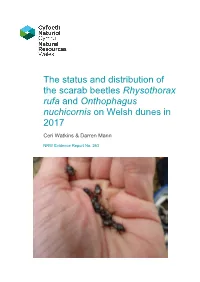
The Status and Distribution of the Scarab Beetles Rhysothorax Rufa and Onthophagus Nuchicornis on Welsh Dunes In
The status and distribution of the scarab beetles Rhysothorax rufa and Onthophagus nuchicornis on Welsh dunes in 2017 Ceri Watkins & Darren Mann NRW Evidence Report No. 263 D8 NRW Evidence Report No. 263 About Natural Resources Wales Natural Resources Wales is the organisation responsible for the work carried out by the three former organisations, the Countryside Council for Wales, Environment Agency Wales and Forestry Commission Wales. It is also responsible for some functions previously undertaken by Welsh Government. Our purpose is to ensure that the natural resources of Wales are sustainably maintained, used and enhanced, now and in the future. We work for the communities of Wales to protect people and their homes as much as possible from environmental incidents like flooding and pollution. We provide opportunities for people to learn, use and benefit from Wales' natural resources. We work to support Wales' economy by enabling the sustainable use of natural resources to support jobs and enterprise. We help businesses and developers to understand and consider environmental limits when they make important decisions. We work to maintain and improve the quality of the environment for everyone and we work towards making the environment and our natural resources more resilient to climate change and other pressures. Evidence at Natural Resources Wales Natural Resources Wales is an evidence based organisation. We seek to ensure that our strategy, decisions, operations and advice to Welsh Government and others are underpinned by sound and quality-assured evidence. We recognise that it is critically important to have a good understanding of our changing environment. We will realise this vision by: • Maintaining and developing the technical specialist skills of our staff; • Securing our data and information; • Having a well resourced proactive programme of evidence work; • Continuing to review and add to our evidence to ensure it is fit for the challenges facing us; and • Communicating our evidence in an open and transparent way. -

Comparison of Coleoptera Emergent from Various Decay Classes of Downed Coarse Woody Debris in Great Smoky Mountains National Park, USA
University of Nebraska - Lincoln DigitalCommons@University of Nebraska - Lincoln Center for Systematic Entomology, Gainesville, Insecta Mundi Florida 11-30-2012 Comparison of Coleoptera emergent from various decay classes of downed coarse woody debris in Great Smoky Mountains National Park, USA Michael L. Ferro Louisiana State Arthropod Museum, spongymesophyll@gmail.com Matthew L. Gimmel Louisiana State University AgCenter, phalacrid@gmail.com Kyle E. Harms Louisiana State University, kharms@lsu.edu Christopher E. Carlton Louisiana State University Agricultural Center, ccarlton@agcenter.lsu.edu Follow this and additional works at: https://digitalcommons.unl.edu/insectamundi Ferro, Michael L.; Gimmel, Matthew L.; Harms, Kyle E.; and Carlton, Christopher E., "Comparison of Coleoptera emergent from various decay classes of downed coarse woody debris in Great Smoky Mountains National Park, USA" (2012). Insecta Mundi. 773. https://digitalcommons.unl.edu/insectamundi/773 This Article is brought to you for free and open access by the Center for Systematic Entomology, Gainesville, Florida at DigitalCommons@University of Nebraska - Lincoln. It has been accepted for inclusion in Insecta Mundi by an authorized administrator of DigitalCommons@University of Nebraska - Lincoln. INSECTA A Journal of World Insect Systematics MUNDI 0260 Comparison of Coleoptera emergent from various decay classes of downed coarse woody debris in Great Smoky Mountains Na- tional Park, USA Michael L. Ferro Louisiana State Arthropod Museum, Department of Entomology Louisiana State University Agricultural Center 402 Life Sciences Building Baton Rouge, LA, 70803, U.S.A. spongymesophyll@gmail.com Matthew L. Gimmel Division of Entomology Department of Ecology & Evolutionary Biology University of Kansas 1501 Crestline Drive, Suite 140 Lawrence, KS, 66045, U.S.A. -

A Baseline Invertebrate Survey of the Knepp Estate - 2015
A baseline invertebrate survey of the Knepp Estate - 2015 Graeme Lyons May 2016 1 Contents Page Summary...................................................................................... 3 Introduction.................................................................................. 5 Methodologies............................................................................... 15 Results....................................................................................... 17 Conclusions................................................................................... 44 Management recommendations........................................................... 51 References & bibliography................................................................. 53 Acknowledgements.......................................................................... 55 Appendices.................................................................................... 55 Front cover: One of the southern fields showing dominance by Common Fleabane. 2 0 – Summary The Knepp Wildlands Project is a large rewilding project where natural processes predominate. Large grazing herbivores drive the ecology of the site and can have a profound impact on invertebrates, both positive and negative. This survey was commissioned in order to assess the site’s invertebrate assemblage in a standardised and repeatable way both internally between fields and sections and temporally between years. Eight fields were selected across the estate with two in the north, two in the central block -
Coleoptera: Introduction and Key to Families
Royal Entomological Society HANDBOOKS FOR THE IDENTIFICATION OF BRITISH INSECTS To purchase current handbooks and to download out-of-print parts visit: http://www.royensoc.co.uk/publications/index.htm This work is licensed under a Creative Commons Attribution-NonCommercial-ShareAlike 2.0 UK: England & Wales License. Copyright © Royal Entomological Society 2012 ROYAL ENTOMOLOGICAL SOCIETY OF LONDON Vol. IV. Part 1. HANDBOOKS FOR THE IDENTIFICATION OF BRITISH INSECTS COLEOPTERA INTRODUCTION AND KEYS TO FAMILIES By R. A. CROWSON LONDON Published by the Society and Sold at its Rooms 41, Queen's Gate, S.W. 7 31st December, 1956 Price-res. c~ . HANDBOOKS FOR THE IDENTIFICATION OF BRITISH INSECTS The aim of this series of publications is to provide illustrated keys to the whole of the British Insects (in so far as this is possible), in ten volumes, as follows : I. Part 1. General Introduction. Part 9. Ephemeroptera. , 2. Thysanura. 10. Odonata. , 3. Protura. , 11. Thysanoptera. 4. Collembola. , 12. Neuroptera. , 5. Dermaptera and , 13. Mecoptera. Orthoptera. , 14. Trichoptera. , 6. Plecoptera. , 15. Strepsiptera. , 7. Psocoptera. , 16. Siphonaptera. , 8. Anoplura. 11. Hemiptera. Ill. Lepidoptera. IV. and V. Coleoptera. VI. Hymenoptera : Symphyta and Aculeata. VII. Hymenoptera: Ichneumonoidea. VIII. Hymenoptera : Cynipoidea, Chalcidoidea, and Serphoidea. IX. Diptera: Nematocera and Brachycera. X. Diptera: Cyclorrhapha. Volumes 11 to X will be divided into parts of convenient size, but it is not possible to specify in advance the taxonomic content of each part. Conciseness and cheapness are main objectives in this new series, and each part will be the work of a specialist, or of a group of specialists.