California's Offshore Wind Electricity Opportunity
Total Page:16
File Type:pdf, Size:1020Kb
Load more
Recommended publications
-
Renewable Tracking Progress Appendix
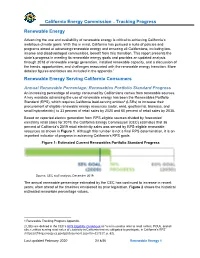
California Energy Commission – Tracking Progress Renewable Energy Advancing the use and availability of renewable energy is critical to achieving California’s ambitious climate goals. With this in mind, California has pursued a suite of policies and programs aimed at advancing renewable energy and ensuring all Californians, including low- income and disadvantaged communities, benefit from this transition. This report presents the state’s progress in meeting its renewable energy goals and provides an updated analysis through 2018 of renewable energy generation, installed renewable capacity, and a discussion of the trends, opportunities, and challenges associated with the renewable energy transition. More detailed figures and tables are included in the appendix.1 Renewable Energy Serving California Consumers Annual Renewable Percentage: Renewables Portfolio Standard Progress An increasing percentage of energy consumed by Californians comes from renewable sources. A key mandate advancing the use of renewable energy has been the Renewables Portfolio Standard (RPS), which requires California load-serving entities2 (LSEs) to increase their procurement of eligible renewable energy resources (solar, wind, geothermal, biomass, and small hydroelectric) to 33 percent of retail sales by 2020 and 60 percent of retail sales by 2030. Based on reported electric generation from RPS-eligible sources divided by forecasted electricity retail sales for 2019, the California Energy Commission (CEC) estimates that 36 percent of California’s 2019 retail electricity sales was served by RPS-eligible renewable resources as shown in Figure 1. Although this number is not a final RPS determination, it is an important indicator of progress in achieving California’s RPS goals. Figure 1: Estimated Current Renewables Portfolio Standard Progress Source: CEC staff analysis, December 2019 The annual renewable percentage estimated by the CEC has continued to increase in recent years, often ahead of the timelines envisioned by prior legislation. -

Analyzing the Energy Industry in United States
+44 20 8123 2220 info@marketpublishers.com Analyzing the Energy Industry in United States https://marketpublishers.com/r/AC4983D1366EN.html Date: June 2012 Pages: 700 Price: US$ 450.00 (Single User License) ID: AC4983D1366EN Abstracts The global energy industry has explored many options to meet the growing energy needs of industrialized economies wherein production demands are to be met with supply of power from varied energy resources worldwide. There has been a clearer realization of the finite nature of oil resources and the ever higher pushing demand for energy. The world has yet to stabilize on the complex geopolitical undercurrents which influence the oil and gas production as well as supply strategies globally. Aruvian's R'search’s report – Analyzing the Energy Industry in United States - analyzes the scope of American energy production from varied traditional sources as well as the developing renewable energy sources. In view of understanding energy transactions, the report also studies the revenue returns for investors in various energy channels which manifest themselves in American energy demand and supply dynamics. In depth view has been provided in this report of US oil, electricity, natural gas, nuclear power, coal, wind, and hydroelectric sectors. The various geopolitical interests and intentions governing the exploitation, production, trade and supply of these resources for energy production has also been analyzed by this report in a non-partisan manner. The report starts with a descriptive base analysis of the characteristics of the global energy industry in terms of economic quantity of demand. The drivers of demand and the traditional resources which are used to fulfill this demand are explained along with the emerging mandate of nuclear energy. -

Barriers, Opportunities, and Research Needs Draft Report
Public Interest Energy Research (PIER) Program FINAL PROJECT REPORT TASK 5. Biomass Energy in California’s Future: Barriers, Opportunities, and Research Needs_ Draft Report Prepared for: California Energy Commission Prepared by: UC Davis California Geothermal Energy Collaborative DECEMBER 2013 CEC‐500‐01‐016 Prepared by: Primary Author(s): Stephen Kaffka, University of California, Davis Robert Williams, University of California, Davis Douglas Wickizer, University of California, Davis UC Davis California Geothermal Energy Collaborative 1715 Tilia St. Davis, CA 95616 www.cgec.ucdavis.edu Contract Number: 500‐01‐016 Prepared for: California Energy Commission Michael Sokol Contract Manager Reynaldo Gonzalez Office Manager Energy Generation Research Office Laurie ten Hope Deputy Director Energy Research & Development Division Robert P. Oglesby Executive Director DISCLAIMER This report was prepared as the result of work sponsored by the California Energy Commission. It does not necessarily represent the views of the Energy Commission, its employees or the State of California. The Energy Commission, the State of California, its employees, contractors and subcontractors make no warrant, express or implied, and assume no legal liability for the information in this report; nor does any party represent that the uses of this information will not infringe upon privately owned rights. This report has not been approved or disapproved by the California Energy Commission nor has the California Energy Commission passed upon the accuracy or adequacy of the information in this report. ACKNOWLEDGEMENTS The California Goethermal Energy Collaborative would like to thank the California Energy Commission and its Public Interest Energy Research Program (PIER) for sponsoring this important work as well as the Geothermal Energy Association for assisting in tracking down the most up to date data both within the United States and abroad. -

Microgrid Market Analysis: Alaskan Expertise, Global Demand
Microgrid Market Analysis: Alaskan Expertise, Global Demand A study for the Alaska Center for Microgrid Technology Commercialization Prepared by the University of Alaska Center for Economic Development 2 3 Contents Introduction .................................................................................................................................................. 4 Market Trends ............................................................................................................................................... 5 Major Microgrid Segments ....................................................................................................................... 5 Global demand of microgrids ................................................................................................................... 5 Where does Alaska fit into the picture? Which segments are relevant? ................................................. 7 Remote/Wind-Diesel Microgrids .......................................................................................................... 8 Military Microgrid ................................................................................................................................. 8 Microgrid Resources with Examples in Alaska .............................................................................................. 8 Wind .......................................................................................................................................................... 8 Kotzebue ............................................................................................................................................ -

Incorporating Renewables Into the Electric Grid: Expanding Opportunities for Smart Markets and Energy Storage
INCORPORATING RENEWABLES INTO THE ELECTRIC GRID: EXPANDING OPPORTUNITIES FOR SMART MARKETS AND ENERGY STORAGE June 2016 Contents Executive Summary ....................................................................................................................................... 2 Introduction .................................................................................................................................................. 5 I. Technical and Economic Considerations in Renewable Integration .......................................................... 7 Characteristics of a Grid with High Levels of Variable Energy Resources ................................................. 7 Technical Feasibility and Cost of Integration .......................................................................................... 12 II. Evidence on the Cost of Integrating Variable Renewable Generation ................................................... 15 Current and Historical Ancillary Service Costs ........................................................................................ 15 Model Estimates of the Cost of Renewable Integration ......................................................................... 17 Evidence from Ancillary Service Markets................................................................................................ 18 Effect of variable generation on expected day-ahead regulation mileage......................................... 19 Effect of variable generation on actual regulation mileage .............................................................. -

The Green Economic Recovery: Wind Energy Tax Policy After Financial Crisis and the American Recovery and Reinvestment Tax Act of 2009
CORE Metadata, citation and similar papers at core.ac.uk Provided by University of Oregon Scholars' Bank JEFFRY S. HINMAN∗ The Green Economic Recovery: Wind Energy Tax Policy After Financial Crisis and the American Recovery and Reinvestment Tax Act of 2009 I. The Benefits, Challenges, and Potential of the U.S. Wind Industry................................................................................... 39 A. Environmental Benefits of Wind...................................... 40 B. Economic Benefits of Wind ............................................. 41 1. Jobs and Economic Activity........................................ 41 2. Competitiveness with Traditional Power Plants ......... 43 C. Challenges for the Wind Energy Industry ......................... 44 1. Efficiency, Grid Access, and Intermittency ................ 44 2. Environmental Concerns and Local Opposition ......... 45 II. Federal Support for Renewable Energy Past and Present ....... 46 A. Renewable Energy Tax Policy 1978 to 1992 .................... 47 1. The National Energy Act of 1978 ............................... 48 2. Additional State-Level Tax Incentives in California During the 1980s ....................................... 50 3. The California Wind Boom......................................... 51 4. Shortcomings of the Wind Boom................................ 52 5. The Free Market Approach 1986 to 1992 ................... 53 ∗ J.D., University of Oregon School of Law, 2009; Editor-in-Chief, Journal of Environmental Law and Litigation, 2008–2009; Recipient, Tax Law Certificate of Completion; B.S., Oregon State University, 2002. I want to thank the editorial staff of the Journal of Environmental Law and Litigation for their friendship and masterful edits. I also want to extend my appreciation to the excellent tax law faculty at the University of Oregon, Professors Roberta Mann and Nancy Shurtz, for their guidance and feedback. Finally, and most importantly, I owe a huge debt of gratitude to my incredible wife Kathleen for her patience and support. -

Jacobson and Delucchi (2009) Electricity Transport Heat/Cool 100% WWS All New Energy: 2030
Energy Policy 39 (2011) 1154–1169 Contents lists available at ScienceDirect Energy Policy journal homepage: www.elsevier.com/locate/enpol Providing all global energy with wind, water, and solar power, Part I: Technologies, energy resources, quantities and areas of infrastructure, and materials Mark Z. Jacobson a,n, Mark A. Delucchi b,1 a Department of Civil and Environmental Engineering, Stanford University, Stanford, CA 94305-4020, USA b Institute of Transportation Studies, University of California at Davis, Davis, CA 95616, USA article info abstract Article history: Climate change, pollution, and energy insecurity are among the greatest problems of our time. Addressing Received 3 September 2010 them requires major changes in our energy infrastructure. Here, we analyze the feasibility of providing Accepted 22 November 2010 worldwide energy for all purposes (electric power, transportation, heating/cooling, etc.) from wind, Available online 30 December 2010 water, and sunlight (WWS). In Part I, we discuss WWS energy system characteristics, current and future Keywords: energy demand, availability of WWS resources, numbers of WWS devices, and area and material Wind power requirements. In Part II, we address variability, economics, and policy of WWS energy. We estimate that Solar power 3,800,000 5 MW wind turbines, 49,000 300 MW concentrated solar plants, 40,000 300 MW solar Water power PV power plants, 1.7 billion 3 kW rooftop PV systems, 5350 100 MW geothermal power plants, 270 new 1300 MW hydroelectric power plants, 720,000 0.75 MW wave devices, and 490,000 1 MW tidal turbines can power a 2030 WWS world that uses electricity and electrolytic hydrogen for all purposes. -

California's Energy Future
California’s Energy Future: The View to 2050 Summary Report May 2011 Jane C. S. Long (co-chair) LEGAL NOTICE This report was prepared pursuant to a contract between the California Energy Commission (CEC) and the California Council on Science and Technology (CCST). It does not represent the views of the CEC, its employees, or the State of California. The CEC, the State of California, its employees, contractors, and subcontractors make no warranty, express or implied, and assume no legal liability for the information in this report; nor does any party represent that the use of this information will not infringe upon privately owned rights. ACKNOWLEDGEMENTS We would also like to thank the Stephen Bechtel Fund and the California Energy Commision for their contributions to the underwriting of this project. We would also like to thank the California Air Resources Board for their continued support and Lawrence Livermore National Laboratory for underwriting the leadership of this effort. COPYRIGHT Copyright 2011 by the California Council on Science and Technology. Library of Congress Cataloging Number in Publications Data Main Entry Under Title: California’s Energy Future: A View to 2050 May 2011 ISBN-13: 978-1-930117-44-0 Note: The California Council on Science and Technology (CCST) has made every reasonable effort to assure the accuracy of the information in this publication. However, the contents of this publication are subject to changes, omissions, and errors, and CCST does not accept responsibility for any inaccuracies that may occur. CCST is a non-profit organization established in 1988 at the request of the California State Government and sponsored by the major public and private postsecondary institutions of California and affiliate federal laboratories in conjunction with leading private-sector firms. -

Renewable Energy in Alaska WH Pacific, Inc
Renewable Energy in Alaska WH Pacific, Inc. Anchorage, Alaska NREL Technical Monitor: Brian Hirsch NREL is a national laboratory of the U.S. Department of Energy, Office of Energy Efficiency & Renewable Energy, operated by the Alliance for Sustainable Energy, LLC. Subcontract Report NREL/SR-7A40-47176 March 2013 Contract No. DE-AC36-08GO28308 Renewable Energy in Alaska WH Pacific, Inc. Anchorage, Alaska NREL Technical Monitor: Brian Hirsch Prepared under Subcontract No. AEU-9-99278-01 NREL is a national laboratory of the U.S. Department of Energy, Office of Energy Efficiency & Renewable Energy, operated by the Alliance for Sustainable Energy, LLC. National Renewable Energy Laboratory Subcontract Report 15013 Denver West Parkway NREL/SR-7A40-47176 Golden, Colorado 80401 March 2013 303-275-3000 • www.nrel.gov Contract No. DE-AC36-08GO28308 This publication was reproduced from the best available copy submitted by the subcontractor and received minimal editorial review at NREL. NOTICE This report was prepared as an account of work sponsored by an agency of the United States government. Neither the United States government nor any agency thereof, nor any of their employees, makes any warranty, express or implied, or assumes any legal liability or responsibility for the accuracy, completeness, or usefulness of any information, apparatus, product, or process disclosed, or represents that its use would not infringe privately owned rights. Reference herein to any specific commercial product, process, or service by trade name, trademark, manufacturer, or otherwise does not necessarily constitute or imply its endorsement, recommendation, or favoring by the United States government or any agency thereof. The views and opinions of authors expressed herein do not necessarily state or reflect those of the United States government or any agency thereof. -

TB Pickens Misadventure with Wind
T. Boone’s Windy Misadventure And the Global Backlash Against Wind Energy By Robert Bryce Posted on Jul. 28, 2011 Three years ago this month, T. Boone Pickens launched a multi-million dollar crusade to bring more wind energy to the US. “Building new wind generation facilities,” along with energy efficiency and more consumption of domestic natural gas, the Dallas billionaire claimed, would allow the US to “replace more than one-third of our foreign oil imports in 10 years.” Those were halcyon times for the wind industry. These days, Pickens never talks about wind. He’s focused instead on getting a fat chunk of federal subsidies so he can sell more natural gas to long-haul truckers through his company, Clean Energy Fuels. (Pickens and his wife, Madeleine, own about half of the stock of Clean Energy, a stake worth about $550 million.) While the billionaire works the halls of Congress seeking a subsidy of his very own, he's also trying to find a buyer for the $2 billion worth of wind turbines he contracted for back in 2008. The last news report that I saw indicated that he was trying to foist the turbines off onto the Canadians. Being dumped by Pickens is only one of a panoply of problems facing the global wind industry. Among the issues: an abundance of relatively cheap natural gas, a growing backlash against industrial wind projects due to concerns about visual blight and noise, increasing concerns about the murderous effect that wind turbines have on bats and birds, the extremely high costs of offshore wind energy, and a new study which finds that wind energy’s ability to cut carbon dioxide emissions have been overstated. -

California's Water-Energy Relationship
CALIFORNIA ENERGY COMMISSION California's Water – Energy Relationship Prepared in Support of the 2005 Integrated EPORT Energy Policy Report Proceeding (04-IEPR-01E) R TAFF S INAL F NOVEMBER 2005 CEC-700-2005-011-SF Arnold Schwarzenegger, Governor 1 CALIFORNIA ENERGY COMMISSION Primary Author Gary Klein California Energy Commission Martha Krebs Deputy Director Energy Research and Development Division Valerie Hall Deputy Director Energy Efficiency & Demand Analysis Division Terry O’Brien Deputy Director Systems Assessment & Facilities Siting Division B. B. Blevins Executive Director DISCLAIMER This paper was prepared as the result of work by one or more members of the staff of the California Energy Commission. It does not necessarily represent the views of the Energy Commission, its employees, or the State of California. The Energy Commission, the State of California, its employees, contractors and subcontractors make no warrant, express or implied, and assume no legal liability for the information in this paper; nor does any party represent that the uses of this information will not infringe upon privately owned rights. This paper has not been approved or disapproved by the California Energy Commission nor has the California Energy Commission passed upon the accuracy or adequacy of the information in this paper. 2 ACKNOWLEDGEMENTS The California’s Water-Energy Relationship report is the product of contributions by many California Energy Commission staff and consultants, including Ricardo Amon, Shahid Chaudhry, Thomas S. Crooks, Marilyn Davin, Joe O’Hagan, Pramod Kulkarni, Kae Lewis, Laurie Park, Paul Roggensack, Monica Rudman, Matt Trask, Lorraine White and Zhiqin Zhang. Staff would also like to thank the members of the Water-Energy Working Group who so graciously gave of their time and expertise to inform this report. -

Wind Energy Is Not the Answer
WIND ENERGY IS NOT THE ANSWER by Bradley S. Tupii Abstract. Wind energy is not the answer to climate change concerns and cannot do the heavy lifting required by the modern American economy. It would take hundreds of thousands of wind turbines to make a substantial contribution to America’s energy needs. Building so many turbines inevitably causes conflicts with human and animal habitats. Wind turbine noise is a serious problem for those who live in the vicinity of so-called wind farms. * * * Introduction. Wind energy is not a modern phenomenon. Man harnessed the wind with sailboats and windmills hundreds of years ago. Charles Brush developed a wind-powered electric generator in 1888.2 Small, wind-powered generators such as the Jacobs Wind-Electric Machine became popular in the Midwest in the early 20th Century.3 These windmills became obsolete when Depression-era programs brought more reliable electric power to rural areas.4 Wind energy began a slow resurgence during the Carter administration when the Public Utility Regulatory Policies Act of 19785 fostered state tax incentives for wind power development and allowed non-utility energy producers to sell electricity to utilities.6 Currently, wind power is hailed by some as a key weapon in the battle against global warming and as an important contributor to American energy independence. This paper will argue that wind energy is neither. Wind power cannot generate enough reliable electricity to replace conventional energy sources, including those that generate greenhouse gases. Assuming for the sake of argument that carbon dioxide is contributing to global climate change, wind power will not materially reduce CO2 emissions.