Volunteering with Madison Senior Center 330 W
Total Page:16
File Type:pdf, Size:1020Kb
Load more
Recommended publications
-
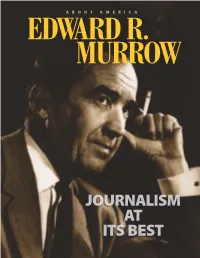
Edward R. Murrow
ABOUT AMERICA EDWARD R. MURROW JOURNALISM AT ITS BEST TABLE OF CONTENTS Edward R. Murrow: A Life.............................................................1 Freedom’s Watchdog: The Press in the U.S.....................................4 Murrow: Founder of American Broadcast Journalism....................7 Harnessing “New” Media for Quality Reporting .........................10 “See It Now”: Murrow vs. McCarthy ...........................................13 Murrow’s Legacy ..........................................................................16 Bibliography..................................................................................17 Photo Credits: University of Maryland; right, Digital Front cover: © CBS News Archive Collections and Archives, Tufts University. Page 1: CBS, Inc., AP/WWP. 12: Joe Barrentine, AP/WWP. 2: top left & right, Digital Collections and Archives, 13: Digital Collections and Archives, Tufts University; bottom, AP/WWP. Tufts University. 4: Louis Lanzano, AP/WWP. 14: top, Time Life Pictures/Getty Images; 5 : left, North Wind Picture Archives; bottom, AP/WWP. right, Tim Roske, AP/WWP. 7: Digital Collections and Archives, Tufts University. Executive Editor: George Clack 8: top left, U.S. Information Agency, AP/WWP; Managing Editor: Mildred Solá Neely right, AP/WWP; bottom left, Digital Collections Art Director/Design: Min-Chih Yao and Archives, Tufts University. Contributing editors: Chris Larson, 10: Digital Collections and Archives, Tufts Chandley McDonald University. Photo Research: Ann Monroe Jacobs 11: left, Library of American Broadcasting, Reference Specialist: Anita N. Green 1 EDWARD R. MURROW: A LIFE By MARK BETKA n a cool September evening somewhere Oin America in 1940, a family gathers around a vacuum- tube radio. As someone adjusts the tuning knob, a distinct and serious voice cuts through the airwaves: “This … is London.” And so begins a riveting first- hand account of the infamous “London Blitz,” the wholesale bombing of that city by the German air force in World War II. -

The Journal of the Duke Ellington Society Uk Volume 23 Number 3 Autumn 2016
THE JOURNAL OF THE DUKE ELLINGTON SOCIETY UK VOLUME 23 NUMBER 3 AUTUMN 2016 nil significat nisi pulsatur DUKE ELLINGTON SOCIETY UK http://dukeellington.org.uk DESUK COMMITTEE HONORARY MEMBERS OF DESUK Art Baron CHAIRMAN: Geoff Smith John Lamb Vincent Prudente VICE CHAIRMAN: Mike Coates Monsignor John Sanders SECRETARY: Quentin Bryar Tel: 0208 998 2761 Email: qbryar@gmail.com HONORARY MEMBERS SADLY NO LONGER WITH US TREASURER: Grant Elliot Tel: 01284 753825 Bill Berry (13 October 2002) Email: g.elliot143@btinternet.com Harold Ashby (13 June 2003) Jimmy Woode (23 April 2005) MEMBERSHIP SECRETARY: Mike Coates Tel: 0114 234 8927 Humphrey Lyttelton (25 April 2008) Email: MBigwidge@aol.com Louie Bellson (14 February 2009) Joya Sherrill (28 June 2010) PUBLICITY: Chris Addison Tel:01642-274740 Alice Babs (11 February, 2014) Email: chrisj.addison@hotmail.com Herb Jeffries (25 May 2014) MEETINGS: Antony Pepper Tel: 01342-314053 Derek Else (16 July 2014) Email: ap@antonypepper.com Clark Terry (21 February 2015) Joe Temperley (11 May, 2016) COMMITTEE MEMBERS: Roger Boyes, Ian Buster Cooper (13 May 2016) Bradley, George Duncan, Frank Griffith, Frank Harvey Membership of Duke Ellington Society UK costs £25 SOCIETY NOTICES per year. Members receive quarterly a copy of the Society’s journal Blue Light. DESUK London Social Meetings: Civil Service Club, 13-15 Great Scotland Yard, London nd Payment may be made by: SW1A 2HJ; off Whitehall, Trafalgar Square end. 2 Saturday of the month, 2pm. Cheque, payable to DESUK drawn on a Sterling bank Antony Pepper, contact details as above. account and sent to The Treasurer, 55 Home Farm Lane, Bury St. -
INTRODUCTION: BLUE NOTES TOWARD a NEW JAZZ DISCOURSE I. Authority and Authenticity in Jazz Historiography Most Books and Article
INTRODUCTION: BLUE NOTES TOWARD A NEW JAZZ DISCOURSE MARK OSTEEN, LOYOLA COLLEGE I. Authority and Authenticity in Jazz Historiography Most books and articles with "jazz" in the title are not simply about music. Instead, their authors generally use jazz music to investigate or promulgate ideas about politics or race (e.g., that jazz exemplifies democratic or American values,* or that jazz epitomizes the history of twentieth-century African Americans); to illustrate a philosophy of art (either a Modernist one or a Romantic one); or to celebrate the music as an expression of broader human traits such as conversa- tion, flexibility, and hybridity (here "improvisation" is generally the touchstone). These explorations of the broader cultural meanings of jazz constitute what is being touted as the New Jazz Studies. This proliferation of the meanings of "jazz" is not a bad thing, and in any case it is probably inevitable, for jazz has been employed as an emblem of every- thing but mere music almost since its inception. As Lawrence Levine demon- strates, in its formative years jazz—with its vitality, its sexual charge, its use of new technologies of reproduction, its sheer noisiness—was for many Americans a symbol of modernity itself (433). It was scandalous, lowdown, classless, obscene, but it was also joyous, irrepressible, and unpretentious. The music was a battlefield on which the forces seeking to preserve European high culture met the upstarts of popular culture who celebrated innovation, speed, and novelty. It 'Crouch writes: "the demands on and respect for the individual in the jazz band put democracy into aesthetic action" (161). -
The Edward R. Murrow of Docudramas and Documentary
Media History Monographs 12:1 (2010) ISSN 1940-8862 The Edward R. Murrow of Docudramas and Documentary By Lawrence N. Strout Mississippi State University Three major TV and film productions about Edward R. Murrow‟s life are the subject of this research: Murrow, HBO, 1986; Edward R. Murrow: This Reporter, PBS, 1990; and Good Night, and Good Luck, Warner Brothers, 2005. Murrow has frequently been referred to as the “father” of broadcast journalism. So, studying the “documentation” of his life in an attempt to ascertain its historical role in supporting, challenging, and/or adding to the collective memory and mythology surrounding him is important. Research on the docudramas and documentary suggests the depiction that provided the least amount of context regarding Murrow‟s life (Good Night) may be the most available for viewing (DVD). Therefore, Good Night might ultimately contribute to this generation (and the next) having a more narrow and skewed memory of Murrow. And, Good Night even seems to add (if that is possible) to Murrow‟s already “larger than life” mythological image. ©2010 Lawrence N. Strout Media History Monographs 12:1 Strout: Edward R. Murrow The Edward R. Murrow of Docudramas and Documentary Edward R. Murrow officially resigned from Life and Legacy of Edward R. Murrow” at CBS in January of 1961 and he died of cancer AEJMC‟s annual convention in August 2008, April 27, 1965.1 Unquestionably, Murrow journalists and academicians devoted a great contributed greatly to broadcast journalism‟s deal of time revisiting Edward R. Murrow‟s development; achieved unprecedented fame in contributions to broadcast journalism‟s the United States during his career at CBS;2 history. -

Jacques Butler “Jack”
1 The TRUMPET of JACQUES BUTLER “JACK” Solographer: Jan Evensmo Last update: July 7, 2019 2 Born: April 29, 1909 Died: 2003 Introduction: There is no doubt: Jacques Butler was well known in the Norwegian jazz community, because he was visiting Oslo in 1940 and recorded one 78 rpm. together with our own best jazz performers. So, we grew up with him! History: Raised in Washington, D.C., studied dentistry at Howard University, began playing trumpet at the age of 17. Moved to New York City, worked with Cliff Jackson in the late 1920s, with Horace Henderson (1930-1). Led own band (in New York and on tour) 1934-35, worked with Willie Bryant, then to Europe. Joined Willie Lewis band (late 1936), worked mainly with Willie Lewis until 1939, then toured Scandinavia from June 1939. Was in Norway at the commencement of World War II, returned to the U.S.A. in April 1940. Led own band, worked with Mezz Mezzrow (spring 1943), with Art Hodes (summer 1943- 44), with Bingie Madison (1945), with bassist Cass Carr (summer 1947). Worked in Toronto, Canada (1948). Returned to Europe in late 1950, led own band on various tours, then played long residency at ‘La Cigale’, Paris, from 1953 until returning to the U.S.A. in 1968. Still plays regularly in New York (at the time of writing). Appeared in the film ‘Paris Blues’ (1961). (ref. John Chilton). 3 JACK BUTLER SOLOGRAPHY SAMMY LEWIS & HIS BAMVILLE SYNCOPATORS NYC. June 14, 1926 Edwin Swayze (cnt, arr), Jack Butler (cnt, cl?), Oscar Hammond (tb), Eugene Eikelberger (cl, as), Paul Serminole (p), Jimmy McLin (bjo), Lester Nichols (dm), Sammy Lewis (vo). -
The Highest Note in the Century Since His Birth, Duke Ellington Has Been the Most Important Composer of Any Music, Anywhere Blumenthal, Bob
Document 1 of 1 The highest note In the century since his birth, Duke Ellington has been the most important composer of any music, anywhere Blumenthal, Bob. Boston Globe [Boston, Mass] 25 Apr 1999: 1. Abstract The late Duke Ellington, whose 100th birthday will be celebrated on Thursday, disliked the word "jazz." As he famously remarked, the only subsets of music he recognized were good and bad. Rather than stress categorical distinctions, Ellington preferred to celebrate artists and works that were, in another of his oft-quoted phrases, "beyond category." The magnitude of Ellington's legacy should be clear to all who can hear, and even to those who can only count. Just look at the numbers. From 1914, when he wrote "Soda Fountain Rag" as an aspiring pianist in his native Washington, D.C., until shortly before his death, on May 24, 1974, Ellington was responsible for nearly 2,000 documented compositions. From 1923, when he first gained employment in New York for his Washingtonians at Barron Wilkins's Harlem nightclub, he kept an orchestra together through boom andbust. The notion of writing for specific individuals as part of an ensemble reached its highest form of expression with Ellington. Rather than simply creating music for a three-piece trombone section, he crafted lines that fit the plungered growl of Joe "Tricky Sam" Nanton, the fluency of Lawrence Brown, and the warmth of Jual Tizol's valved instrument; and he applied this practice to every chair in the band. This led Ellington to collect musicians whose "tonal personality" (another favor-ite image) inspired him, ratherthan those who might simply blendinto an undifferentiated orchestral mass. -

Edward R. Murrow: Journalism at Its Best
ABOUT AMERICA EDWARD R. MURROW JOURNALISM AT ITS BEST TABLE OF CONTENTS Edward R. Murrow: A Life .............................................................1 Freedom’s Watchdog: The Press in the U.S. ....................................4 Murrow: Founder of American Broadcast Journalism ....................7 Harnessing “New” Media for Quality Reporting .........................10 “See It Now”: Murrow vs. McCarthy ...........................................13 Murrow’s Legacy...........................................................................16 Bibliography ..................................................................................17 Photo Credits: 12: Joe Barrentine, AP/WWP. Front cover: © CBS News Archive 13: Digital Collections and Archives, Page 1: CBS, Inc., AP/WWP. Tufts University. 2: top left & right, Digital Collections and Archives, 14: top, Time Life Pictures/Getty Images; Tufts University; bottom, AP/WWP. bot tom, AP/ W WP. 4: Louis Lanzano, AP/WWP. Back cover: Edward Murrow © 1994 United States 5: left, North Wind Picture Archives; Postal Service. All Rights Reserved. right, Tim Roske, AP/WWP. Used with Permission. 7: Digital Collections and Archives, Tufts University. 8: top left, U.S. Information Agency, AP/WWP; right, AP/WWP; bottom left, Digital Collections Executive Editor: George Clack and Archives, Tufts University. Managing Editor: Mildred Solá Neely 10: Digital Collections and Archives, Tufts Art Director/Design: Min-Chih Yao University. Contributing editors: Chris Larson, 11: left, Library of American -
" the Strange Birth Of'cbs Reports'" Revisited
DOCUMENT RESUMEL ED 205 963 CS 206 427 AUTHOR Baughman, James L. TITLE "The Strange Birth of 'CBS Reports'" Revisited. .PUB DATE Aug 81 NOTE 24p.: Paper presented at the Annual Meeting of the Association for Education in Journalism (64th, East Lansing, M/, August 8-11, 1981). EBBS PRICE MP01/PC01 Plus Postage. DESCRIPTORS *Broadcast industry: *Broadcast TO.evision: Case Studies: *News Reporting: *Programing (Broadcast): Socioeconomic Influences \ IDENTIFIERS *Broadcast History: *CBS !rports ABSTRACT - Aired by the Columbia Broadcasting system (CBS) during the 1960s, "CBS Reports" proved to be one of that network's most honored efferts at television news coverage. CBSchairman, William S. Paley, based his decision to air the show on the presence of a sponsor and in response to the prospect of an open-endedFederal Communications Commission (FCC) Inquiry into network operations and a critics' tempest over the departure of another CBS News Program, ."See It Nov." The path of "CBS Reports" serves to illustrate twopoints: the economics of prograNing in the 1950s did mattergreatly to at least one network deciding for prime time news, andcritics and regulator) probably,did influence such determinations.(HOD) ** 4 *$ * Reproductions supplied by EDRS are the best that can be made from the original document. a U.S. DEPARTMENT OF EDUCATION NATIONAL INSTITUTE OF EDUCATION EOVC.ITIONAL RESOURCES AtFORMATION CENTER IERtCt .9 the docutown tve been teprodk.cod es "coned Rom the tenon co oroamabon t*Newry 4 Move changes have been mete to ."Mont teorOducten gyably History Division P0,071.0lva, a opinions maid n the docv meni do not /*cemet', r*Preitat °He. -
Duke Ellington 4 Meet the Ellingtonians 9 Additional Resources 15
ellington 101 a beginner’s guide Vital Statistics • One of the greatest composers of the 20th century • Composed nearly 2,000 works, including three-minute instrumental pieces, popular songs, large-scale suites, sacred music, film scores, and a nearly finished opera • Developed an extraordinary group of musicians, many of whom stayed with him for over 50 years • Played more than 20,000 performances over the course of his career • Influenced generations of pianists with his distinctive style and beautiful sound • Embraced the range of American music like no one else • Extended the scope and sound of jazz • Spread the language of jazz around the world ellington 101 a beginner’s guide Table of Contents A Brief Biography of Duke Ellington 4 Meet the Ellingtonians 9 Additional Resources 15 Duke’s artistic development and sustained achievement were among the most spectacular in the history of music. His was a distinctly democratic vision of music in which musicians developed their unique styles by selflessly contributing to the whole band’s sound . Few other artists of the last 100 years have been more successful at capturing humanity’s triumphs and tribulations in their work than this composer, bandleader, and pianist. He codified the sound of America in the 20th century. Wynton Marsalis Artistic Director, Jazz at Lincoln Center Ellington, 1934 I wrote “Black and Tan Fantasy” in a taxi coming down through Central Park on my way to a recording studio. I wrote “Mood Indigo” in 15 minutes. I wrote “Solitude” in 20 minutes in Chicago, standing up against a glass enclosure, waiting for another band to finish recording. -
2009 Annual Report
2009 ANNUAL REPORT Table of Contents Letter from the President & CEO ......................................................................................................................5 About The Paley Center for Media ................................................................................................................... 7 Board Lists Board of Trustees ........................................................................................................................................8 Los Angeles Board of Governors ................................................................................................................ 10 Media Council Board of Governors ..............................................................................................................12 Public Programs PALEYDOCEVENTS ..................................................................................................................................14 INSIDEMEDIA Events .................................................................................................................................15 PALEYDOCFEST .......................................................................................................................................19 PALEYFEST: Fall TV Preview Parties ..........................................................................................................20 PALEYFEST: William S. Paley Television Festival ..........................................................................................21 Robert M. -

AMS Newsletter August 2011
AMS NEWSLETTER THE AMERICAN MUSICOLOGICAL SOCIETY CONSTITUENT MEMBER OF THE AMERICAN COUNCIL OF LEARNED SOCIETIES VOLUME XLI, NUMBER 2 August 2011 ISSN 0402-012X “The Suburb across the Bay” AMS San Francisco 2011 10–13 November www.ams-net.org/sanfrancisco “From its very beginnings Oakland has suf- fered by comparison with its more illustri- ous suburb across the bay,” quipped the Local Co-Chairs in this Newsletter when the photo Bureau Visitors & Convention Francisco San Society last came to the Bay Area twenty- one years ago . They also went on to point out that the previous season, the Athletics had won in four straight games over the San Francisco Giants… But don’t worry—that isn’t true anymore; the Giants beat every- body last year (though this Italian still has no idea how that game works) . You will have a swell time in the “suburb across the bay,” the thirteenth most populous city in the U S. and home to the current World Series champions, the San Francisco Giants . settled by Ohlone Native Americans prob- of alternative and local events . There are The San ranciscoF Bay, protected by the ably around eight thousand years ago, the museums for all tastes, and restaurants for two land “fingers” called the Golden Gate protected bay being a perfect setting for a all pockets . It may well be the most open (hence the name of the red bridge), was port for trade as well as warfare activities . city in the country, accepting everyone and The surrounding natural resources provided everything as an integral part of its mission . -

Paris Blues, Visited Cliff Thompson
CORE Metadata, citation and similar papers at core.ac.uk Provided by Iowa Research Online Masthead Logo The Iowa Review Volume 26 Article 45 Issue 1 Spring 1996 Paris Blues, Visited Cliff Thompson Follow this and additional works at: https://ir.uiowa.edu/iowareview Part of the Creative Writing Commons Recommended Citation Thompson, Cliff. "Paris Blues, Visited." The Iowa Review 26.1 (1996): 167-171. Web. Available at: https://doi.org/10.17077/0021-065X.4559 This Contents is brought to you for free and open access by Iowa Research Online. It has been accepted for inclusion in The oI wa Review by an authorized administrator of Iowa Research Online. For more information, please contact lib-ir@uiowa.edu. Cliff Thompson Paris Blues, Visited FOUR FACTS DETERMINE the kind of escapism I often seek: (1) I love cities; (2) I love films; (3) I often fantasize?and probably that is the right word?about living in an America less characterized by violent crime, a thing so common that it has come to seem less an outrage than a or fine exacted for being too naive careless; and (4) being black and, or more important, possessing a grain two of social awareness, I am sensitive are to the ways in which different groups of people portrayed in the media. even The combination of these four apparently disconnected and possibly me contradictory phenomena sometimes leads to watch certain films made circa 1960, particularly those set in large cities. For diversion-hunters of my persuasion, such films, among them Breakfast at Tiffany's, La Dolce Vita, serve and Sweet Smell of Success, have it all.