Gabon, Sao Tome & Principe
Total Page:16
File Type:pdf, Size:1020Kb
Load more
Recommended publications
-

Mozambique 30/10-11/11 2011
Mozambique 30/10-11/11 2011 Nyati Lodge, Saõ Sebastiaõ Introduction This former Portuguese colony, with a bad history of a recent civil war, is not a well visited area for bird watching. This was fully clear when my non birding, but wildlife interested wife came up with this as our autumn destination for 2011. Searching the internet for trip reports, bird guides and other what-to-do and what-to-see activities resulted in almost nothing. Because we both have had quite a tough working period just before our leave this was more like a real family vacation in the end. That meant less local activities than expected. For example, we had the intention of rent a car and drive our selves. Nothing we tried, though it is possible. Not much of traffic, almost no signs of military activity or police ditto and the roads not as bad as expected. Your hotel can easily arrange this if you wish. This trip was bought from the Swedish agency Sydafrikaresor www.sydafrikaresor.se web page only in Swedish. They organized with flights and hotel when we had decided to go to Vilanculos, a small seaside town about 700 km north of Maputo, the capitol city of Mozambique. The total cost for flights and room, with breakfast included, ended up with 2840 Euros each. We flew with SAS to London and then with the excellent South African Airways to Jo’burg. The last leg we flew with Mozambique Air to Vilanculos, with a short stopover in Inhambane. The return flight was directly from Vilanculos to Jo’burg. -

Spectacled Thrush Or Big-Eye Grieve)
UWI The Online Guide to the Animals of Trinidad and Tobago Behaviour Turdus nudigenis (Spectacled Thrush or Big-eye Grieve) Family: Turdidae (Thrushes) Order: Passeriformes (Perching Birds) Class: Aves (Birds) Fig. 1. Spectacled thrush, Turdus nudigenis. [http://www.hbw.com/species, downloaded 5 September 2016] TRAITS. This bird is known as big-eye grieve in Trinidad. It was also known as the bare-eyed thrush, however there is another African thrush species with the same common name, thus it is now known internationally as the spectacled thrush. Turdus nudigenis is about 23-24cm in length and weighs 60g. It is the only thrush in South America and the Lesser Antilles with a conspicuous bare yellow-orange eye ring (Hilty, 2003); the yellow part of the eye is skin that has no feathers. It also has a yellowish bill (Fig. 1). This thrush has a plain colour, it is greyish olive above, and the underparts are brownish grey with a throat that has dusky streaks (Bond, 1993). Males and females look alike, however the adult female has slightly paler underparts than the male (Clement and Hathway, 2000). Turdus nudigenis juveniles have flecks above and spots on their underparts (Hilty, 2003). They also have a thinner eye ring than their parents. UWI The Online Guide to the Animals of Trinidad and Tobago Behaviour ECOLOGY. Turdus nudigenis can be found in the Lesser Antilles and South America mainly Colombia, Venezuela and Brazil. They are also very common in Trinidad and Tobago (Kenefick et al., 2011). The spectacled thrush resides in open habitats such as orchards, gardens, savannas and urban areas that are bushy and have trees (Hilty, 2003). -

Sierra Leone Rockfowl and Upper Guinea Specials 21St February to 7Th March 2022 (15 Days)
Sierra Leone Rockfowl and Upper Guinea Specials 21st February to 7th March 2022 (15 days) White-necked Rockfowl by Adam Riley RBL Sierra Leone Itinerary 2 Sierra Leone is a core West African destination, offering visitors a diverse range of exciting Upper Guinea forest birds and mammals. Rockjumper pioneered this tour during reconnaissance trips in 2005 and then led three successful tours in the course of 2006; these being the first-ever birding tours to the country. Sierra Leone’s biologically rich rainforests support no less than 15 of the 16 Upper Guinea endemic bird species, including the fabled White-necked Rockfowl that will form the basis of our tour. Forest specialties abound and we will focus on finding the rare Gola Malimbe, Sierra Leone Prinia, Black-headed Rufous Warbler, Hartlaub’s Duck, Brown-cheeked Hornbill, Sharpe’s Apalis, Kemp’s Longbill, White-breasted Guineafowl and Red-cheeked Wattle-eye; while the wooded savannas are home to the stunning Emerald Starling, Crimson Seedcracker and Turati’s Boubou, to name but a few. THE TOUR AT A GLANCE… THE ITINERARY Day 1 Arrival in Freetown Day 2 Freetown and Western Peninsula Forest Reserve Day 3 Regent Forest and transfer to Tiwai Island Day 4 Tiwai Island Day 5 Tiwai Island to Kenema Day 6 Kenema to Lalehun and walk in to Gola North (Tourist Camp) Day 7 Gola North (Tourist Camp) Day 8 Gola North to Lalehun and transfer to Kenema Day 9 Kenema to Koidu Day 10 Koidu to Loma Mountains and walk to camp 1 Day 11 Loma Mountains – camp 1 Day 12 Loma Mountains – camp 1 to Koidu Day 13 Koidu to Makeni via Bumbuna area Day 14 Bumbuna area Day 15 Makeni to Lungi International airport and departure RBL Sierra Leone Itinerary 3 TOUR MAP… THE TOUR IN DETAIL… Day 1: Arrival in Freetown. -
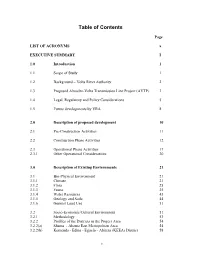
Table of Contents
Table of Contents Page LIST OF ACRONYMS a EXECUTIVE SUMMARY I 1.0 Introduction 1 1.1 Scope of Study 1 1.2 Background – Volta River Authority 2 1.3 Proposed Aboadze-Volta Transmission Line Project (AVTP) 3 1.4 Legal, Regulatory and Policy Considerations 5 1.5 Future developments by VRA 8 2.0 Description of proposed development 10 2.1 Pre-Construction Activities 11 2.2 Construction Phase Activities 12 2.3 Operational Phase Activities 17 2.3.1 Other Operational Considerations 20 3.0 Description of Existing Environments 21 3.1 Bio-Physical Environment 21 3.1.1 Climate 21 3.1.2 Flora 25 3.1.3 Fauna 35 3.1.4 Water Resources 43 3.1.5 Geology and Soils 44 3.1.6 General Land Use 51 3.2 Socio-Economic/Cultural Environment 51 3.2.1 Methodology 53 3.2.2 Profiles of the Districts in the Project Area 54 3.2.2(a) Shama - Ahanta East Metropolitan Area 54 3.2.2(b) Komenda - Edina - Eguafo - Abirem (KEEA) District 58 i 3.2.2(c) Mfantseman District 61 3.2.2(d) Awutu-Effutu-Senya District 63 3.2.2(e) Tema Municipal Area 65 3.2.2(f) Abura-Asebu-Kwamankese 68 3.2.2(g) Ga District 71 3.2.2(h) Gomoa District 74 3.3 Results of Socio-Economic Surveys 77 (Communities, Persons and Property) 3.3.1 Information on Affected Persons and Properties 78 3.3.1.1 Age Distribution of Affected Persons 78 3.3.1.2 Gender Distribution of Affected Persons 79 3.3.1.3 Marital Status of Affected Persons 80 3.3.1.4 Ethnic Composition of Afected Persons 81 3.3.1.5 Household Size/Dependents of Affected Persons 81 3.3.1.6 Religious backgrounds of Affected Persons 82 3.3.2 Economic Indicators -
Comments on the Ornithology of Nigeria, Including Amendments to the National List
Robert J. Dowsett 154 Bull. B.O.C. 2015 135(2) Comments on the ornithology of Nigeria, including amendments to the national list by Robert J. Dowsett Received 16 December 2014 Summary.—This paper reviews the distribution of birds in Nigeria that were not treated in detail in the most recent national avifauna (Elgood et al. 1994). It clarifies certain range limits, and recommends the addition to the Nigerian list of four species (African Piculet Verreauxia africana, White-tailed Lark Mirafra albicauda, Western Black-headed Batis Batis erlangeri and Velvet-mantled Drongo Dicrurus modestus) and the deletion (in the absence of satisfactory documentation) of six others (Olive Ibis Bostrychia olivacea, Lesser Short-toed Lark Calandrella rufescens, Richard’s Pipit Anthus richardi, Little Grey Flycatcher Muscicapa epulata, Ussher’s Flycatcher M. ussheri and Rufous-winged Illadopsis Illadopsis rufescens). Recent research in West Africa has demonstrated the need to clarify the distributions of several bird species in Nigeria. I have re-examined much of the literature relating to the country, analysed the (largely unpublished) collection made by Boyd Alexander there in 1904–05 (in the Natural History Museum, Tring; NHMUK), and have reviewed the data available in the light of our own field work in Ghana (Dowsett-Lemaire & Dowsett 2014), Togo (Dowsett-Lemaire & Dowsett 2011a) and neighbouring Benin (Dowsett & Dowsett- Lemaire 2011, Dowsett-Lemaire & Dowsett 2009, 2010, 2011b). The northern or southern localities of species with limited ranges in Nigeria were not always detailed by Elgood et al. (1994), although such information is essential for understanding distribution patterns and future changes. For many Guineo-Congolian forest species their northern limit in West Africa lies on the escarpment of the Jos Plateau, especially Nindam Forest Reserve, Kagoro. -
A Bioacoustic Record of a Conservancy in the Mount Kenya Ecosystem
Biodiversity Data Journal 4: e9906 doi: 10.3897/BDJ.4.e9906 Data Paper A Bioacoustic Record of a Conservancy in the Mount Kenya Ecosystem Ciira wa Maina‡§, David Muchiri , Peter Njoroge| ‡ Department of Electrical and Electronic Engineering, Dedan Kimathi University of Technology, Nyeri, Kenya § Dedan Kimathi University Wildlife Conservancy, Dedan Kimathi University of Technology, Nyeri, Kenya | Ornithology Section, Department of Zoology, National Museums of Kenya, Nairobi, Kenya Corresponding author: Ciira wa Maina (ciira.maina@dkut.ac.ke) Academic editor: Therese Catanach Received: 17 Jul 2016 | Accepted: 23 Sep 2016 | Published: 05 Oct 2016 Citation: wa Maina C, Muchiri D, Njoroge P (2016) A Bioacoustic Record of a Conservancy in the Mount Kenya Ecosystem. Biodiversity Data Journal 4: e9906. doi: 10.3897/BDJ.4.e9906 Abstract Background Environmental degradation is a major threat facing ecosystems around the world. In order to determine ecosystems in need of conservation interventions, we must monitor the biodiversity of these ecosystems effectively. Bioacoustic approaches offer a means to monitor ecosystems of interest in a sustainable manner. In this work we show how a bioacoustic record from the Dedan Kimathi University wildlife conservancy, a conservancy in the Mount Kenya ecosystem, was obtained in a cost effective manner. A subset of the dataset was annotated with the identities of bird species present since they serve as useful indicator species. These data reveal the spatial distribution of species within the conservancy and also point to the effects of major highways on bird populations. This dataset will provide data to train automatic species recognition systems for birds found within the Mount Kenya ecosystem. -
Disaggregation of Bird Families Listed on Cms Appendix Ii
Convention on the Conservation of Migratory Species of Wild Animals 2nd Meeting of the Sessional Committee of the CMS Scientific Council (ScC-SC2) Bonn, Germany, 10 – 14 July 2017 UNEP/CMS/ScC-SC2/Inf.3 DISAGGREGATION OF BIRD FAMILIES LISTED ON CMS APPENDIX II (Prepared by the Appointed Councillors for Birds) Summary: The first meeting of the Sessional Committee of the Scientific Council identified the adoption of a new standard reference for avian taxonomy as an opportunity to disaggregate the higher-level taxa listed on Appendix II and to identify those that are considered to be migratory species and that have an unfavourable conservation status. The current paper presents an initial analysis of the higher-level disaggregation using the Handbook of the Birds of the World/BirdLife International Illustrated Checklist of the Birds of the World Volumes 1 and 2 taxonomy, and identifies the challenges in completing the analysis to identify all of the migratory species and the corresponding Range States. The document has been prepared by the COP Appointed Scientific Councilors for Birds. This is a supplementary paper to COP document UNEP/CMS/COP12/Doc.25.3 on Taxonomy and Nomenclature UNEP/CMS/ScC-Sc2/Inf.3 DISAGGREGATION OF BIRD FAMILIES LISTED ON CMS APPENDIX II 1. Through Resolution 11.19, the Conference of Parties adopted as the standard reference for bird taxonomy and nomenclature for Non-Passerine species the Handbook of the Birds of the World/BirdLife International Illustrated Checklist of the Birds of the World, Volume 1: Non-Passerines, by Josep del Hoyo and Nigel J. Collar (2014); 2. -

STATUS SURVEY of AFRICAN GREEN PIGEON (Treroncalvus
STATUS SURVEY OF AFRICAN GREEN PIGEON (Treroncalvus, Temminck, 1808) IN EKITI STATE, NIGERIA BY OWOLABI, BIBITAYO AYOBAMI B. Wildlife Management (EWM/13/5440) A THESIS IN THE DEPARTMENT OF ECOTOURISM AND WILDLIFE MANAGEMENT, SUBMITTED TO THE SCHOOL OF POST GRADUATE STUDIES, THE FEDERAL UNIVERSITY OF TECHNOLOGY,AKURE, ONDO STATE. IN PARTIAL FULFILLMENT OF THE REQUIREMENT FOR THE AWARD OF THE DEGREE OF MASTER OF AGRICULTURAL TECHNOLOGY IN ECOTOURISM AND WILDLIFE MANAGEMENT. OCTOBER 2015. ABSTRACT The study focused on assessment and survey of thestatus survey of African Green Pigeon in EkitiState,Nigeria. Following the reconnaissance survey of the state, five sites were purposively selected, which represented areas where African Green Pigeon were commonly sighted. These areas were Counting station A (Aramoko/IjeroEkiti), Counting station B (IsanEkiti), Counting station C (IkogosiEkiti), Counting station D (Awo/IgedeEkiti) and Counting station E (IyemeroEkiti). The study area represents a typical rain forest ecosystem. Three methods were used for collecting data for the study (Point count method, direct observation and vegetation assessment technique). A meantotal of 97 birds were counted during the wet and dry season of the study, 46during the dry season and 51 counted during the wet season.Total mean number of bird in Counting Station A in the dry period was 10 and 9 in the wet season, accounting for a standard error of 3 ± 2.186birds sighted in the dry season and 3 ± 2.646in the wet season. Counting Station B forest patches, had a total of 29 birds, 9 sighted in the dry and 14 in the wet period, 3 ± 1.201 as standard error of birds sighted in the wet season and 3 ± 1.527 foe the dry season while counting Station C forest patches with 8 birds sighted in the dry and 12 birds recorded in the wet season, having a standard error of 3 ± 2.603 birds sighted in the dry and 3 ± 0.577 in the wet season. -

South Africa: Magoebaskloof and Kruger National Park Custom Tour Trip Report
SOUTH AFRICA: MAGOEBASKLOOF AND KRUGER NATIONAL PARK CUSTOM TOUR TRIP REPORT 24 February – 2 March 2019 By Jason Boyce This Verreaux’s Eagle-Owl showed nicely one late afternoon, puffing up his throat and neck when calling www.birdingecotours.com info@birdingecotours.com 2 | TRIP REPORT South Africa: Magoebaskloof and Kruger National Park February 2019 Overview It’s common knowledge that South Africa has very much to offer as a birding destination, and the memory of this trip echoes those sentiments. With an itinerary set in one of South Africa’s premier birding provinces, the Limpopo Province, we were getting ready for a birding extravaganza. The forests of Magoebaskloof would be our first stop, spending a day and a half in the area and targeting forest special after forest special as well as tricky range-restricted species such as Short-clawed Lark and Gurney’s Sugarbird. Afterwards we would descend the eastern escarpment and head into Kruger National Park, where we would make our way to the northern sections. These included Punda Maria, Pafuri, and the Makuleke Concession – a mouthwatering birding itinerary that was sure to deliver. A pair of Woodland Kingfishers in the fever tree forest along the Limpopo River Detailed Report Day 1, 24th February 2019 – Transfer to Magoebaskloof We set out from Johannesburg after breakfast on a clear Sunday morning. The drive to Polokwane took us just over three hours. A number of birds along the way started our trip list; these included Hadada Ibis, Yellow-billed Kite, Southern Black Flycatcher, Village Weaver, and a few brilliant European Bee-eaters. -

Bird Checklists of the World Country Or Region: Ghana
Avibase Page 1of 24 Col Location Date Start time Duration Distance Avibase - Bird Checklists of the World 1 Country or region: Ghana 2 Number of species: 773 3 Number of endemics: 0 4 Number of breeding endemics: 0 5 Number of globally threatened species: 26 6 Number of extinct species: 0 7 Number of introduced species: 1 8 Date last reviewed: 2019-11-10 9 10 Recommended citation: Lepage, D. 2021. Checklist of the birds of Ghana. Avibase, the world bird database. Retrieved from .https://avibase.bsc-eoc.org/checklist.jsp?lang=EN®ion=gh [26/09/2021]. Make your observations count! Submit your data to ebird. -
Avibase Page 1Of 6
Avibase Page 1of 6 Col Location Date Start time Duration Distance Avibase - Bird Checklists of the World 1 Country or region: Bwindi Impenetrable National Park 2 Number of species: 588 3 Number of endemics: 0 4 Number of breeding endemics: 0 5 Number of introduced species: 1 Recommended citation: Lepage, D. 2021. Checklist of the birds of Bwindi Impenetrable National Park. Avibase, the world bird database. Retrieved from .https://avibase.bsc- eoc.org/checklist.jsp?lang=EN®ion=ug04uu01&list=howardmoore&format=2 [12/05/2021]. Make your observations count! Submit your data to ebird.org - Legend: [x] accidental [ex] extirpated [EX] extinct [EW] extinct in the wild [E] endemic [e] endemic (country/region) Egyptian Goose Tambourine Dove Black Cuckoo Hottentot Teal Namaqua Dove African Cuckoo African Black Duck Montane Nightjar African Crake Red-billed Teal Mottled Spinetailed Swift Black Crake Comb Duck Cassin's Spinetailed Swift White-spotted Flufftail Helmeted Guineafowl Scarce Swift Buff-spotted Flufftail Crested Guineafowl African Palm Swift Red-chested Flufftail Blue Quail Alpine Swift African Finfoot Scaly Francolin Mottled Swift Grey Crowned Crane Red-necked Spurfowl White-rumped Swift Great Blue Turaco Handsome Francolin Horus Swift Eastern Grey Plantain-eater Crested Francolin Little Swift Bare-faced Go-away-bird Ring-necked Francolin African Swift Ruwenzori Turaco Little Grebe Common Swift Black-billed Turaco Speckled Pigeon Blue-headed Coucal Ross's Turaco Afep Pigeon White-browed Coucal Marabou African Olive Pigeon African Black -
Loango Extension 22 September to 26Th September 2021 (5 Days)
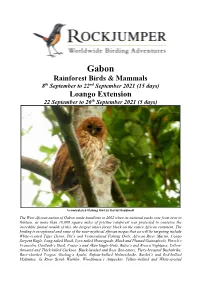
Gabon Rainforest Birds & Mammals 8th September to 22nd September 2021 (15 days) Loango Extension 22 September to 26th September 2021 (5 days) Vermiculated Fishing Owl by David Hoddinott The West African nation of Gabon made headlines in 2002 when its national parks rose from zero to thirteen, as more than 10,000 square miles of pristine rainforest was protected to conserve the incredible faunal wealth of this, the largest intact forest block on the entire African continent. The birding is exceptional and some of the near-mythical African megas that we will be targeting include White-crested Tiger Heron, Pel’s and Vermiculated Fishing Owls, African River Martin, Congo Serpent Eagle, Long-tailed Hawk, Lyre-tailed Honeyguide, Black and Plumed Guineafowls, Finsch’s Francolin, Hartlaub’s Duck, Fraser’s and Akun Eagle-Owls, Bates’s and Brown Nightjars, Yellow- throated and Thick-billed Cuckoos, Black-headed and Rosy Bee-eaters, Fiery-breasted Bushshrike, Bare-cheeked Trogon, Gosling’s Apalis, Rufous-bellied Helmetshrike, Rachel’s and Red-bellied Malimbes, Ja River Scrub Warbler, Woodhouse’s Antpecker, Yellow-bellied and White-spotted RBL Gabon Itinerary 2 Wattle-eyes, Black-chinned and Loango Weavers, Congo Moor Chat and Black-collared Bulbul. Due to its small population and vast rainforest resources, Gabon is also unique in harbouring significant numbers of African rainforest mammals that have either disappeared or are very difficult to see elsewhere such as Forest Elephant and Forest Buffalo, sounders of Red River Hogs and a plethora of monkeys.